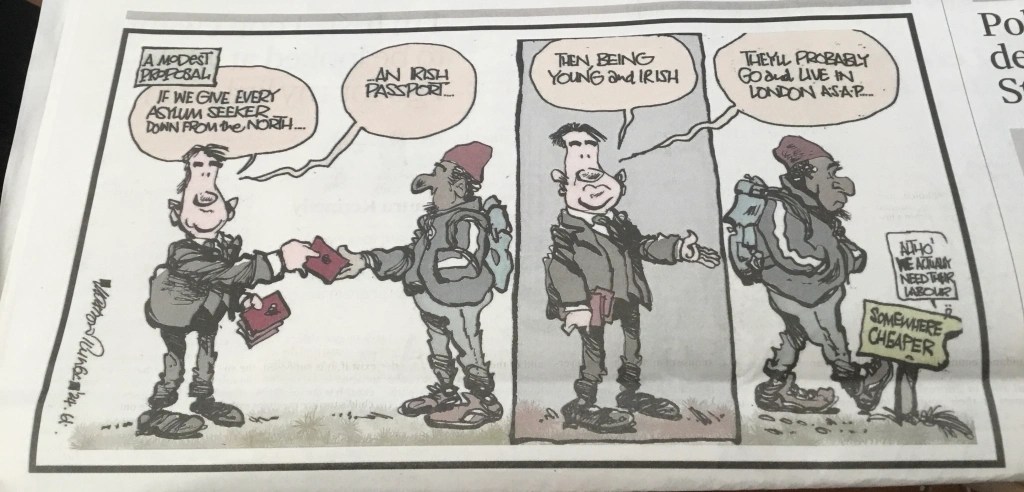
There is only one civilised response over rows about offering decent accommodation to refugees and asylum seekers : the Irish state must help and support human beings fleeing from wars, famine, destruction and poverty in their native lands. Protests against accommodation centres, hotels, and hosting schemes are a magnet for racist attacks on immigrants.
In other words :
Socialism With a Human Face Versus Liberalism With a Shark Smile
These protests are often presented as demands for local “consultation”
Claims are broadcast that refugees and asylum seekers are getting favourable treatment
Vulnerable people are threatened with the old ugly policy of “Go, Move, Shift”
The real story is an old one : Go, Move, Shift. Christy Moore’s song says it all :
Six in the morning out in Inchicore The guards came through the wagon door. John Maughan was arrested in the cold A travelling boy just ten years old.
CHORUS
Mary Joyce was living at the side of the road No halting place and no fixed abode. The vigilantes came to the Darndale site And they shot her son in the middle of the night.
Similar racist protests have stained many parts of Ireland since 2023 : O’Connell Street, Coolock, Darndale, and the East Wall area in Dublin; Newtownmountkennedy (Wicklow), Athlone (Midlands), Ballaghaderreen (Roscommon) and Roscrea (Tipperary) are other examples.
In recent days this political cancer has erupted again – this time in Galway.
Sad to say, we witness more shameful dog-whistle racism, again dressed up as “consultation” with the local community. It continues. Sinn Féin TD for Galway West Mairéad Farrell is following the wretched example set by a number of her party colleagues – lessons have not been learned.
The story is covered on the Cedar Lounge Site – a link is here :
“According to the department, an appraisal of the offer has been paused for three months to allow locals to advance a proposal to develop a community hotel at the site.
A meeting took place earlier this month inviting members of the community to voice their concerns over the possibility of using the hotel to house asylum seekers.
Local councillors and TDs have spoken out over the issue, attempting to assure locals that a proper consultation process will be followed through.
TD for Galway East Mairead Farrell said: “I have organised a meeting with the department for tomorrow morning. I have been in constant contact with the department from last night to this morning.
“They have told me categorically that no one has been moved into Carna and I have organised a meeting, I will give an update at that point.”
In a statement, the department have confirmed that a pause on the appraisal of the hotel remains in place. They said that there was no current contract in place for IPAS but that some people fleeing the war in Ukraine were still being housed there.”
Irish Independent, online, March 26 2025
Ukrainians in Ireland feared cut in ‘vital’ accommodation payment – Red Cross Payment to hosts worth €800 a month was due to expire on March 31
The Irish government is jumping in; part of its agenda is the old tactic of Divide and Rule.
A payment to hosts worth €800 a month, enabling Ukrainian refugees to get accommodation was due to expire on March 31. The state authorities have backed down temporarily, thanks in part to protests by welfare agencies such as the Red Cross and the Ukrainian community in Ireland. Here is a link :
There has been an increase in reports of uncertainty and anxiety among Ukrainians living in Ireland, as the Government is expected to make a decision on the continuation of payments to accommodation hosts, the Irish Red Cross has said.
The humanitarian charity said there has been “a significant rise” in calls from concerned individuals since late last year.
The Accommodation Recognition Payment (ARP) is a tax-free payment of €800 for those providing accommodation to Ukrainians who arrive in the Republic under the EU Temporary Protection Directive. The scheme is due to expire on March 31st.
The Government is expected to extend the scheme with consideration being given to a €200 reduction in the monthly rate.
decision is “most likely” to be announced towards the end of this week, according to a source, with meetings taking place between the Department of Integration and Department of Justice.
“There has been no final decision yet, with nothing signed off,” the source added.
The Irish Red Cross said on Monday that the payment has been “a vital financial support” for 19,000 Irish hosts.
The organisation is due to present findings of the largest survey of Irish hosts to date to the Government on Tuesday.
Niall O’Keeffe, head of international and migration with the Irish Red Cross, said the accommodation programme has been “a lifeline for many very vulnerable people”.
“It’s not just a value-for-money accommodation solution, many hosts have become invaluable support networks, helping their guests in the transition to life in Ireland and guiding them to access essential supports and training,” Mr O’Keeffe said.
“Reducing support for vulnerable people will force them to make difficult decisions: living in poverty or returning to danger.”
Minister for Integration Norma Foley said last week there would likely be changes to the monthly €800 payment with an announcement due shortly.
Ms Foley said the issue was being dealt with and required engagement with the Department of Justice. The Fianna Fáil TD said she would not “pre-empt” the decision but was conscious that the scheme was due to expire at the end of next month.
Deirdre Garvey, secretary general of the Irish Red Cross, said the conflict in Ukraine has dramatically changed the lives of millions of people and has had a devastating impact on individual lives that “we can never measure”.
“Ireland has recognised this suffering and continues to respond generously. The Irish Red Cross has worked with the wider Red Cross Movement to provide humanitarian assistance in Ukraine and in the surrounding countries that have hosted most of those fleeing conflict in Ukraine,” Ms Garvey said.
“The needs now are as great as ever. Many of the millions who fled are unable to return home, and those who remain face dire conditions, with limited access to water, heat, healthcare and other essential services. Three years on, the mental health toll is huge, both for those who remain and those who fled to safety.”
In a remarkable development, the Sinn Féin migration spokesperson Matt Carthy TD (Cavan-Monaghan) criticises the government’s temporary climbdown : See the link here :
The Red Cross and Ukrainian community protests persuaded the government to back off. Vigilance is necessary, because the state may come back with cutback proposals later this year.
At this point it should be obvious to all anti-racists that saying the ARP is “unfair” to other renters is a racist cop-out. The issue is whether it should be scrapped, or extended to others in need of housing. Leftists should argue the latter as a matter of principle. A possible slogan could be “ Don’t End…Extend “. In other words Extend the ARP to extend to all asylum seekers and refugees as a first step.
Some public representatives have got the balance right :
Example 1 is Ruth Coppinger TD (Solidarity – People Before Profit) :
“A rightward change in government in Germany, and a similar likely change in government in France in 2027, means that Europe will no longer present a united front on the issue.
Much like the initial response to the Covid-19 pandemic, the John Lennon-esque vision of a country truly united in the face of a societal challenge gave way to good old-fashioned pessimism.
The (Sinn Féin) manifesto read “the special status of Ukrainians under the Temporary Protection Directive should come to an end no later than March 2026. We believe that continually extending temporary measures is not a sustainable solution and is problematic for everyone.”
“If a beneficiary of Temporary Protection is from a part of Ukraine that is safe then, save for exceptional cases, return should be assisted.”
Socialism With a Human Face Versus Liberalism With a Shark Smile
Ukrainian refugees are targets of state racism; left-wing public representatives should support them :
240 refugees are housed at Hubble Student Accommodation; of the 240 Ukrainians at the site, there are 49 school students and 77 are in employment. Following pushback, plans to move the refugees with six days’ notice were paused. Local Labour TD Marie Sherlock said, “the reasoning put forward by the government does not add up” and stated that the decision by the government is “unconscionable.” The government claimed that there was a need to vacate the rooms in a bid to protect the rent pressure zone status of the accommodation, a claim which Sherlock refuted. “The RPZ exemption has already kicked in because the student accommodation units have not been rented out to students for more than two years.” “This flies in the face of a stated government intent to try and help Ukrainians integrate into the communities they live in,” she stated. The term “socialism with a human face” is closely associated with the Prague Spring of 1968, and it appears the new government is pursuing a “liberalism with a shark smile” approach with regard to immigration.
Karim Zidan at SportsPolitika writes an excellent report on the appearance of Irish rapist-racist boxing superstar Conor McGregor at Donald Trump’s Washington DC White House on St Patrick’s Day 2025.
Zidan correctly observes that Irish government leaders Micheál Martin and Simon Harris distanced themselves from the Trump-McGregor Rapist-Racist summit. The socialist-feminist Dáil Deputy Ruth Coppinger (Solidarity-People Before Profit) points out that Martin voluntarily walked into the Trump-McGregor trap by lickspittling the American President at a March 12 White House event.
‘Two rapists in the White House’: TD tells Dáil McGregor’s visit to Trump was an insult to women
Ahead of a meeting with U.S. President Donald Trump on Monday to mark St. Patrick’s Day, former UFC champion Conor McGregor made an appearance at the White House briefing room, where he took questions from the baffled reporters in attendance.
As he stood at the podium alongside press secretary Karoline Leavitt, McGregor warned that “Ireland is at the cusp of potentially losing its Irishness” due to a so-called “illegal immigration racket.”
“It’s high time that America is made aware of what is going on in Ireland,” McGregor said, adding “What is going on in Ireland is a travesty.”
Shortly following the verdict, McGregor was removed as the spokesperson for Proper No. Twelve, the Irish whiskey brand he helped create in 2018 before selling the brand three years later. Several retailers in the UK and Ireland have also removed Proper from its shelves, including Tesco.
Yet despite being liable for rape, McGregor was welcomed with open arms to the White House, with Leavitt claiming “we couldn’t think of a better guest to have with us on St Patrick’s Day.” The White House even shared a video of McGregor emerging from the West Wing before saying “Happy Paddy’s Day, America” to the camera.
McGregor’s White House welcome comes as no surprise, given President Donald Trump’s long-standing love for combat sports, particularly the UFC. No other sports organization aligned itself with Trump’s presidency as closely—or worked as hard to support his political rise—as the UFC.
During a meeting with Irish prime minister Micheal Martin last week, Trump said McGregor was his favourite Irish person partly because “he’s got the best tattoos I’ve ever seen”.
And yet, Trump’s fondness for McGregor extend beyond his taste for the fighter’s tattoos. McGregor has also voiced his support for Trump’s presidency and was in attendance at his inauguration in January. The two men also share a political vision marked by resurgent nationalism, isolationism, and a streak of anti-migrant hysteria.
McGregor’s views on migrants came to a head in November 2023, when he helped stoke anti-migrant sentiments that led to one of the most violent riots in Dublin’s history. The riot started after a man stabbed three young children and a care assistant in Dublin. Far-right activists quickly blamed immigration, stoking public rage after the suspect was identified as being originally from Algeria.
McGregor tweeted that Ireland was “at war” in the lead-up to the riots. In the aftermath of the chaos, he followed up by tweeting “you reap what you sow.” He had previously spent weeks stoking anti-migrant sentiments on social media, including endorsing a “task force” to monitor migrants.
McGregor’s anti-migrant stances quickly made him a symbol for the far right throughout Europe. Kampf der Nibelungen, a German neo-Nazi MMA league, shared several of McGregor’s tweets in their Telegram channel, including one where the fighter called for a “task force” for all entrants coming into Ireland and demanded that the Irish government “correct this or you are all finished.” AI generated illustrations of McGregor holding a shotgun and leading an army of angry gun-wielding men waving Irish flags also spread on platforms such as 4chan, Gab, and Twitter.
McGregor’s views also caught the attention of some of Trump’s inner circle, including Elon Musk, who showed interest in the idea of McGregor running for office in Ireland. The 36-year-old has repeatedly stated his intention to run for president of Ireland, calling himself the “only logical choice” to lead the nation. Ironically, the Irish presidency is predominantly a ceremonial role, serving as representative of the Irish state.
And yet, McGregor’s meeting with Trump speaks to the role that combat sports plays in modern politics, with UFC fighters serving as the conduits of conservative values and right-wing policy. It’s yet another example of how Trump’s MAGA ideology aligns with MMA’s ethos—one where success isn’t won through negotiation or diplomacy, but through sheer strength, power, and dominance.
Nevertheless, while McGregor has managed to secure a coveted meeting with Trump, there are few people in Ireland who believe he is speaking on their behalf. Ireland’s Taoiseach Michael Martin tweeted today that “Conor McGregor’s remarks are wrong, and do not reflect the spirit of St. Patrick’s Day, or the views of the people of Ireland.” Meanwhile, Ireland’s Minister for Foreign Affairs and Trade and Minister for Defence Simon Harris added that “McGregor doesn’t speak for Ireland.”
“He doesn’t speak for the people of Ireland,” Harris said. “He has no mandate to do such, and my views on him are very clear, well established, previously articulated, long standing and on the public record.”
An Irish Times Report (May 21 2025) carries an “inside story” on the Trump-McGregor White House Rapist-Racist Summit. McGregor’s visiting team included a Dublin City Councillor Philip Sutcliffe, who discussed the chance that the racist-rapist boxer may run for the office of Irish President :
“Many believe all of this is a prelude to McGregor formally entering the race for the Irish presidential election which is due to take place after the summer. McGregor has repeatedly indicated he intends to run, although it is not at all clear if he would obtain the required support to get on the ballot paper.
Sutcliffe says he hopes McGregor will run and that he will have Washington’s full support if he does.
“Not only Washington, he’ll have the backing of Putin. He’s another fan of Conor’s,” he added.
In the conflict between Soviet Russia with Joseph Stalin at its head and Nazi Germany, I would have supported Soviet Russia. I suppose you could argue that might make me some kind of Stalinist. After all, I would have been supporting the Stalinist government. Not only that, I may even have hoped the US might provide it with funding to continue to organise its military effort, so you could probably label me an American stooge too. (in fact, the US did supply Soviet Russia with millions of tonnes of food, weapons and equipment during the Second World War).
But a distinction should be made. What one is supporting most fundamentally in this case is not Stalinism but rather the struggles of the Russian people themselves,[1] their imperilled freedoms at the hands of a brutal, barbaric foreign invasion. People fighting and dying – not because they had some great love for Stalin – but because they didn’t want to be bombed and maimed and killed at the hands of a foreign power. Because they didn’t want to live their day-to-day lives under the shadow of foreign occupation.
Of course, one could ignore all this. One could assert, for instance, that the Russian population were simply being manipulated in the interests of the Stalinist government (and vicariously the US itself) and, therefore, it was Stalinism and the US government who were the true objects of international support. Certainly, the defeat of Germany did bolster the imperial power of the US and Russia. But were the millions of Russians who fought and died against fascism – were those lives merely the ‘proxies’ of the interests of Stalin and the United States government who supported him?
Such an assertion most would find obscene. It is obscene because it involves the annihilation of a living content – the struggles and sacrifice of millions of people fighting for their concrete freedoms – in favour of the interests and relationships of a set of given states and governments considered in empty and schematic isolation.
For similar reasons, I support the right of the Ukrainian people to resist foreign occupation. As a necessary corollary, I also support the means by which they might do so – even if that means receiving funding and ammunition from the US and NATO (though if you can suggest some other alternative beyond capitulation at the point of a Russian gun, I really am all ears).
But none of this is the same as saying I support Zelensky, or that I support the US and NATO. At the most basic philosophical level, it simply means to recognise that freedom – as Kant put it – is ‘an end in itself’. It has an objective and social reality whether or not the arms the freedom fighters take up are provided by this particular imperial power or that one. Likewise, freedom has an objective reality whether or not it is being menaced by Russian bombs or Israeli bombs or Nazi bombs.
The 18th World Congress of the Fourth International took place in Belgium from 23 to 28th February. The wide-ranging discussion covered the international situation in all its aspects from the structural polycrisis in its environmental, economic, social and political aspects to the movements of resistance, and the need to build and strengthen our own International. One particular point of debate was how as internationalist revolutionary Marxists we express our opposition to the Russian invasion of Ukraine and our solidarity with the resistance of the Ukrainian people to this invasion, to the neoliberal policies of the Zelensky government and to neoliberal militarization.
We publish here the resolution presented by the majority of the outgoing IC, approved by the congress by 95 votes in favour, 23 against, 3 abstentions and 5 no votes, and the alternative resolution presented by a number of delegations rejected 31 for, 80 against, 9 abstentions.
Duncan Chapel has complied a table comparing both resolutions, indicating areas of agreement and disagreement.
1. In February 2022, Putin launched a full-scale invasion of Ukraine in an attempt to turn the country into a Russian satellite. This attempt has caused hundreds of thousands of dead and wounded already. But the regime in Moscow has long been characterised by expansionist Greater Russian imperialist ideology, which sees superpowers as endowed with the right to extend their zone of influence by all means possible, challenging established norms of international law and legitimising a new era of imperialist redistribution. Thus, for the Kremlin, the daily increasing human cost of this aggression is no reason to cease it, and further intensification is instrumental to terrorise the Ukrainian people into submission.
2. What was supposed to be a “special military operation” to bring down the Kyiv government in a matter of days has turned into a three-year entanglement in full-scale war. This development was unexpected not only for Putin but also for the Western powers—Biden even offered to help Zelensky evacuate. It is precisely the determination and resilience of the Ukrainian resistance that has thwarted Putin’s plans to this day.
3. The invasion of Ukraine was not only an attempt to reassert the role of Russia in the capitalist competition but also a deliberate attempt to tighten control over Russian society and crush all dissent. Anti-war activists have been prosecuted and sentenced to long prison terms on trumped charges. Socialist organisations, such as that of our comrades in the Russian Socialist Movement, have been forced to disband, and their members have had to flee. While feminists continue to mobilise, they do it under constant pressure with threats of imprisonment for even uttering the word “war”.
4. As internationalists, we defend Ukraine’s right to self-determination and their right to resist the invasion. People’s movements are an integral part of this resistance, waging a struggle on two fronts: against the occupants and against the Zelensky government. In this unequal fight, we stand together with other progressive forces in the country. We urge all internationalist left to develop political and material solidarity with trade unionists, feminists, and social and democratic activists in Ukraine. Just as the Fourth International has been doing this since the beginning of the aggression within the framework of the “European Network of Solidarity with Ukraine” (ENSU/RESU) and together with the Ukrainian left-wing organisation, Sotsialnyi Rukh.
5. Once again, we underline that we have no illusions about the nature of Ukraine’s regime. Their government is right-wing and neo-liberal, not shying away from mobilising fear to stay in power. It is just as keen to satisfy domestic capitalists as to reassure the Western powers of its ability to adapt to their demands. Its anti-social and anti-democratic policies are counter-productive in terms of defending Ukraine. They oppose the needs of its working classes, provoke their resentment, undermine social trust, and, as a result, the government relies on increasingly authoritarian measures. This makes standing with the Ukrainian wage earners and their organisations all the more important. We cannot abandon them when they desperately need solidarity, especially if our vision of emancipation is that of a struggle from below, where the people rise to fight, independant from the government and the great powers.
This is an important discussion because a Trump-Putin alliance threatens Ukraine.
What are the implications in Ireland?
A very simple policy should be supported by the left in Ireland :
We do not have a policy of “Neutrality” in the conflict between Israel and Palestine – we are for Palestine. We must not have a policy of “Neutrality” in the conflict between Russia and Ukraine – we must be for Ukraine. Trump-Putin are promoting genocide in Palestine and Ukraine.
Concretely, the Irish state helps Ukraine to clear mines planted by the Russian genocidal invaders.
The Irish left must support this measure.
Moving things forward :
Expand mine clearing and related non lethal military support.
That has to be the policy of the Irish left – no ifs and buts.
Alongside that, we must oppose any Irish state attempt to to join imperialist military alliances such as NATO – a firm policy of Non-Alignment is required.
I understand your arguments. I share your argument that we need a perspective of solidarity for the whole continent of Europe. This perspective includes massive support for the Ukrainian resistance. However, the fact that the countries of Europe and the USA have so far given too little support to Ukraine is not due to military inferiority vis-à-vis Russia but has political and economic reasons. At least some important sectors of capital have always focused on resuming “reasonable economic relations” with Russia.
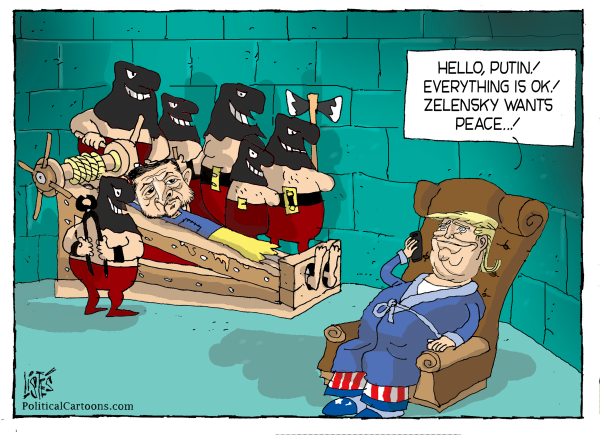
Trump backs Putin against Ukraine. History turns darker
How bad can it get? When we strip away US president Donald Trump’s insults and temper fits, what can he actually do?
First, he can withdraw US military aid to Ukraine – which he has been talking about doing since long before the US presidential election. If the European states got their act together, which is possible, the effects of this would be constrained.
Former Polish President and Labour Leader Lech Wałesa has denounced a thuggish attack on Ukrainian President Volodymyr Zelenskyy in the Washington DC White House on Friday February 28. The perpetrators were a convicted rapist – the US President Donald Trump – and the rapist’s sidekick, the US Vice President JD Vance. TV viewers all over the world were shocked by these scenes. One day afterwards, Vance was forced to abandon a skiing holiday by many pro-Ukraine protesters in the New England state of Vermont.
This makes me so happy. Thank you Vermont. This is so deserving to the POS human being vance is. He was beyond rude to a world leader and showed that he had no breadth of the ongoing war in Ukraine. http://www.politicususa.com/p/jd-vance-f…
The good news is that progressive revolt seems to be starting in the United States of America.
A leading spokesperson is Bernie Sanders, an independent Senator from the New England state of Vermont.
Bernie SandersI don’t want to hear any Republicans talk about “freedom” unless they have the guts to call out Trump for the lies that he is telling about Putin and Ukraine.It was Russia that started the war, not Ukraine.Putin is the dictator, not Zelensky#News&Politics
The ignorant racist anti-Ukraine thug, Vice-President JD Vance, is not welcome in Vermont :
This makes me so happy. Thank you Vermont. This is so deserving to the POS human being vance is. He was beyond rude to a world leader and showed that he had no breadth of the ongoing war in Ukraine. http://www.politicususa.com/p/jd-vance-f…
One man is not joining the growing progressive popular pro-Ukraine in the USA.
His name is Jeffrey Sachs, a right-wing economist whose hands are very dirty ; “Sachs’ methods for stabilizing economies became known as shock therapy and were similar to successful approaches used in Germany after the two world wars”
The anti-Ukraine views of Dr Sachs are endorsed and shared by the ignorant imperialist thugs running the Washington White House, the convicted rapist President Donald Trump and his sidekick JD Vance, who publicly ambushed Ukraine’s President Volodymyr Zelensky on February 28 2025 in the White House.
A friend has begun vital work – examination of the 2025 FFFGBG Programme for Government, which contains lots of measures these parties did not propose during the recent general election campaign.
Alarming things
The programme for government has a few alarming things in it – (and the government has a few alarming people in it) eg there’s lots of commitment to reduce carbon emissions alongside actions and plans that will directly increase carbon emissions. There’s a bunch of mangled science around the particular characteristics of methane and it’s basically a valentine card to those involved in data center construction.
Shutting people up over Israel’s genocide
It also has a commitment to recognise a particular and highly contested definition of anti- semitism which would help those who want us to shut up about Israel’s genocide and occupation – and which was as far as I can remember not part of any single party or politician’s election platform. It would be very interesting to find out how and from where and on whose request this made it into the programme.
Readers may like the explanation of how Irish-American students greeted gullible racists stepping off trains and buses in South Bend Indiana, brought Ku Klux Klan racist thugs down familiar dark alleys, and administered physical education which would never be forgotten.
Many Irish-Americans have a shameful history of collaborating with nativist racists, but counter-examples exist. We thank Dave Schubert for drawing our attention to this fascinating story.
The author of this article, Brendan O’Shaughnessy, gives us a practical link between the past and the present :
Todd Tucker, the Klan story’s chronicler, lives and writes in Valparaiso, Indiana. He said the recent re-emergence of white supremacism and the Klan have clear parallels in the history he researched. Klan members even showed up during his book tour in 2004. “The Klan is a very durable American institution,” Tucker said by phone. “One of the reasons it’s durable is because it’s adaptable. It doesn’t surprise me at all to find them at the front of the mob. Fear of immigrants, fear of change — that we’re changing for the worse. And an ability to capitalize on those fears — they’ve always been really effective at that.”
A Clash Over Catholicism
Notre Dame students confronted the Ku Klux Klan in 1924
Published August 2018
It was May 1924, and the Ku Klux Klan wanted to showcase its power and cement its sudden grip on Indiana politics by holding a picnic and parade in South Bend, the most Catholic area in the state.
About 500 University of Notre Dame students showed their objections by storming downtown and ripping the hoods and robes off surprised Klan members. As the Klan arrived in trains, buses and cars, the students roughed members up in alleys and stole their regalia for battle trophies. They chased the rest to the Klan headquarters downtown at the corner of Wayne and Michigan streets.