“A Confederacy of Gobshites – Ireland’s Government of Contempt”- by Éamonn Sweeney
Once again, thanks to the editor of the Cedar Lounge Blog for drawing the attention of readers to very good Éamonn Sweeney left-wing analysis to the current Dublin government, which administers the 26 county bit of Ireland.
On this blog we describe the Mícheál Martin / Simon Harris government as FFFGBG – that is : a coalition of Fianna Fáil (FF), Fine Gael (FG), and Beggar-Gombeens (BG’s). The BG’s were assembled by the North Tipperary ex-FG minister Michael Lowry, who was thoroughly investigated by the Mahon Tribunal following credible allegations of financial corruption in the 1990’s. Fine Gael’s ethical standards are extremely low, but the party was obliged to expel Mr Lowry.
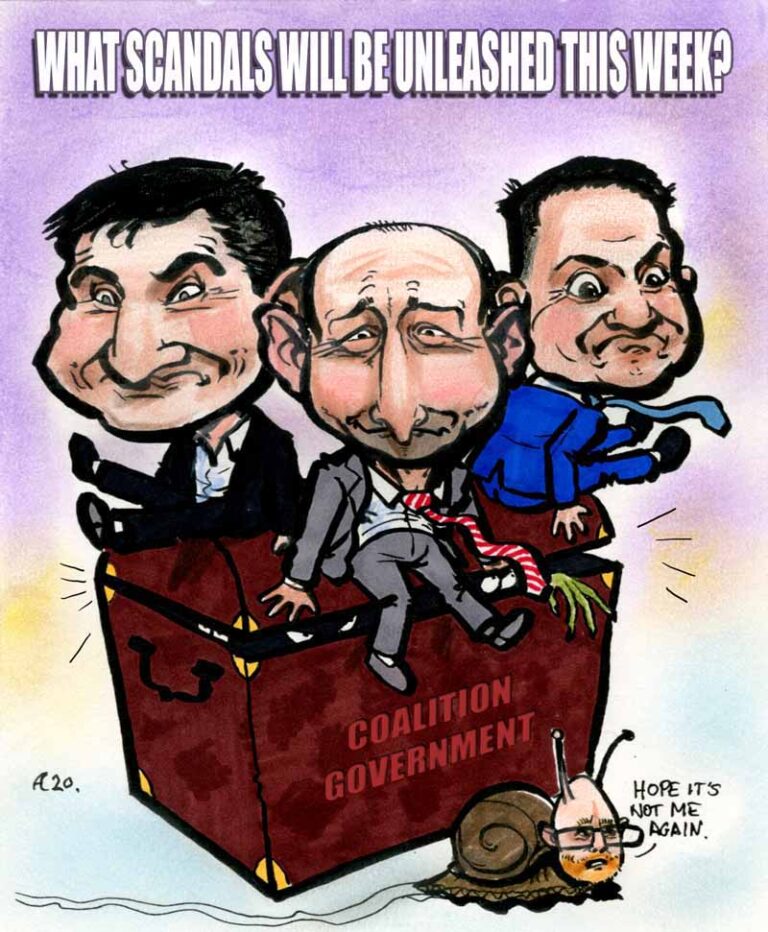

The BG’s got many perks for propping up the FFFG Martin-Harris duo – the biggest was the position of Dáil Ceann Comhairle (speaker) handed to the Wexford racist, and former FG member, Verona Murphy.
Some of the BG’s might be tempted to join their racist-fascist soul-brothers who lead the fuel blockade movement.
A coherent left-wing alternative is very badly needed.
Here is an immediate problem, which all of the left must deal with on the same page :
No doubt the fascist-racist fuel-protesters will turn up at the gates of Leinster House for a Dáil confidence vote on Tuesday. The assembled crowd may be addressed by speakers from Aontú, the II Party, assorted fascist-racists (the protesters’ own spokespersons) and possibly Sinn Féin.
All of the left should refuse unconditionally to share a public platform with the far-right.
John Meehan April 14 2026
Link :
A Confederacy of Gobshites – Ireland’s Government of Contempt
Ireland has a Gobshite Government. Micheál Martin is a gobshite. Simon Harris is a gobshite. Jim O’Callaghan is a gobshite. Helen McEntee is a gobshite. It’s gobshites all the way down.
The country has had bad governments in the past, incompetent governments, corrupt governments, governments marked by the unthinking conservatism you get when two parties have had a monopoly on power for over a century.
But there’s something uniquely dispiriting about the current administration which derives from the impression that they can barely be bothered to engage with the opposition either inside or outside the Dáil chamber.
They neither defend their policies nor debate with those who disagree with them. Their preferred approach is a complacently high-handed dismissal of the notion that they owe anyone any explanation at all for their actions.
Take this year’s debate over the government’s Residential Tenancies Bill, a pitifully inadequate attempt to address a housing crisis rapidly becoming a national emergency.
Opposition parties pointed out that the immediate result of the bill would be an increase in the already exorbitant rents paid by tenants. Allied to a surge in evictions as unscrupulous landlords strove to break tenancies so they could relet properties at the higher “Market Rents” enabled by the legislation.
Anyone paying attention could see this was going to happen. The supposed aim of the bill, creating the conditions for new investment in the property market which will increase supply and bring down rents, is a much more nebulous thing.
There’s no certainty that this will ever happen. The government is effectively ceding responsibility to the hidden hand of the market, something to which it ascribes an almost magical power.
When challenged on this point in the Dáil Taoiseach Micheál Martin’s response was to tell Sinn Fein Leader Mary Lou McDonald, “You’re full of soundbites. You couldn’t care less about providing houses for young people in this country.”
Failing to provide houses for young people in this country is in fact the outstanding achievement of Martin’s government. No blacker pot ever drew attention to a kettle’s stygian hue.
This tactic of defending their record by attacking the motives of their opponents has become such a distinguishing feature of the government’s current term that it feels like somebody’s idea of a masterplan, a kind of Machiavellianism for eejits.
When Labour leader Ivana Bacik criticised the government’s plan to lower the required building standards for apartments, Martin told her she was being “vague”, said that her arguments, “lacked substance and depth” and accused her of being opposed to private investment.
He liked the “lacking in substance and depth,” line so much that he used it on Social Democrat leader Holly Cairns too. Given his own complete failure on the issue this affectation of dismissing opposition arguments from a great intellectual height displays a certain chutzpah.
You could argue that Martin has no option but to behave like this because his record is essentially indefensible. But in fact his government’s housing policy makes perfect sense from an ideological point of view. Fianna Fáil and Fine Gael are right wing parties whose first consideration is the welfare of their own supporters.
Nothing will damage the credibility of FF/FG among those supporters like a fall in house prices. Rents can be added to that equation. The primary aim of the government’s bill was, unsurprisingly, the same as its primary result.
The housing crisis is, after all, only a problem for those who don’t own a house. For those who own multiple properties, it’s a golden opportunity. Soaring rents are a godsend to someone with a spare house from which they can make previously undreamed of profits. They will hope the current situation continues as long as possible. They’re likely to be government voters and it is their interests which are sacrosanct to the government.
This position may be unpalatable to people on the left but it is at least relatively coherent. The hypocrisy of the government lies in pretending that the housing issue Affects Us All. while refusing to admit what it’s doing.
Told the legislation would lead to opportunistic evictions and rent rises Tánaiste Simon Harris accused the opposition of having a grudge against the private sector.
When a corporate landlord announced plans to evict the tenants of 36 houses in Wexford housing minister James Browne, who represents the constituency, absolved the new legislation of responsibility. Despite the fact that the landlords had expressly declared that the planned evictions (currently on hold) were a direct result of the legislation.
This determination to barefacedly deny the truth is not confined to the housing issue. Take the controversy over the use of X’s Grok tool to create sexualised images of children. People Before Profit TD Paul Murphy said in the Dáil that the government, “don’t want to do anything about it because you don’t want to annoy or harm your relationship with Big Tech.”
Martin’s reaction was to bellow, “How dare you, who do you think you are? That you’ve some moral superiority everyone else.” This resembled nothing more than the bad faith yelp of faux outrage over the offence against his privacy emitted by a husband whose wife has just discovered him in the act of adultery.
In reality Murphy’s assertion is hardly outlandish. The Irish attitude towards “Big Tech” is notoriously subservient. So much so that France has pressed repeatedly for Ireland to be stripped of the EU oversight role which has fallen to the country because so many tech companies are based here.
Johnny Ryan of the Irish Council of Civil Liberties told an Oireachtas committee that Ireland is, “a digital haven,” pointing out that when the country’s Data Protection Commissioner was asked to act against Meta by the European Data Protection Board their reaction was to sue the EDPB instead.
The Irish government’s view on such matters was spectacularly illustrated at the beginning of the Grok controversy when Minister of State Patrick O’Donovan declared that those using the technology to create sexual imagery were to blame rather than the company.
Echoes of the National Rifle Association’s, “Guns don’t kill people, people kill people,” may have been inadvertent but O’Donovan’s intervention was further evidence of the side the Irish government takes on these matters. This is a state which fought a long legal battle AGAINST the European Commission’s order that Apple pay it 14 billion Euros in back taxes.
It’s possible to defend the government’s position on the grounds that it’s made necessary by the economy’s heavy dependence on the US tech sector. It might be an ignoble position but can at least be justified on pragmatic grounds.
Murphy was merely stating something which everyone knows to be true. Martin’s furious response is rooted in the unnatural desire of government politicians to pretend they’re concerned citizens just like everyone else rather than the people actually running the country.
Another example came when Martin, confronted in the Dail about the shameful lack of housing and care options for adults with disabilities declared that he would “personally,” deal with the matter. It’s hard to think of. a more meaningless political statement.
The neglect of this issue derives in large part from the policy of governments in which Martin has served for well over a decade. Those affected don’t need his personal contribution, they need his political contribution. Pretending that the Good Person can be divorced from the Uncaring Politician is evasion of a very Irish kind.
This pretence of powerlessness took on a more sinister aspect when Simon Harris followed a declaration that too many immigrants were entering Ireland by blaming “The Left,” for “shutting down debate.”
Let’s leave the Pros and Cons of the immigration debate aside entirely. If Ireland’s immigration policy is wrong, the fault partly lies with Harris who’s been in power for the last decade. “The Left” has never been in power in Ireland and has little political influence here. Most media commentators are, to be charitable about it, on the centre-right.
Even the most fiercely anti-immigrant campaigner is unlikely to have much sympathy for Harris’ contention that he was prevented from following his instincts by a lobby whose power resides largely in his mind.
His resentment may be partly based on the fact for years his political philosophy was based on agreeing slavishly with whatever was most popular on Irish Twitter that day. Cast adrift by its transformation to X and the destruction of his old “nice guy,” persona by an impatient reaction to a voter during the last election campaign, the nowhere man has nowhere to go.
It’s another example of a government unable to justify itself resorting instead to innuendo. Martin did a similar thing when implying that a far larger number of people had turned down offers of social housing in Cork than was actually the case. The sneaky, “Do you see? Hah? Do you get it?” note is a trademark of Taoiseach and government alike.
The dishonesty is exhausting. An administration which accuses opponents of undermining democracy has done a wonderful job of increasing public cynicism about politics.
Darragh O’Brien will announce the opening of a new runway at Dublin Airport before flying abroad to speak about the need to tackle global warming. Helen McEntee will justify government inaction on the Occupied Territories Bill on the grounds that these things are hard to do.
The OTB is a classic example of how faith in the political process is undermined. Banning imports from illegal settlements in the West Bank and other areas seems a no brainer. It would be popular with the public which is why the government trumpeted its intention to act.
So why the foot dragging? Because the government is worried that the US might take a dim view of it. Again, this is something everyone knows but which the government refuses to admit, taking refuge instead in McEntee’s empty protestations that the matter has become unexpectedly complex.
A lie is always at root an expression of contempt. It may be that the poor poll ratings endured by FF/FG in the years before their surprise win at the last election engendered a feeling of contempt towards the electorate.
The ratings are no better now and their contempt for those who don’t vote for the government has grown. So has the contempt for their political representatives.
FF/FG have long been doing the number about Sinn Fein being unfit for government because of the party’s historical paramilitary connections. They now seem to regard anyone to their left in the same light. Martin cannot hide his apparent belief that Cairns, Bacik and Murphy don’t really have the right to question him. He will not furnish them with a proper explanation because they don’t deserve one.
It’s worth remembering that the government’s current term began with an alliance brokered with independent TDs which included concessions so unprecedented they resulted in uproar at Leinster House.
FF/FG’s determination to ram through this deal may have owed something to the idea, popular among pundits at the time, that the recent victory of Donald Trump in America, presaged a “vibe shift.” No more Mr. Nice Guy! The grown-ups are back in charge!
Or it may simply have reflected the arrogance which you can expect from two parties which, between them, have been in power for the entire history of the Irish state. Yet that feisty beginning has been replaced by a sense of exhaustion.
The administration will not defend its policies honestly because it doesn’t think it has to. But it also just can’t be bothered. It seems to see government as less a vehicle for actually running the country than as a way to provide FF/FG politicians with lucrative ministerial jobs. Martin et al are the beneficiaries of the country’s most expensive Community Employment Scheme.
Their voters support the two governing parties more from indifference than enthusiasm. We’ve had plenty of governments which were disliked but none so widely despised. No-one respects its members anymore. How can you? They’re Gobshites.
A Footnote on Gobshites.
There seems to be a misconception among some English people concerning the meaning of the word, “Gobshite.” They appear to believe it refers to a streetwise snappy talker, a kind of verbal guttersnipe.
A well-known English music journalist used to describe herself on Twitter as a, “professional gobshite,” for example. And I’ve seen Roddy Doyle described approvingly in an English newspaper as “a real Dublin gobshite.” (No smart comments at the back, Roddy is a fine writer and a decent man.)
I also recall a friend of mine in London with a fondnesss for all things Irish announcing as a group of us sat down for a pint, “Here we are lads, all the gobshites together.” This may have been true but it’s not what he meant.
Gobshite is a term of contempt. It may be the supreme Irish term of contempt. Someone may describe themselves as, “A big eejit,” in the self-deprecatory hope of eliciting affection. Gobshite cannot be used in the same way. Delivered with conviction, it is the nuclear weapon of Irish argument.
It is the worst word. That’s why it perfectly describes our worst ever government.
Context :
How the current FFFGBG Dublin government was built :




Leave a Reply