Archive for the ‘Referendums’ Category
A series of Tributes to the Investigative Journalist Ed Moloney – “A strong voice against censorship: both that of the state and the more insidious self-censorship that had crept into journalism”
A number of tributes to the investigative journalist Ed Moloney are published below.
Also included is an account of how Ed published sensational evidence about the role of William Stobie (at one time a quarter-master in the loyalist paramilitary Ulster Defence Association), in the political murder of Belfast human rights lawyer Pat Finucane. The British state’s unsuccessful attempt to obtain details of the journalist’s confidential sources were defeated.
It is refreshing to read tributes about about a man I knew well that are kind, affectionate, and that do not pretend Ed was a saint.
He had a short fuse!


European Law might overrule bigoted British Supreme Court Anti-Transgender ruling in 6 County bit of Ireland – since Brexit, the north is different from Great Britain
Voters in the 6 County bit of Ireland rejected Brexit in the 2016 British State referendum by a large margin : 55 to 45 per cent. This was a unique political event – opposition to Brexit broke down the normal sectarian divide on an important constitutional development in the north of Ireland : Almost all nationalists voted against Brexit, and they were joined by a significant number of Unionist (perhaps ex-Unionist) voters.
Afterwards a decision was needed : would a new European Union (EU) – Britain border divide the 6 and 26 county bits of Ireland – or would a new border emerge, dividing the island of Great Britain from all of Ireland?
Everybody knew a new Brexit border could not be imposed on Ireland. The British government needed window-dressing for its Unionist allies : the “Windsor Framework” was unveiled with a walk-on part for the reluctant British monarch King Charles.
This rickety constitutional construction kicked a sleeping dog. The 1998 Good Friday Agreement. copperfastened an imperialist crime – the 1922 partition of Ireland. A promise that partition could be ended through an internal 6 county referendum is part of the GFA – but this was never meant to happen. The architects of the GFA reasoned, correctly in 1998, that an anti-partition majority in the north of Ireland was extremely unlikely. The Unionist Veto was safe. After Brexit, not any more.
The former Fine Gael leader and taoiseach, Leo Varadkar, is saying out loud what many people know is true but do not want to hear :
A Nigel Farage-led UK goverment could herald a united Ireland – Varadkar
Read the rest of this entry »Nell McCafferty’s Funeral from Derry was broadcast late on RIP.IE – Minus an Eamonn McCann Eulogy, Gay Rainbow Flags, or any personal memories of a woman who “changed Ireland for the better”
Many people who knew Nell McCafferty could not get to her funeral in St. Columb’s Cathedral, Derry. An alternative was offered on RIP.IE – a live broadcast starting at 12.30pm. When interested viewers tuned in, they were mystified, seeing only a blank screen. The livestream did not start until after 1.00pm, as a priest shared the altar with three men conducting a religious ceremony containing no stories about one of Derry’s most talented writers, Nell McCafferty. At one screening venue a small group of Nell’s fans – including Máirín Johnson who travelled on the legendary Dublin-Belfast contraceptive train with Nell in 1971 – were not impressed. We learned later that Eamonn McCann delivered a eulogy in front of the altar – A report is below. Source :
Nell McCafferty “Changed Ireland for the Better”
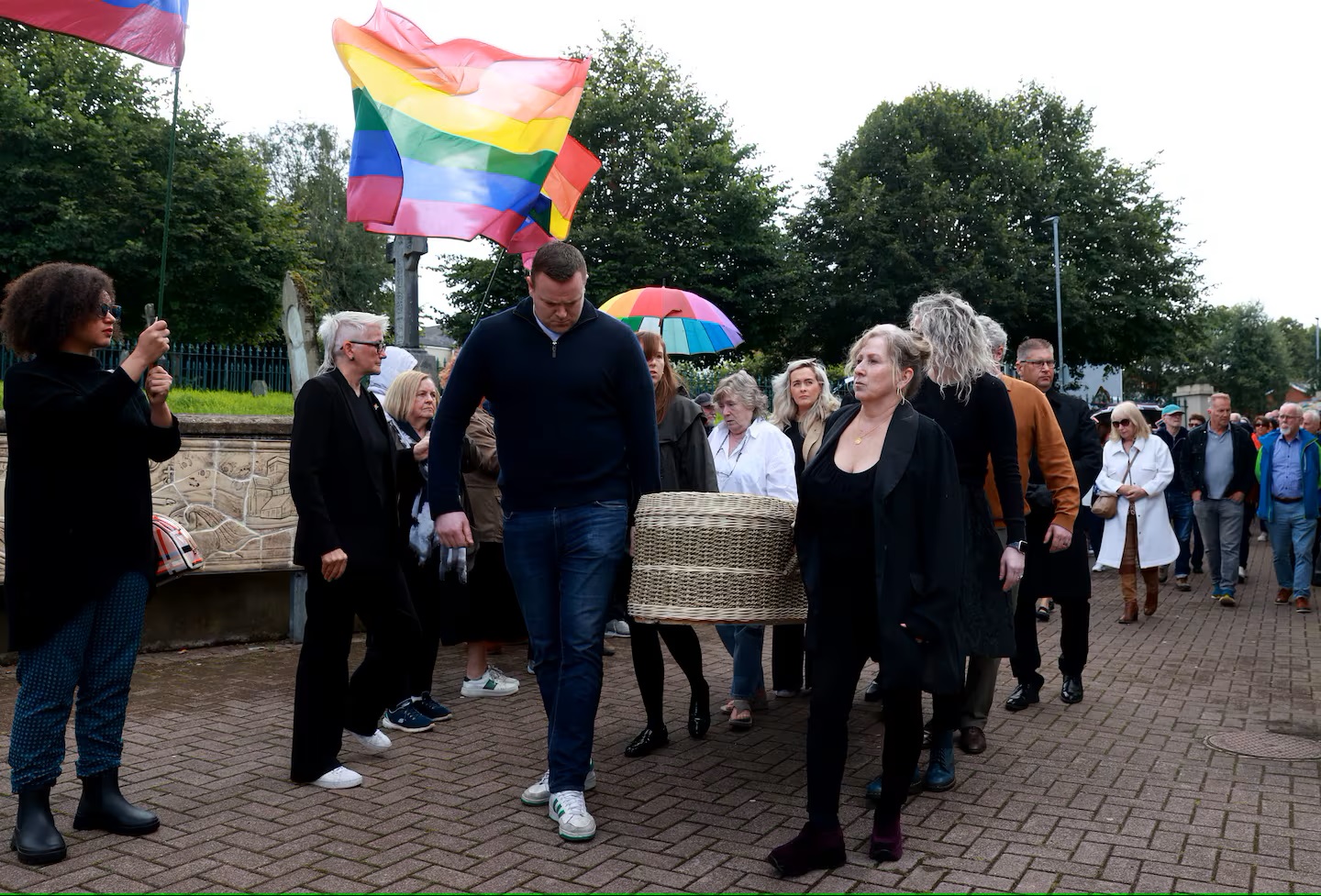

Eamonn McCann delivers a eulogy for Nell McCafferty, St Columb’s Cathedral Derry, August 23 2024
Nell McCafferty ‘changed Ireland for the better’, mourners at her funeral in Derry’s Bogside told
Campaigning journalist and author, who focused on women’s rights, poverty and social injustice, died on Wednesday aged 80
Nell McCafferty “changed Ireland for the better”, mourners at her funeral have been told.
Delivering an elegy in advance of her funeral Mass in Derry’s Bogside on Friday, the veteran civil rights campaigner and journalist Eamonn McCann said it was “given to very few of us to actually change the world”.
Read the rest of this entry »Robert Ballagh’s “The Thirtieth of January”: A Bloody Sunday Painting and the Troubles in the Two Bits of Ireland
In this interview the artist Robert Ballagh discusses the painting “The Thirtieth of January”, depicting Bloody Sunday in Derry in 1972. The conversation provides valuable insights into Ballagh’s personal experiences and artistic process, shedding light on the political and social context of the time.
The interview provides a unique insight into the historical and cultural significance of the painting.
Critical issues related to the Irish government’s response to the conflict, the impact of the Bloody Sunday event, and the broader social and political implications are highlighted. Ballagh’s commentary on the role of the Irish government, the impact on nationalist communities, and the establishment of the Special Criminal Court adds depth to the discussion.
Bloody Sunday Painting – the Thirtieth of January – Robert Ballagh
Thursday, January 20 2022. John Meehan interviews the artist Robert Ballagh in Number Five Arbour Hill.
We are talking about Robert’s painting : The Thirtieth of January, a representation of Bloody Sunday in Derry, January 30 1972.
John Meehan :
Why did you zone in on Derry’s Bloody Sunday , and put so much effort into making this painting? What makes it different from so many other big events during “The Troubles” in the north of Ireland, which lasted for 30 years, from 1968 to 1998?
Robert Ballagh
Well, it’s a long time ago now 50 years, but I have to say that it had an enormous effect on me, and I don’t think I’m alone with that historical experience. I suppose one thing I should say, I was only thinking about this, and I haven’t said anything about this experience to others. I’m a Dubliner. I’ve lived all my life in Dublin. But unlike most Dubliners – it wasn’t by design – I had an extraordinary rich knowledge of the North of Ireland, before the conflict began. Because I was a professional musician in a showband. We used to play at least once or twice a week in the north. So I was in every town village or city in the north that had a ballroom or ballrooms. And so I experienced the reality of life in that society, and became very aware of the sectarian differences, shall we say – the nature of the society, which people didn’t appreciate at all. I tell one very short story to illustrate that. We played fairly regularly in one of the very popular ballrooms in Belfast : Romano’s in Queen Street. We developed quite a following! In the show business vernacular the word groupie was used. These girls used follow us, they came down to Dublin once or twice to hear us. And we were playing one night in Romano’s.

After the dance, they came up and we’re talking to us. They asked “When are you playing again in Belfast?”.
I remember saying “Oh, I think we’re here next week.”
“Oh, really?”
“Yeah – we’re playing in a ballroom called the Astor” which I knew was in Smithfield.
And they said, “Oh, we can’t go there.” And I said, “Why?” – because it was a public ballroom. It wasn’t attached to any organization or anything. It was a public ballroom.
They said, “Oh, no, that’s a taig hall”
And it was the first time I realized, and we realized, that our fan base in Belfast was Protestant.
The March 8 2024 Referendums in Ireland – A few final thoughts – Vote Yes/Yes
A few final thoughts.
An Irish Times letter-writer offers good advice :
“The arguments made against the proposed constitutional amendments are akin to the owner of a 30-year-old banger, which keeps breaking down, refusing a 10-year-old car as a replacement because they were really hoping for a brand-new model.
When the perfect choice is not on offer, reasonable people take the best option available.
Vote Yes on March 8th to consign a few antiquated bangers to the scrapheap, where they belong. – Yours, etc,
JOHN THOMPSON,
Dublin 7.”
A number of left wing activists calling for a No vote in the Care Referendum are making a classic ultra-left mistake. They are not guided by a concrete analysis of the question on the ballot paper. As a result they advocate keeping reactionary, sexist, and partitionist wording in the Irish Constitution.
Read the rest of this entry »The March 8 2024 Care and Family Referendums in Ireland – Which is better : the existing wording or the suggested replacements?
Let’s keep it very simple. These 2 constitutional provisions are symbolic.
The basic information is provided here : Electoral Commission Explanation of Care and Family Referendums in Ireland. We are concentrating on the Care Referendum, as some people on the Irish left are advocating a No vote, meaning that the existing reactionary sexist wording in DeValera’s 1937 Constitution will remain in place.
In any referendum you are only voting on the question you are asked – not on the question you would like to be asked.
Voters should ask themselves : Is the existing wording worse than the proposed changes?
Yes or No?

Any objective left-wing and feminist reading of the relevant texts can only come to one conclusion : The proposed changes are better.
Read the rest of this entry »The Border Partitioning Ireland – Credible opinion polls, Brexit, and Perfidious Albion
A new credible opinion poll in the six county bit of Ireland states the following :
This matters, because under the terms of the 1998 Good Friday Agreement (GFA), if a six county (Northern Ireland) referendum results in a pro United Ireland majority, partition will be dead.
There is no reason to doubt the accuracy of this survey – it is consistent with many other recent opinion polls.
Under the GFA, the NI Secretary of State (currently Chris Heaton-Harris) has the power to call a referendum. This Westminster minister is not obliged to call a referendum unless a series of surveys indicate that a majority of voters in the six county statelet (NI) will vote for a change in the constitutional status.
This was a perfect arrangement for the Dublin and London governments in 1998 – a big majority of the people living in Ireland (on both sides of the border) voted to accept a Unionist Veto. No real prospect of a shift in attitudes seemed possible. But something big happened in 2016 which is having long-term results : Brexit.
Read the rest of this entry »According to Ireland’s constitution, a woman’s duties are in the home – but a referendum could be about to change its sexist wording
Eamon DeValera’s 1937 Irish Constitution contains symbolic sexist wording – the “woman in the home” clause. Laura Cahillane explains why almost everyone on the Irish and feminist left is advocating a Yes vote.
Laura Cahillane, University of Limerick
On March 8 – International Women’s Day – Irish citizens will vote in a referendum on whether or not to replace the so-called “woman in the home” clause in the Irish constitution.
This clause, which dates from 1937, specifies that: “The State recognises that by her life within the home, woman gives to the State a support without which the common good cannot be achieved.” It goes on to say that: “The State shall, therefore, endeavour to ensure that mothers shall not be obliged by economic necessity to engage in labour to the neglect of their duties in the home.”
Originally, the purpose of the provision was to acknowledge the importance of care in the home, which was then provided almost exclusively by mothers. The purpose was to ensure that mothers could remain in the home and would not be forced to work due to financial reasons.
However, the state help implied by the wording was never actually put into practice – women were never supported to provide care in the home. Worse, the constitution was often used to bolster arguments that a woman’s place was in the home and that policies which excluded women from work were acceptable.
Now, as part of a double referendum, Irish citizens will have the chance to change the constitution to a more gender-neutral wording. This is alongside another vote on whether to change the constitution’s definition of “family” to expand it beyond marriage.
Read the rest of this entry »Have British Tories Thrown Jeffrey Donaldson’s Democratic Unionist party to the Wolves? Is the”Windsor Framework” the “NI Protocol” in Different Clothes?
Readers may wonder :
Has British Prime Minister Rishi Sunak thrown the Democratic Unionist party of British-occupied Ireland to the wolves? Early indications suggest the answer is Yes.
The cause? Brexit.
Sunak’s former boss Boris Johnson’s negotiated a 2019 “Oven Ready Brexit” which featured the “Northern Ireland Protocol” (NIP) in 2019. This facilitated a landslide Tory General Election victory in December of that year. Things were different in the six-county bit of Ireland (Northern Ireland) and Scotland. In both of these locations, the Brexiteer forces were soundly rejected by the voters. Sunak now claims the NIP has been replaced by the “Windsor Framework”.
Establishment media outlets are ecstatic, claiming the Third British Brexit Prime Minister of 2021 has “Done the Impossible”
https://www.irishtimes.com/politics/2023/02/28/windsor-framework-brexit-deal-what-the-papers-say/
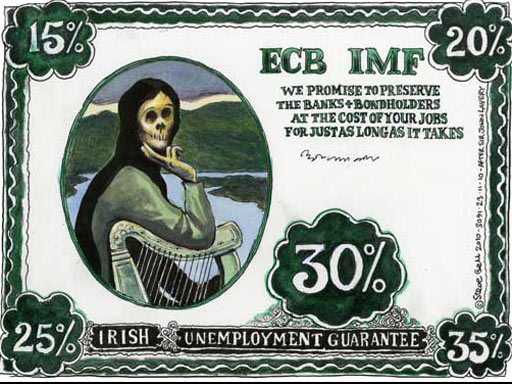
There is one significant dissenting note, which is almost certainly closer to the truth. It comes from the outstanding British Guardian cartoonist Steve Bell :
Read the rest of this entry »


 Tomás Ó Flatharta