The scenes we’re witnessing in Ballymena, Larne and elsewhere are vile and indefensible attempted pogroms. They should be utterly condemned by all.
These attacks haven’t occurred out of thin air, however.
In a context of community frustration at deprivation, waiting lists and crumbling public services, far right agitators are spreading racist lies on social media to blame migrants, and Unionist politicians have deliberately fanned the flames of their hate.
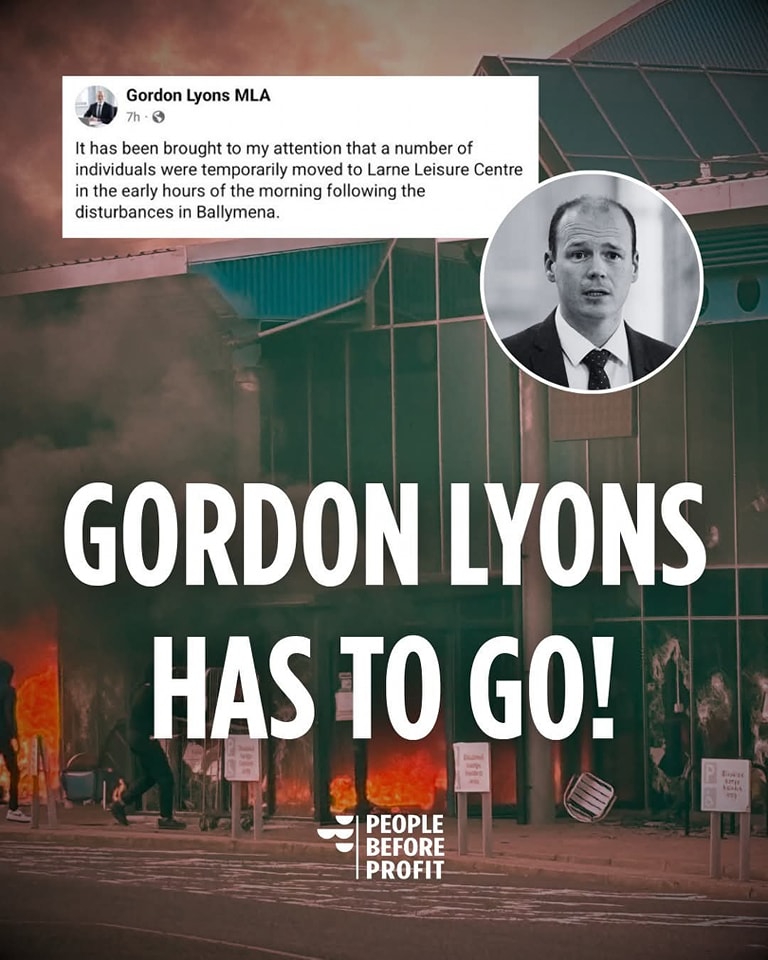
Last night, the DUP Minister for Communities Gordon Lyons posted the location of people sheltering from riots:
“It has been brought to my attention that a number of individuals were temporarily moved to Larne Leisure Centre in the early hours of the morning following the disturbances in Ballymena.”
The leisure centre was attacked later that evening – motivated by sheer racism. Gordon Lyons should resign immediately.
Other Unionist politicians have been whipping up anti-immigrant rhetoric.
On Monday Paul Frew, also DUP, went on the attack about immigration in a session on violence against women, and also referenced the case of sexual assault which sparked the racist riots in Ballymena. Frew also railed about immigration in Ballymena in a debate on the 20th May.
The TUV’s Timothy Gaston beat the anti-immigration drum on that same day: “Migration puts pressure on hospitals, schools and housing: that is a fact.”
This is the racist playbook on display. It blames migrants and minorities for the problems in our society. Migrants didn’t underfund the health service, minorities don’t hike up rents, asylum seekers don’t keep wages down. These problems are caused by the super rich, by landlords, and by politicians who protect them
Unionist politicians bear serious responsibility for the hateful scenes of recent days. They dog-whistled and whipped up racist sentiments. Loyalist paramilitaries and far right agitators took the next logical step, attacking ordinary people and making them fear for their lives.
Don’t be taken in by the DUP, the TUV and the far right. Stand up for humanity in a time of fear and chaos.
There is only one civilised response over rows about offering decent accommodation to refugees and asylum seekers : the Irish state must help and support human beings fleeing from wars, famine, destruction and poverty in their native lands. Protests against accommodation centres, hotels, and hosting schemes are a magnet for racist attacks on immigrants.
In other words :
Socialism With a Human Face Versus Liberalism With a Shark Smile
These protests are often presented as demands for local “consultation”
Claims are broadcast that refugees and asylum seekers are getting favourable treatment
Vulnerable people are threatened with the old ugly policy of “Go, Move, Shift”
The real story is an old one : Go, Move, Shift. Christy Moore’s song says it all :
Six in the morning out in Inchicore The guards came through the wagon door. John Maughan was arrested in the cold A travelling boy just ten years old.
CHORUS
Mary Joyce was living at the side of the road No halting place and no fixed abode. The vigilantes came to the Darndale site And they shot her son in the middle of the night.
Similar racist protests have stained many parts of Ireland since 2023 : O’Connell Street, Coolock, Darndale, and the East Wall area in Dublin; Newtownmountkennedy (Wicklow), Athlone (Midlands), Ballaghaderreen (Roscommon) and Roscrea (Tipperary) are other examples.
In recent days this political cancer has erupted again – this time in Galway.
Sad to say, we witness more shameful dog-whistle racism, again dressed up as “consultation” with the local community. It continues. Sinn Féin TD for Galway West Mairéad Farrell is following the wretched example set by a number of her party colleagues – lessons have not been learned.
The story is covered on the Cedar Lounge Site – a link is here :
“According to the department, an appraisal of the offer has been paused for three months to allow locals to advance a proposal to develop a community hotel at the site.
A meeting took place earlier this month inviting members of the community to voice their concerns over the possibility of using the hotel to house asylum seekers.
Local councillors and TDs have spoken out over the issue, attempting to assure locals that a proper consultation process will be followed through.
TD for Galway East Mairead Farrell said: “I have organised a meeting with the department for tomorrow morning. I have been in constant contact with the department from last night to this morning.
“They have told me categorically that no one has been moved into Carna and I have organised a meeting, I will give an update at that point.”
In a statement, the department have confirmed that a pause on the appraisal of the hotel remains in place. They said that there was no current contract in place for IPAS but that some people fleeing the war in Ukraine were still being housed there.”
Irish Independent, online, March 26 2025
Ukrainians in Ireland feared cut in ‘vital’ accommodation payment – Red Cross Payment to hosts worth €800 a month was due to expire on March 31
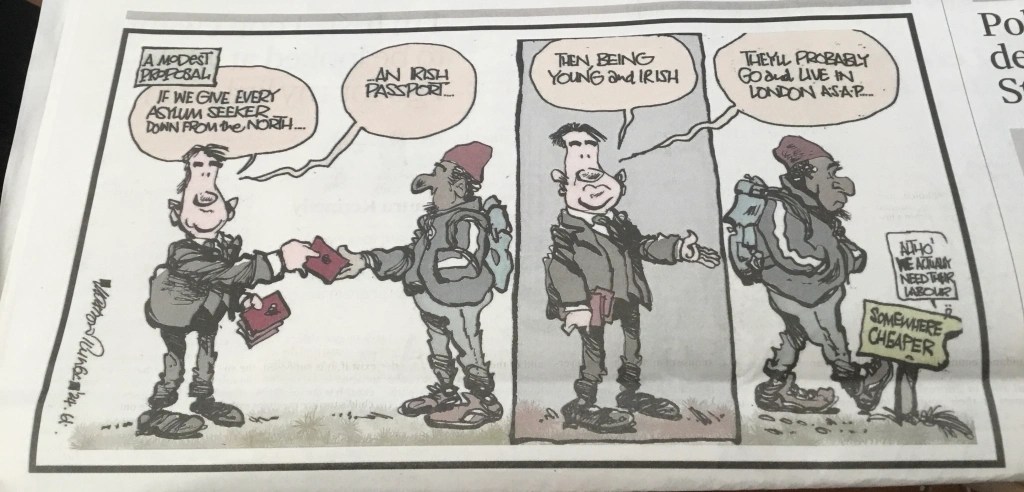
The Irish government is jumping in; part of its agenda is the old tactic of Divide and Rule.
A payment to hosts worth €800 a month, enabling Ukrainian refugees to get accommodation was due to expire on March 31. The state authorities have backed down temporarily, thanks in part to protests by welfare agencies such as the Red Cross and the Ukrainian community in Ireland. Here is a link :
There has been an increase in reports of uncertainty and anxiety among Ukrainians living in Ireland, as the Government is expected to make a decision on the continuation of payments to accommodation hosts, the Irish Red Cross has said.
The humanitarian charity said there has been “a significant rise” in calls from concerned individuals since late last year.
The Accommodation Recognition Payment (ARP) is a tax-free payment of €800 for those providing accommodation to Ukrainians who arrive in the Republic under the EU Temporary Protection Directive. The scheme is due to expire on March 31st.
The Government is expected to extend the scheme with consideration being given to a €200 reduction in the monthly rate.
decision is “most likely” to be announced towards the end of this week, according to a source, with meetings taking place between the Department of Integration and Department of Justice.
“There has been no final decision yet, with nothing signed off,” the source added.
The Irish Red Cross said on Monday that the payment has been “a vital financial support” for 19,000 Irish hosts.
The organisation is due to present findings of the largest survey of Irish hosts to date to the Government on Tuesday.
Niall O’Keeffe, head of international and migration with the Irish Red Cross, said the accommodation programme has been “a lifeline for many very vulnerable people”.
“It’s not just a value-for-money accommodation solution, many hosts have become invaluable support networks, helping their guests in the transition to life in Ireland and guiding them to access essential supports and training,” Mr O’Keeffe said.
“Reducing support for vulnerable people will force them to make difficult decisions: living in poverty or returning to danger.”
Minister for Integration Norma Foley said last week there would likely be changes to the monthly €800 payment with an announcement due shortly.
Ms Foley said the issue was being dealt with and required engagement with the Department of Justice. The Fianna Fáil TD said she would not “pre-empt” the decision but was conscious that the scheme was due to expire at the end of next month.
Deirdre Garvey, secretary general of the Irish Red Cross, said the conflict in Ukraine has dramatically changed the lives of millions of people and has had a devastating impact on individual lives that “we can never measure”.
“Ireland has recognised this suffering and continues to respond generously. The Irish Red Cross has worked with the wider Red Cross Movement to provide humanitarian assistance in Ukraine and in the surrounding countries that have hosted most of those fleeing conflict in Ukraine,” Ms Garvey said.
“The needs now are as great as ever. Many of the millions who fled are unable to return home, and those who remain face dire conditions, with limited access to water, heat, healthcare and other essential services. Three years on, the mental health toll is huge, both for those who remain and those who fled to safety.”
In a remarkable development, the Sinn Féin migration spokesperson Matt Carthy TD (Cavan-Monaghan) criticises the government’s temporary climbdown : See the link here :
The Red Cross and Ukrainian community protests persuaded the government to back off. Vigilance is necessary, because the state may come back with cutback proposals later this year.
At this point it should be obvious to all anti-racists that saying the ARP is “unfair” to other renters is a racist cop-out. The issue is whether it should be scrapped, or extended to others in need of housing. Leftists should argue the latter as a matter of principle. A possible slogan could be “ Don’t End…Extend “. In other words Extend the ARP to extend to all asylum seekers and refugees as a first step.
Some public representatives have got the balance right :
Example 1 is Ruth Coppinger TD (Solidarity – People Before Profit) :
“A rightward change in government in Germany, and a similar likely change in government in France in 2027, means that Europe will no longer present a united front on the issue.
Much like the initial response to the Covid-19 pandemic, the John Lennon-esque vision of a country truly united in the face of a societal challenge gave way to good old-fashioned pessimism.
The (Sinn Féin) manifesto read “the special status of Ukrainians under the Temporary Protection Directive should come to an end no later than March 2026. We believe that continually extending temporary measures is not a sustainable solution and is problematic for everyone.”
“If a beneficiary of Temporary Protection is from a part of Ukraine that is safe then, save for exceptional cases, return should be assisted.”
Socialism With a Human Face Versus Liberalism With a Shark Smile
Ukrainian refugees are targets of state racism; left-wing public representatives should support them :
240 refugees are housed at Hubble Student Accommodation; of the 240 Ukrainians at the site, there are 49 school students and 77 are in employment. Following pushback, plans to move the refugees with six days’ notice were paused. Local Labour TD Marie Sherlock said, “the reasoning put forward by the government does not add up” and stated that the decision by the government is “unconscionable.” The government claimed that there was a need to vacate the rooms in a bid to protect the rent pressure zone status of the accommodation, a claim which Sherlock refuted. “The RPZ exemption has already kicked in because the student accommodation units have not been rented out to students for more than two years.” “This flies in the face of a stated government intent to try and help Ukrainians integrate into the communities they live in,” she stated. The term “socialism with a human face” is closely associated with the Prague Spring of 1968, and it appears the new government is pursuing a “liberalism with a shark smile” approach with regard to immigration.
Engaging with hostile media goes with the territory
Firstly I am qualified to write on this topic. I did my first national media interview in 1996, a full 28 years ago. Since then there is barely a national or local media outlet that I haven’t engaged with. Most of those engagements over all of those years have been hostile. I was generally pushing an industrial or campaigning issue to a media which has a single opposing ideological focus and a narrow ownership that dictates control and editorial output and attitude. As a result I have been pilloried, defamed, targeted and abused. I’ve been ‘Public Enemy Number One’, ‘Mister Misery’, I’ve had national newspapers’ doctor photographs of me to make me look as evil as possible and I’ve had so many agendas laid at my door that I’d need to build a lengthy driveway to accommodate them all.
Yet in that 28 years I have never hidden from my responsibility to engage on behalf of whatever cause I was advocating at the time. It goes with the territory. So I understand more than most how the Irish media treat those who refuse to bend a knee to it. I’m ‘qualified’ to write this from years of raw and difficult experience in the field.
Legitimate claims or agenda-driven hyperbole?
So when, last Saturday, the media were yet again held up as the big bad bogeyman doing down the decent people I can assess the legitimacy of those claims or whether it is simply agenda driven hyperbole. The claims on that day were entirely unconnected on fact but very connected in attitude and intent. The first claimant that particular day (and it’s just one day of these constant claims) was from the Father of Cathal Crotty blaming the media for his Son’s troubles. The second was by a left wing blog blaming the media bogeyman for Clare Daly losing her European Parliament seat. These claims are so ridiculously baseless that they would be funny, and in ways they are, if they were not seeking to perpetuate dangerous agenda’s, one of misogyny and gender violence, the other of political pandering to dangerous populism. Whether the abuse is justifying a thug using his military training to beat a defenceless young woman or excusing a woman Politician not being able to defend her awful voting record on behalf of her electors the agenda is clear – blame the ‘media bogeyman’ as a deflection from basic undeniable reality. In other words create fake news and alternate facts to obscure reality.
With the final tallies counted and remaining seats filled, People Before Profits (PBP) Dublin South West and RISE members Diarmuid Flood and Paul Murphy review the deeply polarised Local and European Elections and outline five key takeaways.
For the second election in a row, dramatic political changes took place in the course of the local and European elections. Sinn Féin started the year polling around 30% and yet ended up with less than 12% nationally in the local Elections. Independents and Others started the year with around 15%, but won close to 25% on June 6th. Fianna Fáil and Fine Gael both hit 23%, coming from the high teens and around 20% respectively. In many ways, these appear to be the opposite political trends to what we saw in the General Election of 2020. Back then, Sinn Féin grew dramatically as hope for an end to 100 years of Fianna Fail and Fine Gael rule propelled them to be the biggest party in vote share for the first time ever. Volatility is clearly in the air.
However, what we saw in the five weeks of the election campaign did not come from nowhere. The election catalysed and accelerated existing processes. In the absence of major progressive social struggles, with the exception of the Palestine solidarity movement, the political terrain has undoubtedly shifted rightwards. Ireland has caught up with most of the rest of Europe and the Global North, with the emergence of a reactionary social movement in opposition to asylum seekers and the growth of a racist, climate denialist, anti-LGBTQ, and sexist far-right.
Overall, the June 7 2024 Local and European elections in the 26 County bit of Ireland were good news for the ruling coalition elected in February 2020. The Fianna Fáil-Fine Gael-Greens plus Gombeens (FFFGGG) combination scored an important victory, setting them up for a possible return to the seat of government in Dublin’s Leinster House in less than 12 months, when a new general election must happen.
Even worse, due to ominous rising support for Gombeen currents (primarily the Independent Ireland [II]) party and extreme racists, FFFG might be able to dump the Greens and rule on their own – or coalesce with the II gombeens and other toxic racist-right populists.
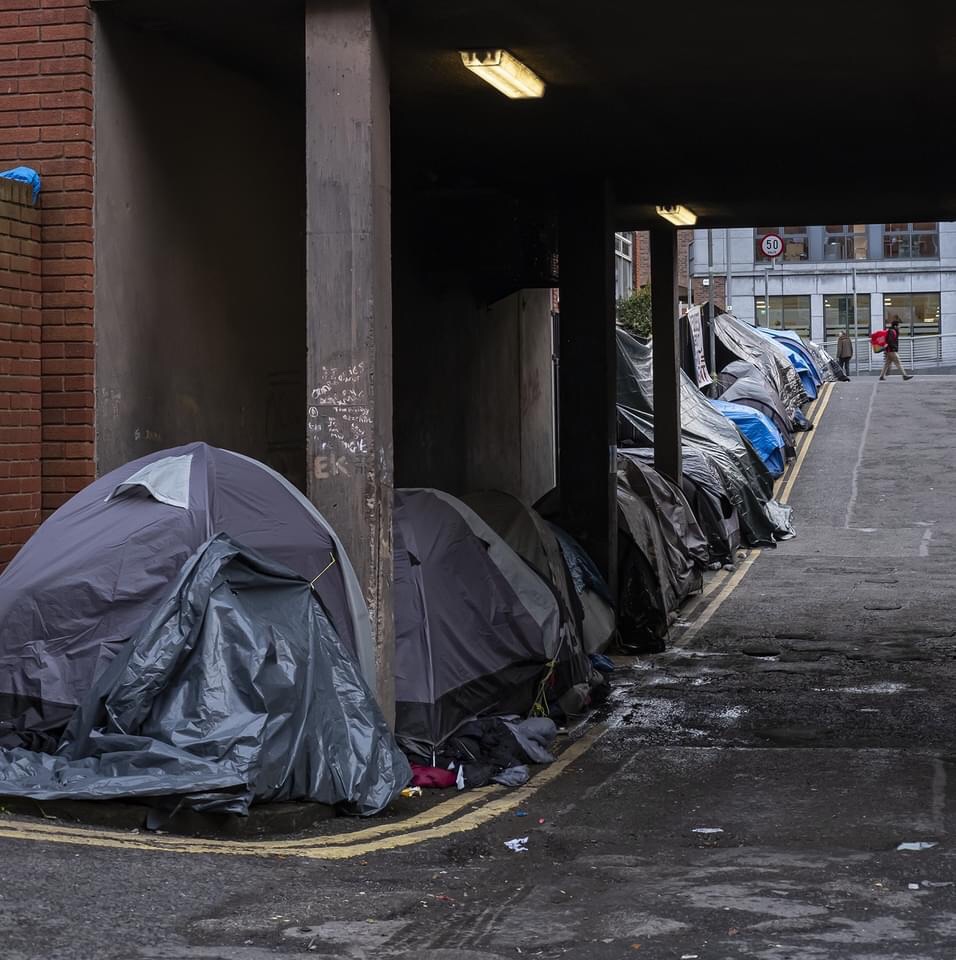
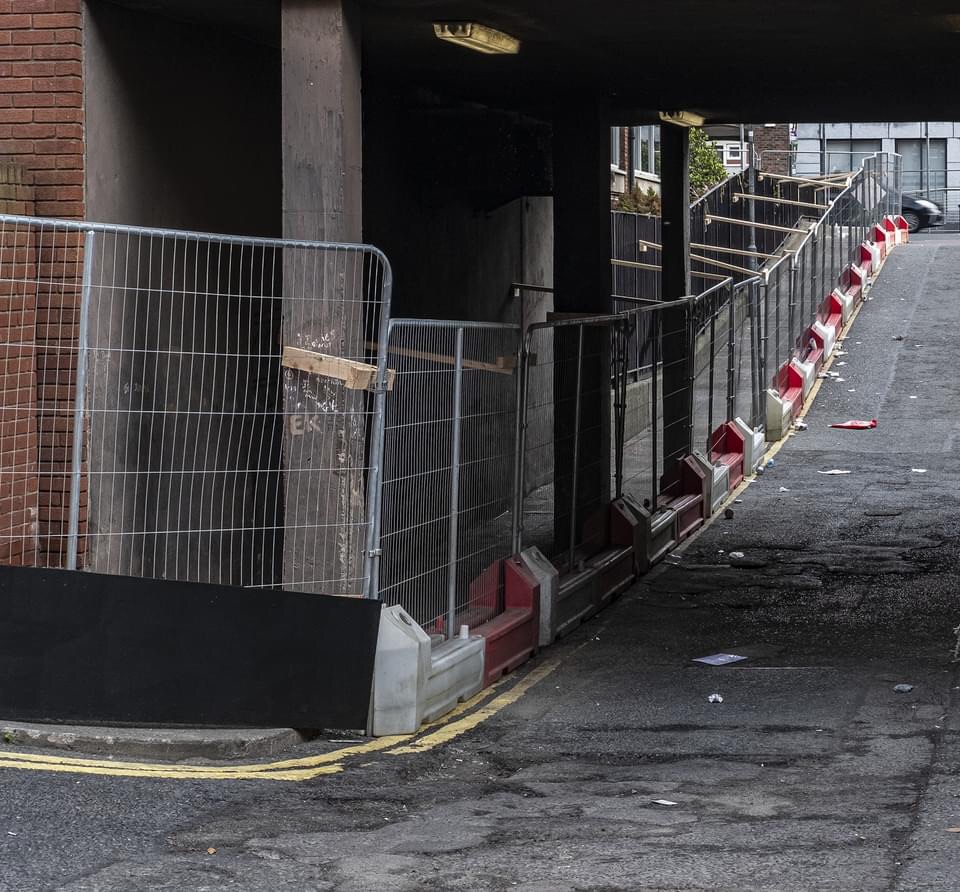
Barriers replace tents on Mount Street and along the Grand Canal. Barriers now extend along the Grand Canal from Mount Street to South Richmond Street. Good luck to the people in the tents getting through this mess.
Well done Chris. There is no political and moral difference between the actions of the arsonists and racist protesting scum who try to prevent asylum seekers getting shelter in hostels or hotels – and the actions of government ministers and functionaries – like Harris the Taoiseach and Harris the Garda boss. Double-standard “opposition” politicians who dog-whistle to the racists saying “No Open Borders” – E.g. the Sinn Féin Justice spokesperson Donnacha Ó Laoghaire – also share the blame. Genuine anti-racists can and will do much better.
In this interview the artist Robert Ballagh discusses the painting “The Thirtieth of January”, depicting Bloody Sunday in Derry in 1972. The conversation provides valuable insights into Ballagh’s personal experiences and artistic process, shedding light on the political and social context of the time.
The interview provides a unique insight into the historical and cultural significance of the painting.
Critical issues related to the Irish government’s response to the conflict, the impact of the Bloody Sunday event, and the broader social and political implications are highlighted. Ballagh’s commentary on the role of the Irish government, the impact on nationalist communities, and the establishment of the Special Criminal Court adds depth to the discussion.
Bloody Sunday Painting – the Thirtieth of January – Robert Ballagh
Thursday, January 20 2022. John Meehan interviews the artist Robert Ballagh in Number Five Arbour Hill.
We are talking about Robert’s painting : The Thirtieth of January, a representation of Bloody Sunday in Derry, January 30 1972.
John Meehan :
Why did you zone in on Derry’s Bloody Sunday , and put so much effort into making this painting? What makes it different from so many other big events during “The Troubles” in the north of Ireland, which lasted for 30 years, from 1968 to 1998?
Robert Ballagh
Well, it’s a long time ago now 50 years, but I have to say that it had an enormous effect on me, and I don’t think I’m alone with that historical experience. I suppose one thing I should say, I was only thinking about this, and I haven’t said anything about this experience to others. I’m a Dubliner. I’ve lived all my life in Dublin. But unlike most Dubliners – it wasn’t by design – I had an extraordinary rich knowledge of the North of Ireland, before the conflict began. Because I was a professional musician in a showband. We used to play at least once or twice a week in the north. So I was in every town village or city in the north that had a ballroom or ballrooms. And so I experienced the reality of life in that society, and became very aware of the sectarian differences, shall we say – the nature of the society, which people didn’t appreciate at all. I tell one very short story to illustrate that. We played fairly regularly in one of the very popular ballrooms in Belfast : Romano’s in Queen Street. We developed quite a following! In the show business vernacular the word groupie was used. These girls used follow us, they came down to Dublin once or twice to hear us. And we were playing one night in Romano’s.
Robert Ballagh’s “The Thirtieth of January”
After the dance, they came up and we’re talking to us. They asked “When are you playing again in Belfast?”. I remember saying “Oh, I think we’re here next week.” “Oh, really?” “Yeah – we’re playing in a ballroom called the Astor” which I knew was in Smithfield. And they said, “Oh, we can’t go there.” And I said, “Why?” – because it was a public ballroom. It wasn’t attached to any organization or anything. It was a public ballroom. They said, “Oh, no, that’s a taig hall” And it was the first time I realized, and we realized, that our fan base in Belfast was Protestant.
Saoirse McHugh, a Green Party Candidate in the February 8 2020 Irish General Election, recommends this Carl Kinsella article opposing Green Party participation in a Fianna Fáil / Fine Gael Coalition Government.
Hey, Green Party. This might sound crazy but… I’m from the future.
And I’m here to warn you that very bad things will happen if you accept Fine Gael and Fianna Fáil’s offer to enter government as their junior coalition partners. I’m talking lose all your seats, never-trusted-again, no-more-wolves-for-Eamon-Ryan bad.
But I accept that there are plenty of people, not just Mícheál, Leo and the lads, who are ramping up the pressure for ye to simply take the climate brief you want so badly and prop up the two boys until 2025.
Their arguments go like this: Ireland is in the midst of a crisis, therefore it needs a government. The Greens have the seats to plug the gap, therefore the junior coalition partner must be the Greens. The Greens are driven by the urgency of climate change above all else, therefore they should jump at this chance.
But you haven’t. Yet.
But if it makes so much damn sense, then why has this proposal remained in early negotiations, gathering criticism for the Green grassroots, rather than seeing a delighted Eamon Ryan skipping off into the sunset as the Tánaiste, or guaranteed a few spins on the rolling Taoiseach waltzer?
It’s simple: because some Greens know that what they want, including the demographics they need to keep onside, is not compatible with five more years of centre-right governance that prioritises profits, banks, big business and economic growth over saving the actual planet.
Long story short, I’m here to warn the Greens that if they go into government with Fianna Fáil and Fine Gael, that’s it for them. Read the rest of this entry »
In Dublin Bay North, as elsewhere, at first it seemed as though the socialist voice of the working class was going to also be swept away by the growth of the Sinn Féin vote. The Green vote too, might have been a challenge for socialists (although it was more of a challenge for Labour and other middle-ground and middle class parties). But as the counts went on, the transfers from Sinn Féin were strongly to the left, much more so than had been anticipated, although there were some losses to the presence of radical socialists in the Dáil and as activists with the advantages that being a TD brings to helping organise campaigns. We were sorry to see Ruth Coppinger and Séamus Healy lose their seats but delighted that after a difficult looking start, on the whole, the socialist left held their ground. In fact, we should have gained a seat in Dublin Bay North and at the expense of Seán Haughey of Fianna Fáil, who before the election had been a twenty-to-one favourite.



 Tomás Ó Flatharta