Archive for the ‘Irish Republican Army (IRA)’ Category
Brendan Hughes, Gerry Adams, and a collapsed court case in London’s Royal Courts of Justice
Newspaper readers who followed reports of a very unusual Gerry Adams London trial were not surprised by its collapse.
Procedurally. for this category of case, there is a 3 year time limit. People injured in three IRA bombings – Old Bailey 1973; Docklands and Manchester 1996 – put Gerry Adams in the dock seeking nominal damages of £1 on the grounds that the former Sinn Féin president had been an IRA leader.
Claimants were well aware of these rules, – they did not have a leg to stand on legally. The only issue was whether Judge Jonathan Swift (yes, same name as the famous Irish satirist who wrote Gulliver’s Travels!) would apply the rules. Judge Swift would have looked a bigger fool than Lemuel Gulliver if he ignored the regulations, and an appeal court later overturned his verdict. [1]
Mark Hennessy contributed this analysis in the March 19 2026 issue of the Irish Times :
Read the rest of this entry »A series of Tributes to the Investigative Journalist Ed Moloney – “A strong voice against censorship: both that of the state and the more insidious self-censorship that had crept into journalism”
A number of tributes to the investigative journalist Ed Moloney are published below.
Also included is an account of how Ed published sensational evidence about the role of William Stobie (at one time a quarter-master in the loyalist paramilitary Ulster Defence Association), in the political murder of Belfast human rights lawyer Pat Finucane. The British state’s unsuccessful attempt to obtain details of the journalist’s confidential sources were defeated.
It is refreshing to read tributes about about a man I knew well that are kind, affectionate, and that do not pretend Ed was a saint.
He had a short fuse!


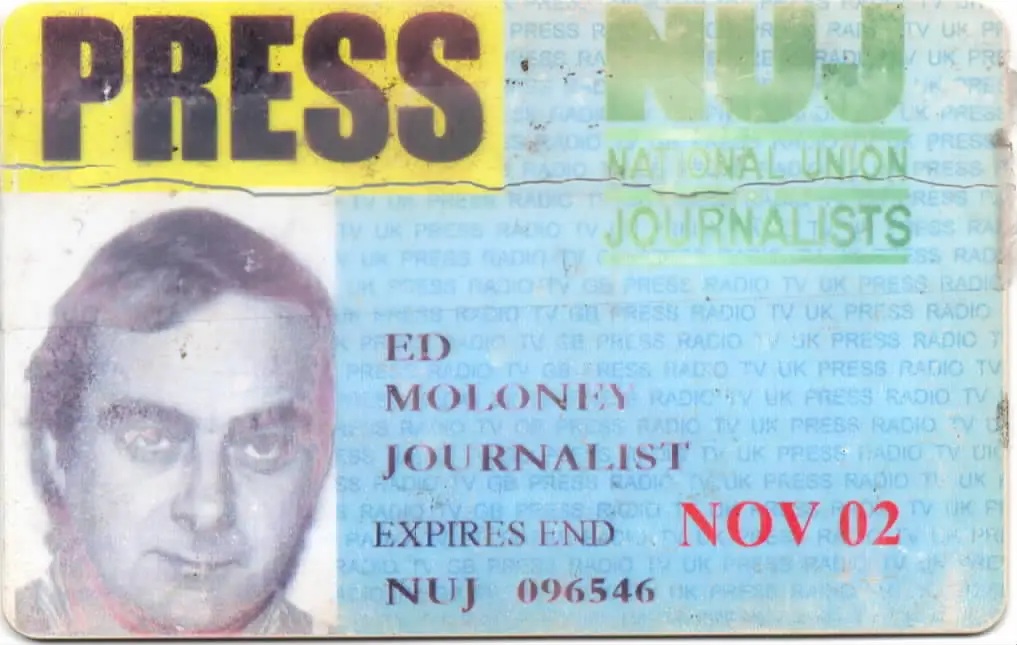
A tribute to the outstanding journalist Ed Moloney, who passed away in New York Aged 77
Ed was a great friend and will be missed.
Condolences to Joan McKiernan, and all friends, colleagues, and comrades.
A reminder : Ed Moloney’s work on issues concerning child abuse in the six-county bit of Ireland which remain unsolved :
John Meehan October 20 2025
Matt Morrison would not survive in an American immigration holding cell – he boarded a one-way flight to Dublin leaving behind a life he had built in the USA
The numbers of people leaving the USA to live in Ireland (26 county bit) are increasing. All the numbers are here.
I am guessing, but I think this may be the first time since records began that more people emigrated from the USA to Ireland than the other way around. It would be interesting to view population flows between the US and the 6 county bit of Ireland. Readers may wish to discuss changing times.
Far-right crazies such as Presidents Donald Trump and Vladimir Putin are destroying the lives of of ordinary people everywhere.
Matthew Morrison’s personal story offers context.
John Meehan September 2 2025
‘The walls were closing in,’ says ex-IRA man who self-deported over ICE fears
Catherine Fegan, Belfast Telegraph, September 1st, 2025
Matthew ‘Matt’ Morrison said he wouldn’t survive in an American immigration holding cell.
“I wouldn’t have my medication,” the 69-year-old told the Irish Independent this week.
“They would take my brace off my legs. They would take my stick. The fact is 12 or 13 people have died this year alone [in US immigration detention centres]. So, you understand the type of fear I had.”
Morrison, a former member of the IRA, had been living in the US for almost 40 years when he decided to “self-deport” back to Ireland over fears that he might be picked up by US Immigration and Customs Enforcement (ICE).
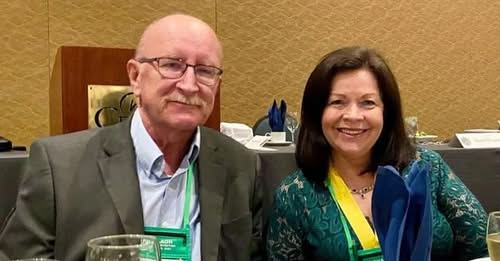
Originally from Derry, Morrison moved to St Louis, Missouri, in 1985 after spending 10 years in prison.
In 1976, he was imprisoned over attempted murder in an IRA raid on a British army barracks.
Read the rest of this entry »Irish Times Tribute to Nell McCafferty, March 28 1944 – August 21 2024 – Hold the Front Page – Nell has a story
An excellent tribute : Web Link :
Nell McCafferty Obituary – Journalist and Feminist Campaigner
Update, Dublin Gathering, Friday August 23, The Teachers’ Club, 36 Parnell Square West, at 12.30. Nell McCafferty’s funeral will be livestreamed.
RIP.IE Notice :
https://rip.ie/death-notice/nell-mccafferty-derry-derry-city-566175
- Born: March 28th, 1944
- Died: August 21st, 2024
- Nell got to the front page in the end :
“Nell”, she called her autobiography, and that was how she was known.

Small, fierce and feisty. That mop of curls, the waft of cigarette smoke, the tongue in cheek smile and her distinctive walk, like a sailor ashore. Everyone soon knew her smoky Derry voice, laconic, challenging, always ready to break into laughter. You never knew what Nell was going to say next. It was often outrageous. She was a character, and she loved to play herself to the hilt. She was also one of the most important Irish journalists of the latter half of the twentieth century. She listened. She paid attention. She told the truth.
She was, wrote her friend, the historian Margaret Mac Curtain, “unequalled in the extraordinary breadth and fearless candour she has brought to bear on controversial subjects.” Her journalistic career started in The Irish Times in 1970, when the paper’s late Northern editor and editor, Fergus Pyle, commissioned her to write about the new bathroom in her family home in Beechwood Street in Derry’s Bogside.
Home was her touchstone. She vaunted her street-cred. She was part of a Bogside aristocracy that included Martin McGuinness, Eamonn McCann, Seamus Deane, Paddy Doherty, John Hume, Dana and Phil Coulter. Her mother was her biggest fan and harshest critic.
McCafferty was born in 1944. Her father, Hugh, was a clerk for the British admiralty by day and a bookie’s clerk at the dog track at night. Her mother, Lily, reared six children. Another daughter died at birth.
Her parents had to work hard to keep poverty at bay. She was fascinated and frightened by the poverty of the tenements where her father was raised. One of his brothers had died as a British soldier at the Somme. Her mother’s parents were Sergeant Duffy, a Catholic RUC man, and his wife Sarah, a Protestant who “turned”.
Read the rest of this entry »“Frogs’ legs and lobster Thermidor – or the ABC of republican strategy” – Fearghal Mac Bhloscaidh
Fearghal Mac Bhloscaidh is one of the most interesting political writers in Ireland. The article below is a detailed analysis of Ireland’s peace process, which begins with a speech delivered by Bernadette McAliskey the year before the Good Friday Agreement was signed in 1998. I remember it well. (*)
John Meehan
About the author : Fearghal Mac Bhloscaidh is a Belfast-based historian and the author of a number of important books, including Tyrone: the Irish Revolution, 1912-1923 (Four Courts Press, 2014).

As a young man, I listened to a speech by Bernadette McAliskey the year before the signing of the Good Friday Agreement – the pinnacle of what became known as the ‘peace process’. McAliskey did not object to peace, she had notoriously been subtitled by the BBC in a 1992 interview, when she said: ‘No sane human being supports violence. We are often inevitably cornered into it by powerlessness, by lack of democracy, by lack of willingness of people to listen to our problems. We don’t choose political violence, the powerful force it on us.’ (quoted in Curtis, 1998:297) By the time I heard her speak in 1997, the powerful had arrested her pregnant daughter, Róisín, with the intent to extradite her to Germany. By 2000, the powerful admitted that Róisín, who had never been charged, had no case to answer as there was ‘not a realistic prospect of convicting Miss McAliskey for any offence.’ (Guardian, 20 July 2000). What struck me at the time, was that the powerful had a vendetta against a woman and her family because she had stood up for socialist republican principles for thirty years at that stage. Last month, fifty-five years after the Burntollet march and her subsequent election as the then youngest female Westminster MP ever, McAliskey gave the main oration at the solidarity march in Dublin, where she told the crowd that ‘Palestine is the litmus test of our humanity’ and then urged those present not to vote for any politician who would legitimise the Biden administration, which was ‘enabling genocide’, by attending the St Patrick’s Day events in the White House (Irish News, 14 January 2024).
McAliskey’s speech from all those years ago stuck in my mind because in the questions afterwards she was asked about the peace process and used a powerful analogy that I hadn’t heard before at that stage, but I have heard and used myself on numerous occasions since. She welcomed an end to violence but warned that the provisional movement appeared to be going down a well-worn reformist path that would eventually denude it of any revolutionary potential. She compared the republican movement to a frog, which if placed in a pot of boiling water, will immediately sense the danger, and jump out to save itself, but, if immersed in tepid water brought slowly to the boil so that the change in temperature remains gradual, the frog does not realise it’s boiling to death. In line with their – soon to be – new mates in New Labour, Sinn Féin had swallowed TINA – there is no alternative. Plan A – armed struggle has failed, now we try Plan B. In Sinn Fein’s case, this meant the long march through the institutions, acceptance of the principle of consent and parliamentary reformism on the classical constitutional nationalist model. McAliskey had the temerity to ask for a Plan C, which might mean retaining socialist republican principles and challenging the powerful rather than getting into bed with them.
Read the rest of this entry »‘Lost Boys’ Film Adds Fuel To Kincora Fire And One Question: ‘Why Did The BBC Drop This Film?’ – Re- Blogged Posts which originally appeared on Ed Moloney’s site, The Broken Elbow
Introduction :
On Wednesday September 27 a world premiere takes place in Dublin’s Irish Film Institute

World Premiere
During the winter of 1969, young boys started to disappear from the streets of Belfast, never to be seen again. By 1974, as the Troubles were reaching a bloody and vicious peak, five boys in total had vanished within a five-mile radius. Fifty years later, as the disappearances remain unsolved and families continue to search for answers, filmmaker Des Henderson (How to Diffuse a Bomb) reopens these largely forgotten cold-cases, unearthing disturbing revelations in secret state documents to tell an extraordinary tale of abuse, trauma and potential cover-up.
Notes by Sunniva O’Flynn
Ed Moloney offers the recommendation below. Chris Moore, a journalist who has researched the subject thoroughly for many decades, wrote a fascinating (and chilling) background story about state collusion and child abuse on Ed Moloney’s blog in June 2023. it is reprinted below.
‘Lost Boys’ Film Adds Fuel To Kincora Fire And One Question: ‘Why Did The BBC Drop This Film?’
I had the opportunity yesterday to watch the new Kincora film made by Belfast’s own film company Alleycats. Called ‘Lost Boys’ it asks a simple but necessary question: was the disappearance and murder of four Belfast schoolboys in the 1970’s linked to the subsequent Kincora scandal, which broke some few years afterwards, revealing that all the employees at the home for wayward boys had been abusing inmates for years?
Read the rest of this entry »The Man Who Blew the Whistle on the late British IRA Spy Freddie Scappaticci
Ed Moloney has diligently reported on the Steaknife (Freddie Scappaticci) story for many years. Skeletons are falling out of cupboards : Link : http://thebrokenelbow.com/2023/04/11/the-man-who-blew-the-whistle-on-scap/
His name is Ian Hurst although for a long time this former intelligence officer in the British Army’s Force Research Unit (FRU) called himself ‘Martin Ingram’ whenever he met the media. A chirpy Mancunian who served with the FRU in Derry, he broke with the military and gradually emerged in public with secrets to tell, angered by what he believed was the shameful way an agent he ran in the IRA had been treated.
The Derry IRA’s quarter master’s department included in its ranks one Frank Hegarty, whose career in the IRA had been controversial. He had been expelled some years before by Ivor Bell, then the chief of staff, when it was discovered that he had been having an affair with the wife of a soldier in the Ulster Defence Regiment (UDR) and had failed to tell his superiors. And so it was that eyebrows were raised when the news filtered through that Hegarty was back, a move that had been arranged by Martin McGuinness.

Ian Hurst, pictured in his days as a soldier in the Force Research Unit
Hegarty’s exposure as a spy and death at the hands of the Internal Security Department – the IRA’s spycatchers – led to more internal speculation about McGuinness’ true loyalties. The Belfast-based veteran IRA leader, Brian Keenan was one who did not keep those doubts to himself. The pair had never got on and Keenan blamed McGuinness for facilitating his arrest in Northern Ireland and subsequent deportation to a London court where he received a lengthy sentence for IRA bombings in England in the early 1970’s.
Read the rest of this entry »Oh Ah, Up the Ra “One Song Two Reactions – Why is it different when the rugby boys sing Celtic Symphony?” – Joe Brolly, Derry All-Ireland Winner, Gaelic Athletic Association
This story assesses three sporting activities in Ireland – Gaelic Games, Soccer, and Rugby. It shines a light on a misogynous (woman-hating) West-British media culture.
Thanks to the Dublin Council of Trade Unions for bringing this story to our attention.
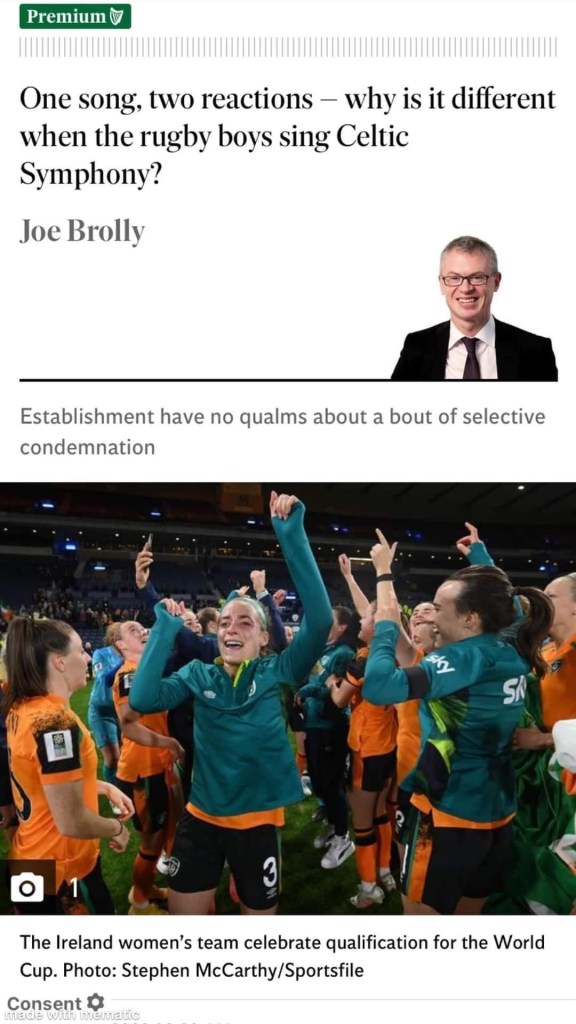
Joe Brolly in the Sunday Independent, January 8 2023 :
Read the rest of this entry »


 Tomás Ó Flatharta