Archive for the ‘International Political Analysis’ Category
Ukrainian socialist and academic, Yuliya Yurchenko, speaks at a public meeting ‘Ireland – Ukraine International Solidarity of the Left’ in Dublin on Monday November 21 : Teachers’ Club, 36 Parnell Square West, Dublin 1.
Ukrainian Socialist Yuliya Yurchenko to speak at Solidarity Meeting in Dublin :
Ukrainian socialist and academic, Yuliya Yurchenko, speaks at a public meeting ‘Ireland – Ukraine International Solidarity of the Left’ in Dublin on Monday November 21.
The meeting is organised by Irish Left With Ukraine, which says that the purpose of the meeting is to extend solidarity to the Ukrainian people as they continue to resist the Russian invasion of their country – and to amplify the voices of Ukrainian socialists and trade unionists.

Statement – Meeting Chairperson Nóirín Greene
Read the rest of this entry »“Road to Repeal: 50 years of struggle in Ireland for contraception and abortion” – An outstanding PhotoBook – Interview with Co-Author Therese Caherty
We’ve come a long way!
The fight for reproductive freedom in Ireland
Irish publisher Lilliput Press recently launched the photobook, Road to Repeal: 50 years of struggle in Ireland for contraception and abortion, in Dublin’s Mansion House. Social policy analyst Pauline Conroy, photographer Derek Speirs and journalist. Therese Caherty have documented in pictures and words Ireland’s choice movement over half a century.
John Meehan interviews Therese about the project, where it came from and the future for reproductive rights in Ireland.
John Meehan – What gave you idea for the book?
Therese Caherty – Our project began in 2013 at Against the Tide, a retrospective of 1980s activism by photographer Rose Comiskey. At a closing discussion on Irish feminism, a young woman asked some of us oldies – Why did you let the 8th Amendment happen? It wasn’t a view we were familiar with. But you could see where she was coming from. She had arrived into the world of the Eighth and seen, maybe experienced, its effects. And she was angry.
In 2014 we answered her question with Women to Blame, a multimedia exhibition on the struggle in Ireland for contraception and abortion. Today, thanks to Lilliput Press, we have what we always wanted – a permanent home for that exhibition. Road to Repeal commemorates in pictures and words a people– powered movement that believed in a more equal Ireland for women and pregnant people, and their unfettered right to independent decision– making about parenthood.
We see our book as part of that movement of activists and participants and a contribution to it. It’s not for profit and all royalties go to the National Women’s Council of Ireland.
Read the rest of this entry »Ireland – Ukraine International Solidarity of the Left – Teachers’ Club, 36 Parnell Square West, Dublin 1, 7pm – 9pm – Monday November 21 2022
Yuliya Yurchenko – an active supporter of the European Network for Solidarity with Ukraine (ENSU) – speaks at this Dublin meeting. https://ukraine-solidarity.eu/
Find out more about Irish Left With Ukraine here :
https://www.facebook.com/groups/466892938791354/?ref=share

The meeting will be chaired by Nóirín Greene (Former member of the Irish Congress of Trade Unions [ICTU]) Executive. The other speakers are : David Joyce (ICTU International Officer); Séamus Dooley (National Union of Journalists, Guest Speaker); A Ukrainian socialist refugee who is living in Ireland.
Find out more about Yuliya Yurchenko here :
https://www.gre.ac.uk/people/rep/faculty-of-business/yuliya-yurchenko
://www.plutobooks.com/author/yuliya-yurchenko/
Yuliya Yurchenko is a Senior Lecturer in Political Economy at the Department of Economics and International Business and a researcher at the Political Economy, Governance, Finance and Accountability Institute, University of Greenwich, UK. She is the author of Ukraine and the Empire of Capital (Pluto, 2017). She researches state, capital and society relations as well as public services, with a regional focus on Europe and Ukraine.
Read the rest of this entry »The Fallacies of the Call for “Negotiations” Between Ukraine and Russia – Charles Pierson
The following article was submitted to the USA journal Counterpunch replying to the article mentioned in the paragraph below. Counterpunch refused to publish it.
We wish to thank the New York based Irish-American activist Joan McKiernan who brought the article below to our attention. This vital discussion is occurring in many parts of the world, including Ireland. If you wish to actively participate in principled left-wing solidarity with the Ukrainian masses we recommend the European Network for Solidarity With Ukraine (ENSU). The ENSU’s Irish supporters work with Irish Left With Ukraine (ILWU), which has organised a public meeting in Dublin taking place on November 21 2022. The main speaker is ENSU activist Yuliya Yurchenko.
John Meehan November 10 2022
Links :
ENSU https://ukraine-solidarity.eu/ ILWU : https://www.facebook.com/groups/466892938791354


“Victory against Russia,” is the wrong goal in Ukraine, writes Binoy Kampmark (“Vicarious Zeal: Fighting to the Last Ukrainian,” Counterpunch, Jul. 15, 2022). Kampmark, a frequent contributor to Counterpunch, worries that Ukraine and the West are demanding what amounts to Russia’s “unconditional surrender.” Instead of demanding Russia’s surrender, Kampmark recommends peace talks. A negotiated peace, he writes, will shorten the war and save lives. Unfortunately, “Hard-headed peace talks, let alone anything approximating to negotiations have … become taboo.”
I respect Binoy Kampmark. I believe this is the first time I have disagreed with something he has written, but I do disagree. Strongly. Here’s why.
Russian-Ukrainian Peace Talks Since the Russian Invasion
Kampmark appears to have bought into the myth propagated by the “anti-imperialist left” that Ukraine refuses to negotiate. That puts the onus on Ukraine for rejecting peace. The truth is that negotiations between Russia and Ukraine began even before Russia invaded Ukraine on February 24. Russia and Ukraine, together with France and Germany, met in January and February to attempt to defuse the growing crisis.
Statement by Ukrainian Feminists in Solidarity with Iranian Women
Ukrainian Feminists offer solidarity to their sisters in Iran. The Teheran and Moscow régimes are reactionary allies.
the Iranian state is not only oppressing its own citizens. It also provides support for other oppressive and imperialist regimes. During the last few weeks, Iranian drones employed by the Russian army have killed tens of civilians and destroyed countless housing and critical infrastructure objects in Ukraine.
We, Ukrainian feminists, express our solidarity with Iranian uprising, triggered by the brutal murder of Mahsa Amini by the Iranian Morality Police. Thousands of women responded to this crime by going out on the streets, cutting their hair and publicly taking off and burning hijabs as a symbol of their oppression. What started as a protest against police brutality and obligatory hijab, quickly transformed into a general resistance of the Iranian people against the patriarchal and dictatorial mullah regime and the authoritarian form of capitalism that it represents. The grassroot mobilization is today being joined by schoolgirls, students, trade unions, ethnic minorities, and people from other social groups affected by the economic crises, high food prices, social cuts, and privatization. This new wave of struggles thus continues and expands the series of uprisings against socio-economic inequalities, political oppression and ethnic disctimination that shook Iran during the last decade.
Source : https://femwork.org/en/fm-news/solidarity-with-iranian-women-eng/


Changing of the Guard 💂♀️ in London’s 10 Downing Street – British Prime Ministers 2022
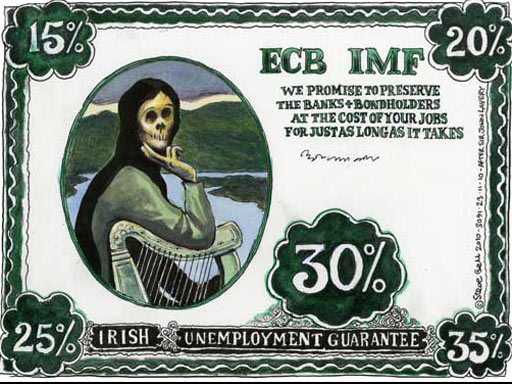
Brilliant Satirists are superb political analysts – getting the message across, injecting lethal poison into the heart of a terminally ill body. Examples :


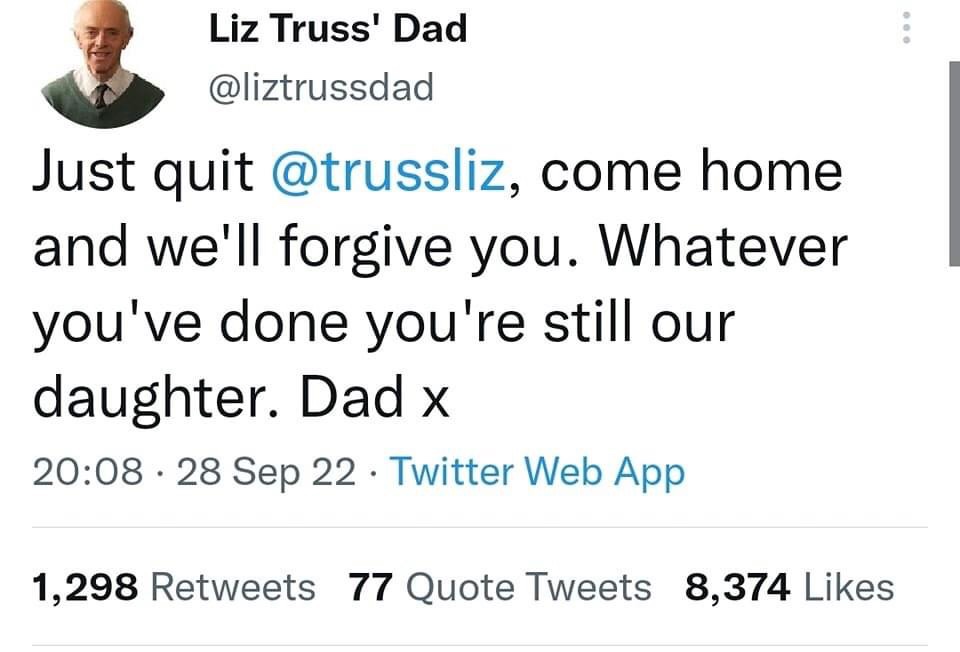


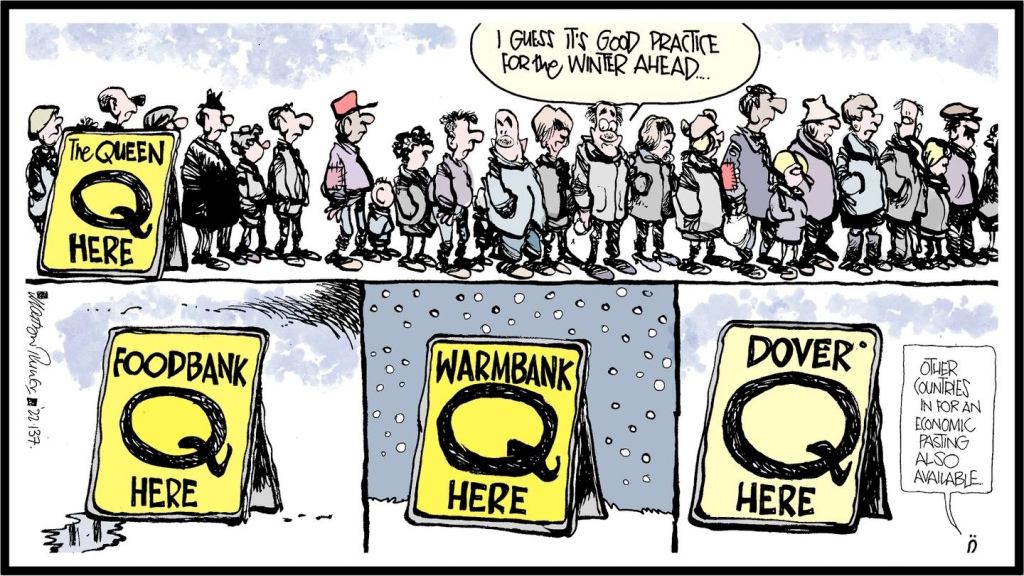
Solutions? Smashing Brexit would be an excellent start!
‘A Workers Republic for Ireland’ by Thomas J. O’Flaherty from The Toiler. December 17, 1921.
This blog is named after Tomás Ó Flatharta, the first known Irish supporter of the 1920’s Left Opposition which opposed the policies pursued by the Russian Bolshevik government headed by Josef Stalin. Ó Flatharta was a prolific writer, and wrote this fascinating article previewing the partition of Ireland in December 2021. Ó Flatharta looks at “official” Irish-American support for Ireland’s cause, and points out its limitations and hypocrisies. He endorses the policies pursued by the revolutionary marxist James Connolly, a leader of Ireland’s Easter 1916 Rising who was executed by the British imperialists.
Here is a flavour of Ó Flatharta’s analysis, which has a lot of contemporary relevance.
When Connolly led the revolt in Dublin in 1916 some of his comrades in other countries did not understand why he lined up with the Nationalist elements. They claimed that Connolly. lost his original Marxian purity. These elements could not see in the revolutionary opportunism of Connolly the tactic that is today the guiding star of every revolutionary party in the world. Connolly’s idea was to mobilize all the available discontent in Ireland and hurl it at the enemy. Out of the inevitable sacrifice which the Easter Week Revolution entailed would spring a new movement inspired by the example of the martyrs of Easter Week. Connolly knew quite well that national independence alone would never give Ireland independence until the Empire was overthrown, therefore every move made to overthrow the Empire tended to bring about the inevitable revolution. The Citizen Army composed of members of the Trade Unions was pledged not alone to strike for Irish freedom but for the Workers’ Republic. The Nationalist Volunteers had a certain contempt for the men of the citizen army. The former were carried away with their hostility to England into a feeling of sympathy with Germany. The citizen army, however, was just as much opposed to the Kaiser as to King Gorge and hung over its headquarters the banner with the inscription “We serve neither King nor Kaiser.”
When Eoin MacNaill, the leader of the Nationalist Volunteers, issued the countermanding order which kept the full force of the members of that body from participating in the Easter Week revolution, Connolly called out his citizen army. The army of the workers was the backbone of the rising and according to Seamus MacManus in his “Story of the Irish Race,” it was Connolly’s insistence on making a fight that ultimately carried the motion for the insurrection. But since Easter Week Irish labor has been relegated to obscurity and the Irish middle class have been given credit on American platforms and in the Irish journals for the great struggle that has been carried on against British tyranny.
‘A Workers Republic for Ireland’ by Thomas J. O’Flaherty from The Toiler. December 17, 1921.
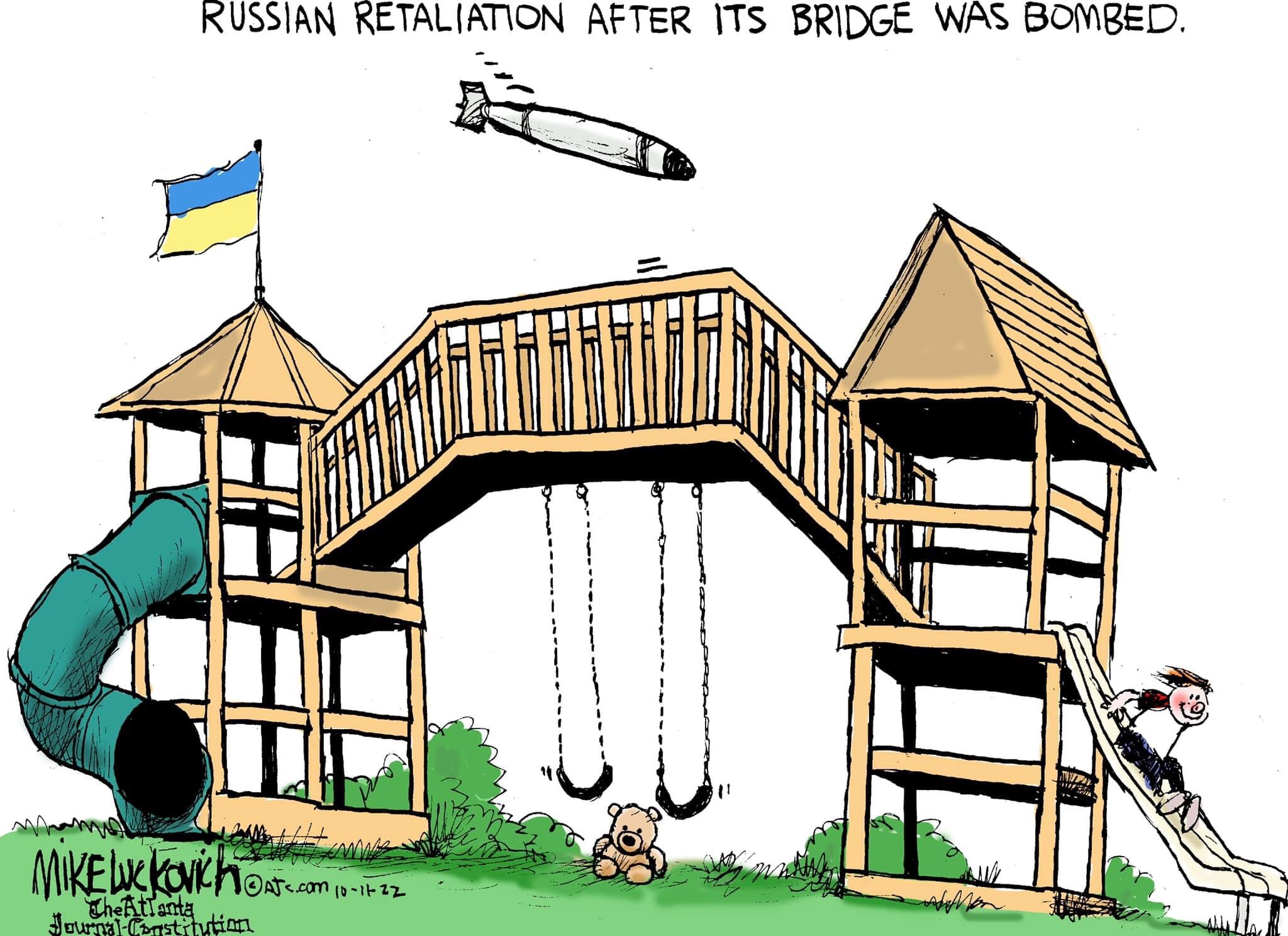
Read the rest of this entry »Double-Standards: The Destroyed Kerch Bridge in Crimea, Russia’s Bombing of Civilian Targets – How will the Westplainers on the Left React?
Russia is losing the war in Ukraine – that is clear. The principled left is for solidarity with Ukraine and favours Immediate Withdrawal of the Russian military forces from Ukraine – also, clear. https://ukraine-solidarity.eu/
Two cartoons and a satirical meme sum up some options :
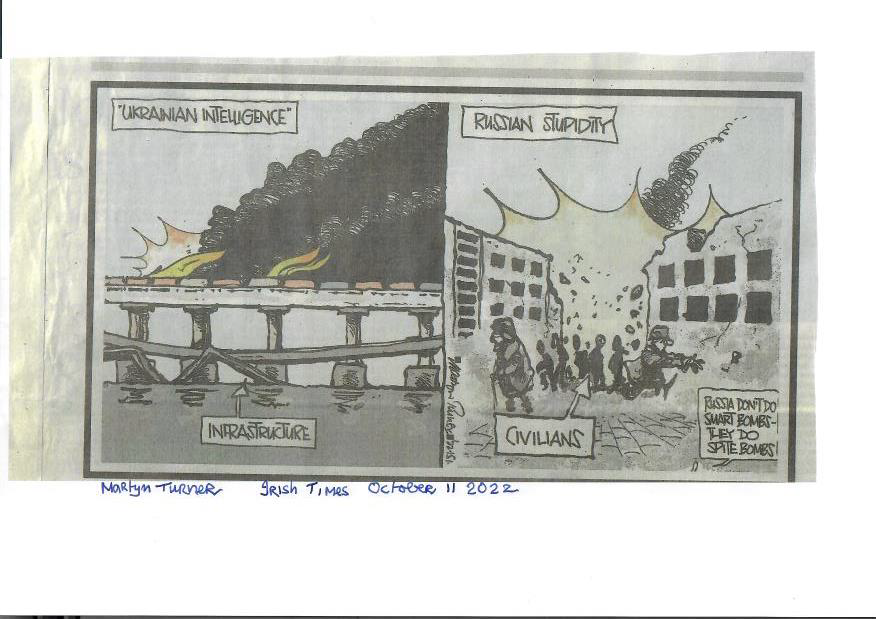

Two correspondents offer observations
Read the rest of this entry »


 Tomás Ó Flatharta