Archive for the ‘1921 Treaty Partitioning Ireland’ Category
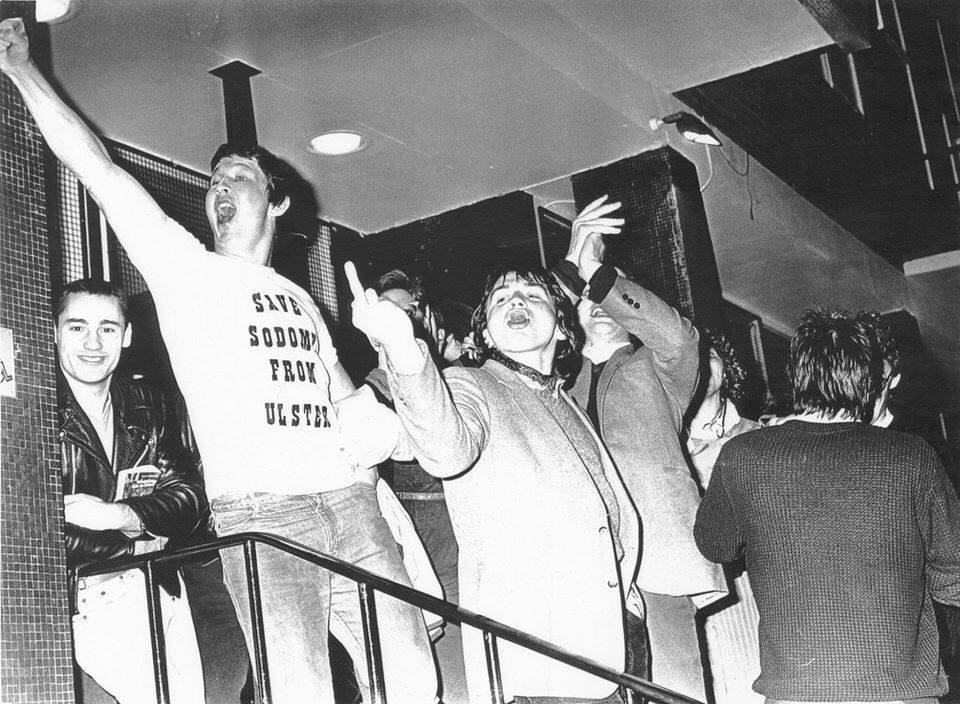
Saving Sodomy from Ulster – Public professions of Christianity frequently mask horrible crimes
Slugger O’Toole is a politically liberal site based in the 6 county bit of Ireland. One of its writers observes :
One of the great lessons in life is that the more someone publicly professes to be a ‘Christian,’ the more unchristian their private life is.
Years ago, I met one of the leading figures in the Save Ulster From Sodomy Campaign. I have a surprisingly good gaydar for a straight guy, and it was pinging off the chart. This guy had spent much of the 70s and 80s persecuting gays while himself being as gay as Eurovision. I felt sorry for him; he was a product of his upbringing. To live your life as a lie and with such self-loathing must be very tiring on the soul.
https://sluggerotoole.com/2024/03/30/public-morality-private-hypocrisy/
The Save Ulster from Sodomy campaign was a vicious anti-gay operation run by the Democratic Unionist party (DUP) and the Reverend Ian Paisley’s Free Presbyterian church. Paisley, a busy man, was leader of the DUP, and moderator of his church.
An effective counter-campaign, Save Sodomy from Ulster, was the brainchild of Tarlach Mac Niallais. Link : CoVid-19 Has Taken Tarlach Mac Niallais From Us in New York – A Courageous Fighter from North Belfast who “Saved Sodomy from Ulster”
In Ireland, Christianity took over public life after the partition settlement of 1922. The Catholic Church controlled key parts of the state in the 26 county southern bit. In the North the Orange State was a Protestant State for a Protestant People.
Read the rest of this entry »Piety and Politics of the Democratic Unionist party in the Six County bit of Ireland – with the fall of Sir Jeffrey Donaldson “It feels like the end of days now”
In his final public sighting as DUP leader, Sir Jeffrey Donaldson was at Stormont for a Christian Easter service.
It was Wednesday evening and there was a feel-good sense in Parliament Buildings. The DUP and Sinn Fein had been working together harmoniously for eight weeks, and now politicians were coming together for an uplifting ecumenical concert.
With Donaldson in the audience, prayers were said for political leaders, and at the end the relaxed DUP leader went to have his photo taken with Eurovision winner Dana, who was singing at the event.
Sir Jeffrey Donaldson MP and his wife Eleanor are scheduled to appear in court on April 24 in connection with serious criminal charges (described below). In the next weeks and months we will see how this story unfolds. The context is important – what effect will this have on the the Democratic Unionist party (DUP) which Mr Donaldson led until Good Friday 2024?
In a context where extreme right forces are on the march in most parts of the world, it is useful to add some Irish cross-border detail to Jeffrey Donaldson’s “final public sighting as DUP leader”. Sir Jeffrey was pleased to pose for a photo with Eurovision winner Dana (Rosemary Scallon) who attempted (and failed) to revive the religious far-right in the 26 County bit of Ireland. In the late 1990’s Scallon had some brief electoral success in a Presidential election, and won a European Parliament seat. However by 2011 Scallon’s political green-devil comet crashed and burned. The extremist Catholic far-right had become deeply unpopular. Most people in Ireland had turned against the Catholic Church, deeply implicated in a succession of child abuse scandals and hatred of pro-feminist causes such as the legalisation of abortion , divorce, same-sex marriage, contraception and gay rights. Shrewder right -wing politicians such as Fine Gael Taoiseach (Prime Minister) Enda Kenny saw the writing on the wall ; In the Dáil (parliament) this leader of the Dublin government stated that the Vatican was responsible for the “torture” of Irish children.
Read the rest of this entry »Background to current Donaldson investigation: Terrible track record of 6 County British state institutions dealing with politically sensitive criminal cases
All need to show unconditional solidarity with the two women who came forward in the rape case which led to Sir Jeffrey Donaldson resigning from the leadership of the Democratic Unionist party in the six-county bit of Ireland.
In the Easter Sunday 2024 edition of the Belfast Sunday Life tabloid Lady Eleanor Donaldson is named as the co-defendant in the Jeffrey Donaldson MP rape case. Jeffrey and Eleanor are a married couple.

Two women came forward to the state authorities with allegations categorised as “historical”. In this context, what does the word “historical” mean, precisely? That is a very important question.
Read the rest of this entry »Sir Jeffrey Donaldson MP, leader of the far-right, homophobic, and misogynistic, Democratic Unionist party (DUP), deletes all his social media accounts – and he is gone!
Sir Jeffrey Donaldson MP, leader of the far-right, homophobic, and misogynistic, Democratic Unionist party (DUP), deletes all his social media accounts
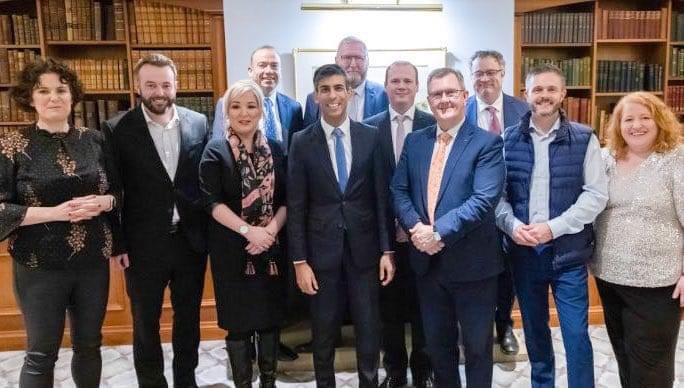
Donaldson’s party runs the recently revived Stormont assembly government in coalition with Sinn Féin and the Alliance Party.
James Connolly
The reliable Slugger O’Toole site reports :
Sir Jeffrey Donaldson deletes all his social media accounts – Slugger O’Toole Report
Thanks also to the Cedar Lounge Revolution
Read the rest of this entry »The March 8 2024 Referendums in Ireland – A few final thoughts – Vote Yes/Yes
A few final thoughts.
An Irish Times letter-writer offers good advice :
“The arguments made against the proposed constitutional amendments are akin to the owner of a 30-year-old banger, which keeps breaking down, refusing a 10-year-old car as a replacement because they were really hoping for a brand-new model.
When the perfect choice is not on offer, reasonable people take the best option available.
Vote Yes on March 8th to consign a few antiquated bangers to the scrapheap, where they belong. – Yours, etc,
JOHN THOMPSON,
Dublin 7.”
A number of left wing activists calling for a No vote in the Care Referendum are making a classic ultra-left mistake. They are not guided by a concrete analysis of the question on the ballot paper. As a result they advocate keeping reactionary, sexist, and partitionist wording in the Irish Constitution.
Read the rest of this entry »The March 8 2024 Care and Family Referendums in Ireland – Which is better : the existing wording or the suggested replacements?
Let’s keep it very simple. These 2 constitutional provisions are symbolic.
The basic information is provided here : Electoral Commission Explanation of Care and Family Referendums in Ireland. We are concentrating on the Care Referendum, as some people on the Irish left are advocating a No vote, meaning that the existing reactionary sexist wording in DeValera’s 1937 Constitution will remain in place.
In any referendum you are only voting on the question you are asked – not on the question you would like to be asked.
Voters should ask themselves : Is the existing wording worse than the proposed changes?
Yes or No?

Any objective left-wing and feminist reading of the relevant texts can only come to one conclusion : The proposed changes are better.
Read the rest of this entry »“Frogs’ legs and lobster Thermidor – or the ABC of republican strategy” – Fearghal Mac Bhloscaidh
Fearghal Mac Bhloscaidh is one of the most interesting political writers in Ireland. The article below is a detailed analysis of Ireland’s peace process, which begins with a speech delivered by Bernadette McAliskey the year before the Good Friday Agreement was signed in 1998. I remember it well. (*)
John Meehan
About the author : Fearghal Mac Bhloscaidh is a Belfast-based historian and the author of a number of important books, including Tyrone: the Irish Revolution, 1912-1923 (Four Courts Press, 2014).

As a young man, I listened to a speech by Bernadette McAliskey the year before the signing of the Good Friday Agreement – the pinnacle of what became known as the ‘peace process’. McAliskey did not object to peace, she had notoriously been subtitled by the BBC in a 1992 interview, when she said: ‘No sane human being supports violence. We are often inevitably cornered into it by powerlessness, by lack of democracy, by lack of willingness of people to listen to our problems. We don’t choose political violence, the powerful force it on us.’ (quoted in Curtis, 1998:297) By the time I heard her speak in 1997, the powerful had arrested her pregnant daughter, Róisín, with the intent to extradite her to Germany. By 2000, the powerful admitted that Róisín, who had never been charged, had no case to answer as there was ‘not a realistic prospect of convicting Miss McAliskey for any offence.’ (Guardian, 20 July 2000). What struck me at the time, was that the powerful had a vendetta against a woman and her family because she had stood up for socialist republican principles for thirty years at that stage. Last month, fifty-five years after the Burntollet march and her subsequent election as the then youngest female Westminster MP ever, McAliskey gave the main oration at the solidarity march in Dublin, where she told the crowd that ‘Palestine is the litmus test of our humanity’ and then urged those present not to vote for any politician who would legitimise the Biden administration, which was ‘enabling genocide’, by attending the St Patrick’s Day events in the White House (Irish News, 14 January 2024).
McAliskey’s speech from all those years ago stuck in my mind because in the questions afterwards she was asked about the peace process and used a powerful analogy that I hadn’t heard before at that stage, but I have heard and used myself on numerous occasions since. She welcomed an end to violence but warned that the provisional movement appeared to be going down a well-worn reformist path that would eventually denude it of any revolutionary potential. She compared the republican movement to a frog, which if placed in a pot of boiling water, will immediately sense the danger, and jump out to save itself, but, if immersed in tepid water brought slowly to the boil so that the change in temperature remains gradual, the frog does not realise it’s boiling to death. In line with their – soon to be – new mates in New Labour, Sinn Féin had swallowed TINA – there is no alternative. Plan A – armed struggle has failed, now we try Plan B. In Sinn Fein’s case, this meant the long march through the institutions, acceptance of the principle of consent and parliamentary reformism on the classical constitutional nationalist model. McAliskey had the temerity to ask for a Plan C, which might mean retaining socialist republican principles and challenging the powerful rather than getting into bed with them.
Read the rest of this entry »The Border Partitioning Ireland – Credible opinion polls, Brexit, and Perfidious Albion
A new credible opinion poll in the six county bit of Ireland states the following :
This matters, because under the terms of the 1998 Good Friday Agreement (GFA), if a six county (Northern Ireland) referendum results in a pro United Ireland majority, partition will be dead.
There is no reason to doubt the accuracy of this survey – it is consistent with many other recent opinion polls.
Under the GFA, the NI Secretary of State (currently Chris Heaton-Harris) has the power to call a referendum. This Westminster minister is not obliged to call a referendum unless a series of surveys indicate that a majority of voters in the six county statelet (NI) will vote for a change in the constitutional status.
This was a perfect arrangement for the Dublin and London governments in 1998 – a big majority of the people living in Ireland (on both sides of the border) voted to accept a Unionist Veto. No real prospect of a shift in attitudes seemed possible. But something big happened in 2016 which is having long-term results : Brexit.
Read the rest of this entry »


 Tomás Ó Flatharta