Archive for the ‘Catholic Church’ Category
Birds of a Feather Flock Together – Vladimir Putin, Donald Trump, Nigel Farage and Sammy Wilson MP (DUP, East Antrim)
There is more to this story than initially meets the eye. Much capitalist development is based on Ethnic Cleansing of original populations and the plantation of new non-indigenous populations – it happened in the United States of America (USA) and Australia – naming just two. It did not happen so brutally in Ireland – but British imperialism made a significant effort.
Links :
Plantation of Ulster
Ethnic Cleansing of Ireland – Wikipedia
The Northern province of Ulster was “planted” in the 1600’s, but the native Irish were not completely exterminated. Waves of native Irish emigrated – especially in the 19th century after a misnamed Famine (in reality a “Great Hunger” caused by British Imperialist Policy) drove millions of the native Irish to the four corners of the globe. These emigrants kept alive the idea of Irish freedom, and played a significant role in every attempt to rid Ireland of British rule.
The stubborn Irish “national question” remains on today’s agenda because of the 1922 Anglo-Irish Treaty which divided Ireland into 2 sectarian states. A key feature of extreme Irish Unionism is identification with plantation/ethnic cleansing forms of capitalism – and that goes a long way towards explaining Irish far-right Unionist sympathy for the present day attempted ethnic cleansing of Palestine and Ukraine. We should situate recent pro-Putin and anti-Ukraine statements by the British far-right politician Nigel Farage and Sammy Wilson within this framework :

Link :
The Russian imperialist occupation of Crimea, Luhansk and Donetsk is ethnic cleansing capitalism in action – accompanied by child stealing and abuse similar to the behaviour of the Catholic Church in the 26 county bit of Ireland from the 1930’s to the 1990’s.
An excellent Ukrainian blog, Ukr-Taz, covers the story of Putin’s ethnic cleansing dreams in Ukraine, and Donald Trump’s enthusiastic support :
Trump on Putin’s “dream”
29 06 2024
For all that can be said about Thursday’s debate between Joe Biden and Donald Trump — including about the former’s dismal performance and about the boundless creativity of Trump’s fabrications on almost every topic under the sun — Trump’s curious note about Putin’s “dream” stood out to me:
Read the rest of this entry »Rory Hearne accuses Ciaran Mullooly of ‘hypocrisy’ in scathing attack on the “Independent Ireland” racist party – a wolf in Blueshirt clothes
This is an Irish Independent Story, June 3 2024.
A few ex Fianna Fáil and Fine Gael Dáil Deputies formed Independent Ireland (IIP) recently, led by a man with a famous name, Michael Collins TD (Cork South-West). The 1922 pro-treaty inheritors of the dead Michael Collins legacy went on to establish the failed fascist Blueshirts in the 1930’s led by Fine Gael’s first president Eoin O’Duffy.
The IIP is running two well known broadcasters (Ciarán Mullooly and Niall Boylan) in the European elections.
Social Democrat Euro-Parliament candidate Rory Hearne presents a convincing left-wing anti-racist case against the IIP wolf in Blueshirt clothes.
Rory Hearne accuses Ciaran Mullooly of ‘hypocrisy’ in scathing attack on Independent Ireland
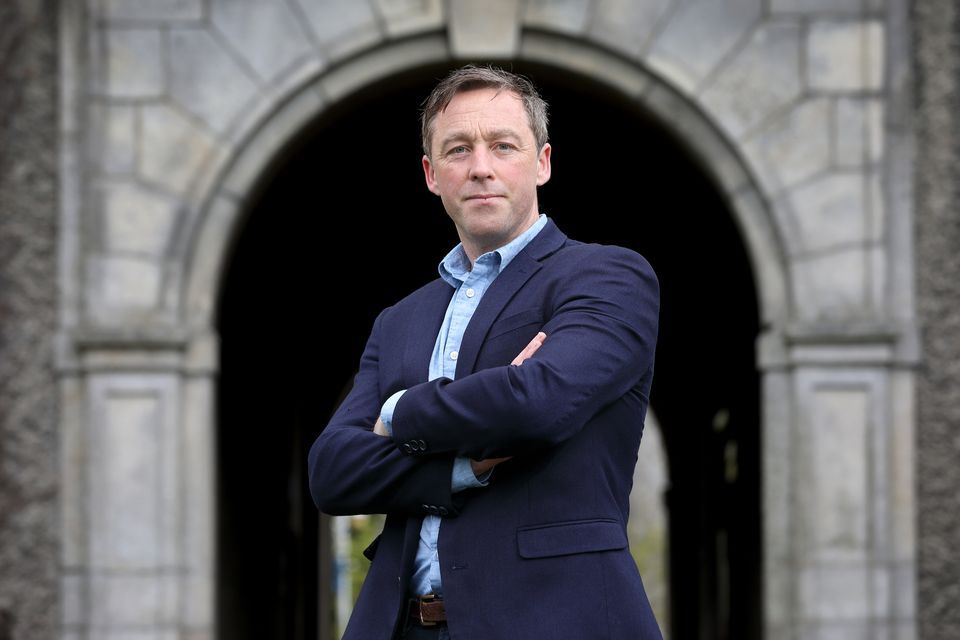
“Why won’t Mullooly and others call for tougher action against the real causes of the housing and homelessness crisis – the vulture funds and corporate landlords locking people out of a home, evicting people and raising the rents?”
Mr Hearn said Independent Ireland offers “no solutions” for the problems that have been caused due to a lack of accommodation.
“The election next week will set the course of Ireland and Europe for many years to come. Are we to turn into a divided society?
“Or are we going to come together and address the real causes of the crises, work on solutions together, and treat migrants and asylum-seekers with the dignity every human being deserves, and see migrants for how they positively contribute to and enrich our country.”
Read the rest of this entry »Robert Ballagh’s “The Thirtieth of January”: A Bloody Sunday Painting and the Troubles in the Two Bits of Ireland
In this interview the artist Robert Ballagh discusses the painting “The Thirtieth of January”, depicting Bloody Sunday in Derry in 1972. The conversation provides valuable insights into Ballagh’s personal experiences and artistic process, shedding light on the political and social context of the time.
The interview provides a unique insight into the historical and cultural significance of the painting.
Critical issues related to the Irish government’s response to the conflict, the impact of the Bloody Sunday event, and the broader social and political implications are highlighted. Ballagh’s commentary on the role of the Irish government, the impact on nationalist communities, and the establishment of the Special Criminal Court adds depth to the discussion.
Bloody Sunday Painting – the Thirtieth of January – Robert Ballagh
Thursday, January 20 2022. John Meehan interviews the artist Robert Ballagh in Number Five Arbour Hill.
We are talking about Robert’s painting : The Thirtieth of January, a representation of Bloody Sunday in Derry, January 30 1972.
John Meehan :
Why did you zone in on Derry’s Bloody Sunday , and put so much effort into making this painting? What makes it different from so many other big events during “The Troubles” in the north of Ireland, which lasted for 30 years, from 1968 to 1998?
Robert Ballagh
Well, it’s a long time ago now 50 years, but I have to say that it had an enormous effect on me, and I don’t think I’m alone with that historical experience. I suppose one thing I should say, I was only thinking about this, and I haven’t said anything about this experience to others. I’m a Dubliner. I’ve lived all my life in Dublin. But unlike most Dubliners – it wasn’t by design – I had an extraordinary rich knowledge of the North of Ireland, before the conflict began. Because I was a professional musician in a showband. We used to play at least once or twice a week in the north. So I was in every town village or city in the north that had a ballroom or ballrooms. And so I experienced the reality of life in that society, and became very aware of the sectarian differences, shall we say – the nature of the society, which people didn’t appreciate at all. I tell one very short story to illustrate that. We played fairly regularly in one of the very popular ballrooms in Belfast : Romano’s in Queen Street. We developed quite a following! In the show business vernacular the word groupie was used. These girls used follow us, they came down to Dublin once or twice to hear us. And we were playing one night in Romano’s.

After the dance, they came up and we’re talking to us. They asked “When are you playing again in Belfast?”.
I remember saying “Oh, I think we’re here next week.”
“Oh, really?”
“Yeah – we’re playing in a ballroom called the Astor” which I knew was in Smithfield.
And they said, “Oh, we can’t go there.” And I said, “Why?” – because it was a public ballroom. It wasn’t attached to any organization or anything. It was a public ballroom.
They said, “Oh, no, that’s a taig hall”
And it was the first time I realized, and we realized, that our fan base in Belfast was Protestant.
Saving Sodomy from Ulster – Public professions of Christianity frequently mask horrible crimes
Slugger O’Toole is a politically liberal site based in the 6 county bit of Ireland. One of its writers observes :
One of the great lessons in life is that the more someone publicly professes to be a ‘Christian,’ the more unchristian their private life is.
Years ago, I met one of the leading figures in the Save Ulster From Sodomy Campaign. I have a surprisingly good gaydar for a straight guy, and it was pinging off the chart. This guy had spent much of the 70s and 80s persecuting gays while himself being as gay as Eurovision. I felt sorry for him; he was a product of his upbringing. To live your life as a lie and with such self-loathing must be very tiring on the soul.
https://sluggerotoole.com/2024/03/30/public-morality-private-hypocrisy/
The Save Ulster from Sodomy campaign was a vicious anti-gay operation run by the Democratic Unionist party (DUP) and the Reverend Ian Paisley’s Free Presbyterian church. Paisley, a busy man, was leader of the DUP, and moderator of his church.
An effective counter-campaign, Save Sodomy from Ulster, was the brainchild of Tarlach Mac Niallais. Link : CoVid-19 Has Taken Tarlach Mac Niallais From Us in New York – A Courageous Fighter from North Belfast who “Saved Sodomy from Ulster”
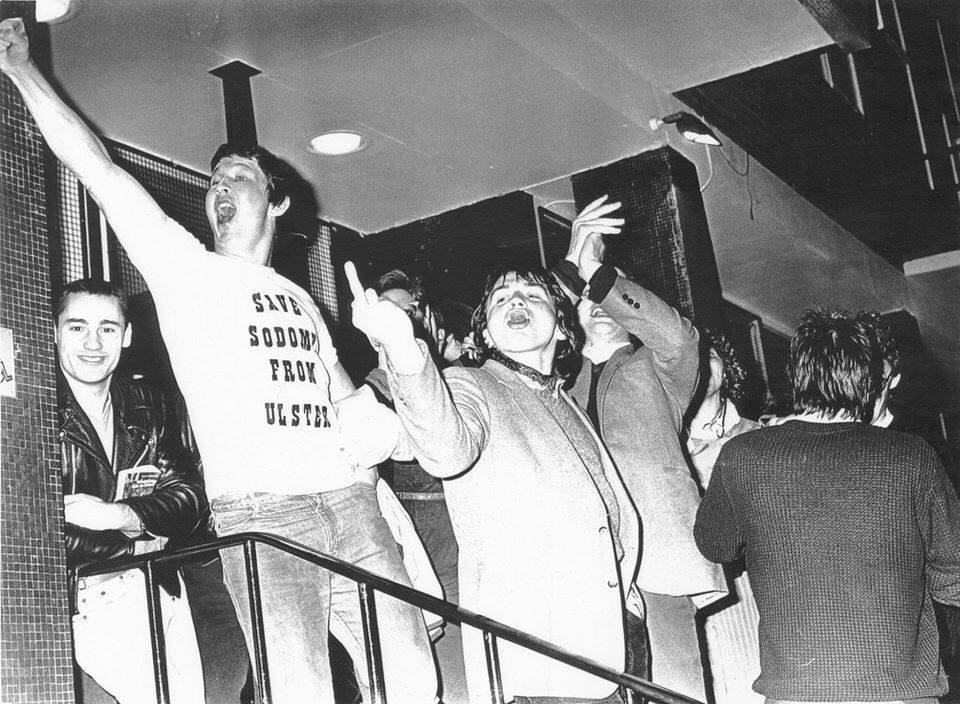
In Ireland, Christianity took over public life after the partition settlement of 1922. The Catholic Church controlled key parts of the state in the 26 county southern bit. In the North the Orange State was a Protestant State for a Protestant People.
Read the rest of this entry »Piety and Politics of the Democratic Unionist party in the Six County bit of Ireland – with the fall of Sir Jeffrey Donaldson “It feels like the end of days now”
In his final public sighting as DUP leader, Sir Jeffrey Donaldson was at Stormont for a Christian Easter service.
It was Wednesday evening and there was a feel-good sense in Parliament Buildings. The DUP and Sinn Fein had been working together harmoniously for eight weeks, and now politicians were coming together for an uplifting ecumenical concert.
With Donaldson in the audience, prayers were said for political leaders, and at the end the relaxed DUP leader went to have his photo taken with Eurovision winner Dana, who was singing at the event.
Sir Jeffrey Donaldson MP and his wife Eleanor are scheduled to appear in court on April 24 in connection with serious criminal charges (described below). In the next weeks and months we will see how this story unfolds. The context is important – what effect will this have on the the Democratic Unionist party (DUP) which Mr Donaldson led until Good Friday 2024?
In a context where extreme right forces are on the march in most parts of the world, it is useful to add some Irish cross-border detail to Jeffrey Donaldson’s “final public sighting as DUP leader”. Sir Jeffrey was pleased to pose for a photo with Eurovision winner Dana (Rosemary Scallon) who attempted (and failed) to revive the religious far-right in the 26 County bit of Ireland. In the late 1990’s Scallon had some brief electoral success in a Presidential election, and won a European Parliament seat. However by 2011 Scallon’s political green-devil comet crashed and burned. The extremist Catholic far-right had become deeply unpopular. Most people in Ireland had turned against the Catholic Church, deeply implicated in a succession of child abuse scandals and hatred of pro-feminist causes such as the legalisation of abortion , divorce, same-sex marriage, contraception and gay rights. Shrewder right -wing politicians such as Fine Gael Taoiseach (Prime Minister) Enda Kenny saw the writing on the wall ; In the Dáil (parliament) this leader of the Dublin government stated that the Vatican was responsible for the “torture” of Irish children.
Read the rest of this entry »
The March 8 2024 Referendums in Ireland – A few final thoughts – Vote Yes/Yes
A few final thoughts.
An Irish Times letter-writer offers good advice :
“The arguments made against the proposed constitutional amendments are akin to the owner of a 30-year-old banger, which keeps breaking down, refusing a 10-year-old car as a replacement because they were really hoping for a brand-new model.
When the perfect choice is not on offer, reasonable people take the best option available.
Vote Yes on March 8th to consign a few antiquated bangers to the scrapheap, where they belong. – Yours, etc,
JOHN THOMPSON,
Dublin 7.”
A number of left wing activists calling for a No vote in the Care Referendum are making a classic ultra-left mistake. They are not guided by a concrete analysis of the question on the ballot paper. As a result they advocate keeping reactionary, sexist, and partitionist wording in the Irish Constitution.
Read the rest of this entry »The March 8 2024 Care and Family Referendums in Ireland – Which is better : the existing wording or the suggested replacements?
Let’s keep it very simple. These 2 constitutional provisions are symbolic.
The basic information is provided here : Electoral Commission Explanation of Care and Family Referendums in Ireland. We are concentrating on the Care Referendum, as some people on the Irish left are advocating a No vote, meaning that the existing reactionary sexist wording in DeValera’s 1937 Constitution will remain in place.
In any referendum you are only voting on the question you are asked – not on the question you would like to be asked.
Voters should ask themselves : Is the existing wording worse than the proposed changes?
Yes or No?

Any objective left-wing and feminist reading of the relevant texts can only come to one conclusion : The proposed changes are better.
Read the rest of this entry »According to Ireland’s constitution, a woman’s duties are in the home – but a referendum could be about to change its sexist wording
Eamon DeValera’s 1937 Irish Constitution contains symbolic sexist wording – the “woman in the home” clause. Laura Cahillane explains why almost everyone on the Irish and feminist left is advocating a Yes vote.
Laura Cahillane, University of Limerick
On March 8 – International Women’s Day – Irish citizens will vote in a referendum on whether or not to replace the so-called “woman in the home” clause in the Irish constitution.
This clause, which dates from 1937, specifies that: “The State recognises that by her life within the home, woman gives to the State a support without which the common good cannot be achieved.” It goes on to say that: “The State shall, therefore, endeavour to ensure that mothers shall not be obliged by economic necessity to engage in labour to the neglect of their duties in the home.”
Originally, the purpose of the provision was to acknowledge the importance of care in the home, which was then provided almost exclusively by mothers. The purpose was to ensure that mothers could remain in the home and would not be forced to work due to financial reasons.
However, the state help implied by the wording was never actually put into practice – women were never supported to provide care in the home. Worse, the constitution was often used to bolster arguments that a woman’s place was in the home and that policies which excluded women from work were acceptable.
Now, as part of a double referendum, Irish citizens will have the chance to change the constitution to a more gender-neutral wording. This is alongside another vote on whether to change the constitution’s definition of “family” to expand it beyond marriage.
Read the rest of this entry »


 Tomás Ó Flatharta