Let’s have a little fun regarding the nomination campaign of the conservative far-right, anti-choice and racist candidate Maria Steen; Steen is a veteran or Ireland’s anti-choice movement; readers can stay up-to-date here :
“Independent Ireland is expected to make a decision tomorrow or Wednesday morning.
Their decision could influence whether other TDs or senators – rumoured to include a small number on the conservative wing of Fianna Fáil – would lend her their vote before the presidential nomination deadline of noon on Wednesday.” (RTÉ News Report).
The entire Fianna Fáil organisation is conservative – although occasionally it makes gestures towards the left. Between 2011 and 2018 the party leadership realised it had to dump a too close association with Catholic Church anti-feminism and the vile crime of institutional child abuse. It is continuing this tactic by nominating the high-profile Gaelic Athletic Association (GAA) figure Jim Gavin to be President of Ireland. Gavin states he is pro-choice, pro same-sex marriage, and voted to lift the constitutional ban on abortion in 2018. These statements make him totally unacceptable to the Irish far-right, which includes Maria Steen and the Aontú party led by ex Sinn Féin TD Peader Tóibín, who is in charge of the Maria Steen bingo card. It is a racing certainty Steen will be on the presidential ballot – she has the nominations of 13 or 14 Oireachtas members plus 4 from the Irish Independent party.
Deepest condolences to all Cathleen’s family, friends, feminists, socialists, community activists and neighbours. She was a true warrior for all sorts of progressive causes. a very inclusive person, good singer, and unafraid to speak very plainly and politely when it was necessary. She was great company. There are great memories. She helped make Kilbarrack Dublin and Ireland a better place, especially for women. John Meehan
I first met Cathleen in the mid 1980’s via her great friends Joe Kelly and Therese Caherty.
Here are a few memories
23 People launched The Alliance for a No Vote (ANV), October 6 2001 in Dublin. Ivana Bacik, a Trinity College Dublin (TCD) Law Professor, introduced the discussion. ANV spokespersons included Sinéad Ní Chúalacháin, Catherine Naji and Cathleen O’Neill.
Founding organisations :
Irish Family Planning Association; Irish Council for Civil Liberties Women’s Sub-Committee; Lawyers for Choice; Cork Women’s Right to Choose Group; Dublin Abortion Rights Group; Women’s Education Research & Resource Centre, UCD; Pro Choice Campaign; Socialist Party; Workers’ Solidarity Movement.
Bertie Ahern’s government tried to sneak in an anti-choice amendment to the Irish constitution overturning a 1992 Supreme Court decision which made abortion in Ireland legal in certain circumstances – the X Case Judgement. The pro-choice side won.
A friend has begun vital work – examination of the 2025 FFFGBG Programme for Government, which contains lots of measures these parties did not propose during the recent general election campaign.
Alarming things
The programme for government has a few alarming things in it – (and the government has a few alarming people in it) eg there’s lots of commitment to reduce carbon emissions alongside actions and plans that will directly increase carbon emissions. There’s a bunch of mangled science around the particular characteristics of methane and it’s basically a valentine card to those involved in data center construction.
Shutting people up over Israel’s genocide
It also has a commitment to recognise a particular and highly contested definition of anti- semitism which would help those who want us to shut up about Israel’s genocide and occupation – and which was as far as I can remember not part of any single party or politician’s election platform. It would be very interesting to find out how and from where and on whose request this made it into the programme.
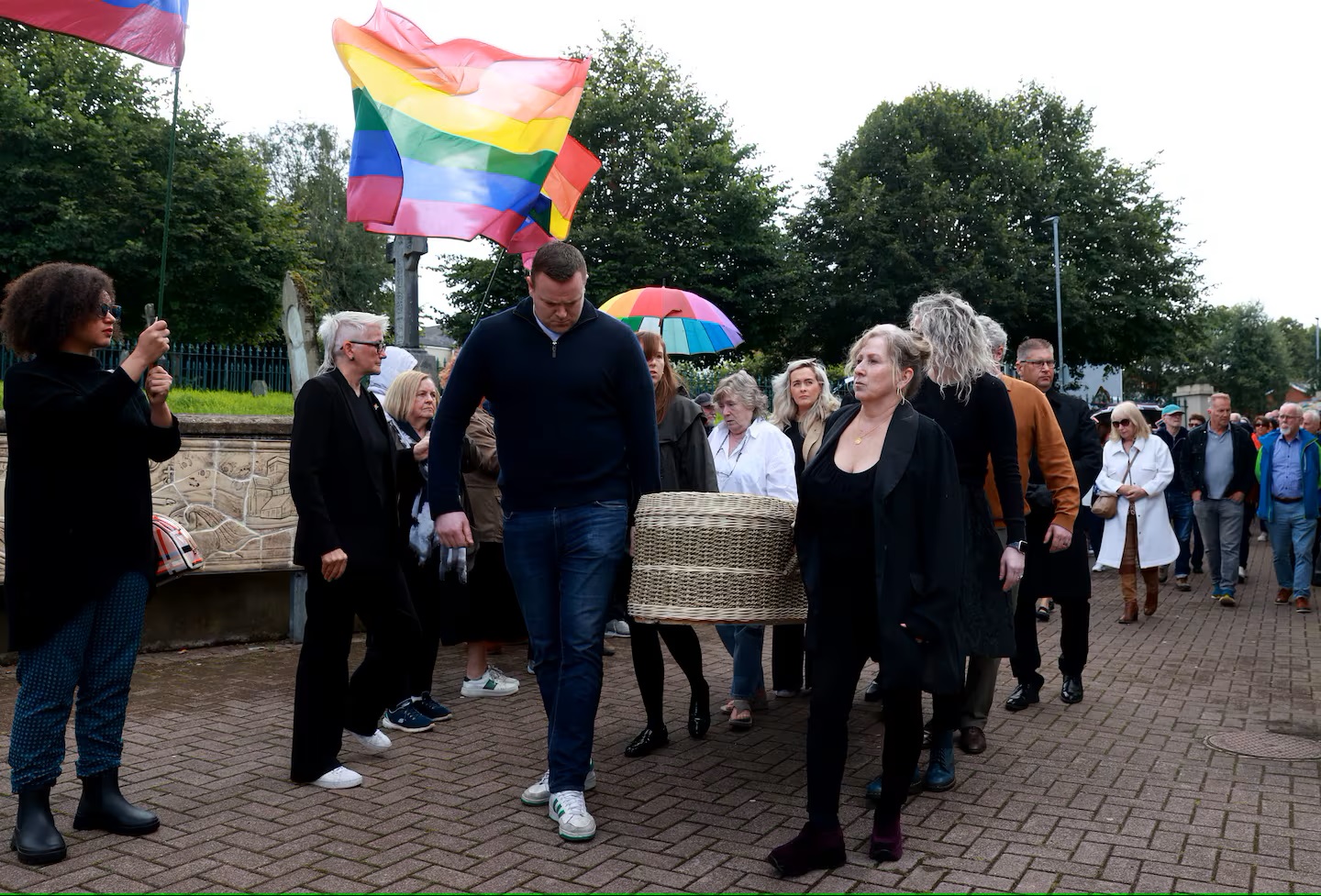
Many people who knew Nell McCafferty could not get to her funeral in St. Columb’s Cathedral, Derry. An alternative was offered on RIP.IE – a live broadcast starting at 12.30pm. When interested viewers tuned in, they were mystified, seeing only a blank screen. The livestream did not start until after 1.00pm, as a priest shared the altar with three men conducting a religious ceremony containing no stories about one of Derry’s most talented writers, Nell McCafferty. At one screening venue a small group of Nell’s fans – including Máirín Johnson who travelled on the legendary Dublin-Belfast contraceptive train with Nell in 1971 – were not impressed. We learned later that Eamonn McCann delivered a eulogy in front of the altar – A report is below. Source : Nell McCafferty “Changed Ireland for the Better”
Eamonn McCann delivers a eulogy for Nell McCafferty, St Columb’s Cathedral Derry, August 23 2024
Nell McCafferty ‘changed Ireland for the better’, mourners at her funeral in Derry’s Bogside told
Campaigning journalist and author, who focused on women’s rights, poverty and social injustice, died on Wednesday aged 80
Nell McCafferty “changed Ireland for the better”, mourners at her funeral have been told.
Delivering an elegy in advance of her funeral Mass in Derry’s Bogside on Friday, the veteran civil rights campaigner and journalist Eamonn McCann said it was “given to very few of us to actually change the world”.
“Nell”, she called her autobiography, and that was how she was known.
Hold the Front Page – Nell has a story – Irish Times August 22 2024
Small, fierce and feisty. That mop of curls, the waft of cigarette smoke, the tongue in cheek smile and her distinctive walk, like a sailor ashore. Everyone soon knew her smoky Derry voice, laconic, challenging, always ready to break into laughter. You never knew what Nell was going to say next. It was often outrageous. She was a character, and she loved to play herself to the hilt. She was also one of the most important Irish journalists of the latter half of the twentieth century. She listened. She paid attention. She told the truth.
She was, wrote her friend, the historian Margaret Mac Curtain, “unequalled in the extraordinary breadth and fearless candour she has brought to bear on controversial subjects.” Her journalistic career started in The Irish Times in 1970, when the paper’s late Northern editor and editor, Fergus Pyle, commissioned her to write about the new bathroom in her family home in Beechwood Street in Derry’s Bogside.
Home was her touchstone. She vaunted her street-cred. She was part of a Bogside aristocracy that included Martin McGuinness, Eamonn McCann, Seamus Deane, Paddy Doherty, John Hume, Dana and Phil Coulter. Her mother was her biggest fan and harshest critic.
McCafferty was born in 1944. Her father, Hugh, was a clerk for the British admiralty by day and a bookie’s clerk at the dog track at night. Her mother, Lily, reared six children. Another daughter died at birth.
Her parents had to work hard to keep poverty at bay. She was fascinated and frightened by the poverty of the tenements where her father was raised. One of his brothers had died as a British soldier at the Somme. Her mother’s parents were Sergeant Duffy, a Catholic RUC man, and his wife Sarah, a Protestant who “turned”.
In this interview the artist Robert Ballagh discusses the painting “The Thirtieth of January”, depicting Bloody Sunday in Derry in 1972. The conversation provides valuable insights into Ballagh’s personal experiences and artistic process, shedding light on the political and social context of the time.
The interview provides a unique insight into the historical and cultural significance of the painting.
Critical issues related to the Irish government’s response to the conflict, the impact of the Bloody Sunday event, and the broader social and political implications are highlighted. Ballagh’s commentary on the role of the Irish government, the impact on nationalist communities, and the establishment of the Special Criminal Court adds depth to the discussion.
Bloody Sunday Painting – the Thirtieth of January – Robert Ballagh
Thursday, January 20 2022. John Meehan interviews the artist Robert Ballagh in Number Five Arbour Hill.
We are talking about Robert’s painting : The Thirtieth of January, a representation of Bloody Sunday in Derry, January 30 1972.
John Meehan :
Why did you zone in on Derry’s Bloody Sunday , and put so much effort into making this painting? What makes it different from so many other big events during “The Troubles” in the north of Ireland, which lasted for 30 years, from 1968 to 1998?
Robert Ballagh
Well, it’s a long time ago now 50 years, but I have to say that it had an enormous effect on me, and I don’t think I’m alone with that historical experience. I suppose one thing I should say, I was only thinking about this, and I haven’t said anything about this experience to others. I’m a Dubliner. I’ve lived all my life in Dublin. But unlike most Dubliners – it wasn’t by design – I had an extraordinary rich knowledge of the North of Ireland, before the conflict began. Because I was a professional musician in a showband. We used to play at least once or twice a week in the north. So I was in every town village or city in the north that had a ballroom or ballrooms. And so I experienced the reality of life in that society, and became very aware of the sectarian differences, shall we say – the nature of the society, which people didn’t appreciate at all. I tell one very short story to illustrate that. We played fairly regularly in one of the very popular ballrooms in Belfast : Romano’s in Queen Street. We developed quite a following! In the show business vernacular the word groupie was used. These girls used follow us, they came down to Dublin once or twice to hear us. And we were playing one night in Romano’s.
Robert Ballagh’s “The Thirtieth of January”
After the dance, they came up and we’re talking to us. They asked “When are you playing again in Belfast?”. I remember saying “Oh, I think we’re here next week.” “Oh, really?” “Yeah – we’re playing in a ballroom called the Astor” which I knew was in Smithfield. And they said, “Oh, we can’t go there.” And I said, “Why?” – because it was a public ballroom. It wasn’t attached to any organization or anything. It was a public ballroom. They said, “Oh, no, that’s a taig hall” And it was the first time I realized, and we realized, that our fan base in Belfast was Protestant.
In his final public sighting as DUP leader, Sir Jeffrey Donaldson was at Stormont for a Christian Easter service. It was Wednesday evening and there was a feel-good sense in Parliament Buildings. The DUP and Sinn Fein had been working together harmoniously for eight weeks, and now politicians were coming together for an uplifting ecumenical concert. With Donaldson in the audience, prayers were said for political leaders, and at the end the relaxed DUP leader went to have his photo taken with Eurovision winner Dana, who was singing at the event.
Sir Jeffrey Donaldson MP and his wife Eleanor are scheduled to appear in court on April 24 in connection with serious criminal charges (described below). In the next weeks and months we will see how this story unfolds. The context is important – what effect will this have on the the Democratic Unionist party (DUP) which Mr Donaldson led until Good Friday 2024?
In a context where extreme right forces are on the march in most parts of the world, it is useful to add some Irish cross-border detail to Jeffrey Donaldson’s “final public sighting as DUP leader”. Sir Jeffrey was pleased to pose for a photo with Eurovision winner Dana (Rosemary Scallon) who attempted (and failed) to revive the religious far-right in the 26 County bit of Ireland. In the late 1990’s Scallon had some brief electoral success in a Presidential election, and won a European Parliament seat. However by 2011 Scallon’s political green-devil comet crashed and burned. The extremist Catholic far-right had become deeply unpopular. Most people in Ireland had turned against the Catholic Church, deeply implicated in a succession of child abuse scandals and hatred of pro-feminist causes such as the legalisation of abortion , divorce, same-sex marriage, contraception and gay rights. Shrewder right -wing politicians such as Fine Gael Taoiseach (Prime Minister) Enda Kenny saw the writing on the wall ; In the Dáil (parliament) this leader of the Dublin government stated that the Vatican was responsible for the “torture” of Irish children.
The far right and conservative Catholics claimed credit for the outcome but so have progressive disability rights and carers’ activists. So who is right? Was this a victory for reactionary or progressive ideas, or is the truth more complicated?
On International Women’s Day, Friday 8th of March, voters in the Republic of Ireland delivered two of the largest defeats in history for referendums put forward by the government. The Family referendum, which proposed extending the constitutional definition of the family to include families based on other “durable relationships” as well as marriage, was rejected by a margin of 68% to 32%. The Care referendum, which proposed replacing a sexist clause in the Constitution about women’s “duties in the home” with a gender-neutral clause pledging the state to “strive” to support family care, was defeated by a record 74% to 26%. Both referendums had been backed by the ruling Fine Gael-Fianna Fáil- Green Party coalition and supported, to varying degrees, by all the major opposition parties. The far right and conservative Catholics claimed credit for the outcome but so have progressive disability rights and carers’ activists. So who is right? Was this a victory for reactionary or progressive ideas, or is the truth more complicated?
Polling data shows that the Family Referendum was rejected by a significantly higher margin in rural areas, ranging from 80% in Donegal to 61% across Dublin. There was less of a clear urban-rural pattern with the Care Referendum but in Dublin, No votes were higher in working class than middle class constituencies for both referendums. An exit poll found that the majority of Fianna Fáil, Sinn Féin and (mostly right wing) Independent voters voted no to both referendums; Fine Gael, Green Party and Labour voters voted Yes-Yes and most People Before Profit and Social Democrat voters voted Yes to the Family referendum but No to the Care referendum. The 6% difference between the No votes in the two referendums suggests that around 6% of voters voted Yes to the Family Referendum and No to the Care Referendum. This compares to 68% of voters who voted No-No and 26% who voted Yes-Yes.
“The arguments made against the proposed constitutional amendments are akin to the owner of a 30-year-old banger, which keeps breaking down, refusing a 10-year-old car as a replacement because they were really hoping for a brand-new model.
When the perfect choice is not on offer, reasonable people take the best option available.
Vote Yes on March 8th to consign a few antiquated bangers to the scrapheap, where they belong. – Yours, etc,
JOHN THOMPSON,
Dublin 7.”
A number of left wing activists calling for a No vote in the Care Referendum are making a classic ultra-left mistake. They are not guided by a concrete analysis of the question on the ballot paper. As a result they advocate keeping reactionary, sexist, and partitionist wording in the Irish Constitution.
Eamon DeValera’s 1937 Irish Constitution contains symbolic sexist wording – the “woman in the home” clause. Laura Cahillane explains why almost everyone on the Irish and feminist left is advocating a Yes vote.
On March 8 – International Women’s Day – Irish citizens will vote in a referendum on whether or not to replace the so-called “woman in the home” clause in the Irish constitution.
This clause, which dates from 1937, specifies that: “The State recognises that by her life within the home, woman gives to the State a support without which the common good cannot be achieved.” It goes on to say that: “The State shall, therefore, endeavour to ensure that mothers shall not be obliged by economic necessity to engage in labour to the neglect of their duties in the home.”
Originally, the purpose of the provision was to acknowledge the importance of care in the home, which was then provided almost exclusively by mothers. The purpose was to ensure that mothers could remain in the home and would not be forced to work due to financial reasons.
However, the state help implied by the wording was never actually put into practice – women were never supported to provide care in the home. Worse, the constitution was often used to bolster arguments that a woman’s place was in the home and that policies which excluded women from work were acceptable.
Now, as part of a double referendum, Irish citizens will have the chance to change the constitution to a more gender-neutral wording. This is alongside another vote on whether to change the constitution’s definition of “family” to expand it beyond marriage.



 Tomás Ó Flatharta