Posts Tagged ‘Racism’
Sinn Féin Election Disaster – The Price Of Putting Popularity Before Principle – Éirigí Analysis
Éirigí, a socialist-republican organisation, “is a political party that was formed in 2006 by a group of Dublin-based community and political activists. We believe that modern Ireland is a deeply undemocratic, unequal and unfair country not by accident, but by design.” Their analysis of Sinn Féin’s unexpectedly weak showing in the June 7 2024 Irish Local and European Elections highlights how the party was bounced into changing its position on immigration and racism :
With a few notable exceptions, this new talking point was propagated without context – with no detailed critique of migration in the modern world – no attempt to explain why the asylum process is in chaos – no robust defence of the core republican principle of equality – no assertion that racism, sectarianism and xenophobia are the enemies of republicanism – no calling out the peddling of hate and division by the far-right.
For potential Sinn Féin voters, the lesson was clear. The party could be bounced into changing its messaging if there were votes at stake, even when those doing the bouncing were far-right bigots. It seems almost certain that the ease with which Sinn Féin was bounced on the issue of immigration did them more electoral damage than their actual position on immigration.
Sinn Féin Election Disaster – The Price Of Putting Popularity Before Principle
Link :
Sinn Féin Election Disaster – The Price Of Putting Popularity Before Principle – Éirigí analysis
Two weeks have now passed since the Local and European elections in the Twenty-Six Counties. Despite Sinn Féin’s frantic spinning to the contrary, the election was nothing short of an unmitigated disaster for the party. The number of votes and seats secured by the party was even lower than the lowest expectations of pollsters, political commentators and Sinn Féin itself.
As recently as July 2022, support for Sinn Féin was at a level not seen in more than a century. The Irish Times/IPSOS opinion poll for that month found that 36% of voters in the Twenty-Six Counties intended to vote for Sinn Féin.

Fourteen months later, in September 2023, the same poll found that 34% still intended to vote for Sinn Féin. Among voters under the age of 34, support was even higher at more than 43%. Despite this, Sinn Féin secured less than 12% of the popular vote in the 2024 Local and European elections.
So, why have two-thirds of Sinn Féin supporters abandoned the party since last September?
Prior to elections the apparent answer to this question seemed obvious to many – immigration. Immigration, it was claimed, had recently become a red-hot issue for many Sinn Féin supporters., and these supporters were now walking away from Sinn Féin in their droves because the party was too ‘soft’ on immigration. It was an open and shut case. Until it wasn’t.
When the ballot boxes were opened on this day two weeks ago, it quickly became clear that the opinion polls had significantly underestimated the scale of Sinn Féin’s woes.
Read the rest of this entry »How well did the left go in the June 9 European election? – by Dick Nichols, Green Left (Australia)
A recommended article :
Source ;
How well did the left go in the June 9 European Election?
How well did the left go in the June 9 European election?

Provisional results of the 2024 European Elections, as at June 19. Source: results.elections.europa.eu
At first glance it looks as if the parties to the left of the social democracy held their ground against the surge of the far right and mainstream right that marked the June 9 European Union (EU) parliamentary elections (see here for results in detail).
Although the smallest of the European parliament’s seven groups, The Left managed to maintain its EU-wide vote at 5.4% and increase its seat tally from 37 to 39 in the 720-seat assembly.
In addition, left green Members of the European Parliaments (MEPs) and those representing stateless nations (part of the Greens group as the European Free Alliance) at least maintained their numbers in the chamber.
See also
Finland: Mass workers’ strike wave continues against gov’t attacks on workers, unions, welfare
Interview: Fascism and resistance in France today
Ukrainian unionists: Oligarchs, not Europe’s poor, should pay for weapons and aid to Ukraine
Workers’ Party of Belgium gains ground in European, national elections
Yet the Greens group as a whole shrank from 71 seats to 53 while that of the liberals (known as Renew) fell from 102 to 79. This drop reflected that the environmental issues that in part drove the big advance of these parties in the 2019 election were less important for many voters this time.
The campaign was dominated by insecurity about the future, the cost of living (particularly housing), the fear of war, the “immigration threat” and intolerance of difference.
In this grim atmosphere the biggest growth went to the mainstream right European People’s Party and the two far-right groups (Identity and Democracy and Conservatives and Reformists): taken together the right and far right won an extra 30 seats, bring it to 324.
Because it would take only 37 ungrouped MEPs to join them to from a reactionary majority, the June 9 result poses with new urgency two old questions about politics in the European parliament. How much, if at all, does the real balance of political forces in the chamber differ from that among its formal groupings? And how much does membership of a group represent disciplined commitment to its positions?
Left divisions over Ukraine
The questions are sharply relevant in the case of the Left group, where differences over what stance to take towards the Russian invasion of Ukraine were already pointing towards a split before June 9.
On May 31, Li Andersson, chairperson of the Finnish Left Alliance told the Helsinki Times that these differences could not be tolerated in the group in the new legislature. Referring to Clare Daly and Mick Wallace, Irish left independent opponents of military aid to Ukraine, Andersson said: “The Nordic Green Left as a whole [covering Finland, Sweden, Denmark, Norway, Iceland, Greenland and the Faroe Islands] is of the opinion that if they manage to win re-election, they can’t join our group.”
For Andersson, the same went for the new Sahra Wagenknecht Alliance: For Reason and Justice (BSW), a split in Germany from leading Left group member Die Linke (The Left). BSW opposes military aid to Ukraine and supports resuming the gas trade with Russia, in common with most of Europe’s far-right parties.
Read the rest of this entry »“Sinn Féin’s disaster was the standout story of the weekend’s count” – Cedar Lounge Revolution Blog starts important discussion
Overall, the June 7 2024 Local and European elections in the 26 County bit of Ireland were good news for the ruling coalition elected in February 2020. The Fianna Fáil-Fine Gael-Greens plus Gombeens (FFFGGG) combination scored an important victory, setting them up for a possible return to the seat of government in Dublin’s Leinster House in less than 12 months, when a new general election must happen.
Even worse, due to ominous rising support for Gombeen currents (primarily the Independent Ireland [II]) party and extreme racists, FFFG might be able to dump the Greens and rule on their own – or coalesce with the II gombeens and other toxic racist-right populists.
Read the rest of this entry »Ireland : Government and opposition ‘giving in to far-right playbook’ – Hope and Courage Collective Speaks Out
Government and opposition politicians are “giving in to the far-right playbook”, while anti-immigration demonstrations have become more aggressive since the Dublin riots, according to the director of the Hope and Courage Collective.
The Hope and Courage Collective, previously the Far Right Observatory, is a national civil society organisation “that works with community groups, advocacy groups, trade unions, activists and academics to stop hate organising in our communities and workplaces”.
The group works to “support communities and civil society to stay grounded, caring and resilient in the face of far-right hate, bigotry and extremism”.

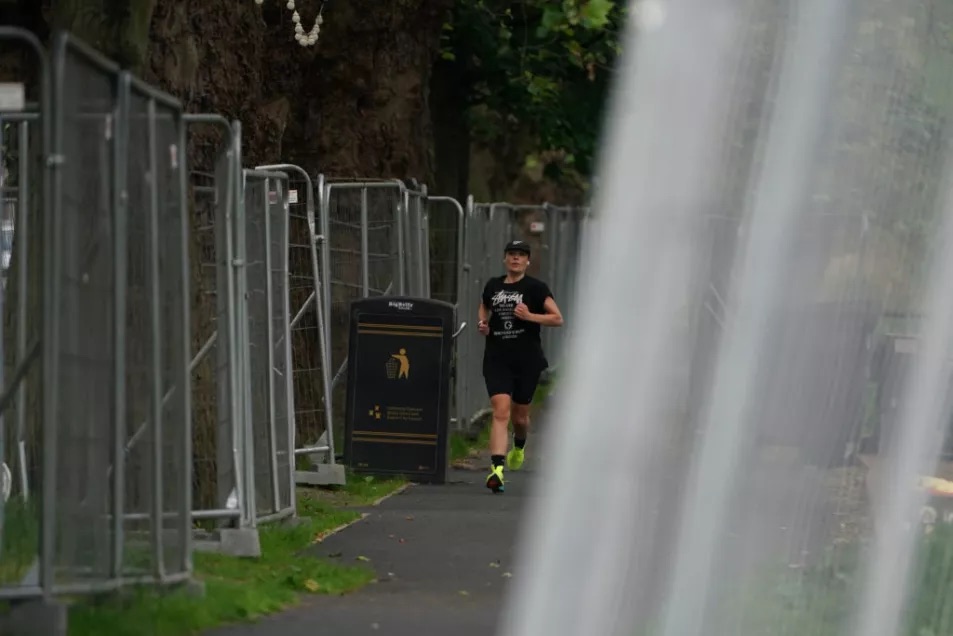

Speaking at a recent Joint Policing Committee, Garda Assistant Commissioner Angela Willis said there has been a fall in anti-immigrant protests in Dublin. However, she noted the level of aggression at demonstrations has increased.
Director of Advocacy and Community Engagement at the Hope and Courage Collective Niamh McDonald told BreakingNews.ie that the group has noticed this trend, adding that anti-immigration demonstrations have become more organised.
Changed Racist Tactics – Blockades Outside Buildings Housing Immigrants
“We have noticed a change since the Dublin riots. It’s a change in the dynamics of the activity around these protests. We would concur that there is a drop in the numbers of people coming out, but the tactics have changed. We see the likes of blockades or encampments outside centres that have been copied across the country since January.
Read the rest of this entry »Scumbags in Dublin who stop immigrants getting shelter – the Dublin government is “punching down” says a group of 30 Non-Governmental Organisations (NGO’s)
Street Photographer Chris Reid reports :
Barriers replace tents on Mount Street and along the Grand Canal. Barriers now extend along the Grand Canal from Mount Street to South Richmond Street. Good luck to the people in the tents getting through this mess.
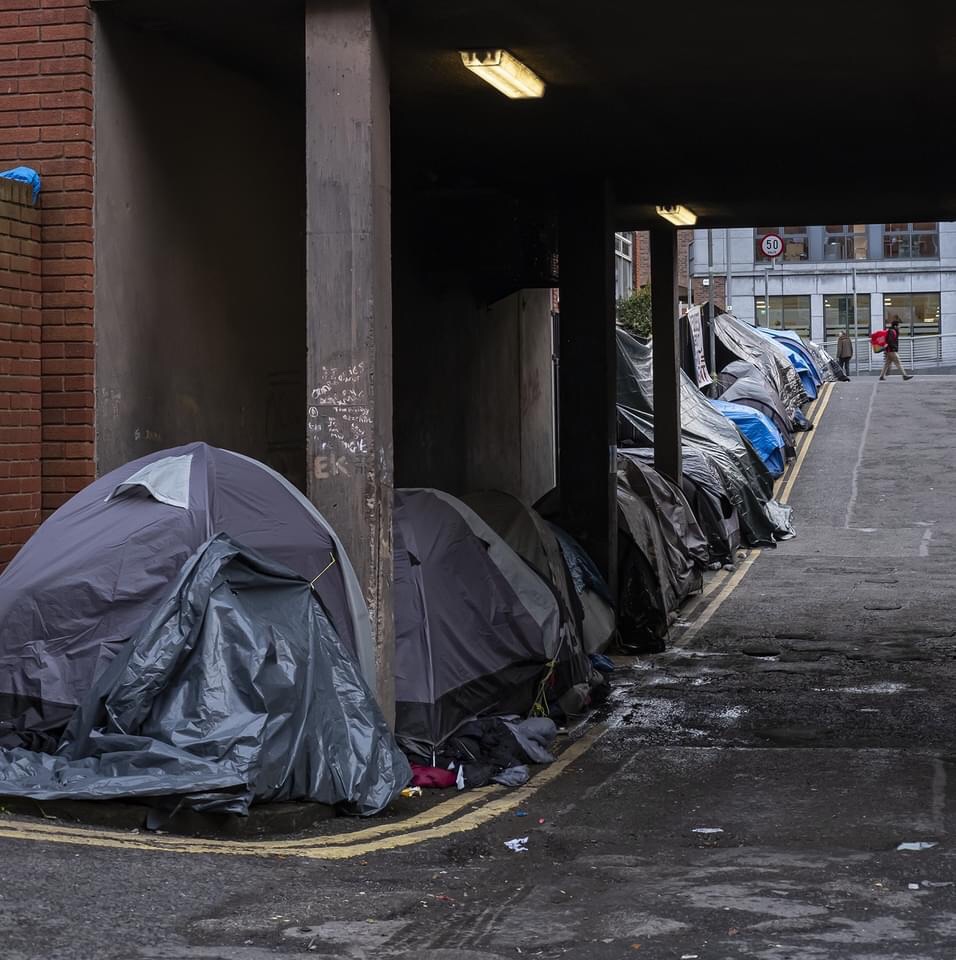
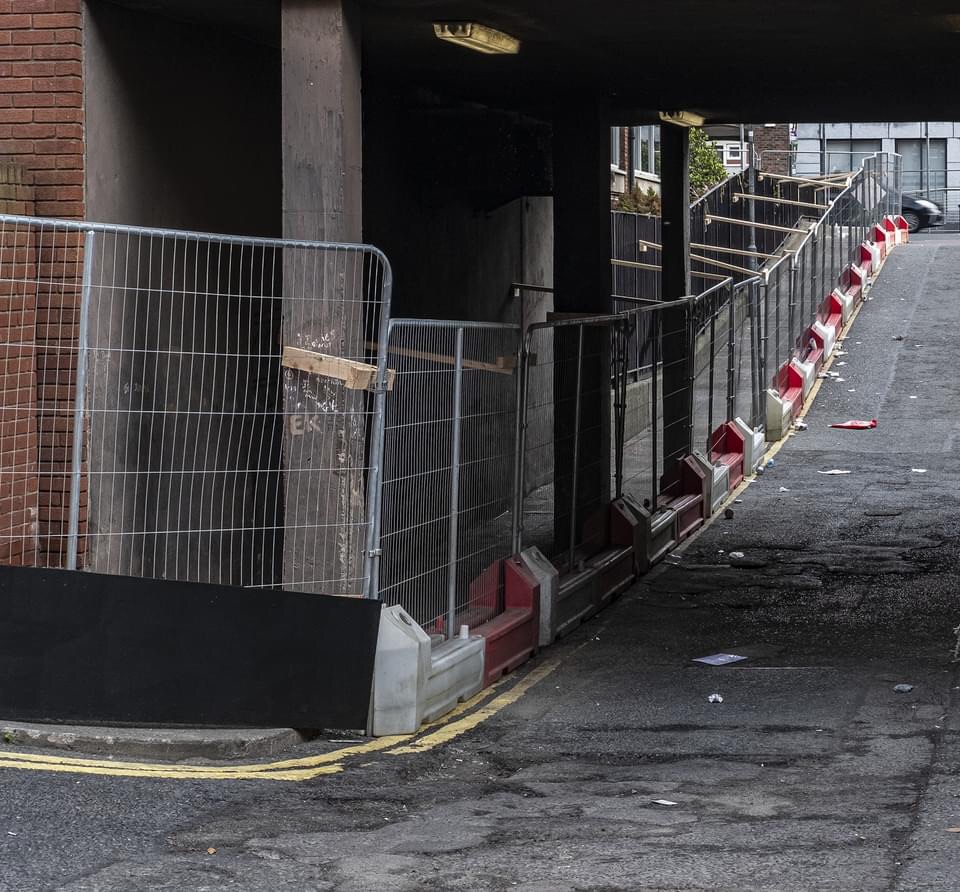
Well done Chris. There is no political and moral difference between the actions of the arsonists and racist protesting scum who try to prevent asylum seekers getting shelter in hostels or hotels – and the actions of government ministers and functionaries – like Harris the Taoiseach and Harris the Garda boss. Double-standard “opposition” politicians who dog-whistle to the racists saying “No Open Borders” – E.g. the Sinn Féin Justice spokesperson Donnacha Ó Laoghaire – also share the blame. Genuine anti-racists can and will do much better.
Read the rest of this entry »Robert Ballagh’s “The Thirtieth of January”: A Bloody Sunday Painting and the Troubles in the Two Bits of Ireland
In this interview the artist Robert Ballagh discusses the painting “The Thirtieth of January”, depicting Bloody Sunday in Derry in 1972. The conversation provides valuable insights into Ballagh’s personal experiences and artistic process, shedding light on the political and social context of the time.
The interview provides a unique insight into the historical and cultural significance of the painting.
Critical issues related to the Irish government’s response to the conflict, the impact of the Bloody Sunday event, and the broader social and political implications are highlighted. Ballagh’s commentary on the role of the Irish government, the impact on nationalist communities, and the establishment of the Special Criminal Court adds depth to the discussion.
Bloody Sunday Painting – the Thirtieth of January – Robert Ballagh
Thursday, January 20 2022. John Meehan interviews the artist Robert Ballagh in Number Five Arbour Hill.
We are talking about Robert’s painting : The Thirtieth of January, a representation of Bloody Sunday in Derry, January 30 1972.
John Meehan :
Why did you zone in on Derry’s Bloody Sunday , and put so much effort into making this painting? What makes it different from so many other big events during “The Troubles” in the north of Ireland, which lasted for 30 years, from 1968 to 1998?
Robert Ballagh
Well, it’s a long time ago now 50 years, but I have to say that it had an enormous effect on me, and I don’t think I’m alone with that historical experience. I suppose one thing I should say, I was only thinking about this, and I haven’t said anything about this experience to others. I’m a Dubliner. I’ve lived all my life in Dublin. But unlike most Dubliners – it wasn’t by design – I had an extraordinary rich knowledge of the North of Ireland, before the conflict began. Because I was a professional musician in a showband. We used to play at least once or twice a week in the north. So I was in every town village or city in the north that had a ballroom or ballrooms. And so I experienced the reality of life in that society, and became very aware of the sectarian differences, shall we say – the nature of the society, which people didn’t appreciate at all. I tell one very short story to illustrate that. We played fairly regularly in one of the very popular ballrooms in Belfast : Romano’s in Queen Street. We developed quite a following! In the show business vernacular the word groupie was used. These girls used follow us, they came down to Dublin once or twice to hear us. And we were playing one night in Romano’s.

After the dance, they came up and we’re talking to us. They asked “When are you playing again in Belfast?”.
I remember saying “Oh, I think we’re here next week.”
“Oh, really?”
“Yeah – we’re playing in a ballroom called the Astor” which I knew was in Smithfield.
And they said, “Oh, we can’t go there.” And I said, “Why?” – because it was a public ballroom. It wasn’t attached to any organization or anything. It was a public ballroom.
They said, “Oh, no, that’s a taig hall”
And it was the first time I realized, and we realized, that our fan base in Belfast was Protestant.
Swastika cut into poster in sinister Far Right threat to socialist candidate – Irish Local and European Elections campaign, 2024 – Safety Measures Urgently Needed
Far-Right agitators in Ireland are escalating their attacks.
Ruth Coppinger, a Solidarity- People Before Profit candidate in Castleknock, and a former Dublin West TD, is the latest target.
Ruth’s press statement below explains the context well, and she makes an excellent proposal :
I am going to make contact with other parties / candidates – in particular those in opposition and on the left who are targeted more by the far right – to suggest that a central log of incidents and threats should be kept in order to take measures for the safety of all those ordinary activists who come out and campaign, as well as community safety in general.
“The far right can’t be allowed to create an atmosphere designed to frighten and to limit the campaigns of the left
Swastika cut into poster in sinister Far Right threat to socialist candidate
A “menacing atmosphere” is being generated by the far right according to a former TD and local election candidate who has had a swastika cut into her image on an election poster. Ruth Coppinger, socialist candidate with People Before Profit-Solidarity in Castleknock ward, Fingal, says supporters found the poster and that “it shows the danger of the far right in these elections, the threat they are to safety and how they would take away democratic rights.”
Read the rest of this entry »“Vote Left” Transfer Pact in June 2024 Irish Elections? – A Positive People Before Profit Initiative
People Before Profit is proposing a “Vote Left” transfer pact to operate in the June 2024 Local and European Elections, 26 Counties
Presenting this positive initiative Paul Murphy TD said
He was fully aware that there would be different perspectives and, but People Before Profit “sees this as just the start of a process to form a left alternative.”
Paul Murphy TD

Link :
PBP Vote Left Transfer Pact Proposal
A useful detailed discussion is taking place on the Cedar Lounge Revolution Blog
(Link : The Cedar Lounge Revolution)
A correspondent, IrishElectionLiterature, opened the discussion on a positive note :
Link :
Vote left, Transfer left, Then What?
In the article below, important points from the discussion are highlighted.
This is a serious matter, especially in a context where it is necessary to confront and defeat the extreme racist right.
Colm Breathnach offers a very good template :
Just a personal thing, but here’s my own general set of rules when it comes to voting where a Proportional Representation system is in operation (obviously First Pat The Post system is much more challenging in terms of decisions):
- Start with the furthest left and keep voting until you reach the border of what you consider to be the left (for me, that’s social democratic or social liberal parties). Of course that border can shift – the Irish Greens were once inside my border of “left”, now they are definitely outside.
- Exclude candidates who consistently hold reactionary positions regardless of their ostensible politics – favour genocide, homophobic etc etc. So the Daly’s of the world don’t feature or let’s say a centre left candidate who justified Israel’s genocide in Gaza.
- Adjust to take account of specific concerns which one might deem important for progress to radical transformation of society. So for example you may alter your ranking to the take into account the candidates position on climate change or Irish unity etc.
Colm continues :
Read the rest of this entry »Weak Arm of the Law in the 26 County bit of Ireland – Police “Hug-a-Thug” Policy imported from the 6 County bit of Ireland
The boss of An Garda Síochána (police force in the 26 county bit of Ireland), Drew Harris, was recruited from the cops in the 6 county bit of Ireland. The people running the two states in partitioned Ireland have developed very close social, political and personal relationships since the the 1998 triumph of the Good Friday Agreement. I recently circulated details of Harris’s “Hug-a-Thug” policy towards growing far-right violence in the 26 counties to a 6 county political activist, who commented this was “reminiscent of the historic style of policing up here”.
Ruling class forces were extremely happy about the continuation of partition guaranteed by the 1998 Good Friday Agreement. They did not foresee that the foundations of partition in Ireland are more rotten than their constitutional plan conceding a Unionist Veto to a majority of the voting population of the six county state. The Brexit referendum result of 2016 lit a slow-burning fuse under the GFA structure; in the meantime we are witnessing the creation of a possible “United Ireland from Hell” which consists of knitting together the most reactionary features of both partitioned states in Ireland.
The following article from the Cedar Lounge Revolution Blog powerfully illustrates the dangers arising from importing 6 county softly-softly policing methods towards the far-right (loyalist paramilitaries), fine-tuned by Garda boss Drew Harris.
John Meehan April 22 2024
Weak Arm of the Law – Cedar Lounge Blog
Link : Weak Arm of the Law – Cedar Lounge Blog
So, Friday comes the news that the previous night:
Gardaí were called to the home of Children’s Minister Roderic O’Gorman on Thursday night when a gang of up to 12 masked men gathered outside his house and huge placards and banners were stretched across his driveway gate, along his wall and fastened to outside polls.
Read the rest of this entry »


 Tomás Ó Flatharta