Posts Tagged ‘europe’
Former French Prime Minister Lionel Jospin of the Socialist Party has passed away aged 88 – Former Trotskyist at the centre of “a story of hope and missed opportunities”
The long life of former French Prime Minister Lionel Jospin, who has passed away at the age of 88, gives us many useful explanations of the state of the left today, not just in France.
A useful list is here :
L’Echec de la gauche – the failure of the left


Jospin moved from the left to the right, and unsuccessfully tried to cover some of his tracks.
We reproduce two articles here from
Europe Solidaire Sans Frontières
- Lionel Jospin the former Trotskyist
- Former French prime minister Lionel Jospin: a story of hope and missed opportunities
Jospin lays the ghost of long past Trotskyism – The French Prime Minister, Mr Lionel Jospin, admitted in 2001 that he began his political career as a Trotskyist
Lara Marlowe, Irish Times Wednesday June 6 2001
The French Prime Minister, Mr Lionel Jospin, admitted yesterday that he began his political career as a Trotskyist. Mr Jospin responded to questions in the National Assembly following press reports that he was a Trotskyist revolutionary who infiltrated the Socialist party on the instructions of his semi-clandestine organisation.
Read the rest of this entry »Donald Trump deploys US diplomats in Paris to threaten magistrate handling a corruption case against fascist politician Marine Le Pen
This story comes from the reliable source Le Monde, and is appearing on the public TV network.
Trump already has serious criminal convictions imposed by USA courts. Are French courts going to issue warrants for the arrest of the US president?
US official lobbied French magistrate over Le Pen’s election ban
The magistrate, Magali Lafourcade, said she was sufficiently concerned by the encounter to notify the foreign ministry.
PARIS — A senior policy adviser from the U.S. State Department asked a French magistrate last year whether she could interveneover the election ban on far-right leader Marine Le Pen.
The previously unreported details of the encounter will refocus attention on U.S. efforts to support the European far right. U.S. President Donald Trump has slammed the electoral ban against Le Pen as an example of using “Lawfare to silence Free Speech.”
French magistrate Magali Lafourcade told POLITICO that she and a colleague held a meeting in May with State Department adviser Samuel Samson, who made headlines last year for proposing the use of American taxpayer funds to support Le Pen.
Read the rest of this entry »“Progressive parties and civil society groups should jointly campaign to force the Government to drop the annual St. Patrick Day’s visit to the White House” – No Irish grovelling in Washington DC on March 17 2026 – Michael Taft’s Call is Spot On
Michael Taft, a researcher employed by the SIPTU trade union makes a very good proposal.
The President of the USA is backing reactionary genocidal actors in many parts of the globe – Ukraine, Palestine – and threatening the people of Iran, Venezuela, and Greenland – the list is growing.

Notes on the Front
Commentary on Irish Political Economy by Michael Taft, researcher for SIPTU
Abandon Paddy’s Day
January 12, 2026

Progressive parties and civil society groups should jointly campaign to force the Government to drop the annual St. Patrick Day’s visit to the White House. There is almost nothing to gain from such a visit and it can only perpetuate what Eoin Burke-Kennedy describes as the ‘Fawning, sycophantic, obsequious [and] “strategic self-emasculation’ approach to the US Administration pursued by Europe and Ireland.
How do you deal with a Head of State who says:
“I don’t need international law . . . [the only limit to my power] is my morality. My own mind. It’s the only thing that can stop me.’
In the last year the US bombed Iraq, Iran, Yemen, Somalia, Venezuela, Syria and Nigeria. It has threatened to invade or annex Panama, Canada, Mexico, Columbia, Cuba and Greenland. It armed the Israeli government’s genocidal attacks on Gaza.
It has withdrawn from 66 international organisations (a full list is here), including vital climate change bodies such as the Intergovernmental Panel on Climate Change, and the UN Framework Convention on Climate Change.
The Trump Administration’s ‘2025 National Security Strategy’ made clear the current US government’s intention to interfere in European democracies. As the Brookings Institute put it:
‘The document points to the “patriotic European parties”—a reference to the hard right as represented by France’s National Rally, the United Kingdom’s Reform party, and the Alternative for Germany—as America’s real allies in Europe. Its stated goal of “cultivating resistance to Europe’s current trajectory within European nations” amounts to a policy of constitutional regime change . . . it is the language of tyranny.’
Indeed, Trump’s document directly references Ireland, stating:
‘America is, understandably, sentimentally attached to . . . Britain and Ireland. The character of these countries is also strategically important . . . we want to work with aligned countries that want to restore their former greatness.’
And it just so happens that Steven Bannon, an important Trump ally and MAGA organiser, is already in Ireland:
‘I’m spending a ton of time behind the scenes on the Irish situation to help form an Irish national party , , , [Ireland is] going to have an Irish Maga, and we’re going to have an Irish Trump. That’s all going to come together. That country is right on the edge thanks to mass migration.’
And it so happens that the US Ambassador attended a recent far-right conference in Meath.
Trashing international law, bombing countries and threatening others, pursuing ‘constitutional regime change’ throughout Europe and Ireland: does this deserve a bowl of shamrock?
Humiliation Redux
It’s not as if the Irish Government is ignorant of what could be in store for them on St. Patrick’s Day. Remember the humiliation it received last year. The Taoiseach received an invitation to the White House late in the day (only 12 days’ notice) and it wasn’t even for St. Patrick’s Day. Of course, the President might have been too busy to meet with the Taoiseach. But Trump and Elon Musk had time to meet Conor McGregor on the day, despite the fact that McGregor had been found guilty of rape by a High Court civil jury.
So why would Trump meet McGregor on St Patrick’s Day rather than the elected representative of the Irish people? According to The Times:
‘The Trump family have deepened their business connections with Conor McGregor with the promise of a $23 million investment in one of the form MMA fighter’s business ventures . . . MMA Inc., an American listed martial arts training company . . . Last September Donald Trump Jr. was announced as a “strategic advisor” to the company.’
The Irish Government will have to come up with something special to compete for the US President’s attention.
What’s the Point?
It is difficult to understand what can be achieved with a visit to the White House on St. Patrick’s Day – that’s if the Irish Government even gets an invitation. There is little political influence Ireland can exert given that Trump has scant regard for international opinion (especially European opinion), never mind international law. If anything, a shamrock-as-usual approach is likely to feed Trump’s belief he can act with little blowback. And it is highly unlikely the Taoiseach would sit down in the Oval Office with the US President and, in front of the cameras, lecture him about a rules-based world order.
There is the foreign investment angle; namely, that Ireland needs to maintain inward US investment and, therefore, refusing to meet the US President could stem the flow of US investment. This doesn’t stand up. Over the St. Patrick’s day holiday, Irish Ministers and representatives can continue to meet with American CEOs, as they have done in the past, based on the work of Irish civil servants in US consulates around the country.
Indeed, Ireland might even get some quiet kudos from American CEOs. Trump has made it his business to humiliate CEOs who are reduced to bringing gifts of gold to the White House. The IDA reports that US companies are so cowed by the Trump administration that they don’t release information on investments and job creation here for fear of retribution from Washington. Ireland provides something that Trump derides – consistency and stability. A bowl of shamrock will not impact this dynamic.
A Coalition to Stop the Visit
According to the Minister for Foreign Affairs:
“Where we see challenging behaviour, we have to call it out, and unfortunately there’s been a lot of that from the US . . . So we will always use our voice, however small it might seem”.
What’s the best way to call out ‘challenging behaviour’? Refusing to visit the White House over the St. Patrick’s Day period. This would be a clear statement that Ireland opposes Trump’s arbitrary, chaotic foreign policy; a clear statement of support for a rules-based international order; a rejection of Trump’s ethno-nationalist portrayal of Europe (‘civilisational erasure’); and a determination to stop American nativist ideologues interfering in Irish and European democracy.
The parties that made up the ‘Connolly coalition’ should come together, with civil society organisations, to campaign against a St. Patrick’s Day visit to the White House – putting forward the arguments, mobilising public opinion and showing the power of progressive cooperation on a key foreign affairs event.
However, it is unlikely the Irish Government will concede. So the opposition parties should plan out an alternative St. Patrick’s Day visit with the participation of opposition party leaders and representatives along with civil society activists. This could include solidarity visits to cities that are under siege: Minneapolis, Chicago and Portland. The party representatives could meet with social constituencies that are struggling under Trump’s rule – in particular, the US trade union movement.
Indeed, there could be an alternative ceremony complete with a bowl of shamrocks Why not hold it in New York City and give the bowl to the newly elected Mayor, Zohran Mamdami? The symbolism would be profound, popular and progressive.
And, without interfering in US electoral politics, if the opposition to a White House visit provokes those sections of Irish America who previously supported Trump to re-think their political support – then we will have done the world a service.
That is how you make even a small voice speak loudly.
Link :
Some Extra Context :
French Far-Right Leader Marine Le Pen Sentenced to 5 Years jail (2 suspended) – banned from running for president for 4 years – a familiar story with many parallels
Currently a right wing Irish coalition government has a parliamentary majority because of a pact with a proven corrupt racist politician from Tipperary Michael Lowry (a former Fine Gael government minister). A number of high-profile Irish politicians have corruption black marks against their names besides Mr Lowry : Former Fianna Fáil heads of government (taoisigh) Charles Haughey and Bertie Ahern; former deputy leader of the right-wing Progressive Democrats Michael Keating; and so on.
The USA White House is run by a convicted rapist, Donald Trump, who promotes the political ambitions of a convicted Irish rapist, the kick-boxer Conor McGregor.
Readers may have noticed that wealthy powerful criminals like Lowry, Trump, McGregor and Marine Le Pen from France do not give up trying to get convictions overturned :
Here is an extract from a routine Irish Times report, May 8 2023 :
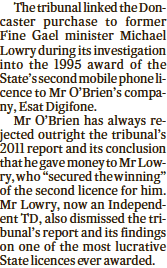
This is the factual position :
“Mr Lowry, a former Fine Gael minister, was previously found by a tribunal to have behaved in a manner that was “profoundly corrupt”. (Irish Examiner, April 2).
Donald Trump is actively trying to get his rapist conviction overturned on very dodgy grounds :
Read the rest of this entry »European Parliament adopts Nordic Left MEPs resolution against Russian ‘shadow fleet’ – Doing Everything We Can to Support Ukraine
Source: Left Party (Sweden)
(November 14, 2024) In the EU election campaign, we promised to do everything we can to support Ukraine. We have now adopted (!) a resolution to stop the Russian shadow fleet.
The shadow fleet consists of poorly maintained, often uninsured ships with unclear ownership that export Russian oil and gas via the Baltic Sea, in violation of EU sanctions against Russia.
The proceeds from these exports fund the war in Ukraine. The shadow fleet threatens both the environment and the people of Ukraine.
With today’s resolution, which Hanna Gedin and Jonas Sjöstedt (pictured) skilfully succeeded in pushing through in the European Parliament, hard pressure is now being put on both the European Commission and the Member States to take the decisions needed to stop the shadow fleet.
This is a great victory for all of us who want to stop the war in Ukraine.

Further information:
Briefing on Russian shadow fleet
Why are Russian ‘shadow’ oil tankers still sailing the Baltic Sea?
by Li Andersson, Jussi Saramo, Jonas Sjöstedt, Merja Kyllönen, Per Clausen, Hanna Gedin, Jan van Aken, Maciej Konieczny, and Zofia Malisz
Read the rest of this entry »Who are ‘the Irish’? History shows we’ve been a mixed bunch for centuries – Maurice J Casey
Who are ‘the Irish’? History shows we’ve been a mixed bunch for centuries
Introduction :
From the 1800’s to the early 1990’s Ireland was a world champion in one cruel activity – export of its own people. During the Great Hunger [An Gorta Mór in Irish] (Famine) of 1845-49 official figures state the population crashed from 8 million to 6 million : 1 million died and 1 million emigrated. In almost every following decade, the population continued to fall – from 8.2 million in 1841 to 4.2 million in 1961.
People of Irish extraction – the diaspora – are estimated to number 70 million. In 1921 the British imperialist government partitioned Ireland into two states – the republic and the north. The revolution heralded by the 1916 Easter Rising was betrayed.
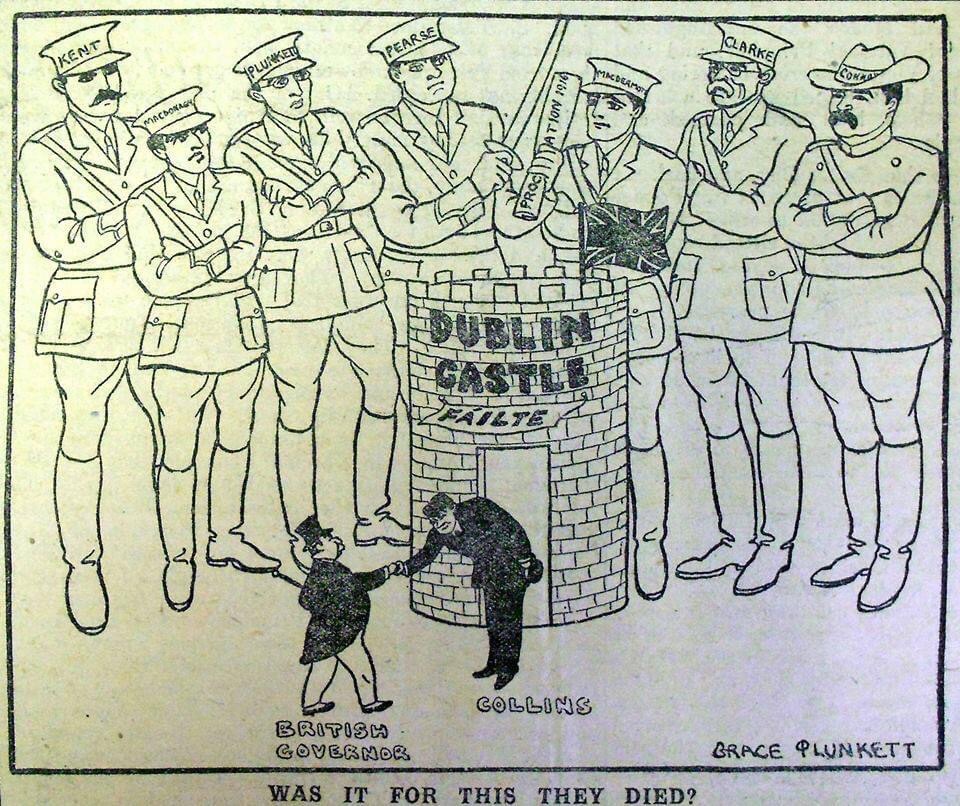
Today Just over 5 million live in the republic, 2 million reside in the north, and 1.5 million Irish passport holders reside outside Ireland and Britain.
Up to the 1990’s immigration to Ireland existed – in relatively small numbers. The trend then altered significantly.
In the 2020’s the population of Ireland rose to 7 million. This remains below the 1841 figure of 8.2 million – so much for racist claims that Ireland is “full”.
Read the rest of this entry »France : A surprise victory and a reprieve from the Rassemblement National (RN)

Photothèque Rouge / Martin Noda / Hans Lucas
Source :
France : A surprise victory and a reprieve from the RN
The Nouveau Front populaire (New Popular Front), a coalition built in just a few days by the left-wing parties (whereas they remained splintered at the recent European parliamentary elections), has just won 182 deputy seats in the French National Assembly, beating the Rassemblement national (RN) and its allies, with 143 seats, and the camp of President Macron with 168 seats.
This is a spectacular reversal of the situation meaning we have gone from the threat of a far-right stranglehold on the state apparatus to a relative left-wing majority in the Assembly, elected on a programme of rupture with neoliberal policies. This reversal cannot be understood without looking at the massive mobilisation in recent weeks of the activist forces of the workers’ and democratic movement in the face of the far right, leading first to the formation of this New Popular Front (with la France insoumise (LFI), Europe Ecologie Les Verts (EELV), the Socialist Party (PS), the Communist Party (PCF) and others including the Nouveau parti anticapitaliste (NPA)), then to a major mobilisation at the ballot box and a very broadly supported vote to reject the RN.
Following on from its 31.34% result in the European elections on 9 June, the RN obtained more than 33% of the vote in the first round of legislative elections on 30 June, and everything suggested that it would obtain a very large number of deputies in the second round, with all the polls giving it well over 200 deputies and possibly even an absolute majority of 289 seats.
Read the rest of this entry »France : The far right has been pushed back by popular mobilization – now we must implement the programme of the New Popular Front – Nouveau Parti Anticapitaliste (NPA)
A great result for the left from France, July 7 2024. The NPA’s reactions is below :
Source :
Far right pushed back by popular mobilization – implement programme of New Popular Front- NPA
The main lesson of the first results of this second round is the setback suffered by the Rassemblement national and its allies. The defeat of the hundreds of fascist, racist, Islamophobic, antisemitic and ultra-racist candidates put forward by the RN is a huge relief for racialized people, women, LGBTI+ people and workers. This victory for the united left has halted the momentum of the far right, which nonetheless won around fifty more seats. This defeat of the far right of Bardella and Le Pen is the fruit of the popular mobilization that took place thanks to the unitive impetus provided by the creation of the New Popular Front.

This is already a victory for the New Popular Front, which was made possible by the rallying of the entire left – political parties, trade unions and campaigning groups – , but also and above all by the grassroots mobilization of large sectors of the working classes, in particular racialized people and young people, who committed themselves everywhere to blocking the RN. This made it possible for a very large number of New Popular Front MPs (including a relative majority for LFI) to be elected to the National Assembly on the basis of a programme that breaks not only with Macronism in the service of the ultra-rich, but also with the liberal left of the Hollande mandate, which had followed the policies of the right.
Read the rest of this entry »British General Election 2024 – Highlights and Lowlights – Loveless Landslide, Sandcastle Majority. Far-Right Hiding in Plain Sight, House of Paisley Falls in Antrim – and a Message of Hope from new MP Shockat Adam, Leicester South
Let’s start with positive news :
Shockat Adam MP, Leicester South – “This is for the people of Gaza”.
When you listen to this June 25 car-crash interview with former Leicester South Labour MP Jonathan Ashworth, you would be forgiven for thinking he was a member of the far-right racist party, Reform.
Shockat Adam was not alone. Five pro-Gaza independent candidates (including former Labour Party leader Jeremy Corbyn in Islington North) are members of the new Westminster parliament :
Read the rest of this entry »


 Tomás Ó Flatharta