Posts Tagged ‘criminal courts’
Kincora House and Lord Mountbatten (grand uncle of King Charles) – Chris Moore and Suzanne Breen Say “It is long past the time that the full truth was told about what happened in the house of horrors” – they are 100 per cent right
We wish to again congratulate the dogged investigative reporter Chris Moore for putting so much dedicated hard work into a shocking story which will not go away.
This smoking volcano has become more active recently. The criminal scandal will not go away, and further political action is vital. We are duty bound to keep up the pressure and, above all, support the victims of horrendous British state crimes.
For decades the Belfast Kincora child abuse scandal has attracted false and unverified accusations. In my own case I refused to believe many rumours about the involvement of Lord Mountbatten in a child abuse ring because no credible evidence was placed in the public arena.
At the Dublin Irish Film Institute (IFI) launch of the stunning documentary “Lost Boys of Belfast” in 2023 I made this observation to one of the documentary makers, Chris Moore.
I had noticed there was no reference to Mountbatten in the sensational documentary. Chris confirmed that the documentary makers made no mention of the Mountbatten allegations because they possessed no credible proof.
Read the rest of this entry »Ireland’s November 29 2024 General Election : Racist Warning Signs
Irish General Election to 34th Dáil; Racist Danger
The June 2024 Euro/ Local results in Ireland produced some alarming results – the racist far-right came from the margins and increased its electoral support. This could be a predictor of the coming General Election result.
Warning signs to anti-racists exist in various opinion surveys. See, for example, these numbers from a recent RedC General Election Opinion Survey) :
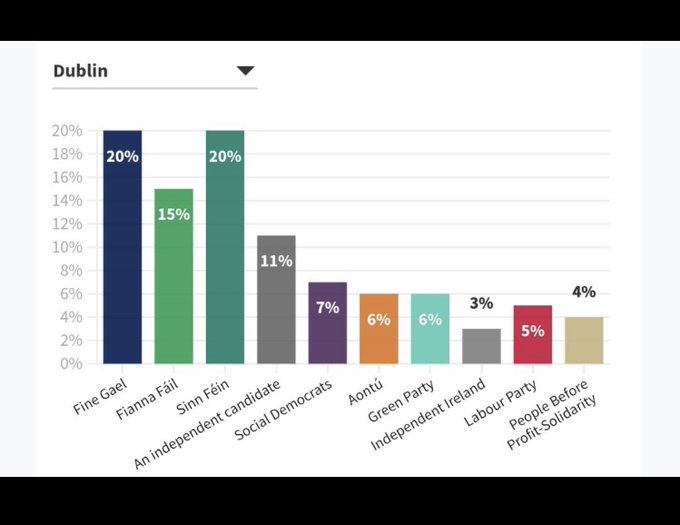
Aontú, a right-wing split from Sinn Féin set up by an anti-choice TD from Meath, Peadar Tóibín, is beginning to hoover up right-wing racist votes which were scattered among various mini-Hitlers in the June 2024 European and Local Elections. We can say the same for the Irish Independence party (II). When we note that a majority of independent candidates are part of the racist far-right, a disturbing picture emerges. The numbers are worse in other parts of the Irish state.
Here is the data from an Irish Times Opinion Poll :
| Irish General Election November 29 2024 Irish Times Survey Results 15/11/24 | ||||
| First preference voting intentions | ||||
| Dublin | Rest of Leinster | Munster | Connacht/Ulster | |
| Fianna Fáil | 16.00% | 19.00% | 27.00% | 13.00% |
| Fine Gael | 22.00% | 29.00% | 22.00% | 29.00% |
| Labour | 9.00% | 3.00% | 2.00% | 3.00% |
| Green Party | 6.00% | 2.00% | 1.00% | 2.00% |
| Sinn Fein | 21.00% | 16.00% | 19.00% | 21.00% |
| People Before Profit/Solidarity | 4.00% | 1.00% | 2.00% | 1.00% |
| Social Democrats | 5.00% | 5.00% | 2.00% | 2.00% |
| Aontú | 2.00% | 4.00% | 3.00% | 2.00% |
| Independent candidate | 15.00% | 21.00% | 21.00% | 25.00% |
Temptation exists : bending to “understandable” fears. For example an election canvasser from a party with one foot in the left put it to me that some voters are “uncomfortable” because their neighbours come from outside Ireland.
Let’s be clear, harsh, and unambiguous : messages like this pander to the racist view that immigrants are criminals and rapists. There is no evidence backing up claims that people born outside Ireland are any worse than Irish natives. It gives oxygen to the far right shite being whispered around communities.
Read the rest of this entry »Robert Ballagh’s “The Thirtieth of January”: A Bloody Sunday Painting and the Troubles in the Two Bits of Ireland
In this interview the artist Robert Ballagh discusses the painting “The Thirtieth of January”, depicting Bloody Sunday in Derry in 1972. The conversation provides valuable insights into Ballagh’s personal experiences and artistic process, shedding light on the political and social context of the time.
The interview provides a unique insight into the historical and cultural significance of the painting.
Critical issues related to the Irish government’s response to the conflict, the impact of the Bloody Sunday event, and the broader social and political implications are highlighted. Ballagh’s commentary on the role of the Irish government, the impact on nationalist communities, and the establishment of the Special Criminal Court adds depth to the discussion.
Bloody Sunday Painting – the Thirtieth of January – Robert Ballagh
Thursday, January 20 2022. John Meehan interviews the artist Robert Ballagh in Number Five Arbour Hill.
We are talking about Robert’s painting : The Thirtieth of January, a representation of Bloody Sunday in Derry, January 30 1972.
John Meehan :
Why did you zone in on Derry’s Bloody Sunday , and put so much effort into making this painting? What makes it different from so many other big events during “The Troubles” in the north of Ireland, which lasted for 30 years, from 1968 to 1998?
Robert Ballagh
Well, it’s a long time ago now 50 years, but I have to say that it had an enormous effect on me, and I don’t think I’m alone with that historical experience. I suppose one thing I should say, I was only thinking about this, and I haven’t said anything about this experience to others. I’m a Dubliner. I’ve lived all my life in Dublin. But unlike most Dubliners – it wasn’t by design – I had an extraordinary rich knowledge of the North of Ireland, before the conflict began. Because I was a professional musician in a showband. We used to play at least once or twice a week in the north. So I was in every town village or city in the north that had a ballroom or ballrooms. And so I experienced the reality of life in that society, and became very aware of the sectarian differences, shall we say – the nature of the society, which people didn’t appreciate at all. I tell one very short story to illustrate that. We played fairly regularly in one of the very popular ballrooms in Belfast : Romano’s in Queen Street. We developed quite a following! In the show business vernacular the word groupie was used. These girls used follow us, they came down to Dublin once or twice to hear us. And we were playing one night in Romano’s.

After the dance, they came up and we’re talking to us. They asked “When are you playing again in Belfast?”.
I remember saying “Oh, I think we’re here next week.”
“Oh, really?”
“Yeah – we’re playing in a ballroom called the Astor” which I knew was in Smithfield.
And they said, “Oh, we can’t go there.” And I said, “Why?” – because it was a public ballroom. It wasn’t attached to any organization or anything. It was a public ballroom.
They said, “Oh, no, that’s a taig hall”
And it was the first time I realized, and we realized, that our fan base in Belfast was Protestant.


 Tomás Ó Flatharta