Archive for the ‘Sinn Féin’ Category
Gerry Foley 1939 – 2012 : An American Revolutionary Inspired by Irish Rebellions
Gerry Foley 1939 – 2012 : An American Revolutionary Inspired by Irish Rebellions
Many thanks to friends and comrades on the Cedar Lounge Site for publishing a tribute to an old friend and comrade, Gerry Foley. Here is an article from March 1996 where Foley analyses the state of the “Peace Process” in Ireland after the IRA had broken its ceasefire and started a bombing campaign in England. Two key points are highlighted here :
There is a well-established pattern in the long history of Irish republicanism that when the movement loses its momentum or its perspective in Ireland it turns to bombing England in the hope that scattered explosions in the imperial heartland will have a political effect greater than anything that can be achieved in Ireland. Such a course was followed in the name of the “Skirmishing Fund” in the 1880s after the Land League struggles were defused by a reformist leadership and at the end of the 1930s when the IRA was torn apart by unresolved political differences and lost its direction.
The movement found itself in a blind alley when it proved unable to
widen the political breakthrough that it had made in 1980-81 as a
result of the mass movement in support of the ten Republican prisoners
who starved themselves to death one after the other in protest against
the British machinery of repression.

This was the basic political context in which Republican leadership
began negotiations with the British authorities in 1990, which led to
the IRA ceasefire on August 31, 1994.
John Meehan April 23 2012 What's behind the breakdown of the Irish Peace Process? by Gerry Foley The Irish "peace process" was not ended by the flurry of IRA bombings in London in February. At the end of the month, the British and Irish governments announced agreement for the start of all-party talks -- including Sinn Fein, the Irish Republican political organization -- on June 10.So-called proximity talks -- that is, indirectly involving Sinn Fein -- were to be held in March 4-13 to prepare for a new round of negotiations. As a condition for including Sinn Fein in the June talks, London and Dublin insisted on a resumption of the IRA ceasefire. Gerry Adams, president of Sinn Fein, and John Hume, leader of the bourgeois nationalist Social Democratic and Labour Party (SDLP), met with the IRA leadership to discuss renewal of the "peace process." The IRA response was noncommittal, obviously reflecting an uneasiness in the Republican movement over where the peace process had been leading. The IRA statement, released February 29, said: "We listened attentively to the case presented by both leaders and noted their shared commitment to restoring the peace process... "For our part," the IRA leadership continued, "we restated our absolute commitment to our republican objectives, which include the free exercise by the Irish people of our inalienable right to national self-determination. "We also took the opportunity to reiterate what we said on February 9 [the date of the statement declaring the end of the ceasefire], stressing that a resolution of the conflict in our country demands justice and an inclusive negotiated settlement without preconditions. "We pointed out to Mr. Hume and Mr. Adams that the failure of the British government to put in place inclusive negotiations free from preconditions, the abuse of the peace process by the British over 18 months, and the absence of an effective and democratic approach capable of providing an irrevocable momentum towards a just and lasting peace in Ireland, were the critical elements which led to the failure, thus farm, of the Irish peace process." The conditions that led to the "peace process" still exist. The British government and its pro-imperialist allies in Northern Ireland have not crushed the insurgency of the radicalized section of the nationalist population in the Catholic ghettos. On the other hand, the military campaign of the IRA has been effectively contained by the massive British military machine. Politically, the militant nationalists have been clearly isolated and on the defensive for many years. In a blind alley The movement found itself in a blind alley when it proved unable to widen the political breakthrough that it had made in 1980-81 as a result of the mass movement in support of the ten Republican prisoners who starved themselves to death one after the other in protest against the British machinery of repression. This was the basic political context in which Republican leadership began negotiations with the British authorities in 1990, which led to the IRA ceasefire on August 31, 1994. On February 9, 1996, the IRA leadership announced that it was ending the ceasefire. Their statement said: "The [ceasefire] presented an historic challenge for everyone, and an Oglaigh na hIireann [IRA] commends the leaderships of nationalist Ireland at home and abroad. "They rose to the challenge. The British prime minister did not. Instead of embracing the peace process, the British government acted in bad faith with Mr. Major and the Unionist leaders squandering this unprecedented opportunity to resolve the conflict.... "We take this opportunity to reiterate our total commitment to our Republican objectives. The resolution of the conflict in our country demands justice. It demands an inclusive negotiated settlement. That is not possible unless and until the British government faces up to its responsibilities. "The blame for the failure thus far of the Irish peace process lies squarely with John Major and his government." This statement was followed within hours by the explosion of a truck bomb outside a large building in the Docklands area of London. The blast was claimed by the IRA. On February 15, a small bomb placed by the IRA in a phone box in London's theatre district was defused by police, following an IRA warning. On February 18, a bomb carried by an IRA operative on a London bus exploded prematurely, killing him and injuring several passengers. According to accounts in the British press, about a third of the IRA men killed since the start of the insurgency in Northern Ireland have died in premature explosions of their own bombs. This figure attests to readiness for self-sacrifice of the Republican volunteers but not to a high degree of military organization. That is understandable. The IRA is based essentially on a small impoverished community that is under the constant surveillance of one of the world's biggest and best equipped professional military forces. A well-established pattern What is decisive for the IRA, therefore, is the political impact of its actions, and in particular the effect on the morale of its activists and supporters. There is a well-established pattern in the long history of Irish republicanism that when the movement loses its momentum or its perspective in Ireland it turns to bombing England in the hope that scattered explosions in the imperial heartland will have a political effect greater than anything that can be achieved in Ireland. Such a course was followed in the name of the "Skirmishing Fund" in the 1880s after the Land League struggles were defused by a reformist leadership and at the end of the 1930s when the IRA was torn apart by unresolved political differences and lost its direction. This pattern tends to recur, despite the fact that its political effects on British and international pubic opinion have always been negative. On the other hand, these actions have served as a symbol of indomitable resistance for Irish Republicans themselves. In the present situation of the peace process, however, the Republican strategy is to use the pressure of international public opinion to induce the British to give concessions to the nationalist people. In this respect, it is hard to see how the London bombings could have any effect other than to weaken the political position of the Republican movement. That point was made in fact in two quite long letters published in the February 29 issue of An Phoblacht/Republican News, the weekly newspaper of the Republican movement. In one of them, a Republican political prisoner in England, Joe O'Connell, wrote: "For the IRA to order a resumption of war until it is promised a date for all-party negotiations -- something which is achievable under the now binned peace process anyway -- must surely go down as the most stupid, blinkered and ill-conceived decision ever made by a revolutionary body anywhere ever before in history." Given the intense pressures on the Republicans in the wake of the London bombings, publication of these letters must have been a carefully considered political decision. Endless "talks about talks" On the other hand, in the same issue of An Phoblacht, the editorial touched on the nub of the problem: "So the convoluted progress of the peace process continues with yet more convoluted language.... "Republicans should welcome the fixed date for all-party talks, but essential guarantees must be in place.... Sinn Fein cannot sign up to a process which underpins the unionist veto [e.g. the veto of the pro-imperialist settler caste that is a majority in Northern Ireland but a minority in Ireland as a whole] and partition.... "On Wednesday evening, in the aftermath of the communique, Unionists signalled that they will not move beyond the first item on the agenda -- in effect, decommissioning [the IRA surrendering its weapons] -- until it is resolved. "In fact, David Trimble went further and said that his party will not meet face to face with Sinn Fein until the issue is resolved. How then can there be all-party talks?" To sum it up, the peace process has become a labyrinth in which the Republicans find themselves becoming more and more lost, further and further from the goals of their struggle, and without even any real alleviation of the repression from which they have been suffering. That is obviously the reason why the IRA statements kept repeating that the movement is going to stick resolutely to its goal -- a united Ireland free of imperialist domination. One might think something else from the Sinn Fein leaders' exaltation of "peace" as the greatest of "sublunary blessings," and from the "hand of friendship" that Adams has extended even to British Prime Minister John Major. Since the IRA have suffered most for the movement's goals, obviously they feel the drift from them most acutely. In this regard, the new promise of "all party talks" solves absolutely nothing. In fact, it appears only to be a continuation of the British delaying tactics designed to exhaust the patience of the militant nationalists and provoke them into desperate acts that can be exploited to further isolate and demoralize themselves and their supporters. Increasing frustration The critics in the February 29 An Phoblacht of the IRA's resumption of military action were quite correct about the effects of these actions. What they failed to recognize is that they are absolutely inevitable if the "peace process" talks about talks keep dragging on with no results expect increasing the confusion and frustration of the nationalist population. In fact, the new agreement for talks is between the British and Irish governments, in which Sinn Fein is included as basically a juvenile delinquent ward of the Irish government. Dublin effectively promised to get the Republicans to mind their manners in order to be accepted into talks, and thus is now twisting their arms harder and harder. After the end of the IRA ceasefire, the Sinn Fein leadership called for public pressure for a resumption of the peace process. On the weekend of February 24-25, in fact, there were demonstrations of tens of thousands of people in Ireland for peace. But Sinn Fein found itself mingling with forces that were demanding a peace that meant simply condemnation of the IRA and abandonment of the goal of national liberation. The IRA itself, while impatient with the "peace process," has still not challenged its basic premise, the "nationalist consensus" -- that is, a bloc of all nationalists, including the Dublin government and the bourgeois nationalists of the SDLP. That is the nub of the problem. The Republicans recognize there is a contradiction between the British imperialist and all nationalists, including the bourgeois nationalists. After all, the bourgeois nationalists rule in the name of the goal of Irish independence. But they have decided to forget that they live by selling out Irish nationalism. Thus, the contradiction cannot be exploited simply by hobnobbing with them. That means that they pull the Republicans rather than the other way around. The only way to exploit the contradiction is to expose the bourgeois nationalists' false pretences of defending the interests of the Irish people. But this requires mass campaigns against the most acutely felt concrete effects of imperialist domination, not abstract appeals to the bourgeois nationalists' presumed love of peace and sense of responsibility, or concern for the fate of their compatriots. The civil rights struggle that led to the insurgency in Northern Ireland and assured its continuation for more than 25 years shows what can be accomplished by such a course. It was the failure of the Republicans to set in motion such a process in the South after the end of the 1980-81 hunger strikes that led them into their present predicament. Gerry Foley was International Editor for Socialist Action USA when this article first appeared in March 1996.

On foot of the sad news that Gerry Foley has died here’s a few pieces relating to him and his life. As a socialist with a profound interest in Ireland and matters Irish and as the author of a number of pamphlets directly linked to that his views of the situation, particularly in the early to mid 1970s are of particular interest.
We start with with a letter from a comrade of his reflecting on his passing and his life.
Dear Comrades,
I just learned from Gerry Foley’s friend in Mexico that Gerry died suddenly today in Mexico. Gerry called me a few days ago to say that he was happily moving from his rented home in Mérida to a happy home in San Cristobol de Las Cases, in the mountains of Chiapas.
Just a few moments ago Gerry was walking into his house. He fell down and died almost immediately…
View original post 633 more words
Violent Legacy of Irish Troubles, British Double-Standards – Boston College Row Revisited
Ed Moloney’s Irish Echo Editorial (an Irish-American Newspaper) on the Boston tapes controversy is required reading for all people genuinely interested in dealing with the violent legacy of the Northern Ireland Troubles (1969-1998, signing of the Good Friday Agreement).
Two key quotes :
Number 1 :But the war has now ended, peace reigns and there is a desperate need for dealing with the past in a way that solidifies that peace and ensures an untroubled future.
The British have chosen a way that does the opposite. The Boston College subpoenas symbolize an approach to this issue based on revenge and the view that alleged combatants in that war should be dragged before the courts, convicted and jailed.
Number 2 :
There will be those, of course, who will say that if Gerry Adams did order Jean McConville’s “disappearance” then he deserves to be prosecuted. In a normal society, one ruled by a normal government, that would be a difficult argument to answer. But Northern Ireland is not, even with the peace process, a normal society and nowhere is this more evident than in the administration of justice.
The plain, undeniable fact is that there are double standards in the way justice is doled out in Northern Ireland.
Read, Circulate, and Act.


Slowly, but inexorably, the penny is dropping, both here in the United States as well as back in Ireland.
The Boston College subpoenas seeking access to oral history interviews with former IRA activists on behalf of the police in Northern Ireland are about the dumbest things that have ever happened in the long relationship between the United States, Britain and Ireland.
The difficulty is not how to describe why they are so dumb, but in counting the ways in which they are so dumb.
First of all, this is not the way in which to heal a conflict like that in the North of Ireland.
Over 3,000 people died and tens of thousands were scarred, physically and mentally, by a war that was undoubtedly one of the longest and most violent, if not the most violent in Irish history.
But the…
View original post 1,543 more words
Belfast to Boston Via Afghanistan
Eamonn McCann has written a fascinating account of former Royal Ulster Constabulary Officers who urged a legal assault on the Boston Archive in order to settle old scores :
Norman Baxter’s Long Crusade
Well worth reading :
http://www.counterpunch.org/2012/02/13/norman-baxters-long-crusade/
Mr Baxter was part of the police team that unsuccessfully investigated the 1998 Omagh Bombing.
http://news.bbc.co.uk/2/hi/8356020.stm
“Bernadette: Notes on a Political Journey” – An exploration of Mass Action Politics
Mass action in Ireland in the late 1960’s and early 1970’s comes across vividly in Lelia Doolan’s Documentary “Bernadette – Notes on a Political Journey” which is screened on the Irish Language Channel TG 4 on Monday January 30
http://www.tg4.ie/tv-listings/tv-listings.html?date=2012-01-30
Here are some reviews :
http://www.irishtimes.com/newspaper/theticket/2011/1118/1224307739334.html
http://www.irishexaminer.com/features/dealing-with-devlin-179994.html
http://spooool.com/2011/11/bernadette-notes-on-a-political-journey/
If you have not already seen this documentary – don’t miss the TG4 Broadcast.
If you have seen it – watch it again!

Bernadette Devlin, A Fearless Socialist
John Meehan January 28 2012
Boston College has undermined all researchers and journalists who rely on confidential sources – Liam Clarke Article
A huge amount has been written about the Boston College Saga – and there is plenty more to come – but Liam Clarke sums up the central issues very well
His full article is here :
We need full open and honest debate on the troubles – that cannot happen when the state uses its power to prosecute people for actions they took during the 1969-98 Northern Ireland war which ended with the signing of the Good Friday Agreement in 1998.
The state is biased and will never – taking the most blatant example – prosecute the people responsible for the murder of fourteen unarmed demonstrators in Derry on Bloody Sunday at the end of January 1972.
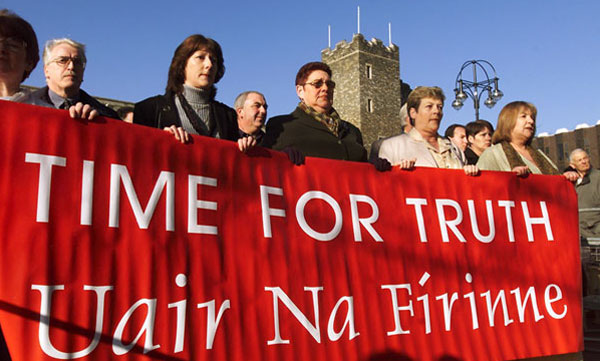
The Saville Inquiry Found British Paratroopers Guilty of Murdering 14 Innocent Civilians - Nobody Prosecuted
Ed Moloney offers the example of Patrick McCullough :
http://thebrokenelbow.com/2012/01/16/no-subpoenas-for-patrick-mccullough/
“Be Patient and Never Give up the Struggle” An interview with Tommy McKearney
International Viewpoint has published a stimulating interview with Tommy McKearney,
http://www.tommymckearney.com/Site/Blog/Blog.html

Tommy McKearney - A Patient Revolutionary Socialist
We hope soon to carry a review of Tommy’s recently published book

Goodbye Armalite, Hello Ballot Box?
Tommy welcomes the United Left Alliance Project :
Q: In late 2010 the United Left Alliance came together to contest the February 2011 general elections in Ireland, winning five seats. What is you assessment of the ULA?
TM: The ULA is a positive and progressive development. The fact that organizations of the left have come together at any time is good and that these groups are doing so at this time of capitalist crisis is heartening and encouraging. The ULA has also given some needed visibility to the left through its articulate and high-profile spokespersons such as Richard Boyd Barrett and Joe Higgins.
Asked about Ed Moloney’s “Voices From the Grave” and the British state attack on the Boston College Belfast Project, Tommy says : Read the rest of this entry »
How ordinary people really shaped the events of 1981 – Eamon McCann
A welcome focus on the politics of Mass Action Versus Militarism –
Eamonn McCann writing in the Belfast Telegraph
United Left Alliance TD’s, part of the Dáil Technical Group – Irish Times Review
For a change, the Irish Times report is fair to the left-wing outsiders.
Debate occurred on this site after the February 25 2011 General Election on whether Luke “Ming” Flanagan could be grouped within the left – we presume that argument is over now. Ming has sided with the United Left Alliance comrades on a variety of key issues since his election in Roscommon-South Leitrim – is the west awake for the left?
The article is discussed on the Cedar Lounge Revolution Site :
http://cedarlounge.wordpress.com/2012/01/12/speaking-about-the-independents-of-the-left/
Ming Flanagan gets this mention: we are told the Independent TD for Roscommon-South Leitrim who has in the past proudly advertised his fondness for the odd cannabis joint
orbits in this area, but is less clearly explicitly left-wing and therefore perhaps more sensibly regarded as being a sometime fellow traveller on some but not all issues.