Archive for the ‘Russia’ Category
Ukrainians Reject “Ridiculous” Calls for Negotiations with Putin’s Ethnic-Cleansing Invaders – That should be the Common Sense Policy of the Radical Left
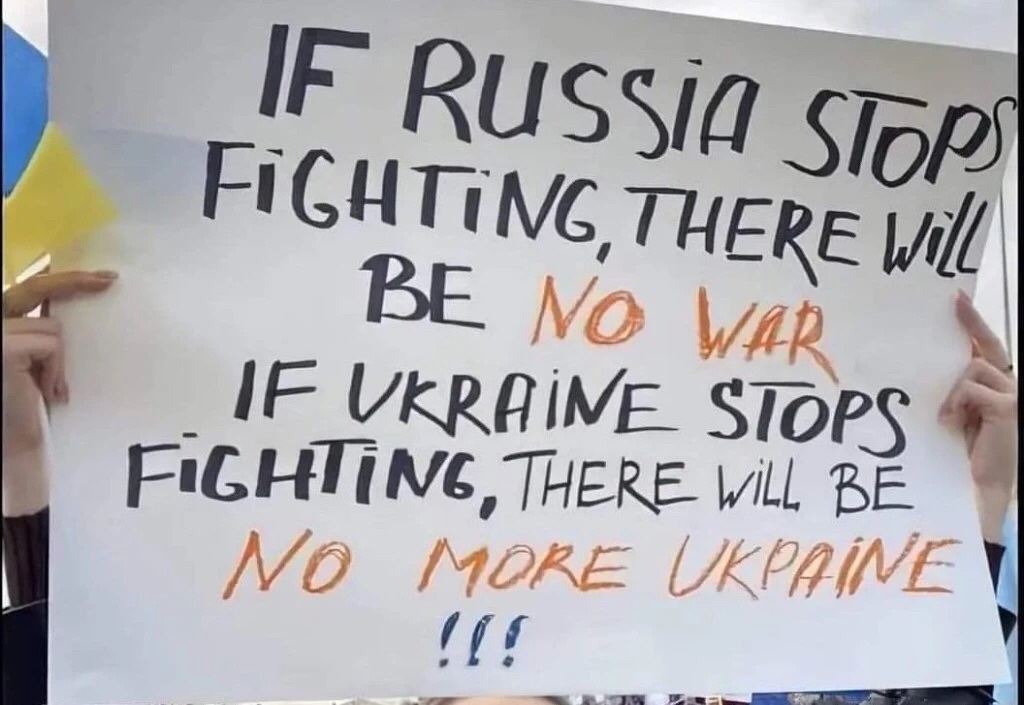
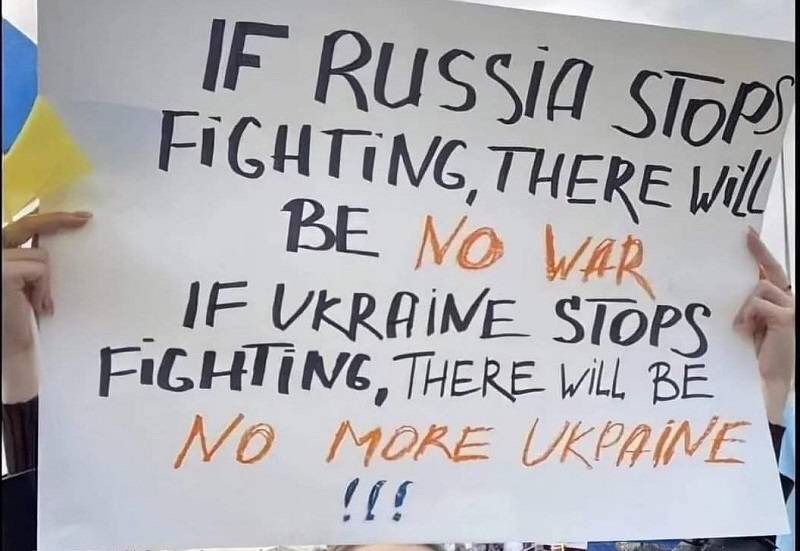
The vast majority of Ukrainians oppose a policy advocated by many western leftists who call for a ceasefire. Left-wing supporters of the ceasefire policy in Ireland – for example Sabina Coyne-Higgins (wife of Irish President Michael D Higgins) and the left-wing party People Before Profit – do not publicly engage with Ukrainians living in Ireland, who have expressed strong rejection of the recent ceasefire plea published by Ms Coyne-Higgins in the Irish Times. Here is one representative example :
Michael Baskin, who has lived in Ireland for 20 years and leads the Ukrainian Crisis Centre in Ireland, said he had spent time since the letter was published trying “to understand what Sabina Higgins was trying to say”.
“Ukraine never wanted this war. I will give a simple example. Somewhere in Ireland someone came to your house, killed your family, and tried to take it from you. Will you negotiate? Like, take a half of it and let’s live like this. It’s ridiculous.
“We can’t give up our country’s future. If we don’t stop Russia now, Ukraine won’t exist in 20 years.”
Ukrainians bridle over Sabina Higgins’s ceasefire letter
Letter by President’s wife no longer visible on Áras an Uachtaráin website – Irish Times July 30 2022
The PBP publicly backed the Coyne-Higgins Statement, stating she “had done nothing wrong”.



A number of left-wing activists disagree.
Read the rest of this entry »The 1914 Howth Gun-Running in Ireland : History Lesson for 21st Century Leftists who oppose a supply of weapons to members of the Ukrainian resistance
According to many sections of the left in Ireland and abroad, Ukrainians should not be supplied with weapons to resist the Russian invaders. Conor Kostick, an anti-war activist and a historian, labels this policy “Evasionism”. Here are accounts of the July 26 1914 Howth Gun-Running, followed by an introduction to left-wing Evasionism.
Remembering The Howth Gun-Running
On July 26th 1914, guns purchased in Germany for the Irish Volunteers were brought to Howth by Erskine Childers upon his yacht the Asgard.
In Howth they were met by the Fianna Eireann led by Bulmer Hobson & Countess Markievicz with carts and wheelbarrows to unload the guns, members of the volunteers were also present in case the police showed up


The harbour master informed the authorities and the Dublin Metropolitan Police were called out.
The police called for military assistance, so a detachment of the Kings Own Scottish Borderers based in Kilmainham was sent.
A riot ensued between the authorities & the volunteers; the authorities were unable to seize the weapons as during the riot they were quickly led away by the Fianna Eireann.
On their return to the barracks, a crowd had gathered in Bachelors Walk and began heckling the soldiers who responded by firing a volley into the crowd.
Three people were killed instantly Mrs Duffy, James Brennan and Patrick Quinn with thirty-eight injured. One man died later of bayonet wounds.
The Bachelor’s Walk massacre as it became known caused revulsion across Ireland and swelled the ranks of the volunteers.
Conor Kostick discusses Evasionism :
There is a type of left argument around the war in Ukraine which has arisen in the West. It is one that condemns Putin’s invasion, but refuses to offer practical support to the people of Ukraine in resisting that invasion. It is the position one can read in Jacobin, or in statements by Chomsky, Corbyn, and the Stop the War Coalition in the UK. In Ireland we have the same type of response to the Russian invasion of Ukraine from People Before Profit and the Socialist Party of Ireland.
I will use the label Evasionist Left for this approach. It’s not clear how representative this trend is internationally, as many on the left do pro-actively support the resistance in Ukraine, e.g. parties such Razem in Poland; those associated with the Fourth International like Left Bloc and the Danish Red Green Alliance; and the main left party in Japan, the Japanese Communist Party.
Ukrainian workers’ war on two fronts
Dick Nichols, a correspondent of the Australian Green Left Weekly, tells us that enemies of workers’ rights are active within the ruling Ukraine government headed by Volodymyr Zelensky. Nichols is a supporter of the European Network for Solidarity with Ukraine (ENSU). https://ukraine-solidarity.eu/to-read/ukraine-anti-social-bill-no-5371-has-been-withdrawn-but-the-threat-has-not-disappeared
When Russia invaded Ukraine on February 24, social conflict inside the country was not put on hold: any illusion that its defence needs might produce a truce in the class struggle soon vanished.
If anything, embattled Ukraine’s war of resistance against Putin’s “special military operation” has intensified a pre-existing domestic confrontation.
This is due to what could be called a “special politico-legal operation” against worker and trade union rights, waged by the most militant neoliberals within the government of President Volodymyr Zelensky, with the apparent blessing of their chief.
It was launched in 2019 to entice foreign investors to Ukraine but stalled in 2020‒21 when the government’s initial attempt at labour market deregulation was repulsed by trade union protests.
The offensive has sped up since the invasion, but now under cover of martial law and in the name of the sacrifice needed to win the war against Russia.
According to Nataliia Lomonosova, of the Ukrainian thinktank Cedos, the talk in government circles is that the Ukrainian state “cannot afford welfare, employment benefits or protection of labour rights” because of the war.
It seems clear from this experience that, however it defeats or survives Putin, Ukraine’s neoliberal government and its friends in the European Union (EU) are determined to turn the country into a business-friendly playing field as soon as possible — starting the job while the war against Russia is yet to be won.
Read the rest of this entry »“Providing Ukraine With Weapons is a Moral Act”
Yuliya Yurchenko, a supporter of the European Network for Solidarity with Ukraine (ENSU), has posted a message written by her comrade Andrij Zinchenko.
My dear European and American friends, what you see at this image shows that providing Ukraine with weapons is a moral act.
Read the rest of this entry »If you do not date to unblur this picture, let me explain what is there. Remanats of a child dead after Russian missile attack in the center of my hometown – Vinnytsya. One of these hundreds of children killed by Russian and Belorusian armies.
NO to NATO, or the identity crisis of the Spanish left
NO to NATO, or the identity crisis of the Spanish left
http://ukrainesolidaritycampaign.org/2022/04/26/no-to-nato-or-the-identity-crisis-of-the-spanish-left/
— Read on ukrainesolidaritycampaign.org/2022/04/26/no-to-nato-or-the-identity-crisis-of-the-spanish-left/
Elisa Moros writes an interesting article concerning the Ukraine policy of the Spanish left. There are parallels with Ireland.
It is dated April 26 2022
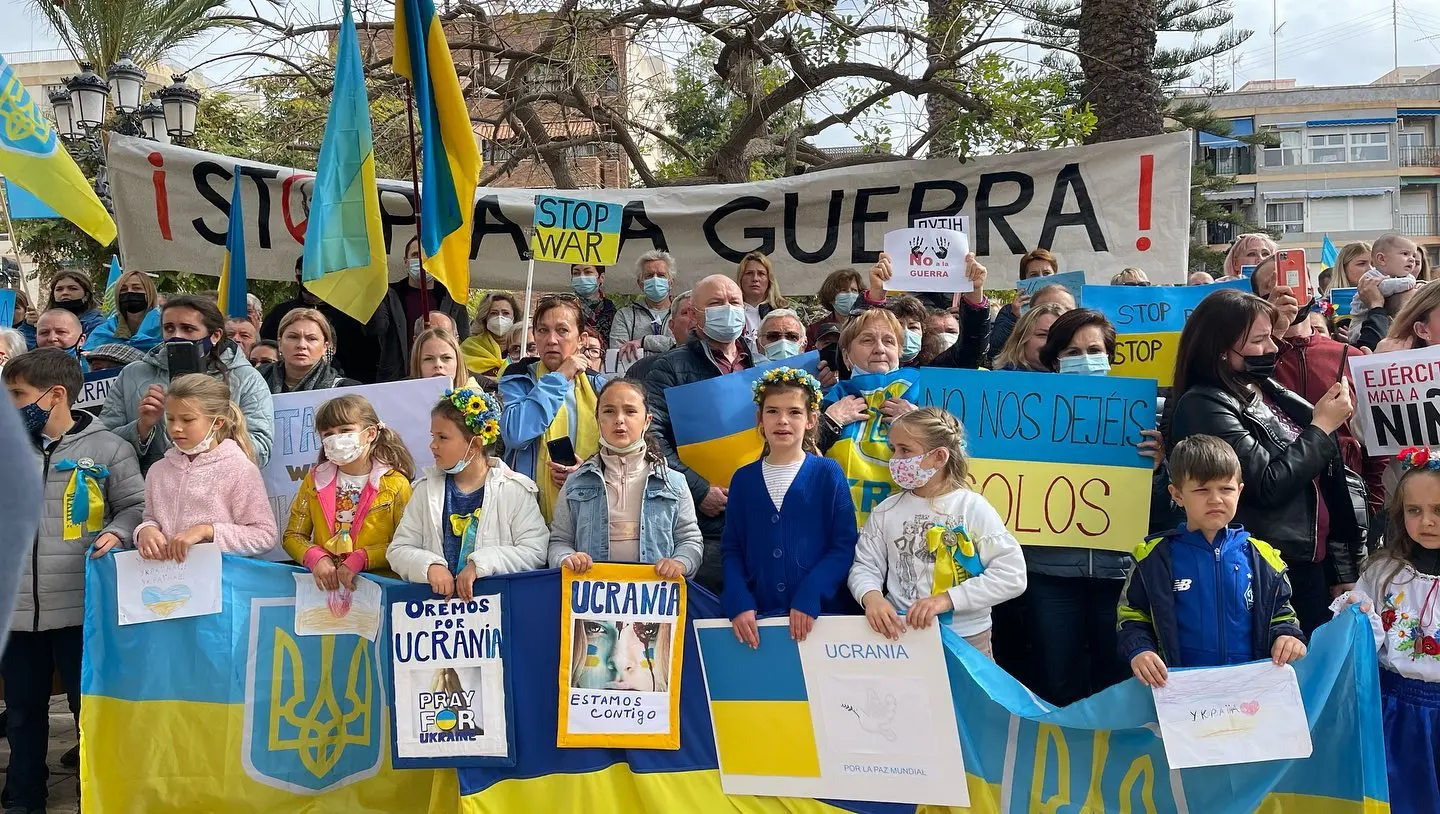
The terrible images reaching us after the withdrawal of Russian troops from the Kyiv region reveal the scope of the Russian offensive. These images force political leaders to unanimously condemn Putin’s attack on Ukraine, including Putin’s natural allies (the far-right). In this context, some of the most radical among us feel the need to express -if only through an aesthetic gesture- their aversion to national unanimity. For example, Members of Parliament (MPs) from the CUP (Catalan pro-independence radical left) and the BNG (Galician nationalist left) as well as the Secretary General of the PCE (Communist Party) refused to applaud Ukrainian President Zelensky when he addressed the Spanish Parliament.
This aesthetic gesture is hardly surprising. Rather, it is the logical consequence of the analysis and positions of the Spanish left on the Ukrainian situation. Albert Botrán (CUP MP) explains the meaning of his gesture in his article “Applauding Zelensky“, in which he begins by stating that “Only Putin is responsible for the Russian occupation of Ukraine”, only to contradict himself in the following paragraph by denouncing the “responsibilities” of the other powers and the Ukrainian state. While only four MPs pushed their logic to its conclusion by refusing to applaud Zelensky, the logic of “Well yes, but actually no” is practically unanimous within the Spanish radical left, which (1) designates the NATO as (at least) co-responsible for the conflict, and therefore (2) opposes any concrete material support to the Ukrainian armed resistance in order to “prevent escalation” and (3) systematically points out (and often exaggerates) all the flaws of the Ukrainian government/state. This then serves in practice as a pretext for these leftists keeping their distance from all sections of the Ukrainian population, and leaving them alone in the face of the Russian imperialist attack. Read the rest of this entry »
“The right to resist.” A manifesto written by over 100 Ukrainian Feminists and Feminist Organisations
“The right to resist.” is a manifesto written by over 100 Ukrainian Feminists and Feminist Organisations
| This is a Manifesto of Ukrainian feminists. Many Ukrainian feminists have come together with a common statement about their priorities. These include armed and unarmed resistance, and a reconstruction of Ukraine centred on equitable social reproduction, labour rights, equality and democracy. It was published in Commons and other online sites on Thursday July 7 2022. You can sign at the link below. The authors ask feminists, activists, and feminist collectives around the world to add their names to the document. https://commons.com.ua/en/right-resist-feminist-manifesto/ |
We, feminists from Ukraine, call on feminists around the world to stand in solidarity with the resistance movement of the Ukrainian people against the predatory, imperialist war unleashed by the Russian Federation. War narratives often portray women* as victims. However, in reality, women* also play a key role in resistance movements, both at the frontline and on the home front: from Algeria to Vietnam, from Syria to Palestine, from Kurdistan to Ukraine


Bad news for survivors of sexual violence after Ukraine ombudsman discredited
Accurate reporting during a war is difficult – and it is essential.
Source : http://www.europe-solidaire.org/spip.php?article63179
The Ukrainian ombudsman Lyudmila Denisova has been sacked for exaggerating the number of rapes by Russian invaders. Her foolishness has done great harm to the struggle for women’s rights in this war. Victims of sexual violence in Ukraine will find it harder to make a complaint. The Kremlin propaganda campaign is also falsely accusing Russian feminists of embezzling funds collected with “fake rape” stories.
In May, the ombudsman for human rights in Ukraine, Lyudmila Denisova, reported hundreds (if not thousands) of cases of rape of Ukrainian civilians by Russian soldiers. Among the cases she described were particularly brutal cases of rape of infants. She received the information from her daughter, who is in charge of the hotline project for such appeals.
Rape in war is always another weapon of war. Several cases of rape and pregnancy after rape (including teenage pregnancies) have already been documented and proven by international organisations.
These heinous crimes are hard to prove and survivors of war rape do not often go public out of fear for the lives of their loved ones.
This is why truth, facts and very balanced statements are always important when talking about war rape.
Poland : Access to Safe and Legal Abortion – Polish parliament debate, June 22 and 23 2022
In Ireland – especially during the dark days of the anti-abortion 8th Amendment to the Irish Constitution ((1983-2018) – women had to travel abroad to get an abortion. In Ukraine today many women raped by invading Russian soldiers flee to Poland where they cannot get an abortion. The left wing party Razem is proposing legislation in the parliament to end the abortion ban in Poland. We must extend solidarity and support.
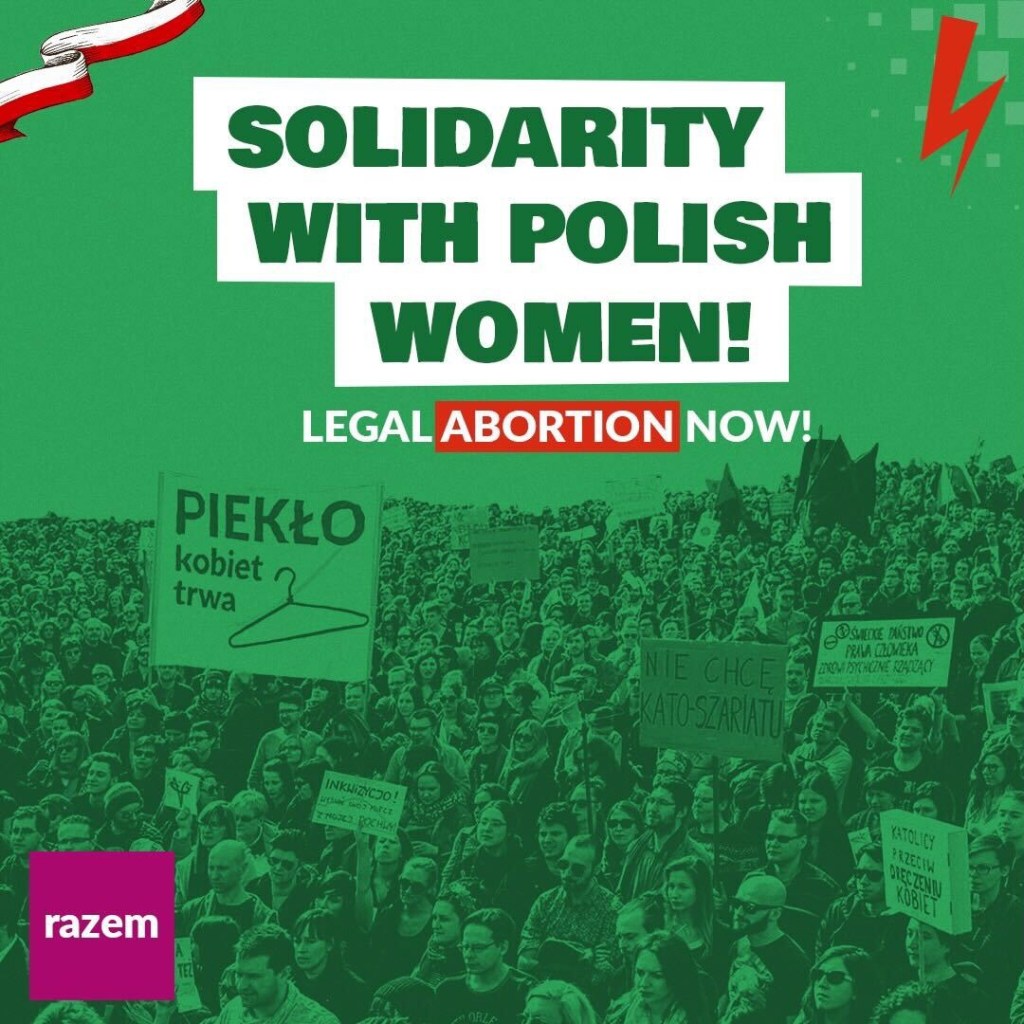


Razem reports :
A great challenge of immediate concern in Poland is the access to safe and legal abortion. Women’s rights to decide about their own bodies have been extremely limited in our country. Under current laws, abortion is permissible only in case of rape, incest or threat to the mother’s health and life. Additionally, as a consequence of social and political pressures, doctors often refuse to perform the procedure. This directly causes the suffering and deaths of many women.
Read the rest of this entry »War in Ukraine – a view from Greece – “Support the Ukrainian people in their resistance against the war!”
The Russian invasion of Ukraine has divided opinion on the left in all parts of the world. Here is an interesting contribution from Greece. Source : https://tpt4.org/2022/06/09/support-the-ukrainian-people-in-their-resistance-against-the-war/?fbclid=IwAR2MG80aYrYE17qsDzgSVrVao4Do8wy-Ga4rfNRpkTsPexhGPIaiVal0LsE
War in Ukraine – a view from Greece
Support the Ukrainian people in their resistance against the war!
by Tassos Anastassiadis
[Αναδημοσίευση από το International Viewpoint, 1/6/2022]
[Το πρωτότυπο, στα ελληνικά, στο site μας και στο site της Αναμέτρησης]
Tassos Anastassiadis is a member of “Anametrisi”’s leadership and also a member of the TPT-“4” (part of the Greek section of the Fourth International). Anametrisi (=confrontation), founded in March 2022, is a product of radical left recomposition process in Greece these last years. [1] This text was submitted to the leadership of Anametrisi on 19 May 2022. The original Greek text is published on Anametrisi’s site.
Positions on the Ukrainian war and our stand
1) The Russian invasion of Ukraine is an “imperialist” attack. [2]. Analyses may differ on the source of this “imperialism” [3], on the extent of its dynamics, on the causes of this particular invasion, and even on its function in the capitalist world arena. But what is fundamental is that it is an unjust war of the strong against the weak. [4] And in particular, it is a “national” type of oppression – that is a challenge at gunpoint to the right of a population to exist as a political entity and to decide for itself and freely about its own existence.
2) From this point of view it is a matter of principle [5] for the left to take a clear position on the war being waged: It must place itself on the side of the weak, those who are under attack and fighting back i.e. on the side of the Ukrainian people. The right of a people, a population, a nation, to define itself is a fundamental component of an emancipatory programme.
3) This means that in this war the left cannot be indifferent: it is not a “war” that is simply taking place somewhere out there, without subjects and without responsibilities. It is a military attack and there is contestation and resistance to it. The left must take a stand against the war being waged by Russia, and consequently, in favour of those who oppose it, basically the Ukrainian people but also the Russian left. That means in favour of the war being waged by the Ukrainian people.
Read the rest of this entry »