Archive for the ‘Left Wing Organisations’ Category
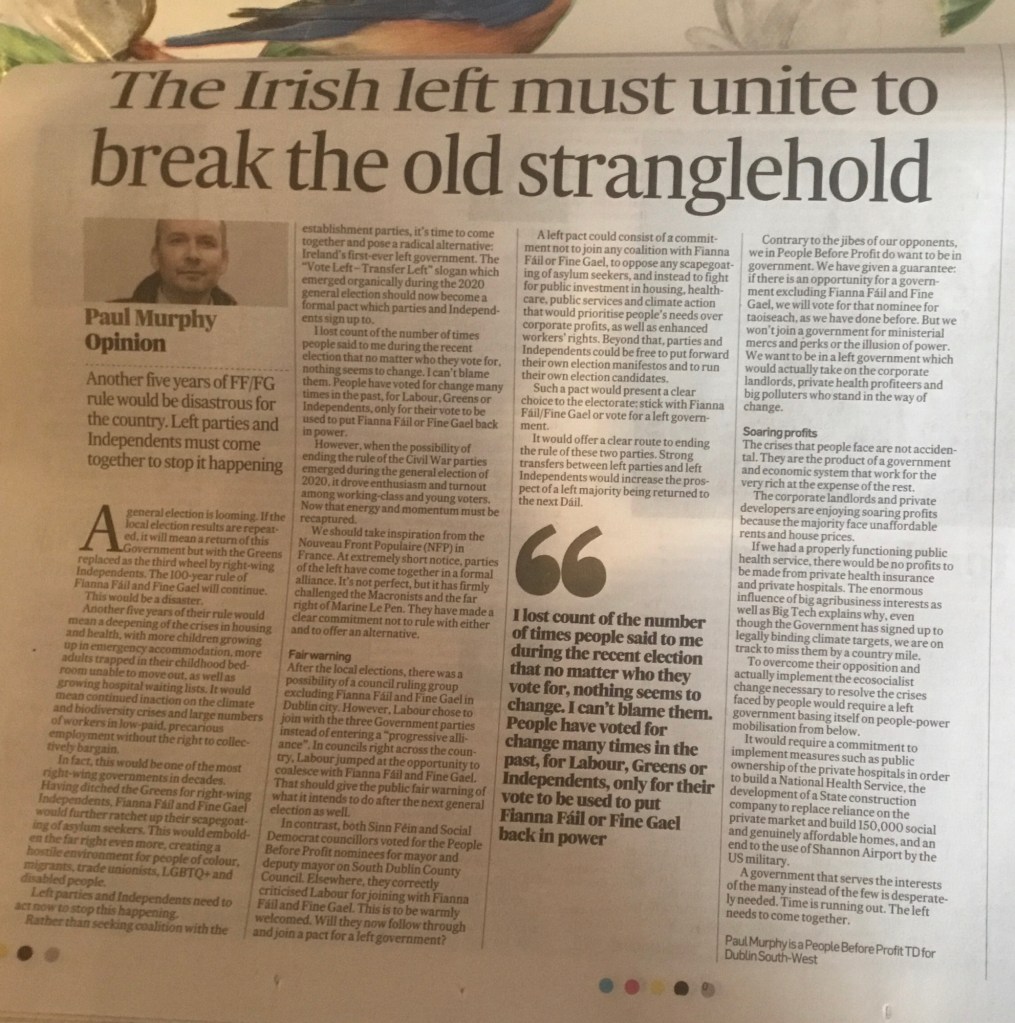
The Irish Left Must Unite to break the old stranglehold – Paul Murphy TD (People Before Profit, Dublin South-West), Irish Times, July 4 2024
Paul Murphy’s opinion piece in the July 4 2024 edition of the Irish Times makes a strong case :
“Another five years of FF/FG rule would be disastrous for the country. Left parties and Independents must come together to stop it happening”
There is a bottom line :
No coalition with Fianna Fáil or Fine Gael.
Time for a new united left alliance to topple Fianna Fáil and Fine Gael
Another five years of FF/FG rule would be disastrous for the country. Left parties and Independents must come together and stop this happening
A general election is looming. If the local election results are repeated, it will mean a return of this Government but with the Greens replaced as the third wheel by right-wing Independents. The 100-year rule of Fianna Fáil and Fine Gael will continue.
This would be a disaster.
Another five years of their rule would mean a deepening of the crises in housing and health, with more children growing up in emergency accommodation, more adults trapped in their childhood bedroom unable to move out, as well as growing hospital waiting lists. It would mean continued inaction on the climate and biodiversity crises and large numbers of workers in low-paid, precarious employment without the right to collectively bargain.
Read the rest of this entry »Major Donor to Nigel Farage’s Reform Party Owns Russian Assets
Link :
Major Donor to Nigel Farage’s Reform Party Owns Russian Assets

We thank Councillor John Lyons (Dublin City, Artane-Whitehall) [Independent Left] for this story.
Major Donor to Nigel Farage’s Reform Party Owns Russian Assets
Reform’s leader has been criticised in recent days for claiming the west provoked Putin’s invasion of Ukraine.
By Adam Barnett and Sam Bright
Jun 26, 2024
One of the biggest donors to Nigel Farage’s anti-net zero Reform UK during the general election campaign has significant Russian business interests, DeSmog can report.
Natural resources investor David Lilley donated £100,000 to Reform on 10 June – a week after Farage announced that he was returning as the party’s leader. Lilley’s donation was the third largest to Reform during the campaign so far.
As revealed by The Mirror and Good Law Project in the former’s print edition, Lilley controls a series of companies that own 12,000 hectares of farmland in the Stavropol region of Russia, in the south west of the country, used to produce cereals and oilseeds.
Lilley confirmed to DeSmog that he still owns this land, saying that “I have never made a secret of my assets in Russia.” He said that he had made no profit on these assets since February 2022 and that he had been prevented from selling them by the Russian state.
Farage has come under fire in recent days for suggesting that Russia’s 2022 invasion of Ukraine was provoked by the west, and for calling on Ukraine to enter peace talks with Russian President Vladimir Putin. Good Law Project executive director Jolyon Maugham told DeSmog that Reform is “starting to feel a bit like Russia’s unofficial British Embassy.”
Read the rest of this entry »Sinn Féin Election Disaster – The Price Of Putting Popularity Before Principle – Éirigí Analysis
Éirigí, a socialist-republican organisation, “is a political party that was formed in 2006 by a group of Dublin-based community and political activists. We believe that modern Ireland is a deeply undemocratic, unequal and unfair country not by accident, but by design.” Their analysis of Sinn Féin’s unexpectedly weak showing in the June 7 2024 Irish Local and European Elections highlights how the party was bounced into changing its position on immigration and racism :
With a few notable exceptions, this new talking point was propagated without context – with no detailed critique of migration in the modern world – no attempt to explain why the asylum process is in chaos – no robust defence of the core republican principle of equality – no assertion that racism, sectarianism and xenophobia are the enemies of republicanism – no calling out the peddling of hate and division by the far-right.
For potential Sinn Féin voters, the lesson was clear. The party could be bounced into changing its messaging if there were votes at stake, even when those doing the bouncing were far-right bigots. It seems almost certain that the ease with which Sinn Féin was bounced on the issue of immigration did them more electoral damage than their actual position on immigration.
Sinn Féin Election Disaster – The Price Of Putting Popularity Before Principle
Link :
Sinn Féin Election Disaster – The Price Of Putting Popularity Before Principle – Éirigí analysis
Two weeks have now passed since the Local and European elections in the Twenty-Six Counties. Despite Sinn Féin’s frantic spinning to the contrary, the election was nothing short of an unmitigated disaster for the party. The number of votes and seats secured by the party was even lower than the lowest expectations of pollsters, political commentators and Sinn Féin itself.
As recently as July 2022, support for Sinn Féin was at a level not seen in more than a century. The Irish Times/IPSOS opinion poll for that month found that 36% of voters in the Twenty-Six Counties intended to vote for Sinn Féin.

Fourteen months later, in September 2023, the same poll found that 34% still intended to vote for Sinn Féin. Among voters under the age of 34, support was even higher at more than 43%. Despite this, Sinn Féin secured less than 12% of the popular vote in the 2024 Local and European elections.
So, why have two-thirds of Sinn Féin supporters abandoned the party since last September?
Prior to elections the apparent answer to this question seemed obvious to many – immigration. Immigration, it was claimed, had recently become a red-hot issue for many Sinn Féin supporters., and these supporters were now walking away from Sinn Féin in their droves because the party was too ‘soft’ on immigration. It was an open and shut case. Until it wasn’t.
When the ballot boxes were opened on this day two weeks ago, it quickly became clear that the opinion polls had significantly underestimated the scale of Sinn Féin’s woes.
Read the rest of this entry »How well did the left go in the June 9 European election? – by Dick Nichols, Green Left (Australia)
A recommended article :
Source ;
How well did the left go in the June 9 European Election?
How well did the left go in the June 9 European election?

Provisional results of the 2024 European Elections, as at June 19. Source: results.elections.europa.eu
At first glance it looks as if the parties to the left of the social democracy held their ground against the surge of the far right and mainstream right that marked the June 9 European Union (EU) parliamentary elections (see here for results in detail).
Although the smallest of the European parliament’s seven groups, The Left managed to maintain its EU-wide vote at 5.4% and increase its seat tally from 37 to 39 in the 720-seat assembly.
In addition, left green Members of the European Parliaments (MEPs) and those representing stateless nations (part of the Greens group as the European Free Alliance) at least maintained their numbers in the chamber.
See also
Finland: Mass workers’ strike wave continues against gov’t attacks on workers, unions, welfare
Interview: Fascism and resistance in France today
Ukrainian unionists: Oligarchs, not Europe’s poor, should pay for weapons and aid to Ukraine
Workers’ Party of Belgium gains ground in European, national elections
Yet the Greens group as a whole shrank from 71 seats to 53 while that of the liberals (known as Renew) fell from 102 to 79. This drop reflected that the environmental issues that in part drove the big advance of these parties in the 2019 election were less important for many voters this time.
The campaign was dominated by insecurity about the future, the cost of living (particularly housing), the fear of war, the “immigration threat” and intolerance of difference.
In this grim atmosphere the biggest growth went to the mainstream right European People’s Party and the two far-right groups (Identity and Democracy and Conservatives and Reformists): taken together the right and far right won an extra 30 seats, bring it to 324.
Because it would take only 37 ungrouped MEPs to join them to from a reactionary majority, the June 9 result poses with new urgency two old questions about politics in the European parliament. How much, if at all, does the real balance of political forces in the chamber differ from that among its formal groupings? And how much does membership of a group represent disciplined commitment to its positions?
Left divisions over Ukraine
The questions are sharply relevant in the case of the Left group, where differences over what stance to take towards the Russian invasion of Ukraine were already pointing towards a split before June 9.
On May 31, Li Andersson, chairperson of the Finnish Left Alliance told the Helsinki Times that these differences could not be tolerated in the group in the new legislature. Referring to Clare Daly and Mick Wallace, Irish left independent opponents of military aid to Ukraine, Andersson said: “The Nordic Green Left as a whole [covering Finland, Sweden, Denmark, Norway, Iceland, Greenland and the Faroe Islands] is of the opinion that if they manage to win re-election, they can’t join our group.”
For Andersson, the same went for the new Sahra Wagenknecht Alliance: For Reason and Justice (BSW), a split in Germany from leading Left group member Die Linke (The Left). BSW opposes military aid to Ukraine and supports resuming the gas trade with Russia, in common with most of Europe’s far-right parties.
Read the rest of this entry »The June 2024 European and Local Elections in Ireland – What do the results tell us about Irish Politics? – Independent Left Analysis
Independent Left on Election 2024

Independent Left candidate Councillor John Lyons topped the poll in Artane-Whitehall 2024 for first preferences in the local government elections of 7 June 2024. This was a terrific result for our small party and above all is a recognition of the consistent, empathetic and determined work carried out by John for individuals and groups in the community he represents on Dublin City Council. The high vote might also be connected to the values and priorities of Independent Left and this deserves some reflection.
Before getting to that, however, what happened in the bigger picture? What do the results tell us about Irish politics in the snapshot provided by the election?
1. Fine Gael turned public concern onto the question of immigration.
It’s an old and, unfortunately, successful tactic by conservative and governing parties that to deflect from how they have facilitated the rich getting richer, they focus public anxiety on immigrants. In the run up to the election, Fine Gael, and their Fianna Fáil and Green partners in government, forced refugees into homelessness then arranged performances such as bulldozing tents to generate attention to the issue. This worked to put a spotlight on Sinn Féin’s response.
2. The Centre Held?
Ever since COVID restrictions gave fascists a focus to organise around, they’ve been growing in Ireland. By mobilising against refugee centres, they gained a following beyond a fringe. Encouraging people to be angry against immigrants plays right into the hands of these fascists. Fine Gael took a calculated risk on this: they chose to give fascism a boost rather than face the electorate on their record in government. After the election they breathed a sigh of relief and pundits everywhere said that the centre held. The reality, unfortunately, is that fascists did make significant gains. Not the gains that they themselves and their US funders hoped for, but about 5% of the electorate voted far-right in the European elections and in the local elections they got five seats, coming very close to a sixth in Artane-Whitehall.
Read the rest of this entry »Rory Hearne accuses Ciaran Mullooly of ‘hypocrisy’ in scathing attack on the “Independent Ireland” racist party – a wolf in Blueshirt clothes
This is an Irish Independent Story, June 3 2024.
A few ex Fianna Fáil and Fine Gael Dáil Deputies formed Independent Ireland (IIP) recently, led by a man with a famous name, Michael Collins TD (Cork South-West). The 1922 pro-treaty inheritors of the dead Michael Collins legacy went on to establish the failed fascist Blueshirts in the 1930’s led by Fine Gael’s first president Eoin O’Duffy.
The IIP is running two well known broadcasters (Ciarán Mullooly and Niall Boylan) in the European elections.
Social Democrat Euro-Parliament candidate Rory Hearne presents a convincing left-wing anti-racist case against the IIP wolf in Blueshirt clothes.
Rory Hearne accuses Ciaran Mullooly of ‘hypocrisy’ in scathing attack on Independent Ireland
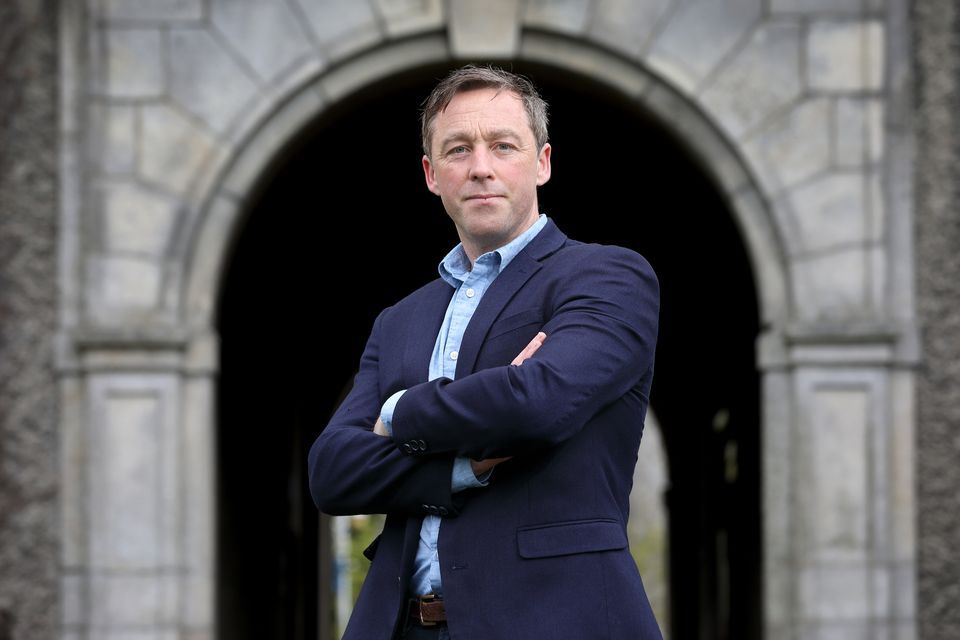
“Why won’t Mullooly and others call for tougher action against the real causes of the housing and homelessness crisis – the vulture funds and corporate landlords locking people out of a home, evicting people and raising the rents?”
Mr Hearn said Independent Ireland offers “no solutions” for the problems that have been caused due to a lack of accommodation.
“The election next week will set the course of Ireland and Europe for many years to come. Are we to turn into a divided society?
“Or are we going to come together and address the real causes of the crises, work on solutions together, and treat migrants and asylum-seekers with the dignity every human being deserves, and see migrants for how they positively contribute to and enrich our country.”
Read the rest of this entry »Robert Ballagh’s “The Thirtieth of January”: A Bloody Sunday Painting and the Troubles in the Two Bits of Ireland
In this interview the artist Robert Ballagh discusses the painting “The Thirtieth of January”, depicting Bloody Sunday in Derry in 1972. The conversation provides valuable insights into Ballagh’s personal experiences and artistic process, shedding light on the political and social context of the time.
The interview provides a unique insight into the historical and cultural significance of the painting.
Critical issues related to the Irish government’s response to the conflict, the impact of the Bloody Sunday event, and the broader social and political implications are highlighted. Ballagh’s commentary on the role of the Irish government, the impact on nationalist communities, and the establishment of the Special Criminal Court adds depth to the discussion.
Bloody Sunday Painting – the Thirtieth of January – Robert Ballagh
Thursday, January 20 2022. John Meehan interviews the artist Robert Ballagh in Number Five Arbour Hill.
We are talking about Robert’s painting : The Thirtieth of January, a representation of Bloody Sunday in Derry, January 30 1972.
John Meehan :
Why did you zone in on Derry’s Bloody Sunday , and put so much effort into making this painting? What makes it different from so many other big events during “The Troubles” in the north of Ireland, which lasted for 30 years, from 1968 to 1998?
Robert Ballagh
Well, it’s a long time ago now 50 years, but I have to say that it had an enormous effect on me, and I don’t think I’m alone with that historical experience. I suppose one thing I should say, I was only thinking about this, and I haven’t said anything about this experience to others. I’m a Dubliner. I’ve lived all my life in Dublin. But unlike most Dubliners – it wasn’t by design – I had an extraordinary rich knowledge of the North of Ireland, before the conflict began. Because I was a professional musician in a showband. We used to play at least once or twice a week in the north. So I was in every town village or city in the north that had a ballroom or ballrooms. And so I experienced the reality of life in that society, and became very aware of the sectarian differences, shall we say – the nature of the society, which people didn’t appreciate at all. I tell one very short story to illustrate that. We played fairly regularly in one of the very popular ballrooms in Belfast : Romano’s in Queen Street. We developed quite a following! In the show business vernacular the word groupie was used. These girls used follow us, they came down to Dublin once or twice to hear us. And we were playing one night in Romano’s.

After the dance, they came up and we’re talking to us. They asked “When are you playing again in Belfast?”.
I remember saying “Oh, I think we’re here next week.”
“Oh, really?”
“Yeah – we’re playing in a ballroom called the Astor” which I knew was in Smithfield.
And they said, “Oh, we can’t go there.” And I said, “Why?” – because it was a public ballroom. It wasn’t attached to any organization or anything. It was a public ballroom.
They said, “Oh, no, that’s a taig hall”
And it was the first time I realized, and we realized, that our fan base in Belfast was Protestant.