“We Only Want the Earth” – Important Trade Union backed James Connolly Documentary on RTÉ 1 TV, Wednesday August 26 2026 – Why did this revolutionary marxist sign the Famous Easter 1916 Proclamation, helping to lead “A social revolution by force of arms”?
A James Connolly Documentary will be broadcast on the Irish State’s main TV broadcast station, Radio Telefís Éireann (RTÉ 1) on
Wednesday August 26 2026, RTÉ 1, 21.30
Yellow Asylum Films Announcement :
WE ONLY WANT THE EARTH
The Life & Ideas of James Connolly
We are delighted to announce the upcoming screening on RTÉ of the feature documentary on James
Connolly, created to inspire and enlighten a contemporary audience about Connolly, his life and his
ideas. It will screen on RTÉ 1 on Wednesday August 26th at 21.30.
An iconic presence on the landscape of Irish socialism and republicanism, the name of James Connolly looms
large in the trade union movement and wherever radical left-wing politics are espoused. The film tries to place
Connolly’s radical ideas and many political achievements against the landscape of the contemporary world as
well as documenting his more prominent role in the 1916 Easter Rising.
As well as many distinguished commentators, union activists and historians, the film also features many songs
and poems – spoken and sung by contemporary artists such as Christy Moore, Stephen Rea, piper David
Power, singers Eoghan Ó Ceannabháin and Esosa Ighodaro as well as Connolly’s great great grand-daughter
Tamsin Iona Connolly Heron. Acclaimed actor Terry O’Neill performs the words of Connolly.
The film aims to reclaim Connolly’s story as well as invoking his important social vision – with a clear eye on
how it resonates in our contemporary time – an era when even democracy itself appears under threat.
The film was independently produced and financed with the support of the Irish Trade Union
movement.
Director & Writer: Alan Gilsenan
Producer & Archive Researcher: Martin Mahon
Executive Producers: Des Geraghty & Noírín Greene
A Yellow Asylum Films Production for the James Connolly Foundation for Educational Equality
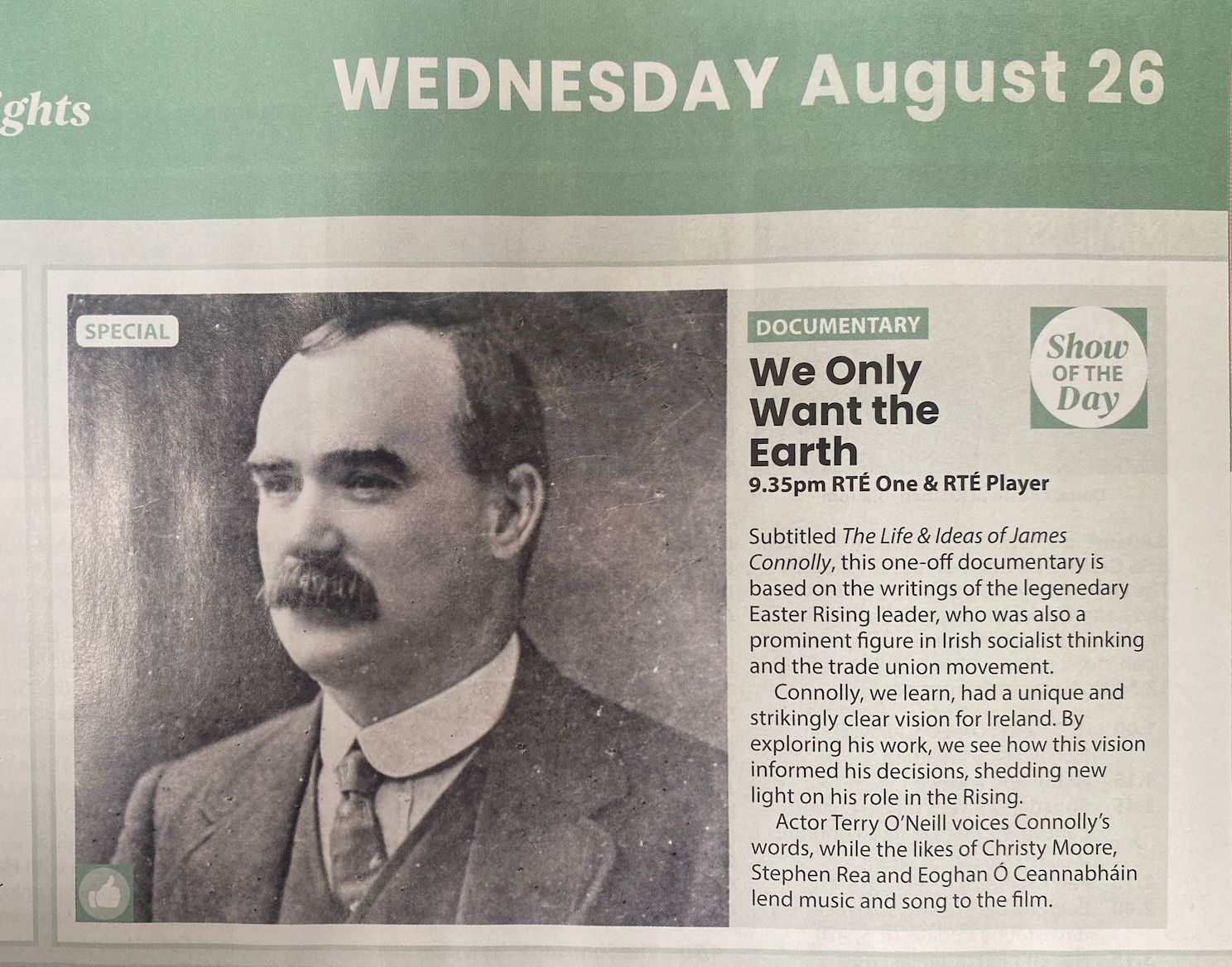
The documentary is recommended to all readers interested in the life and times of James Connolly, a revolutionary marxist activist who became a leader of the growing Irish trade union movement in the early 20th century, and who promoted a distinct socialist and anti-imperialist vision. Connolly was one of the seven signatories of the Easter 1916 Rising in Dublin’s General Post Office (GPO). The British state executed this hero of the Irish working class on May 12 1916.
Ever since, James Connolly has captured a place in the Irish public imagination more than any other figure in the workers’ and socialist movement. No Irish socialist is really taken seriously unless s/he claims to be following in his tradition.
This was the position in 1972, as desbribed in the pages of a weekly political publication, Hibernia :
No fewer than 23…..communist, socialist and left-wing groups exist in Ireland, according to a list appearing in the 23 June 1972 issue of Hibernia. These organisations represent various trends in national and international politics but all, without exception, laid claim to James Connolly as their model and inspiration.
This position is essentially unchanged in 2026.
Yet at the time of his execution Connolly was isolated in the leadership of the Irish workers’ movement and internationally. He is reported as saying in his death-cell “The socialists will not understand why I am here. They forget I am an Irishman”.
Louise Bryant – A contemporary revolutionary socialist and feminist who understood why James Connolly was in Dublin’s GPO at Easter 1916
There were significant exceptions. We begin with a contemporary assessment written by Louise Bryant :
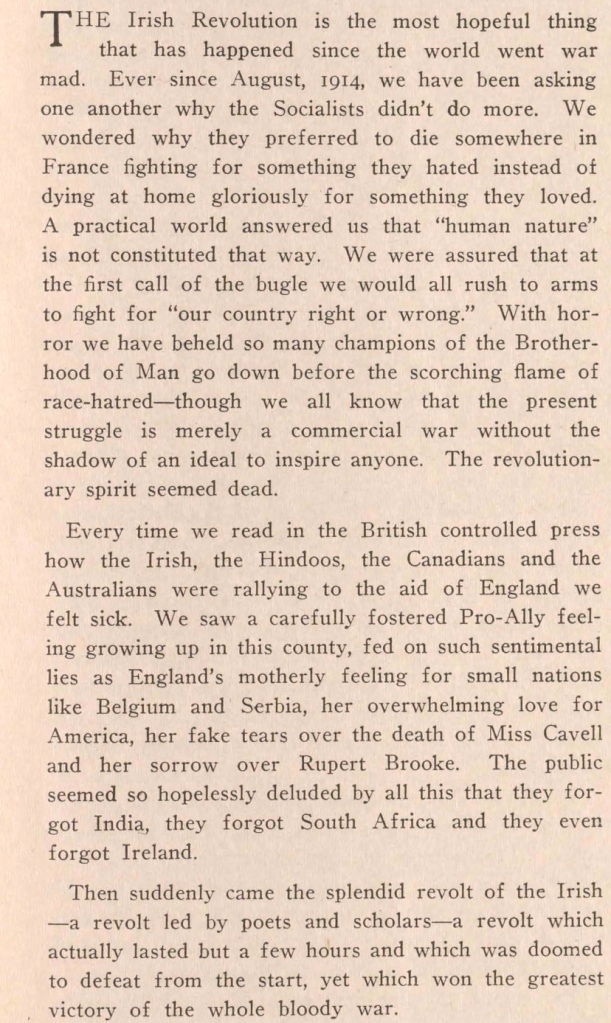
Poets’ Revolution, Louise Bryant, The Masses, Jully 1916
Louise Bryant’s brilliant analysis stemmed from a deep commitment to revolutionary socialist and feminist politics – and a little-known Irish-American background, via her father.
The following account comes from an online biography I discovered in April 2025. Fortunately I saved the following text because the link is now dead. Interested readers might like to assist!
Late one night, Reed brought home with him an Irish labor leader. “This is Jim Larkin,” said Reed, introducing him to Louise. “He ‘ s on the lam…..he ‘ s been telling workers both in Ireland and here that they had better learn to use rifles before they go out on strike.”
Louise ‘ s interest grew as she listened to Reed and Larkin talk. Then, when Larkin began talking about the latest developments in the Irish struggle to get rid of the British, she became excited, and began asking questions. It was then that Reed, for the first time, learned something about her early life.
“You know,” she told a delighted Larkin and an astonished Jack Reed, “my father was a Fenian and even wanted to invade Canada. And I have a brother, Lou Parnell, who is named after a great Irish leader.”
“I ‘ ll be damned,” said Larkin, “that’s Charles Stewart Parnell. Then your father must have been a Protestant.”
“And I’ll be double-damned,” echoed Reed, as he got up, embraced and kissed her.
They talked far into the night and Larkin left while it was still dark. But from that night on she became more and more absorbed in Ireland, and it became one element in her affair with (playwright Eugene) O’Neill, whose middle name was Gladstone, after the British statesman who, at least mildly, favored Irish independence. It was Larkin’s inspiration that prompted her to write the tribute to Sir Roger Casement, an article about the abortive 1916 Easter Day revolt and Sir Roger’s execution for seeking help from the Germans for what was to have been an uprising in Ireland while the British were busy on the battlefields-in Europe.
Bryant also wrote this perceptive note about the British state’s execution of the 1916 rebel Roger Casement :
Sir Roger Casement
(Extract from a Letter)
“HE really was an old trump, you know.- He did
great things in the Congo—and a cheap trinket
like a knighthood didn’t spoil his vision. He never
wavered at the end. I happen to know how much he
wanted to be hanged—how afraid he was that England
might realize her rashness and not go through with it.
His sister, to whom he was everything, felt the same
way. They wanted the protests—they wanted England
shown up—but they felt that it must be, or all the
other lives that were already sacrificed might seem
paid for by this mercy. He knew the Irish; he knew
that while they might forgive the lives that were taken
in the first fury, they could not forgive the one taken
in cool calculation long after it was over.
They never will forget that.
“Anyway, I envy him. I’d like to die at sixty or
sixty-five (I believe that was his age), for something
worth while, in a mad moment of history like this.
“L. B.”
Louise Bryant became known to a mass audience thanks to a magnificent film directed by Warren Beatty – “Reds” – which told the inspiring story of the Louise Bryant and John Reed, chroniclers of the 1917 Russian Revolution.
Link :
World War 1 is about profits – Louise Bryant and Jack Reed Agree – scene from film “Reds”
Link :
Louise Bryant Memorial and Grave
Leaders of the Russian revolution especially VI Lenin and also Leon Trotsky, were almost totally unknown to the world at large when they wrote articles defending the 1916 Rising against charges that it was a “putsch”, and argued that it had a positive significance for socialists.
It would be pleasant to deduce from this that the lesson had been learnt but the suspicion must be that the same has happened to Connolly as has happened to other figures of historical significance after their death – that many who claim to be following in his footsteps do not do so in practice, and could not justify this claim if pressed to explain why.
If this problem is to be confronted honestly and truthfully Connolly’s participation in the Rising with an organisation that could not be classified as anything more than revolutionary nationalist, the Irish Republican Brotherhood(IRB), must be dealt with. No amount of criticism of the inadequacies of the 1916 Proclamation, or of the symbolism and mysticism of writings of the IRB’s Pádraig Pearse, in which he appeared to glory in the idea of violence and bloodshed, will drive the problem away. The fact is that when it came to the final reckoning Connolly had more in common with the IRB than those who, whatever role they had played in the formation of the Irish Trade Union movement, would not commit themselves in the struggle to win Ireland’s independence from the British Empire, at that time the most powerful capitalist nation on earth.
This was illustratged the actions after the Rising of Thomas Johnston, chairperson of the Irish Trade Unions Congress (ITUC) from 1914 to 1916 and later the leader of the Labour Party. He used a great deal of energy trying to expose various acts of brutality the British Army had been responsible for. But he only made representations to the authorities on behalf of people who had not actually participated in the Rising. This led to the point where he wrote to the British labour leader Arthur Henderson (a member of the British imperial war cabinet) about the imprisonment of William O’Brien and PT Daly without referring to Connolly on the day of his execution.
There was a deep and unbridgeable political chasm between Connolly and the people who were later to lead the Labour Party. There is little point in saying this was an “error of judgement” or a “moral failure” on Johnson’s part – though this was certainly the case – unless one goes to the heart of the matter, the principles that were at stake, and can justify the role that Connolly played at the end of his life.
Connolly and Pearse were Irish household names for many decades. Connolly is remembered more as a man who fought for Ireland’s separation from Britain than as one who stood for a socialist revolution. It is one of the ironies of history that in the country where parties on the left had the lowest share of the popular vote than any other in Western Europe, the best know and most respected figure in its labour movement’s history stood on the revolutionary left of the workers’ movement internationally. The issue which brought about the physical and moral collapse of the Second International – the outbreak of the First World War – was the one which helped bring Connolly closer to Pearse and away from his fellow leaders of the Irish Trade Union movement.
In all the other countries of Europe nationalism proved to have greater attractions for the working class than internationalism. Very few of the parties of the Second International proved immune to the wave of xenophobia which swept the continent and the influence of those that did was negligible, though that changed dramatically before the war’s end. In Ireland it was not an overdose of nationalism which prevented workers from seeing the evils of a world war. The extreme wing of the nationalist movement opposed it while the moderate wing under Home Rule Party leader John Redmond, along with the Ulster Unionists, enthusiastically endorsed it.
It was not just agreement on the need to win Ireland’s separation from England that brought Pearse and Connolly together, but also opposition to the world war. And the common ground between them ran deeper than that. The extreme wing of the nationalist movement had consistently tended towards support of struggles for greater democracy. Rumpf, in his study Nationalism and Socialism in Twentieth Century Ireland puts it this way :
“radical nationalism tended always towards socialism, while usually remaining distinct from it. The more moderate the nationalism, the more conservative was its attitude towards the existing social system”
This tendency was apparent in the 1913 lockout when the extreme nationalists with the important exception of Arthur Griffith and Sinn Féin supported the Transport Union. It was evident also in the generally progressive outlook of their members on social issues. Pearse for example had this to say on the issue of women’s suffrage :
“To restrict the franchise in any respect is to prepare the way for some future usurpation of the rights of the sovereign people. The people, that is the whole people, must remain sovereign not only in theory, but in
In the 1970’s I saw the distinguished British broadcaster and historian Robert Kee argue on TV that the IRA campaign of 1919-21 did not have popular support, or a democratic mandate, since it was never endorsed by the Dáil. It did not seem to bother him that the Irish people were never allowed to express their opinions on this issue since the Dáil was suppressed, couldn’t meet openly, and at any given time most of its members were either on the run or in jail. Presumably the Black and Tans were harassed clerks trying to set up polling booths for a referendum. What a pity they took so literally the command “to look into the hearts of the Irish people”…..
Kee was repeating an analysis shared by most establishment historians in Ireland.
Were the leadeers of the 1916 Rising, including Connolly, usurping a democratic mandate of the parliamentary party? That is very doubtful. John Redmond’s Home Rule party got its mandate in 1910 on a promise of full Home Rule. In the period 1910-14 the Home Rulers continually backtracked on this demand, and threw their weight behind a war effort that was to lead to the deaths of 50.000 Irish men on the battlefields of the European continent, and untold misery at home.
Redmond was guilty in words and deeds of glorifying imperialist warfare with these words :
“This war is undertaken in defence of the highest principles of religion and morality and right, and it would be a disgrace forever for our country, a reproach to her manhood, and a denial of the lessons of her history if Young Ireland confined their efforts to remaining at home to defend the shores of ireland from an unlikely invasion, and shrinking from the duty of proving in the field of battle that gallantry and courage which have distinguished their race …..your duty is twofold…Go on drilling and make yourselves efficinet for the work and then assert yourselves as men, not only in Ireland itself, but wherever the firing line extends in defence of right, freedom and religion in this war”
Redmond and his parliamentary party sacrificed tens of thousands of people in the interests of British Imperial Capital, and what is worse, without the slightest intention of sacrificing themselves.
Connolly was acutely aware of this, particularly because he had watched many parties of the Second International over the years accumulate millions of votes, seats in parliament and so on, only to see them rendered utterly powerless and their promises turn to dust with the outbreak of the war. He was so appalled by the war that he believed
“Even an unsuccessful attempt at social revolution by force of arms, following the paralysis of the economic life of militarism, would be less disastrous to the Socialist cause than the act of Socialists allowing themselves to be used in the slaughter of their brothers in the cause”
Forward, 15 August 1914.
It could be accepted that Connolly was justified in trying to bring the war to an end but that this was not the position of the majority of people in August 1914.. This however overlooks that they were given little choice; most sent to die on the European battlefields were forced to go out of economic necessity; many were handed their cards at work and told they could enlist or join the dole queues. Furthermore the government was from 1915 very nervous about the growth of anti-recruitment campaigns and unwilling to introduce formal conscription for fear of provoking mass revolt.
The war led to a situation where nobody could ascertain the will of the people without trying to overthrow the administration that existed at the time. Connolly was well aware that not all those he was going out with in 1916 would go all the way if the Rising was successful.
Connolly, as we know , was executed on May 12 1916. We do not know how he would have reacted to post 1916 events.
We do know that after British imperialism imposed partition on Ireland in 1922 the result was a disaster for the workers’ movement, women’s emancipation and progressive politics in general.
And Connolly made a prediction in 1914 which has amazing contemporary relevance :
Labour and the Proposed Partition of Ireland
The recent proposals of Messrs. Asquith, Devlin, Redmond and Co. for the settlement of the Home Rule question deserve the earnest attention of the working class democracy of this country. They reveal in a most striking and unmistakeable manner the depths of betrayal to which the so-called Nationalist politicians are willing to sink. For generations the conscience of the civilised world has been shocked by the historical record of the partition of Poland; publicists, poets, humanitarians, patriots, all lovers of their kind and of progress have wept over the unhappy lot of a country torn asunder by the brute force of their alien oppressors, its unity ruthlessly destroyed and its traditions trampled into the dust……
Now, what is the position of Labour towards it all? Let us remember that the Orange aristocracy now fighting for its supremacy in Ireland has at all times been based upon a denial of the common human rights of the Irish people; that the Orange Order was not founded to safeguard religious freedom, but to deny religious freedom, and that it raised this religious question, not for the sake of any religion, but in order to use religious zeal in the interests of the oppressive property rights of rackrenting landlords and sweating capitalists. That the Irish people might be kept asunder and robbed whilst so sundered and divided, the Orange aristocracy went down to the lowest depths and out of the lowest pits of hell brought up the abominations of sectarian feuds to stir the passions of the ignorant mob. No crime was too brutal or cowardly; no lie too base; no slander too ghastly, as long as they served to keep the democracy asunder……
Such a scheme as that agreed to by Redmond and Devlin, the betrayal of the national democracy of industrial Ulster would mean a carnival of reaction both North and South, would set back the wheels of progress, would destroy the oncoming unity of the Irish Labour movement and paralyse all advanced movements whilst it endured.
To it Labour should give the bitterest opposition, against it Labour in Ulster should fight even to the death, if necessary, as our fathers fought before us.
Labour and the proposed partition of Ireland, James Connolly, March 14 1914
John Meehan August 26 2026
Jasme




Leave a comment