Lawful, Godly Ulster & Jeffrey Donaldson – The Bridge at Scarva · No. 3 – by LouthForEver
Many questions arise from the criminal child abuse conviction of ex Democratic Unionist party (DUP) leader Sir Jeffrey Donaldson. Between 1985 and 2008 Donaldson raped and abused two courageous women who came forward in 2023.
In that 23 year period the political career of Sir Jeffrey Donaldson blossomed.
A very perceptive analyst, LouthForEver, offers useful context :
Link : https://bsky.app/profile/louthforever.bsky.social/post/3mowwrh7wls2e
For forty years Jeffrey Donaldson was the respectable face of a certain unionism, lecturing the Irish Catholics of the six counties on law, order and godliness. He has woken in a cell, a convicted child rapist. This is the gap the column exists to read, and it has never been wider.
He spent Monday night in Maghaberry, the first of many. That afternoon a jury of seven men and five women in Newry had deliberated for ten hours and found him guilty on every one of eighteen counts, one of rape, thirteen of indecent assault, four of gross indecency, against two children, on dates running from 1985 to 2008. He showed no emotion as the foreman spoke. He wore a small Christian fish pin on the lapel of a pristine navy suit. For four weeks he had called the two women liars from the witness stand. The jury believed them, unanimously, and the judge told a silent courtroom that a long sentence was now inevitable.
Begin there, and stay there, because everything that follows is built on that floor and must never float free of it. The two women are not material for an argument. What was done to them as children is theirs, and it is not anyone’s evidence. The only thing owed them is the plain fact that they were believed. Everything else here is about the man, and the forty years of borrowed authority the verdict has demolished.
The guarantor
For four decades Jeffrey Donaldson was a man of standing, and that was the whole of him. Not an orator, not a thinker, but a guarantor: the steady, church-going, respectable face a certain unionism presented to the world to prove it was the lawful and godly alternative to the other side. He joined the Orange Order at sixteen, and the standing began to accrue. He served in the UDR. He inherited a safe seat, walked out of a peace deal, and turned the walkout into a career. He became chief whip, then leader, then Sir Jeffrey, knight of the realm, and weeks before his arrest he was the toast of Washington and bound for the House of Lords. The standing was the product. He sold it to his party, to two governments, to the Americans, and above all to the people of his own tradition, who were invited to see in him the proof that theirs was the respectable cause. The verdict is the recall notice on forty years of that product, and reading exactly this kind of recall is what the column is for: the distance between what a man tells you he is and what the record holds.
Drumcree
To understand the standing, go to Drumcree, because Drumcree is the Planet Ulster mind entire, and Donaldson lent it his face. Each July through the late nineties, in a field outside Portadown, the Orange Order insisted on its right to march its banners down the Garvaghy Road, a road where Catholic families lived who did not want it past their doors. Not another route. Not a compromise. That road, those homes, those people, who had said no. The Order’s answer to the no was that there could be no no. The right to walk the ground was sacred, older than the objection, and the people on the ground were an obstruction to be cleared from the path of it. When the residents held, and the state at long last agreed with them, the Order laid what witnesses called a siege. Tens of thousands gathered in the fields. The whole region was brought to the edge, summer after summer, for years, until the standoff had run past a thousand days. Placards went up reading “No Taigs Here.”
And around the edges of all that righteous certainty, other men did the work the certainty licensed. The taxi driver Michael McGoldrick was murdered by loyalists in 1996. In 1998, at the very height of it, three small Quinn brothers, children, were burned to death in their home in Ballymoney. Those were the crimes of paramilitaries, and not of any Orangeman standing at the barricade, and the distinction matters and must be held without flinching. But the siege was the cause, and the cause bred the climate, and the climate killed. The march was never only a march. It was a yearly re-enactment of who was meant to hold the ground and who was meant to give way, the Boyne staged afresh down a real road past real front windows, three centuries on, by an Order that takes its name from the winning king. And there, in the photographs from the barricade in 1996, alongside Trimble and the Reverend Martin Smyth, stands Jeffrey Donaldson, Lagan Valley MP, the coming man of respectable unionism, lending the whole squalid spectacle the one thing it could not manufacture for itself: a clean, lawful, church-going face.
That is the Planet Ulster brain in full, and it is worth naming precisely, because it is the thing he embodied. It is grievance and supremacy fused into a single posture, held without any sense of the contradiction: we are the besieged and the wronged party, and we will dominate you, and we will do both at once, in our Sunday suits, with scripture to hand and a sash across the shoulder. It cannot grant the people on the road a full reality, because to do that would be to hear the no and to stop, and stopping is the one thing the worldview forbids. Donaldson was the suit it wore to be taken seriously. He was the face you fix to the front of the thing so that it can be discussed on the evening news as a question of tradition and civil rights, rather than as what it plainly was, a demand by one community to process its dominance through the front gardens of another. The standing laundered the squalor. That was its function, and he performed it for forty years without a public flicker of doubt.
The walkout
The walkout was the same instinct in a committee room. On Good Friday morning in 1998, as David Trimble led the Ulster Unionists to accept the Agreement that ended the war, Donaldson walked out. He spent the next five years convening councils against his own leader, taking the hard public line against any deal with republicans before decommissioning, and rode the wreckage of Trimble into the leadership of the rival party that had opposed the peace from the start. In 2023 he said he had no regrets.
He might have managed one, because the public hard line was never the whole story. Government papers later showed that while he was demanding full decommissioning in front of the cameras, he was in quiet contact with the republican movement, had told officials he would accept the IRA handing over no more than “a couple of bunkers,” and had tried to arrange a meeting with a senior IRA figure at the US ambassador’s residence in Dublin. The man who built a career on refusing to deal was dealing. The hard line was a costume, worn where it paid and shed where it did not. He did it again at the end: he collapsed the Stormont institutions over the Protocol in 2022 and left the North without a government for two years, swearing he would not go back until the sea border was gone, then went back in 2024 on a British command paper he said had removed the checks. The checks remained. He had not removed them. He had simply, once again, said the thing the moment required and trusted his standing to carry it.
The veto and the podium
And the whole time, he was a moral guardian. He opposed abortion. He opposed the marriages of gay people, and his party did more than oppose them. In November 2015 the Northern Ireland Assembly voted, for the first time, in favour of marriage equality, by fifty-three votes to fifty-two. A majority. The DUP struck it down with a petition of concern, the same veto Gavin Robinson and Jon Burrows reached for last week to keep ten-year-olds in the dock, turned that day against the right of people to marry. Donaldson defended the party’s view of marriage as a thing between one man and one woman, called for conscience protections for Christians who wanted no part of it, and described his faith, in his own words, as the anchor that steadied him in the storms of politics. He policed the marriages, the morals and the consciences of other people, in the name of a godliness he carried like a badge, while abusing children across the same decades. Hold the fish pin in your mind. He was wearing it in the dock.
Here the easy charge has to be set down for the true one. It would be cheap, and wrong, to say he controlled the lives of Irish republicans, or of the Catholics of the six counties he spent his career lecturing. He controlled nothing of the kind — despite his efforts as a member of the Ulster Defence Regiment (UDR). The truer and heavier thing is that the settlement many agreed to in order to keep the peace required the rest of us to extend him a legitimacy the record now shreds. It asked republicans to shake his hand. It asked the people of the Garvaghy Road to treat the man at the barricade as a respectable interlocutor. It asked a whole community to receive his lectures on law and order and decency as though he had the standing to deliver them. He stood on a podium for forty years and pronounced on the fitness of others to be free, to marry, to govern themselves, to be trusted. He had no right to that podium. He never had. We know it now with the certainty of a unanimous verdict, but the structure that handed him the microphone never required the certainty. It required only the standing, and the standing was a fraud from the day it was minted.
The cell
So he wakes in Maghaberry, and the navy suit and the fish pin are in a property bag, and Sir Jeffrey is a number on the sex offenders register. The crime is the fixed and terrible fact at the centre of all this, and it belongs to two women who were children when he committed it against them, and who were, at the very last, believed. The forty years of moral authority is the second thing, the thing built on top, and that was the fraud. He was the guarantor of nothing but his own concealment. The lawful, godly Ulster he fronted was, in his own person, a lie. And the only clean thing in the whole squalid business is that it was a jury of ordinary people, in the end, and not a command paper or a podium or a parade, that finally read the gap between the man and the record, and closed it.
A column for people who would rather know how the trick is done than be assured there isn’t one. Part of a wider body of work on Irish politics and unity. Follow on for the rest.
The Stephen Nolan BBC Radio programme covered the story for the full 90 minutes on Tuesday June 23 – a lot of fall-out is already starting.
For the first time rumours circulating about Mr Donaldson, before he was charged in 2024, were publicly broadcast – by the Traditional Unionist Voice (TUV) leader Jim Allister. Barrister Allister was very careful. The TUV leader said he never heard rumours about Donaldson being a child abuse criminal, but had heard talk describing Sir Jeffrey’s “risky lifestyle” and “immoral behaviour” that was not illegal.
The TUV leader also asked if the state authorities knew before 2024 about Donaldson’s criminal behaviour, and used this information to blackmail the DUP leader over the party’s change of Brexit policy.
This latter theory was debunked on the same programme by the Belfast Telegraph journalist Sam McBride, and the journalist’s analysis was convincing.
Sticking to known facts – we learned at the trial that Jeffrey Donaldson’s wife bugged her husband’s car because she suspected infidelity. In the minds of your average pious DUP and TUV member that is “immoral” – but it is not illegal.
An interesting angle :
Why was no successful cover-up available to DUP leader Sir Jeffrey Donaldson?
A former DUP leader – the Reverend Ian Paisley – covered up crimes committed by a child abuser – Mr William McGrath of Kincora House.
Investigative journalist Chris Moore exposed Paisley’s cover-up behaviour in 1982 – but Chris Moore’s employer, the BBC, prevented release of the story. Reverend Ian Paisley’s collaboration with child-abuser William McGrath occurred in the 1970’s. The BBC cover-up happened in 1982. Pressure was applied by the British state to protect the DUP leader.
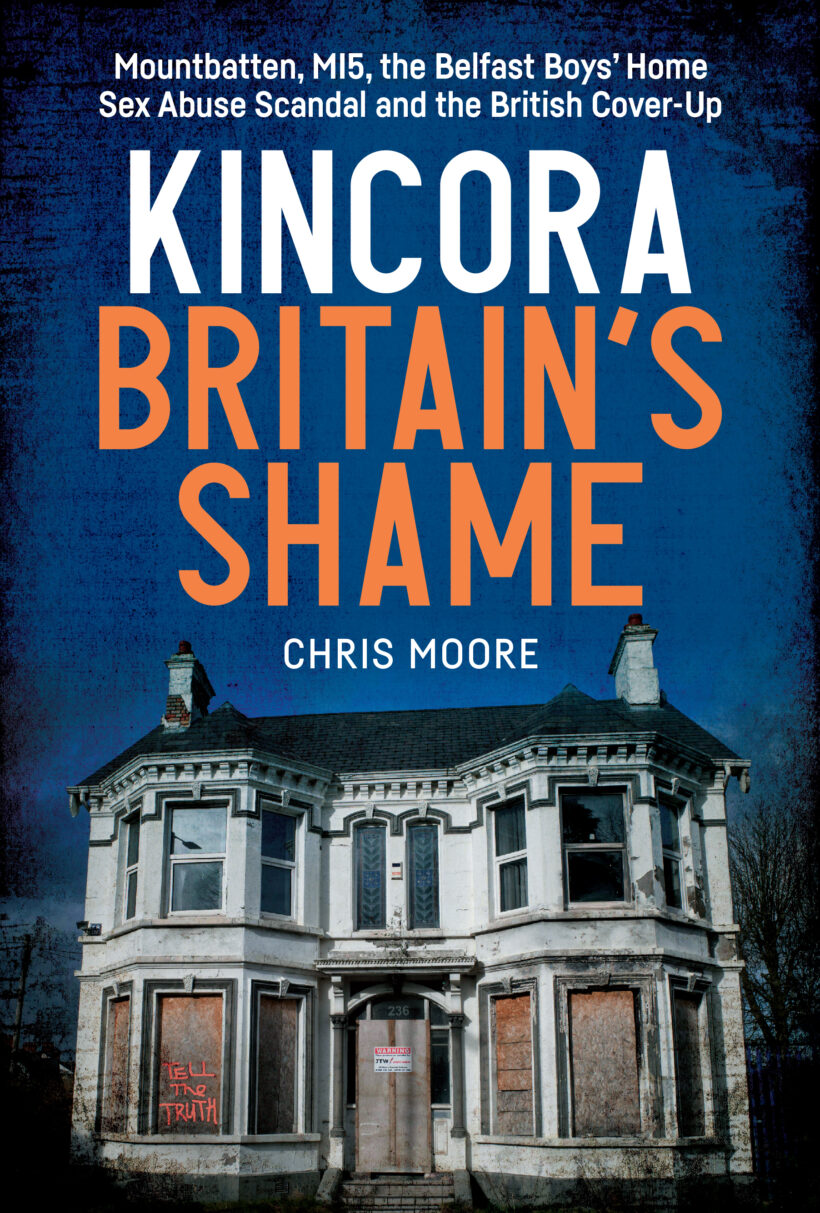
The details are here in Chris Moore’s outstanding book “Kincora, Britain’s Shame”
Sir Jeffrey Donaldson – whose child-abuse career stretched from 1985 to 2008 – could be forgiven for believing that prominent unionist political leaders escaped punishment if they were child-abusers, or knew about such crimes, and failed to do anything about it.
The shadow of Kincora House hangs over the child-abuse conviction of Sir Jeffrey Donaldson.
John Meehan June 23 2026


 Tomás Ó Flatharta
Leave a comment