Hungary – “Defeating Orbán is One Thing – Defeating Orbanism Quite Another”
Donnacha Ó Beacháin discussed the Hungary elections with Flor MacCarthy and
@shonamurray.bsky.social on Oireachtas TV. Defeating Orbán is one thing, dismantling Orbánism quite another Expectations are high and Magyar’s support base is diverse, even contradictory. Managing expectations will be key to avoiding fragmentation
Six lessons from Hungary’s vote and Orbán’s defeat An “illiberal democracy” can be ousted — what India and the world should learn
Link :
Six lessons from Hungary’s vote and Orbán’s defeat
Kavita Krishnan examines the fall of Orbán in greater detail here :
Writing in The Hindu after Viktor Orbán’s 12 April 2026 electoral defeat, Indian Marxist-feminist Kavita Krishnan draws six lessons for an international readership and, above all, for India under Narendra Modi. She argues that illiberal democracies can be ousted at the ballot box; that obituaries for universal democracy are premature; that Ukraine won the Hungarian vote; that regime-change accusations are confessions; that Orbán’s fall is a defeat for Xi Jinping as well as Donald Trump, Vladimir Putin and Benjamin Netanyahu; and that pro-democracy forces must now discard the “West versus rest” map and consolidate their gains across borders. [AN]
Hungarian voters have swept their far-right strongman Viktor Orbán out of office, ending his 16-year run as Prime Minister and electoral autocrat. Here are six lessons the world can take from them.
First, an illiberal democracy can be ousted in elections. Mr. Orbán prepared the model for what he called ’illiberal democracy’ (or electoral autocracy), emulated by many others including Donald Trump and Narendra Modi. Such regimes create an impression of the Great Leader’s unstoppable popularity and electoral invincibility — or what we may call the ’aayega to Orbán hi’ [1] effect. This produces apathy: voting is either a display of fealty, or an exercise in futility.
Hungarians have shattered that illusion, and India must take note.
Democratic resilience affirmed
Second, obituaries to modern universal democracy are premature. Realist experts, as well as illiberal leaders and ideologues, tell us that democracy has no universal validity, it is elitist and unpopular with the majority, even in the West, as proved by popular mandates for Brexit, Mr. Trump, Mr. Orbán, and Mr. Modi, and the stability of the Chinese and Russian regimes.
Péter Magyar, who defeated Mr. Orban, is probably as bad on LGBTQIA+ rights as Mr. Orbán and worse on immigration. But the election is not about him. [2] It is about Hungarians affirming, for all of us, that a majority can vote against majoritarianism; that regime change against tyrants is an irrepressible human urge.
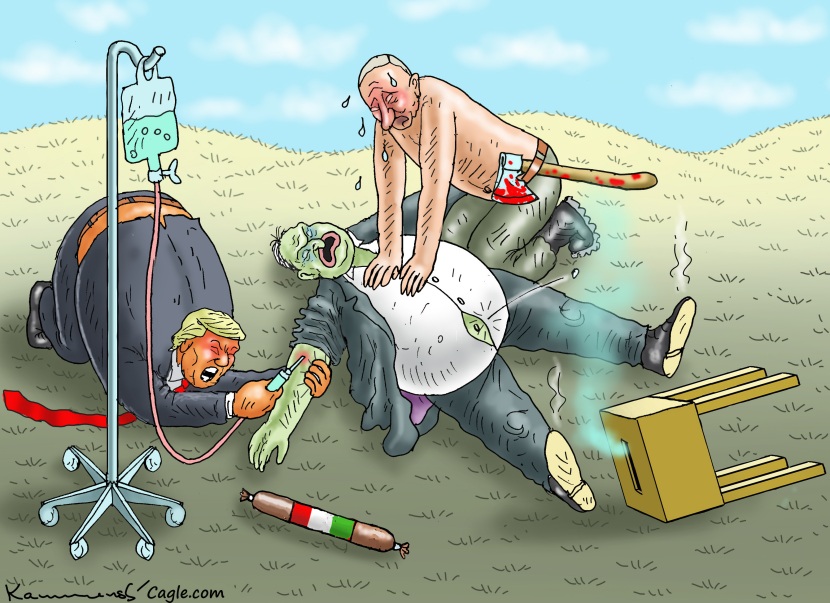
Third, a mandate for Ukraine. What is self-evident in Europe might be less so in India; Ukraine won the Hungarian election.
On winning the 2022 elections, Mr. Orbán claimed to have ’overpowered’ not only his immediate rivals but also Ukrainian President Volodymyr Zelenskyy. Going by his party’s 2026 campaign billboards, a visitor could be forgiven for assuming that Mr. Orbán’s rival was Mr. Zelenskyy, not Mr. Magyar. Mr. Orbán asked Hungarian voters, ’Who should form government: Zelenskyy or me?’
He blamed Hungary’s economic crisis on European Union (EU) aid to Ukraine — a pretext for a ’peace plan’ that was a wishlist by Russian President Vladimir Putin. It is telling that Hungarian voters rebuffed this notion, despite it being legitimised by some geopolitical and economic pundits.
Instead, Hungarians blamed the wrecked economy on Mr. Orbán’s corrupt cronyism that was inseparable from his position as Mr. Putin’s Praetor in Europe. He used Russian oil profits to bankroll ’Europe’s richest far-right think tank’ [3], which funnelled funds to parties such as Reform UK. [4]
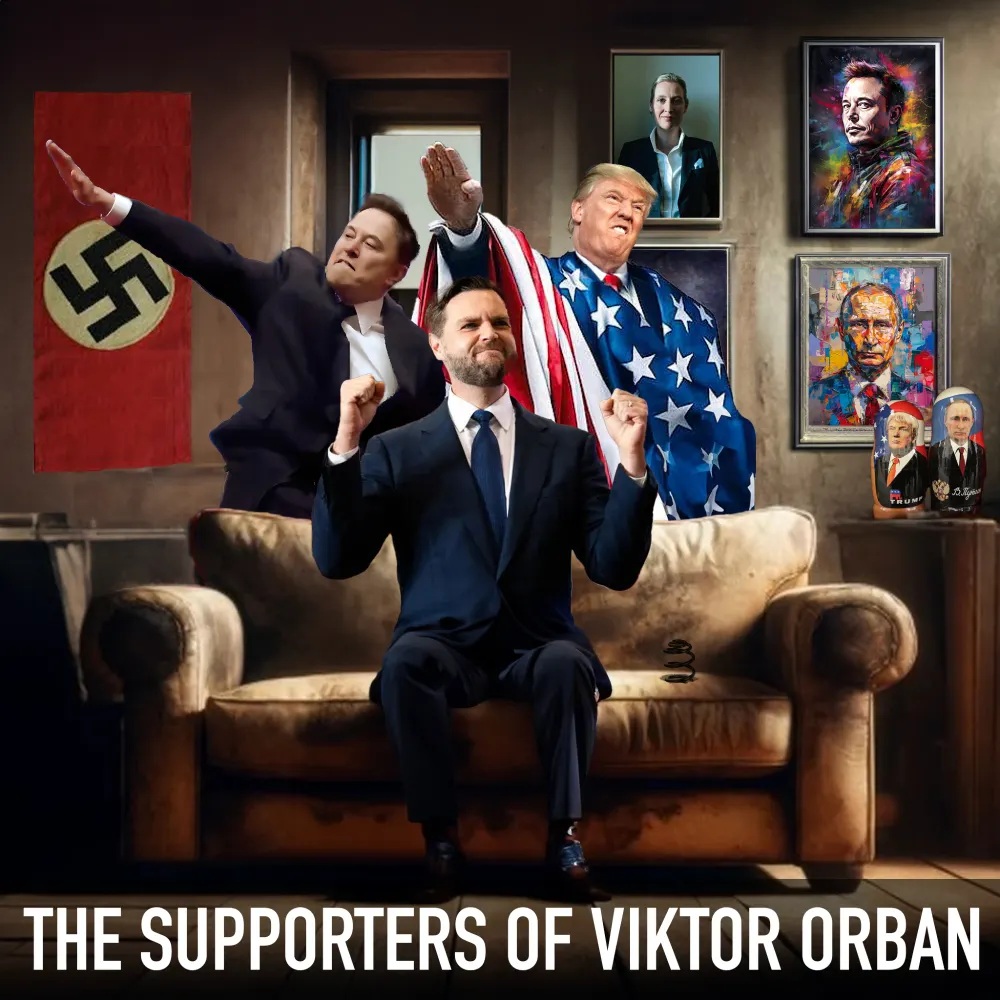
United States Vice-President J.D. Vance boasts that cutting off aid to Ukraine is ’one of the proudest’ achievements of the Trump administration. To him, as to much of Europe’s far-right, a Russian victory over Ukraine would be a victory for what Mr. Vance, in his electoral endorsement of Mr. Orbán, called the ’defence of Western/Christian civilisation and values’. [5]
Like Mr. Trump and Mr. Putin, Israeli Prime Minister Benjamin Netanyahu too endorsed Mr. Orbán because he supports the project of folding Europe into a Russia-led Christian white-supremacist Eurasia, away from the ’evil, globalist’ European Union.
Some of the accusations made
Fourth, regime change accusations are confessions. Mr. Vance accused the EU of “one of the worst examples of foreign election interference”. Mr. Orbán accused Ukraine of funding the opposition party Tisza, just as he has blamed Pride march protests on ’regime change’ and ’colonial’ interference by the EU. As is so often the case, the shrillest accusations are often confessions. Not only were Mr. Netanyahu, Mr. Trump and Mr. Vance star campaigners for Mr. Orbán, but he also invited Russian intelligence operatives and experts in online disinformation to run large-scale fake news campaigns. The Russian embassy itself stands accused of running a pro-Orbán influence operation.
Fifth, Mr. Orbán lost power, Chinese President Xi Jinping lost a friend. Mr. Xi personally called Mr. Orbán a friend. In 2024, when he visited Hungary, the police cracked down on Tibetans to prevent any protests. This friendship was not just pragmatic, it was ideological. The founder of a leading media platform in China, Eric Xun Li, [6] writes in an international left-wing journal that while Mr. Trump’s MAGA movement sees China as a rival, it shares China’s view of Ukraine, Europe, and universalist democracy, as do Mr. Putin and Mr. Orbán. He enthuses, “Hungary stands out as the most pro-China government in Europe”, and is also “the country most closely aligned with Russia”.
Mr. Xi has extolled the ’win-win cooperation’ and ’all-weather’ partnership between Hungary and China. But Hungarians noticed that the Belt and Road Initiative projects are ’win-win’ for Mr. Orbán’s childhood friend and Hungary’s richest businessman, Lőrinc Mészáros, [7] and ’lose-lose’ for Hungary’s economy.
Despite fierce protests by Hungarian students, the Orbán regime went ahead with a project backed personally by Mr. Xi: a campus of Shanghai’s Fudan University in Hungary. Pre-tax construction costs for this campus were “estimated at $1.8 billion, more than the Hungarian government spent on its entire higher-education system in 2019”. [8]
Sustain the momentum
Sixth, it is time to discard the ’West vs rest’ world map. We are accustomed and thus attached to a West versus rest map of the world. But there is no room on that map for Hungary, which was the battleground to decide if Europe should be a de-democratised outpost for Mr. Trump, Mr. Netanyahu, Mr. Putin and Mr. Xi. Mr. Orbán was the sole European leader with the distinction of flouting International Criminal Court arrest warrants for both Mr. Netanyahu and Mr. Putin on genocide charges. [9]
Hungarians defeated not just a national tyrant but also an illiberal international alliance. [10] One hopes that pro-democracy people of the world will unite to do the same. [11]
Kavita Krishnan is a Marxist-feminist activist and writer based in Delhi. A former Politburo member and Secretary of the All-India Progressive Women’s Association of the Communist Party of India (Marxist-Leninist) Liberation, she broke with the CPI(ML) in 2022 over its position on the Russian invasion of Ukraine. She is the author of Fearless Freedom (Penguin, 2020) and has written for The Hindu, Al Jazeera, Democracy Now!, Posle Media and Commons (Spilne). Her forthcoming book is The Global De-Democratisation Project: Script, Actors, Enablers.
P.S.
Source: The Hindu, 29 April 2026.
Notes for ESSF by Adam Novak
Footnotes
[1] In Indian political slang, “Aayega to Modi hi” (“Only Modi will come”) was the BJP’s unofficial 2019 general election refrain, designed to convey the inevitability of a Modi return to office. Krishnan adapts the phrase to describe the aura of invincibility Orbán cultivated in Hungary. See Shivam Vij, “2019 will be known as the ’Aayega To Modi Hi’ election”, The Print, 23 May 2019. Available at: https://theprint.in/opinion/2019-will-be-known-as-the-aayega-to-modi-hi-election/239264/
[2] On Péter Magyar’s trajectory from Fidesz insider to Tisza leader, and on the limits of what his supermajority represents for the Hungarian left, see “Hungary 2026: An Autopsy of Sixteen Years of Illiberalism”, interview with Adam Novak, Europe Solidaire Sans Frontières, April 2026. Available at: http://www.europe-solidaire.org/spip.php?article78532
[3] The reference is to the Mathias Corvinus Collegium (MCC), the Orbán-aligned Budapest-based educational foundation endowed with a multi-billion-euro portfolio of state assets, which has funded CPAC Hungary and hosted international far-right figures. See Paul Lendvai, “Orbán’s State-Funded Right-Wing Propaganda Machine”, Journal of Democracy, January 2023.
[4] Reform UK is a right-wing populist party led by Nigel Farage, originally founded in 2018 as the Brexit Party and rebranded in 2021. It won five seats at the 2024 UK general election with around 14% of the vote.
[5] Vance travelled to Budapest on 7 April 2026 and addressed a Fidesz rally alongside Orbán, urging voters to “stand with Viktor Orbán” against “the bureaucrats in Brussels”. See Justin Spike and Associated Press reporting, April 2026.
[6] Eric Xun Li (Li Shimo) is a Shanghai venture capitalist and political commentator, founder and chairman of the Chinese nationalist news site Guancha.cn, and a trustee of Fudan University’s China Institute. He is a prolific contributor to Foreign Affairs, Foreign Policy, the New York Times and The Economist, where he has argued that liberal democracy is a Western ideological construct and that “strong leaders” such as Orbán, Modi, Putin, Duterte and Sisi represent a post-liberal alternative. See Jude Blanchette, “An International Spokesman for Chinese Nationalism”, Dissent Magazine, Winter 2024.
[7] Lőrinc Mészáros, a former gas-fitter from Orbán’s home village of Felcsút, rose from local mayor to become Hungary’s wealthiest businessman, with an empire spanning construction, tourism, agriculture and media built largely on state and EU procurement contracts. His firms hold significant stakes in Belt and Road-linked projects, including the Budapest-Belgrade railway upgrade.
[8] The $1.8 billion (approximately €1.5 billion) figure was first revealed by Hungarian investigative outlet Direkt36 in April 2021, based on leaked internal government documents; the construction was to be financed principally by a loan from a Chinese state bank, repayable by Hungarian taxpayers. The 2019 Hungarian higher-education budget stood at approximately €1.3 billion. See Szabolcs Panyi and András Pethő, “Huge Chinese loan to cover the construction of Fudan University in Budapest”, Direkt36, 6 April 2021. Available at: https://www.direkt36.hu/en/kinai-hitelbol-keszul-a-magyar-felsooktatas-oriasberuhazasa-a-kormany-mar-oda-is-igerte-egy-kinai-cegnek/
[9] The ICC issued an arrest warrant for Vladimir Putin on 17 March 2023 for the unlawful deportation of Ukrainian children, and for Benjamin Netanyahu on 21 November 2024 for war crimes and crimes against humanity in Gaza. Orbán hosted Netanyahu on a state visit to Budapest in April 2025 and announced Hungary’s withdrawal from the Rome Statute. On the broader pattern of impunity and the neofascist global axis of which Orbán was part, see Gilbert Achcar, “For the Neofascists, only the Law of the Jungle Makes Sense”, Europe Solidaire Sans Frontières, 28 April 2025. Available at: http://www.europe-solidaire.org/spip.php?article75259
[10] For an extended analysis by Krishnan of this “illiberal international” and the ideological convergence between Putin, Xi, Modi, Orbán, Trump, Netanyahu and Meloni, see “Walking a Tightrope on Ukraine: How India Is Balancing Ties to Russia and the United States”, Democracy Now! interview with Amy Goodman and Nermeen Shaikh, Europe Solidaire Sans Frontières, 6 October 2022. Available at: https://www.europe-solidaire.org/spip.php?article64258
[11] On the ideological underpinnings of this global authoritarian alliance as they apply to India specifically, see Kavita Krishnan, “Ambassador for Anti-Democracy: Kavita Krishnan reports on Aleksandr Dugin’s India tour”, Europe Solidaire Sans Frontières, April 2024. Available at: http://www.europe-solidaire.org/spip.php?article73071




Leave a comment