There is only one civilised response over rows about offering decent accommodation to refugees and asylum seekers : the Irish state must help and support human beings fleeing from wars, famine, destruction and poverty in their native lands. Protests against accommodation centres, hotels, and hosting schemes are a magnet for racist attacks on immigrants.
In other words :
Socialism With a Human Face Versus Liberalism With a Shark Smile
These protests are often presented as demands for local “consultation”
Claims are broadcast that refugees and asylum seekers are getting favourable treatment
Vulnerable people are threatened with the old ugly policy of “Go, Move, Shift”
The real story is an old one : Go, Move, Shift. Christy Moore’s song says it all :
Six in the morning out in Inchicore The guards came through the wagon door. John Maughan was arrested in the cold A travelling boy just ten years old.
CHORUS
Mary Joyce was living at the side of the road No halting place and no fixed abode. The vigilantes came to the Darndale site And they shot her son in the middle of the night.
Similar racist protests have stained many parts of Ireland since 2023 : O’Connell Street, Coolock, Darndale, and the East Wall area in Dublin; Newtownmountkennedy (Wicklow), Athlone (Midlands), Ballaghaderreen (Roscommon) and Roscrea (Tipperary) are other examples.
In recent days this political cancer has erupted again – this time in Galway.
Sad to say, we witness more shameful dog-whistle racism, again dressed up as “consultation” with the local community. It continues. Sinn Féin TD for Galway West Mairéad Farrell is following the wretched example set by a number of her party colleagues – lessons have not been learned.
The story is covered on the Cedar Lounge Site – a link is here :
“According to the department, an appraisal of the offer has been paused for three months to allow locals to advance a proposal to develop a community hotel at the site.
A meeting took place earlier this month inviting members of the community to voice their concerns over the possibility of using the hotel to house asylum seekers.
Local councillors and TDs have spoken out over the issue, attempting to assure locals that a proper consultation process will be followed through.
TD for Galway East Mairead Farrell said: “I have organised a meeting with the department for tomorrow morning. I have been in constant contact with the department from last night to this morning.
“They have told me categorically that no one has been moved into Carna and I have organised a meeting, I will give an update at that point.”
In a statement, the department have confirmed that a pause on the appraisal of the hotel remains in place. They said that there was no current contract in place for IPAS but that some people fleeing the war in Ukraine were still being housed there.”
Irish Independent, online, March 26 2025
Ukrainians in Ireland feared cut in ‘vital’ accommodation payment – Red Cross Payment to hosts worth €800 a month was due to expire on March 31
The Irish government is jumping in; part of its agenda is the old tactic of Divide and Rule.
A payment to hosts worth €800 a month, enabling Ukrainian refugees to get accommodation was due to expire on March 31. The state authorities have backed down temporarily, thanks in part to protests by welfare agencies such as the Red Cross and the Ukrainian community in Ireland. Here is a link :
There has been an increase in reports of uncertainty and anxiety among Ukrainians living in Ireland, as the Government is expected to make a decision on the continuation of payments to accommodation hosts, the Irish Red Cross has said.
The humanitarian charity said there has been “a significant rise” in calls from concerned individuals since late last year.
The Accommodation Recognition Payment (ARP) is a tax-free payment of €800 for those providing accommodation to Ukrainians who arrive in the Republic under the EU Temporary Protection Directive. The scheme is due to expire on March 31st.
The Government is expected to extend the scheme with consideration being given to a €200 reduction in the monthly rate.
decision is “most likely” to be announced towards the end of this week, according to a source, with meetings taking place between the Department of Integration and Department of Justice.
“There has been no final decision yet, with nothing signed off,” the source added.
The Irish Red Cross said on Monday that the payment has been “a vital financial support” for 19,000 Irish hosts.
The organisation is due to present findings of the largest survey of Irish hosts to date to the Government on Tuesday.
Niall O’Keeffe, head of international and migration with the Irish Red Cross, said the accommodation programme has been “a lifeline for many very vulnerable people”.
“It’s not just a value-for-money accommodation solution, many hosts have become invaluable support networks, helping their guests in the transition to life in Ireland and guiding them to access essential supports and training,” Mr O’Keeffe said.
“Reducing support for vulnerable people will force them to make difficult decisions: living in poverty or returning to danger.”
Minister for Integration Norma Foley said last week there would likely be changes to the monthly €800 payment with an announcement due shortly.
Ms Foley said the issue was being dealt with and required engagement with the Department of Justice. The Fianna Fáil TD said she would not “pre-empt” the decision but was conscious that the scheme was due to expire at the end of next month.
Deirdre Garvey, secretary general of the Irish Red Cross, said the conflict in Ukraine has dramatically changed the lives of millions of people and has had a devastating impact on individual lives that “we can never measure”.
“Ireland has recognised this suffering and continues to respond generously. The Irish Red Cross has worked with the wider Red Cross Movement to provide humanitarian assistance in Ukraine and in the surrounding countries that have hosted most of those fleeing conflict in Ukraine,” Ms Garvey said.
“The needs now are as great as ever. Many of the millions who fled are unable to return home, and those who remain face dire conditions, with limited access to water, heat, healthcare and other essential services. Three years on, the mental health toll is huge, both for those who remain and those who fled to safety.”
In a remarkable development, the Sinn Féin migration spokesperson Matt Carthy TD (Cavan-Monaghan) criticises the government’s temporary climbdown : See the link here :
The Red Cross and Ukrainian community protests persuaded the government to back off. Vigilance is necessary, because the state may come back with cutback proposals later this year.
At this point it should be obvious to all anti-racists that saying the ARP is “unfair” to other renters is a racist cop-out. The issue is whether it should be scrapped, or extended to others in need of housing. Leftists should argue the latter as a matter of principle. A possible slogan could be “ Don’t End…Extend “. In other words Extend the ARP to extend to all asylum seekers and refugees as a first step.
Some public representatives have got the balance right :
Example 1 is Ruth Coppinger TD (Solidarity – People Before Profit) :
“A rightward change in government in Germany, and a similar likely change in government in France in 2027, means that Europe will no longer present a united front on the issue.
Much like the initial response to the Covid-19 pandemic, the John Lennon-esque vision of a country truly united in the face of a societal challenge gave way to good old-fashioned pessimism.
The (Sinn Féin) manifesto read “the special status of Ukrainians under the Temporary Protection Directive should come to an end no later than March 2026. We believe that continually extending temporary measures is not a sustainable solution and is problematic for everyone.”
“If a beneficiary of Temporary Protection is from a part of Ukraine that is safe then, save for exceptional cases, return should be assisted.”
Socialism With a Human Face Versus Liberalism With a Shark Smile
Ukrainian refugees are targets of state racism; left-wing public representatives should support them :
240 refugees are housed at Hubble Student Accommodation; of the 240 Ukrainians at the site, there are 49 school students and 77 are in employment. Following pushback, plans to move the refugees with six days’ notice were paused. Local Labour TD Marie Sherlock said, “the reasoning put forward by the government does not add up” and stated that the decision by the government is “unconscionable.” The government claimed that there was a need to vacate the rooms in a bid to protect the rent pressure zone status of the accommodation, a claim which Sherlock refuted. “The RPZ exemption has already kicked in because the student accommodation units have not been rented out to students for more than two years.” “This flies in the face of a stated government intent to try and help Ukrainians integrate into the communities they live in,” she stated. The term “socialism with a human face” is closely associated with the Prague Spring of 1968, and it appears the new government is pursuing a “liberalism with a shark smile” approach with regard to immigration.
Karim Zidan at SportsPolitika writes an excellent report on the appearance of Irish rapist-racist boxing superstar Conor McGregor at Donald Trump’s Washington DC White House on St Patrick’s Day 2025.
Zidan correctly observes that Irish government leaders Micheál Martin and Simon Harris distanced themselves from the Trump-McGregor Rapist-Racist summit. The socialist-feminist Dáil Deputy Ruth Coppinger (Solidarity-People Before Profit) points out that Martin voluntarily walked into the Trump-McGregor trap by lickspittling the American President at a March 12 White House event.
‘Two rapists in the White House’: TD tells Dáil McGregor’s visit to Trump was an insult to women
Ahead of a meeting with U.S. President Donald Trump on Monday to mark St. Patrick’s Day, former UFC champion Conor McGregor made an appearance at the White House briefing room, where he took questions from the baffled reporters in attendance.
As he stood at the podium alongside press secretary Karoline Leavitt, McGregor warned that “Ireland is at the cusp of potentially losing its Irishness” due to a so-called “illegal immigration racket.”
“It’s high time that America is made aware of what is going on in Ireland,” McGregor said, adding “What is going on in Ireland is a travesty.”
Shortly following the verdict, McGregor was removed as the spokesperson for Proper No. Twelve, the Irish whiskey brand he helped create in 2018 before selling the brand three years later. Several retailers in the UK and Ireland have also removed Proper from its shelves, including Tesco.
Yet despite being liable for rape, McGregor was welcomed with open arms to the White House, with Leavitt claiming “we couldn’t think of a better guest to have with us on St Patrick’s Day.” The White House even shared a video of McGregor emerging from the West Wing before saying “Happy Paddy’s Day, America” to the camera.
McGregor’s White House welcome comes as no surprise, given President Donald Trump’s long-standing love for combat sports, particularly the UFC. No other sports organization aligned itself with Trump’s presidency as closely—or worked as hard to support his political rise—as the UFC.
During a meeting with Irish prime minister Micheal Martin last week, Trump said McGregor was his favourite Irish person partly because “he’s got the best tattoos I’ve ever seen”.
And yet, Trump’s fondness for McGregor extend beyond his taste for the fighter’s tattoos. McGregor has also voiced his support for Trump’s presidency and was in attendance at his inauguration in January. The two men also share a political vision marked by resurgent nationalism, isolationism, and a streak of anti-migrant hysteria.
McGregor’s views on migrants came to a head in November 2023, when he helped stoke anti-migrant sentiments that led to one of the most violent riots in Dublin’s history. The riot started after a man stabbed three young children and a care assistant in Dublin. Far-right activists quickly blamed immigration, stoking public rage after the suspect was identified as being originally from Algeria.
McGregor tweeted that Ireland was “at war” in the lead-up to the riots. In the aftermath of the chaos, he followed up by tweeting “you reap what you sow.” He had previously spent weeks stoking anti-migrant sentiments on social media, including endorsing a “task force” to monitor migrants.
McGregor’s anti-migrant stances quickly made him a symbol for the far right throughout Europe. Kampf der Nibelungen, a German neo-Nazi MMA league, shared several of McGregor’s tweets in their Telegram channel, including one where the fighter called for a “task force” for all entrants coming into Ireland and demanded that the Irish government “correct this or you are all finished.” AI generated illustrations of McGregor holding a shotgun and leading an army of angry gun-wielding men waving Irish flags also spread on platforms such as 4chan, Gab, and Twitter.
McGregor’s views also caught the attention of some of Trump’s inner circle, including Elon Musk, who showed interest in the idea of McGregor running for office in Ireland. The 36-year-old has repeatedly stated his intention to run for president of Ireland, calling himself the “only logical choice” to lead the nation. Ironically, the Irish presidency is predominantly a ceremonial role, serving as representative of the Irish state.
And yet, McGregor’s meeting with Trump speaks to the role that combat sports plays in modern politics, with UFC fighters serving as the conduits of conservative values and right-wing policy. It’s yet another example of how Trump’s MAGA ideology aligns with MMA’s ethos—one where success isn’t won through negotiation or diplomacy, but through sheer strength, power, and dominance.
Nevertheless, while McGregor has managed to secure a coveted meeting with Trump, there are few people in Ireland who believe he is speaking on their behalf. Ireland’s Taoiseach Michael Martin tweeted today that “Conor McGregor’s remarks are wrong, and do not reflect the spirit of St. Patrick’s Day, or the views of the people of Ireland.” Meanwhile, Ireland’s Minister for Foreign Affairs and Trade and Minister for Defence Simon Harris added that “McGregor doesn’t speak for Ireland.”
“He doesn’t speak for the people of Ireland,” Harris said. “He has no mandate to do such, and my views on him are very clear, well established, previously articulated, long standing and on the public record.”
An Irish Times Report (May 21 2025) carries an “inside story” on the Trump-McGregor White House Rapist-Racist Summit. McGregor’s visiting team included a Dublin City Councillor Philip Sutcliffe, who discussed the chance that the racist-rapist boxer may run for the office of Irish President :
“Many believe all of this is a prelude to McGregor formally entering the race for the Irish presidential election which is due to take place after the summer. McGregor has repeatedly indicated he intends to run, although it is not at all clear if he would obtain the required support to get on the ballot paper.
Sutcliffe says he hopes McGregor will run and that he will have Washington’s full support if he does.
“Not only Washington, he’ll have the backing of Putin. He’s another fan of Conor’s,” he added.
The result of the November 29 General Election in Ireland was a victory for the outgoing government. The two leading conservative parties – Fianna Fáil and Fine Gael (FFFG) won 86 out of 174 seats, only two seats short of an overall majority. Their previous administration needed a mudguard, provided by the Green party (GP), which lost 11 of its 12 seats.
This time the mudguard is likely to come from right-wing gombeens (The Irish mainstream media calls them “gene-pool independents” as most come from FFFG). In the previous Dáil “independent” deputies from this swamp regularly voted confidence in the government, without formally participating in the cabinet. Since the election result was announced, these gombeens have brazenly begged for perks and freebies in exchange for their Dáil votes.
Green or Moderate Left Mudguard Unavailable?
FFFG is in the market for a Green or moderate-left mudguard. Possible partners – (the Labour party [LP] and the Social Democrats [SDs]) – seem unwilling to perform political suicide.
In the words of one source :
I get the feeling the GP example is terrifying them!
FFFG shoppers in the mudguard supermarket may be seeking unavailable bargains :
Labour sources expect that the party will today rule out continuing discussions about entering government with Fine Gael and Fianna Fáil, effectively shutting down that coalition option for the two larger parties.
The party’s TDs will meet at Leinster House at lunchtime where leader Ivana Bacik is expected to propose the move, which is likely to be backed overwhelmingly by those present.
Labour sources were careful not to get ahead of today’s decision, but there is little expectation in the party that its engagement on government will continue. This will draw a distinction with the Social Democrats, who yesterday said they would continue discussions.
But after meetings with Fine Gael and Fianna Fáil this week, there is similarly little expectation in the outgoing government that the Social Democrats are serious about entering coalition.
Source : Jack Horgan-Jones, Election 2024: Labour set ‘to exit coalition talks’ with Fianna Fáil and Fine Gael, Irish Times December 13 2024
On Friday December 13 expectation cruised a little bit closer to certainty, but the Titanic option has not been ruled out :
NEW: Labour leader Ivana Bacik has said that it is “unlikely” that her party will go into Government, as they prepare for one final round of meetings with Fianna Fáil and Fine Gael
Once the post-election dust settles we may see a government composed of Fianna Fáil, Fine Gael, and Beggar-Gombeens (BGs) (FFFGBG) on one side, and a parliamentary opposition operating within a left-wing and ecological spectrum.
A FFFGBG coalition would be composed of Team FFFG (86 TDs) plus enough BG deputies to guarantee a workable Dáil majority.
Some BGs will oppose the government from the right.
Diana O’Dwyer presents a refreshingly honest and interesting analysis of the November 29 2024 Irish General Election result. No attempt is made to hide an obvious fact : this was a setback for the left.
People Before Profit’s (PBP) slogan during the election campaign was “End 100 years of Fianna Fáil and Fine Gael”. But now we are facing into yet another Fianna Fáil-Fine Gael (FF-FG) government. Why has this happened? Are we stuck in a never-ending Groundhog Day or does hope for radical change remain?
After the last election in 2020, escape from a century of FF-FG rule seemed not just possible but probable. The cycle of alternation between the two frenemies had finally been broken with the identical twins of Irish capitalism forced into a grand coalition, propped up by the Green Party with external support from right-wing Independent TDs. [2] The 2008 economic crash and the decade of social upheaval and struggle that followed had enabled Sinn Féin (SF) to steal the mantle of the largest party in the Dáil for the first time and it looked certain to lead the next government.
But now, almost 5 years later, FF and FG have returned with an extra 13 seats and are only one seat short of a majority – compared to 7 short last time. They are not any more popular than they were in 2020 – their share of the vote actually fell slightly (by 0.4%). But in a situation with little in the way of class struggle and where no clear alternative was posed, they were able to maintain and even improve their position. FF topped the poll at 22%, followed by FG on 21% and SF on 19%.
It is certain the two right-wing parties Fianna Fáil and Fine Gael (FFFG) which controlled the outgoing right-wing coalition will form the new government – their previous mudguard, the Green party, was destroyed – coming back with one seat, and losing 11. FFFG can pick new partners. They won 86 seats out of 174 seats, only two seats short of a majority.
We start with important data on the rise of racism in Ireland. Extreme racist candidates polled badly in this general election. Despite the emergence of violent racist organisations in the last 18 months – the majority of Irish citizens remain hostile to this dangerous political cancer.
Exit Poll latest update: Most voters support current level of asylum seeker State benefits or believe they should be expanded, latest election exit poll data shows. #election2024 http://www.irishtimes.com/politics/202…
Sinn Féin’s governmental ambitions fizzled out. The polling attrition suffered by Sinn Féin during the middle part of the year strongly influenced the nature of the campaign. With no real sense that the government parties might be ejected from power, the election was a low-energy affair, with turnout dropping below 60% for the first time in the history of the state.
Analysis: In a year when ruling parties around the world lost elections, Ireland’s outgoing coalition parties bucked that trend
At the end of a year that saw parties around the world punished by voters, Fianna Fáil and Fine Gael have managed to avoid the incumbents’ curse. The coalition partners’ combined first preference votes fell by just 0.4 points – to 42.7% – compared with the 2020 general election. This is a remarkable result, given the high cost of living and continuing housing crisis – all the more so for Fine Gael, which has been in government since 2011.
Sinn Féin’s popularity was the story of the 2020 general election. It emerged as the first choice of nearly a quarter of the electorate (24.5%) but failed to nominate enough candidates to capitalise on this and ended up with fewer seats than Fianna Fáil.
Biding its time in opposition, the party set to work presenting itself as a government in waiting. The polls seemed to confirm this status. The party’s popularity peaked at 36% in 2022 but this figure underwent a slow – and then rapid – decline. An unwillingness to adopt an anti-immigration position, when the issue was becoming politicised in Ireland, saw it lose support with some of its supporters.
This was confirmed in June at the local and European elections. The party’s 11.8% vote share was a very poor showing. Subsequent scandals around the party, on both sides of the border, further damaged its standing with the electorate.
Sinn Féin’s share of 19% of the first preference vote on Friday represents a partial recovery for the party. But it is, nonetheless, a steep decline (5.5 %) from their 2020 performance, leaving Sinn Féin with no realistic path to power.
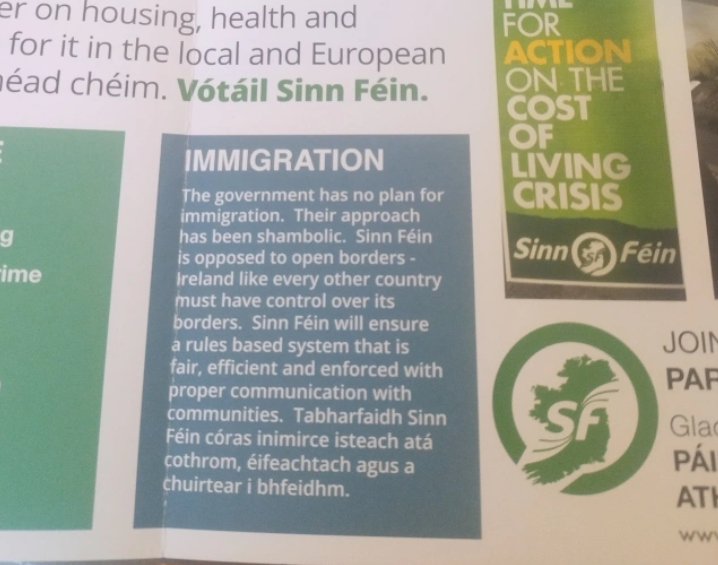
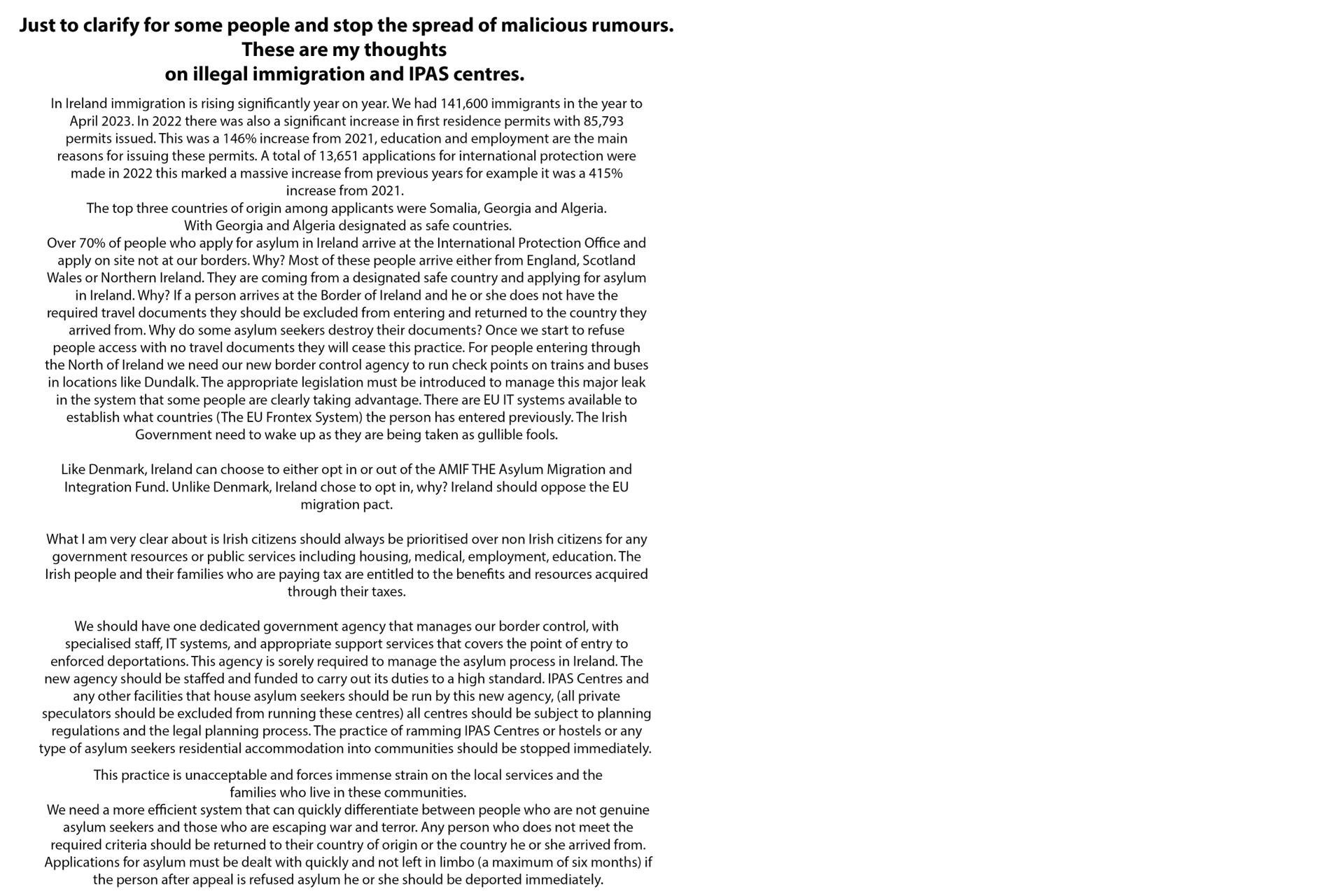
Unfortunately Sinn Féin was willing “to adopt an anti-immigration position” after some initial hesitation. Faced with rising racist agitation in deprived communities, the party pandered to reactionary sentiments. The main capitalist parties did the same – they discovered an issue that could be used to forward a right-wing agenda on a number of fronts. As a result, Sinn Féin lost support to its right – and to its left. The leaflet below, containing anti-immigrant messages, was used all over the state.
In the months leading up to these elections I was struck by messages from friends expressing alarm at this bad turn of events. A number of people said things like “I will not vote for Sinn Féin again”; “I would find it hard to give them a preference” and so on. I wondered if this trend was in any way representative – after all most people in my circle are further left than the general population! The general election proved these sentiments were not isolated.
Most political commentary on the general election notes setbacks suffered by scattered street-gang mini-Hitlers. Candidates like this – for example Malachy Steenson in the Dublin North Inner-City – emerged from the margins, and gained significant electoral support in the June 2024 local elections. They did not repeat their success in the November 2024 general election – they went backwards.
A more dangerous development occurred. A significant number of deputies from the ruling FFFG coalition, and Sinn Féin, promoted or dog-whistled at racist policies. At least 18 successful TD’s [Dáil Deputies] (gombeens) promote racist and misogynistic policies which have gone mainstream. These monsters are a throwback to a Catholic reactionary state that banned abortion, divorce and gay people – a state that threw women out of the workforce, that banished babies and single women to religious prisons run by the Catholic Church. Today’s far-right are disguised in the suits, ties, scarves and daily hairdos of Aontú, the Independent Ireland (II) Party, and a busload of independent TD’s begging for rewards from the new FFFG coalition : a mercs and perks brigade. Two additions to this gang in the new Dáil are Ken O’Flynn ( [II] Cork North-Central) and Gillian Toole [Independent gombeen racist] (Meath East). Others may come forward.
Nikita Hand Secures a Legal Victory over racist superstar kick-boxer Conor McGregor
During the election campaign a woman called Nikita Hand took a legal civil action, alleging rape, against an international celebrity, the kick-boxing superstar Conor McGregor. McGregor is closely associated with a number of mini-Hitler racists, some of whom were elected to Dublin council seats in June 2024. These included Philip Sutcliffe (Dublin South-Central) and Paddy Holohan (Dublin South-West). Most rape trials in Ireland are held behind closed doors, and the details are not widely broadcast.
This civil action was different : every day horrific evidence was headline news. Nikita Hand won her case.
This case damaged the mini-Hitler racist candidates –
An RTÉ News report contains the following information about Councillor Philip Sutcliffe :
In Dublin, Philip Sutcliffe, the head of Crumlin Boxing Club, was elected for the party. He boxed for Ireland at the Olympics in Moscow in 1980 and Los Angeles in 1984, and was elected in the Ballyfermot-Finglas LEA.
One of his most vocal supporters in the lead-up to election day was well-known publican and MMA fighter Conor McGregor. Cllr Sutcliffe has been McGregor’s boxing coach, travelling to fight camps internationally with McGregor, and featuring in social media posts.
On his Facebook page, where he posted regular updates during the campaign, Cllr Sutcliffe shared his support for Derek Blighe, a prominent right-wing nationalist anti-immigration protester and a candidate with the group ‘Ireland First’.
Mr Blighe regularly speaks about “plantations” and “unvettable fake refugees” at anti-immigration gatherings around the country. He has said the war in Ukraine is a “fake war publicised to encourage economic migrants to come to this country”.
“If you’re in this man’s area, vote [number] one for Derek,” Cllr Sutcliffe posted about Mr Blighe, who was running in the Ireland South European constituency and Fermoy Local Electoral Area against Independent Ireland candidates.
Cllr Sutcliffe also reposted video content from abroad about “refugee grooming gangs” while adding his own words: “Remember all this when voting, our government are letting the likes of their kind into Ireland.”
Cllr Sutcliffe was a first-time candidate and received 821 first preference votes, getting a seat on the 10th count.
During the campaign, as a result of the publicity over the McGregor case, the II party was forced to dump Sutcliffe, but his name still appeared on the ballot paper as an II candidate.
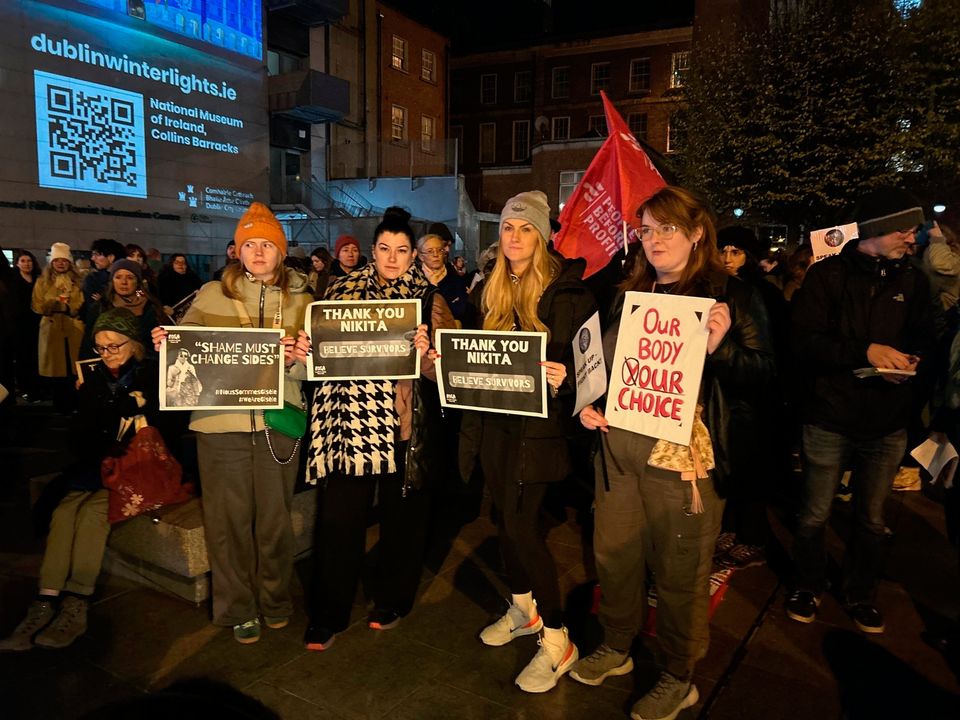
A sizeable protest march supporting Nikita Hand occurred after the verdict :
Women take part in a solidarity demonstration in Dublin after Nikita Hand won her personal injury case against Conor McGregor
Paddy Holohan, McGregor’s sparring partner, polled very well in the June council elections, but did very badly in the General Election. He got 3.7% of No.1 votes, ranked 12th of 16 candidates, with no hope of a seat.
The Gerry Hutch Near-Miss in Dublin Central
A near-miss occurred in Dublin Central, the constituency of Sinn Féin leader Mary Lou McDonald. Statewide Sinn Féin lost 5.5% of its vote-share compared with 2020.
In Dublin Central the drop was much higher : 12.36%. The party lost votes to its left and right. Many of those votes went to a wealthy businessman-gangster, Gerry Hutch, who advocated a sinister anti-immigrant policy.
Some discussion exists on whether Hutch was a racist candidate. He started his campaign making a few reasonable statements, but then came out with a definitive policy which left no room for doubt – Here is Hutch’s extreme racist campaign platform :
Hutch came fourth in the poll. On Saturday November 30 most election experts predicted Hutch would win a seat after seeing the first count – Hutch looked to be too far ahead of the chasing candidates below him. This news attracted a huge posse from the international media to the main Dublin election count centre on Sunday December 1. They were disappointed.
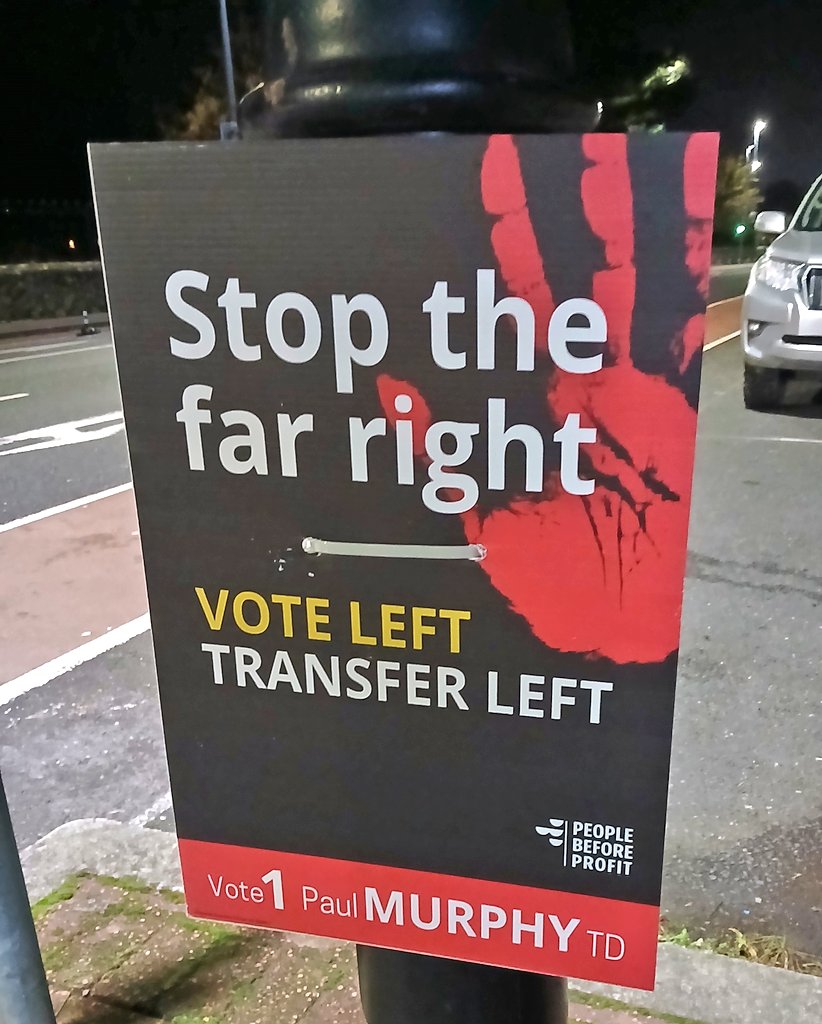
A landslide “Vote Left, Transfer Left” grassroots heave appeared : against Hutch in favour of the nearest candidate below him, Marie Sherlock (Labour party).
The election guru Michael Marsh noted on RTÉ Radio 1 that a record had probably been set : never before, since all similar Irish elections from 1922, had so many voters transferred so heavily against one candidate.
As the counts were announced, Marsh was visibly astonished : the racists transferred heavily to Hutch : Steenson, Kelly, and Smyth of Aontú.
All other candidates (mainly on the left) transferred to each other – and overwhelmingly against Hutch :
Counts
Hutch’s Share
No.5 (Votes of Daly) (Independents for Change)
137 out of 1539
No. 6 (Votes of Ó Ceannabháin) (People Before Profit)
83 out of 2112
No. 7 (Votes of Steenson [Racist])
1262 out of 2195
No. 8 (Votes of Hourigan [Green party])
26 out of 2352
No. 9 (Surplus of Gannon [Social Democrats])
18 out of 881
Left-wing voters transferred in huge numbers to the second elected candidate Gary Gannon (Social Democrats) and the eventual winner of the fourth seat, Marie Sherlock (Labour party). Transfers from the Fine Gael and Fianna Fáil candidates went the same way.
Some may dispute this was a “Vote Left, Transfer Left” phenomenon on the grounds that FFFG votes went overwhelmingly to Sherlock in the last two counts. This is a false and stupid argument. People should grasp the fact that, in this constituency, FFFG voters preferred a Labour party candidate to a racist gangster. That is a sign of hope.
The transfer data in this constituency also shows that Green party voters chose other available left candidates ahead of Hutch, and ahead of the candidates from the two right-wing government coalition parties, FFFG. Comprehensive analysis of data like this in all 43 constituencies is awaited. That said, figures I have seen seem to show that “Vote Left, Transfer Left”, a call promoted by People Before Profit, operated in a large number of constituencies.
At the time of writing it seems certain the outgoing right-wing coalition controlled by Fianna Fáil and Fine Gael will form the new government – their previous partners, the Green party, are likely to be wiped out. FFFG will be able to pick new partners.
We start with important data
Exit Poll latest update: Most voters support current level of asylum seeker State benefits or believe they should be expanded, latest election exit poll data shows. #election2024 http://www.irishtimes.com/politics/202…
In this post we concentrate on the issue of racism and the general election, with a particular focus on the Dublin Central constituency.
Here is a final tally displaying most of the first count
The golden rules for winning a seat in a Proportional Representation(PR) election are
1. Secure a winning position in the first count (In this case 4 seats available, Be in the first 4)
2. Secure at least half a quota
This means that McDonald (Sinn Féin), Donohoe (Fine Gael) and Gannon (Social Democrats) are very likely to win a seat each. The last seat is Gerry Hutch (wealthy businessman with a background in organised crime, a racist) Versus one of this chasing pack : Marie Sherlock (Labour party), Neasa Hourigan (Green party), Eoghan Ó Ceannabháin (People Before Profit), Clare Daly (Independents for Change). The clear leader of this pack is Marie Sherlock. The transfers of candidates below Sherlock can be examined to see if the slogan Vote left, Transfer left operates effectively, or not.
Some discussion exists on whether Hutch is a racist candidate. He started his campaign making some reasonable statements, but then came out with a definitive policy which left no room for doubt – his campaign platform is extreme racist :
How To Vote on November 29? Oppose Any Coalition with FFFGGG – Stop the Far Right : Vote Left, Transfer Left
FFFGGG Equals ; Fianna Fáil, Fine Gael, Greens, Gombeens.
The 2020-2024 coalition government was composed of three parties : FF, FG, and the Greens – and was regularly supported by Right-to-Racist Gombeens (Independents) in the last Dáil.
In this context it is important to know the identity of left-wing and right-wing independent candidates.
A Cedar Lounge Blog writer has done a great job identifying credible candidates on the left who are often categorised as independent. Link : Possible Left Independents in the next Dáil
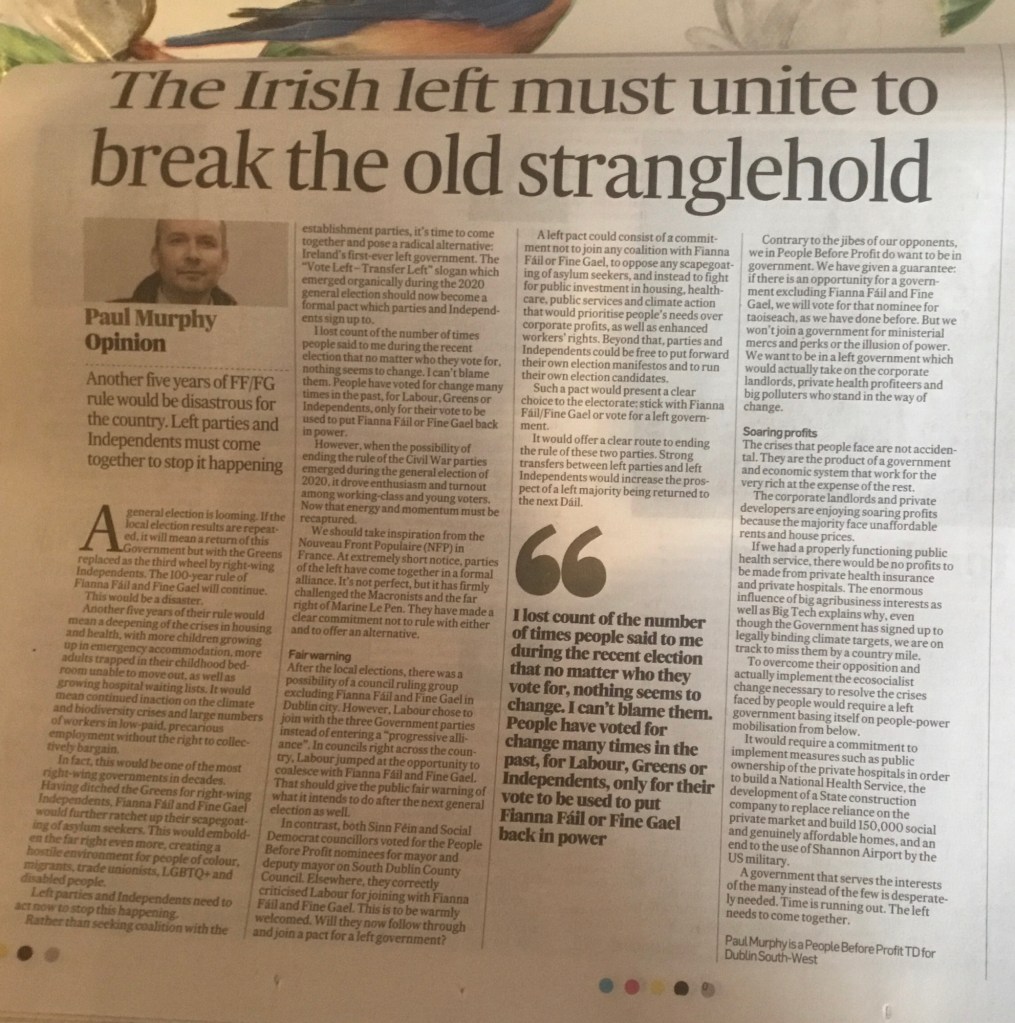
Paul Murphy’s opinion piece in the July 4 2024 edition of the Irish Times makes a strong case :
“Another five years of FF/FG rule would be disastrous for the country. Left parties and Independents must come together to stop it happening”
There is a bottom line :
No coalition with Fianna Fáil or Fine Gael.
The Irish Left must unite to break the old stranglehold, Paul Murphy TD (People Before Profit, Dublin South-West), Irish Times, July 4 2024
Time for a new united left alliance to topple Fianna Fáil and Fine Gael
Another five years of FF/FG rule would be disastrous for the country. Left parties and Independents must come together and stop this happening
A general election is looming. If the local election results are repeated, it will mean a return of this Government but with the Greens replaced as the third wheel by right-wing Independents. The 100-year rule of Fianna Fáil and Fine Gael will continue.
This would be a disaster.
Another five years of their rule would mean a deepening of the crises in housing and health, with more children growing up in emergency accommodation, more adults trapped in their childhood bedroom unable to move out, as well as growing hospital waiting lists. It would mean continued inaction on the climate and biodiversity crises and large numbers of workers in low-paid, precarious employment without the right to collectively bargain.
With the final tallies counted and remaining seats filled, People Before Profits (PBP) Dublin South West and RISE members Diarmuid Flood and Paul Murphy review the deeply polarised Local and European Elections and outline five key takeaways.
For the second election in a row, dramatic political changes took place in the course of the local and European elections. Sinn Féin started the year polling around 30% and yet ended up with less than 12% nationally in the local Elections. Independents and Others started the year with around 15%, but won close to 25% on June 6th. Fianna Fáil and Fine Gael both hit 23%, coming from the high teens and around 20% respectively. In many ways, these appear to be the opposite political trends to what we saw in the General Election of 2020. Back then, Sinn Féin grew dramatically as hope for an end to 100 years of Fianna Fail and Fine Gael rule propelled them to be the biggest party in vote share for the first time ever. Volatility is clearly in the air.
However, what we saw in the five weeks of the election campaign did not come from nowhere. The election catalysed and accelerated existing processes. In the absence of major progressive social struggles, with the exception of the Palestine solidarity movement, the political terrain has undoubtedly shifted rightwards. Ireland has caught up with most of the rest of Europe and the Global North, with the emergence of a reactionary social movement in opposition to asylum seekers and the growth of a racist, climate denialist, anti-LGBTQ, and sexist far-right.
People Before Profit is proposing a “Vote Left” transfer pact to operate in the June 2024 Local and European Elections, 26 Counties
Presenting this positive initiative Paul Murphy TD said
He was fully aware that there would be different perspectives and, but People Before Profit “sees this as just the start of a process to form a left alternative.”
Paul Murphy TD
PBP TD’s Richard Boyd-Barrett, Paul Murphy, and Brid Smith
In the article below, important points from the discussion are highlighted.
This is a serious matter, especially in a context where it is necessary to confront and defeat the extreme racist right.
Colm Breathnach offers a very good template :
Just a personal thing, but here’s my own general set of rules when it comes to voting where a Proportional Representation system is in operation (obviously First Pat The Post system is much more challenging in terms of decisions):
Start with the furthest left and keep voting until you reach the border of what you consider to be the left (for me, that’s social democratic or social liberal parties). Of course that border can shift – the Irish Greens were once inside my border of “left”, now they are definitely outside.
Exclude candidates who consistently hold reactionary positions regardless of their ostensible politics – favour genocide, homophobic etc etc. So the Daly’s of the world don’t feature or let’s say a centre left candidate who justified Israel’s genocide in Gaza.
Adjust to take account of specific concerns which one might deem important for progress to radical transformation of society. So for example you may alter your ranking to the take into account the candidates position on climate change or Irish unity etc.





 Tomás Ó Flatharta