Posts Tagged ‘criminal court’
Irish General Election November 29 2024 – Return of a Fianna Fáil-Fine Gael Coalition – Setback for the Left
It is certain the two right-wing parties Fianna Fáil and Fine Gael (FFFG) which controlled the outgoing right-wing coalition will form the new government – their previous mudguard, the Green party, was destroyed – coming back with one seat, and losing 11. FFFG can pick new partners. They won 86 seats out of 174 seats, only two seats short of a majority.
We start with important data on the rise of racism in Ireland. Extreme racist candidates polled badly in this general election. Despite the emergence of violent racist organisations in the last 18 months – the majority of Irish citizens remain hostile to this dangerous political cancer.
These are good summaries of the overall result :
Brittle Opposition
Sinn Féin’s governmental ambitions fizzled out. The polling attrition suffered by Sinn Féin during the middle part of the year strongly influenced the nature of the campaign. With no real sense that the government parties might be ejected from power, the election was a low-energy affair, with turnout dropping below 60% for the first time in the history of the state.
Link :
Brittle Opposition, Dan Finn
Analysis: In a year when ruling parties around the world lost elections, Ireland’s outgoing coalition parties bucked that trend
At the end of a year that saw parties around the world punished by voters, Fianna Fáil and Fine Gael have managed to avoid the incumbents’ curse. The coalition partners’ combined first preference votes fell by just 0.4 points – to 42.7% – compared with the 2020 general election. This is a remarkable result, given the high cost of living and continuing housing crisis – all the more so for Fine Gael, which has been in government since 2011.
Sinn Féin’s popularity was the story of the 2020 general election. It emerged as the first choice of nearly a quarter of the electorate (24.5%) but failed to nominate enough candidates to capitalise on this and ended up with fewer seats than Fianna Fáil.
Biding its time in opposition, the party set to work presenting itself as a government in waiting. The polls seemed to confirm this status. The party’s popularity peaked at 36% in 2022 but this figure underwent a slow – and then rapid – decline. An unwillingness to adopt an anti-immigration position, when the issue was becoming politicised in Ireland, saw it lose support with some of its supporters.
This was confirmed in June at the local and European elections. The party’s 11.8% vote share was a very poor showing. Subsequent scandals around the party, on both sides of the border, further damaged its standing with the electorate.
Sinn Féin’s share of 19% of the first preference vote on Friday represents a partial recovery for the party. But it is, nonetheless, a steep decline (5.5 %) from their 2020 performance, leaving Sinn Féin with no realistic path to power.
Link :
Why Election 24 saw FF and FG avoid the incumbents’ curse
Unfortunately Sinn Féin was willing “to adopt an anti-immigration position” after some initial hesitation. Faced with rising racist agitation in deprived communities, the party pandered to reactionary sentiments. The main capitalist parties did the same – they discovered an issue that could be used to forward a right-wing agenda on a number of fronts. As a result, Sinn Féin lost support to its right – and to its left. The leaflet below, containing anti-immigrant messages, was used all over the state.
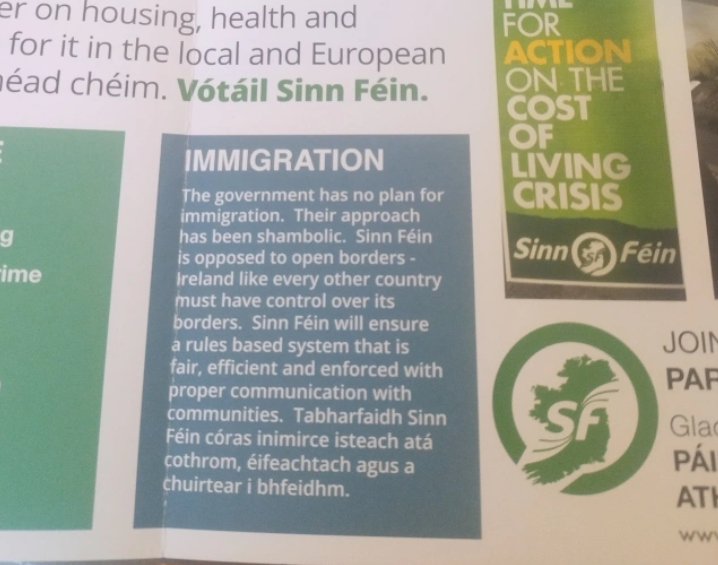
In the months leading up to these elections I was struck by messages from friends expressing alarm at this bad turn of events. A number of people said things like “I will not vote for Sinn Féin again”; “I would find it hard to give them a preference” and so on. I wondered if this trend was in any way representative – after all most people in my circle are further left than the general population! The general election proved these sentiments were not isolated.
Most political commentary on the general election notes setbacks suffered by scattered street-gang mini-Hitlers. Candidates like this – for example Malachy Steenson in the Dublin North Inner-City – emerged from the margins, and gained significant electoral support in the June 2024 local elections. They did not repeat their success in the November 2024 general election – they went backwards.
A more dangerous development occurred. A significant number of deputies from the ruling FFFG coalition, and Sinn Féin, promoted or dog-whistled at racist policies. At least 18 successful TD’s [Dáil Deputies] (gombeens) promote racist and misogynistic policies which have gone mainstream. These monsters are a throwback to a Catholic reactionary state that banned abortion, divorce and gay people – a state that threw women out of the workforce, that banished babies and single women to religious prisons run by the Catholic Church. Today’s far-right are disguised in the suits, ties, scarves and daily hairdos of Aontú, the Independent Ireland (II) Party, and a busload of independent TD’s begging for rewards from the new FFFG coalition : a mercs and perks brigade. Two additions to this gang in the new Dáil are Ken O’Flynn ( [II] Cork North-Central) and Gillian Toole [Independent gombeen racist] (Meath East). Others may come forward.
Nikita Hand Secures a Legal Victory over racist superstar kick-boxer Conor McGregor
During the election campaign a woman called Nikita Hand took a legal civil action, alleging rape, against an international celebrity, the kick-boxing superstar Conor McGregor. McGregor is closely associated with a number of mini-Hitler racists, some of whom were elected to Dublin council seats in June 2024. These included Philip Sutcliffe (Dublin South-Central) and Paddy Holohan (Dublin South-West). Most rape trials in Ireland are held behind closed doors, and the details are not widely broadcast.
This civil action was different : every day horrific evidence was headline news. Nikita Hand won her case.
This case damaged the mini-Hitler racist candidates –
An RTÉ News report contains the following information about Councillor Philip Sutcliffe :
In Dublin, Philip Sutcliffe, the head of Crumlin Boxing Club, was elected for the party. He boxed for Ireland at the Olympics in Moscow in 1980 and Los Angeles in 1984, and was elected in the Ballyfermot-Finglas LEA.
One of his most vocal supporters in the lead-up to election day was well-known publican and MMA fighter Conor McGregor. Cllr Sutcliffe has been McGregor’s boxing coach, travelling to fight camps internationally with McGregor, and featuring in social media posts.
On his Facebook page, where he posted regular updates during the campaign, Cllr Sutcliffe shared his support for Derek Blighe, a prominent right-wing nationalist anti-immigration protester and a candidate with the group ‘Ireland First’.
Mr Blighe regularly speaks about “plantations” and “unvettable fake refugees” at anti-immigration gatherings around the country. He has said the war in Ukraine is a “fake war publicised to encourage economic migrants to come to this country”.
“If you’re in this man’s area, vote [number] one for Derek,” Cllr Sutcliffe posted about Mr Blighe, who was running in the Ireland South European constituency and Fermoy Local Electoral Area against Independent Ireland candidates.
Cllr Sutcliffe also reposted video content from abroad about “refugee grooming gangs” while adding his own words: “Remember all this when voting, our government are letting the likes of their kind into Ireland.”
Cllr Sutcliffe was a first-time candidate and received 821 first preference votes, getting a seat on the 10th count.
Source : Independent Ireland party – a right-racist split from Fianna Fáil
During the campaign, as a result of the publicity over the McGregor case, the II party was forced to dump Sutcliffe, but his name still appeared on the ballot paper as an II candidate.
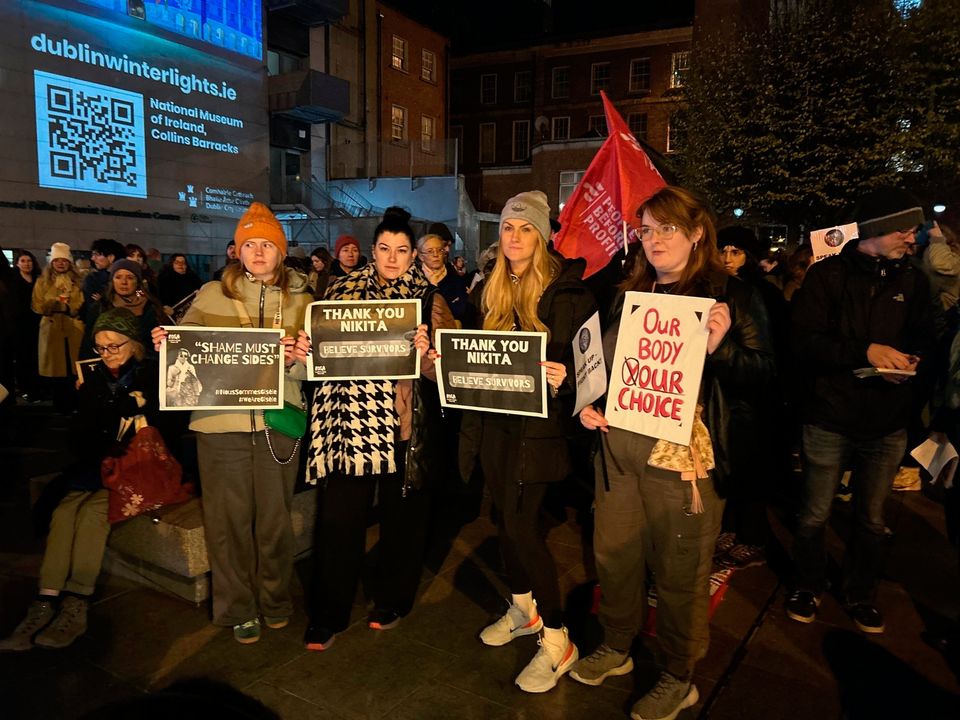
A sizeable protest march supporting Nikita Hand occurred after the verdict :
Paddy Holohan, McGregor’s sparring partner, polled very well in the June council elections, but did very badly in the General Election. He got 3.7% of No.1 votes, ranked 12th of 16 candidates, with no hope of a seat.
The Gerry Hutch Near-Miss in Dublin Central
A near-miss occurred in Dublin Central, the constituency of Sinn Féin leader Mary Lou McDonald. Statewide Sinn Féin lost 5.5% of its vote-share compared with 2020.
In Dublin Central the drop was much higher : 12.36%. The party lost votes to its left and right. Many of those votes went to a wealthy businessman-gangster, Gerry Hutch, who advocated a sinister anti-immigrant policy.
Some discussion exists on whether Hutch was a racist candidate. He started his campaign making a few reasonable statements, but then came out with a definitive policy which left no room for doubt – Here is Hutch’s extreme racist campaign platform :
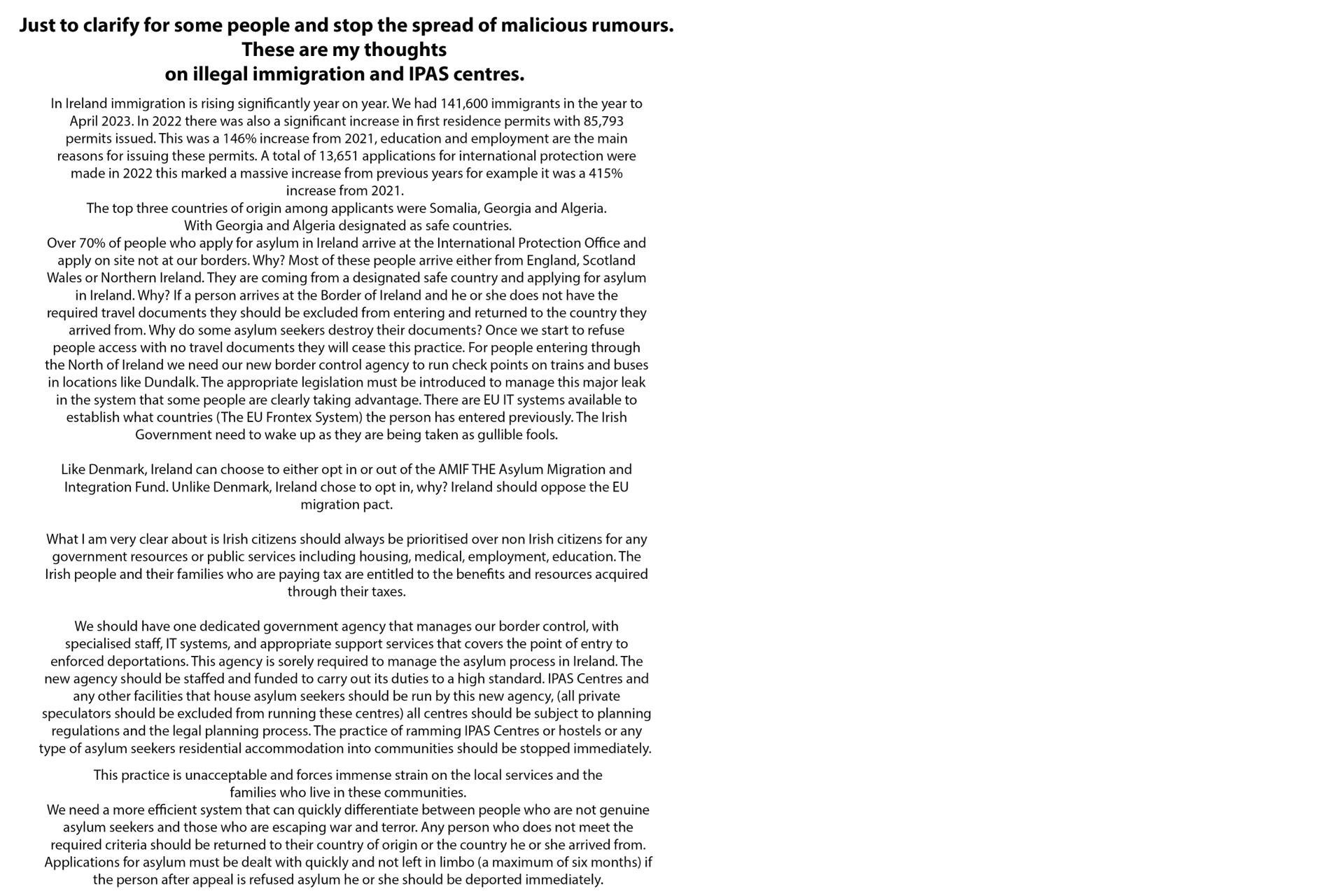
Link :
General Election November 29 2024 – Dublin Central Count
Hutch came fourth in the poll. On Saturday November 30 most election experts predicted Hutch would win a seat after seeing the first count – Hutch looked to be too far ahead of the chasing candidates below him. This news attracted a huge posse from the international media to the main Dublin election count centre on Sunday December 1. They were disappointed.
- A landslide “Vote Left, Transfer Left” grassroots heave appeared : against Hutch in favour of the nearest candidate below him, Marie Sherlock (Labour party).
The election guru Michael Marsh noted on RTÉ Radio 1 that a record had probably been set : never before, since all similar Irish elections from 1922, had so many voters transferred so heavily against one candidate.
As the counts were announced, Marsh was visibly astonished : the racists transferred heavily to Hutch : Steenson, Kelly, and Smyth of Aontú.
All other candidates (mainly on the left) transferred to each other – and overwhelmingly against Hutch :
| Counts | Hutch’s Share |
| No.5 (Votes of Daly) (Independents for Change) | 137 out of 1539 |
| No. 6 (Votes of Ó Ceannabháin) (People Before Profit) | 83 out of 2112 |
| No. 7 (Votes of Steenson [Racist]) | 1262 out of 2195 |
| No. 8 (Votes of Hourigan [Green party]) | 26 out of 2352 |
| No. 9 (Surplus of Gannon [Social Democrats]) | 18 out of 881 |
Left-wing voters transferred in huge numbers to the second elected candidate Gary Gannon (Social Democrats) and the eventual winner of the fourth seat, Marie Sherlock (Labour party). Transfers from the Fine Gael and Fianna Fáil candidates went the same way.
Some may dispute this was a “Vote Left, Transfer Left” phenomenon on the grounds that FFFG votes went overwhelmingly to Sherlock in the last two counts. This is a false and stupid argument. People should grasp the fact that, in this constituency, FFFG voters preferred a Labour party candidate to a racist gangster. That is a sign of hope.
The transfer data in this constituency also shows that Green party voters chose other available left candidates ahead of Hutch, and ahead of the candidates from the two right-wing government coalition parties, FFFG. Comprehensive analysis of data like this in all 43 constituencies is awaited. That said, figures I have seen seem to show that “Vote Left, Transfer Left”, a call promoted by People Before Profit, operated in a large number of constituencies.
Irish General Election November 29 2024 – Preliminary Analyses – Focus on Dublin Central, Dirty Money, and Racism
At the time of writing it seems certain the outgoing right-wing coalition controlled by Fianna Fáil and Fine Gael will form the new government – their previous partners, the Green party, are likely to be wiped out. FFFG will be able to pick new partners.
We start with important data
In this post we concentrate on the issue of racism and the general election, with a particular focus on the Dublin Central constituency.
Here is a final tally displaying most of the first count

The golden rules for winning a seat in a Proportional Representation(PR) election are
- 1. Secure a winning position in the first count (In this case 4 seats available, Be in the first 4)
- 2. Secure at least half a quota
This means that McDonald (Sinn Féin), Donohoe (Fine Gael) and Gannon (Social Democrats) are very likely to win a seat each. The last seat is Gerry Hutch (wealthy businessman with a background in organised crime, a racist) Versus one of this chasing pack : Marie Sherlock (Labour party), Neasa Hourigan (Green party), Eoghan Ó Ceannabháin (People Before Profit), Clare Daly (Independents for Change). The clear leader of this pack is Marie Sherlock. The transfers of candidates below Sherlock can be examined to see if the slogan Vote left, Transfer left operates effectively, or not.
Some discussion exists on whether Hutch is a racist candidate. He started his campaign making some reasonable statements, but then came out with a definitive policy which left no room for doubt – his campaign platform is extreme racist :
Read the rest of this entry »Robert Ballagh’s “The Thirtieth of January”: A Bloody Sunday Painting and the Troubles in the Two Bits of Ireland
In this interview the artist Robert Ballagh discusses the painting “The Thirtieth of January”, depicting Bloody Sunday in Derry in 1972. The conversation provides valuable insights into Ballagh’s personal experiences and artistic process, shedding light on the political and social context of the time.
The interview provides a unique insight into the historical and cultural significance of the painting.
Critical issues related to the Irish government’s response to the conflict, the impact of the Bloody Sunday event, and the broader social and political implications are highlighted. Ballagh’s commentary on the role of the Irish government, the impact on nationalist communities, and the establishment of the Special Criminal Court adds depth to the discussion.
Bloody Sunday Painting – the Thirtieth of January – Robert Ballagh
Thursday, January 20 2022. John Meehan interviews the artist Robert Ballagh in Number Five Arbour Hill.
We are talking about Robert’s painting : The Thirtieth of January, a representation of Bloody Sunday in Derry, January 30 1972.
John Meehan :
Why did you zone in on Derry’s Bloody Sunday , and put so much effort into making this painting? What makes it different from so many other big events during “The Troubles” in the north of Ireland, which lasted for 30 years, from 1968 to 1998?
Robert Ballagh
Well, it’s a long time ago now 50 years, but I have to say that it had an enormous effect on me, and I don’t think I’m alone with that historical experience. I suppose one thing I should say, I was only thinking about this, and I haven’t said anything about this experience to others. I’m a Dubliner. I’ve lived all my life in Dublin. But unlike most Dubliners – it wasn’t by design – I had an extraordinary rich knowledge of the North of Ireland, before the conflict began. Because I was a professional musician in a showband. We used to play at least once or twice a week in the north. So I was in every town village or city in the north that had a ballroom or ballrooms. And so I experienced the reality of life in that society, and became very aware of the sectarian differences, shall we say – the nature of the society, which people didn’t appreciate at all. I tell one very short story to illustrate that. We played fairly regularly in one of the very popular ballrooms in Belfast : Romano’s in Queen Street. We developed quite a following! In the show business vernacular the word groupie was used. These girls used follow us, they came down to Dublin once or twice to hear us. And we were playing one night in Romano’s.

After the dance, they came up and we’re talking to us. They asked “When are you playing again in Belfast?”.
I remember saying “Oh, I think we’re here next week.”
“Oh, really?”
“Yeah – we’re playing in a ballroom called the Astor” which I knew was in Smithfield.
And they said, “Oh, we can’t go there.” And I said, “Why?” – because it was a public ballroom. It wasn’t attached to any organization or anything. It was a public ballroom.
They said, “Oh, no, that’s a taig hall”
And it was the first time I realized, and we realized, that our fan base in Belfast was Protestant.


 Tomás Ó Flatharta