Archive for the ‘Left Wing Organisations’ Category
Rory Hearne accuses Ciaran Mullooly of ‘hypocrisy’ in scathing attack on the “Independent Ireland” racist party – a wolf in Blueshirt clothes
This is an Irish Independent Story, June 3 2024.
A few ex Fianna Fáil and Fine Gael Dáil Deputies formed Independent Ireland (IIP) recently, led by a man with a famous name, Michael Collins TD (Cork South-West). The 1922 pro-treaty inheritors of the dead Michael Collins legacy went on to establish the failed fascist Blueshirts in the 1930’s led by Fine Gael’s first president Eoin O’Duffy.
The IIP is running two well known broadcasters (Ciarán Mullooly and Niall Boylan) in the European elections.
Social Democrat Euro-Parliament candidate Rory Hearne presents a convincing left-wing anti-racist case against the IIP wolf in Blueshirt clothes.
Rory Hearne accuses Ciaran Mullooly of ‘hypocrisy’ in scathing attack on Independent Ireland
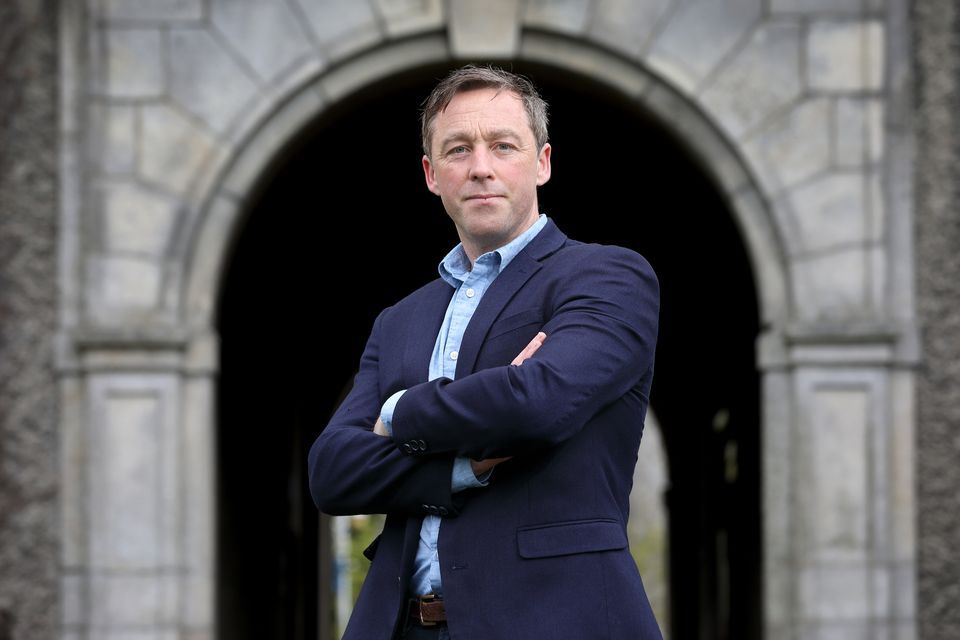
“Why won’t Mullooly and others call for tougher action against the real causes of the housing and homelessness crisis – the vulture funds and corporate landlords locking people out of a home, evicting people and raising the rents?”
Mr Hearn said Independent Ireland offers “no solutions” for the problems that have been caused due to a lack of accommodation.
“The election next week will set the course of Ireland and Europe for many years to come. Are we to turn into a divided society?
“Or are we going to come together and address the real causes of the crises, work on solutions together, and treat migrants and asylum-seekers with the dignity every human being deserves, and see migrants for how they positively contribute to and enrich our country.”
Read the rest of this entry »Robert Ballagh’s “The Thirtieth of January”: A Bloody Sunday Painting and the Troubles in the Two Bits of Ireland
In this interview the artist Robert Ballagh discusses the painting “The Thirtieth of January”, depicting Bloody Sunday in Derry in 1972. The conversation provides valuable insights into Ballagh’s personal experiences and artistic process, shedding light on the political and social context of the time.
The interview provides a unique insight into the historical and cultural significance of the painting.
Critical issues related to the Irish government’s response to the conflict, the impact of the Bloody Sunday event, and the broader social and political implications are highlighted. Ballagh’s commentary on the role of the Irish government, the impact on nationalist communities, and the establishment of the Special Criminal Court adds depth to the discussion.
Bloody Sunday Painting – the Thirtieth of January – Robert Ballagh
Thursday, January 20 2022. John Meehan interviews the artist Robert Ballagh in Number Five Arbour Hill.
We are talking about Robert’s painting : The Thirtieth of January, a representation of Bloody Sunday in Derry, January 30 1972.
John Meehan :
Why did you zone in on Derry’s Bloody Sunday , and put so much effort into making this painting? What makes it different from so many other big events during “The Troubles” in the north of Ireland, which lasted for 30 years, from 1968 to 1998?
Robert Ballagh
Well, it’s a long time ago now 50 years, but I have to say that it had an enormous effect on me, and I don’t think I’m alone with that historical experience. I suppose one thing I should say, I was only thinking about this, and I haven’t said anything about this experience to others. I’m a Dubliner. I’ve lived all my life in Dublin. But unlike most Dubliners – it wasn’t by design – I had an extraordinary rich knowledge of the North of Ireland, before the conflict began. Because I was a professional musician in a showband. We used to play at least once or twice a week in the north. So I was in every town village or city in the north that had a ballroom or ballrooms. And so I experienced the reality of life in that society, and became very aware of the sectarian differences, shall we say – the nature of the society, which people didn’t appreciate at all. I tell one very short story to illustrate that. We played fairly regularly in one of the very popular ballrooms in Belfast : Romano’s in Queen Street. We developed quite a following! In the show business vernacular the word groupie was used. These girls used follow us, they came down to Dublin once or twice to hear us. And we were playing one night in Romano’s.

After the dance, they came up and we’re talking to us. They asked “When are you playing again in Belfast?”.
I remember saying “Oh, I think we’re here next week.”
“Oh, really?”
“Yeah – we’re playing in a ballroom called the Astor” which I knew was in Smithfield.
And they said, “Oh, we can’t go there.” And I said, “Why?” – because it was a public ballroom. It wasn’t attached to any organization or anything. It was a public ballroom.
They said, “Oh, no, that’s a taig hall”
And it was the first time I realized, and we realized, that our fan base in Belfast was Protestant.
Struggles for Self-Determination: Ukraine and Palestine Solidarity Discussion
Link :
Ukraine and Palestine: building real solidarity is hard work
A guest post by JOHN LAWRENCE, from the People and Nature Blog hosted by Simon Pirani.
This article is relevant to the European Parliament Election campaign in Ireland and other parts of Europe.
“Genocide is genocide, a mass grave is a mass grave. We are with the people who are in there, and against the people who put them there”, journalist Ed Vulliamy told a discussion meeting in London on Monday.
The Russian invasion of Ukraine, and Israel’s war on Gaza – both of which have settler colonial and genocidal dimensions – had thrown an unusually clear light on the hypocrisy of people who oppose one, but not the other, Vulliamy said.
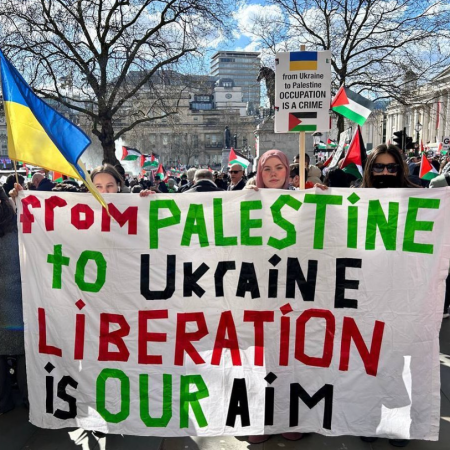
Marching in London, March 2024. Photos from United Action UK on instagram
In the United Nations, Ukrainian president Volodymyr Zelensky abstains over Gaza, and South Africa abstains over Ukraine, Vulliamy said.
“Large sections of the left wonderfully support Gaza but, having denied and justified [the massacre in 1995 of Bosnians by Serb troops at] Srebrenica, at best indulge, or support, Vladimir Putin and his imperial endeavour,” he continued.
Read the rest of this entry »Swastika cut into poster in sinister Far Right threat to socialist candidate – Irish Local and European Elections campaign, 2024 – Safety Measures Urgently Needed
Far-Right agitators in Ireland are escalating their attacks.
Ruth Coppinger, a Solidarity- People Before Profit candidate in Castleknock, and a former Dublin West TD, is the latest target.
Ruth’s press statement below explains the context well, and she makes an excellent proposal :
I am going to make contact with other parties / candidates – in particular those in opposition and on the left who are targeted more by the far right – to suggest that a central log of incidents and threats should be kept in order to take measures for the safety of all those ordinary activists who come out and campaign, as well as community safety in general.
“The far right can’t be allowed to create an atmosphere designed to frighten and to limit the campaigns of the left
Swastika cut into poster in sinister Far Right threat to socialist candidate
A “menacing atmosphere” is being generated by the far right according to a former TD and local election candidate who has had a swastika cut into her image on an election poster. Ruth Coppinger, socialist candidate with People Before Profit-Solidarity in Castleknock ward, Fingal, says supporters found the poster and that “it shows the danger of the far right in these elections, the threat they are to safety and how they would take away democratic rights.”
Read the rest of this entry »“Vote Left” Transfer Pact in June 2024 Irish Elections? – A Positive People Before Profit Initiative
People Before Profit is proposing a “Vote Left” transfer pact to operate in the June 2024 Local and European Elections, 26 Counties
Presenting this positive initiative Paul Murphy TD said
He was fully aware that there would be different perspectives and, but People Before Profit “sees this as just the start of a process to form a left alternative.”
Paul Murphy TD

Link :
PBP Vote Left Transfer Pact Proposal
A useful detailed discussion is taking place on the Cedar Lounge Revolution Blog
(Link : The Cedar Lounge Revolution)
A correspondent, IrishElectionLiterature, opened the discussion on a positive note :
Link :
Vote left, Transfer left, Then What?
In the article below, important points from the discussion are highlighted.
This is a serious matter, especially in a context where it is necessary to confront and defeat the extreme racist right.
Colm Breathnach offers a very good template :
Just a personal thing, but here’s my own general set of rules when it comes to voting where a Proportional Representation system is in operation (obviously First Pat The Post system is much more challenging in terms of decisions):
- Start with the furthest left and keep voting until you reach the border of what you consider to be the left (for me, that’s social democratic or social liberal parties). Of course that border can shift – the Irish Greens were once inside my border of “left”, now they are definitely outside.
- Exclude candidates who consistently hold reactionary positions regardless of their ostensible politics – favour genocide, homophobic etc etc. So the Daly’s of the world don’t feature or let’s say a centre left candidate who justified Israel’s genocide in Gaza.
- Adjust to take account of specific concerns which one might deem important for progress to radical transformation of society. So for example you may alter your ranking to the take into account the candidates position on climate change or Irish unity etc.
Colm continues :
Read the rest of this entry »Ireland’s Open(ish) Border : “selective Garda passport checks on the Border already take place, at times on the basis of quite blatant racial discrimination” – Statement by Human Rights Organisations and Trade Unions
A number of Irish human rights organizations and Trade Unions have issued a very strong statement following a stampede of racist publicity concerning “Open Borders”.
Here is an example from the Sunday Independent (May 5 2025)
Do you believe there should be checkpoints at the border with Northern Ireland to limit the number of asylum-seekers coming from the U.K.?
The newspaper published this summary of its survey :

Once again, Andrew Flood offers a devastating reply
With the trap carefully baited & Sinn Féin blundering into it here’s the spring being sprung. Farage & Dowson cackling with glee as their weird investment pays off. It’s a trap all the way down of course because …
Andrew Flood
It gets dafter – 82% want to go through an expensive deportation process to somewhere we have a common travel area with & where people deported can just walk back across any of the 400+ border crossing points again you can see where accepting this logic rapidly leads
Andrew Flood
Weak Arm of the Law in the 26 County bit of Ireland – Police “Hug-a-Thug” Policy imported from the 6 County bit of Ireland
The boss of An Garda Síochána (police force in the 26 county bit of Ireland), Drew Harris, was recruited from the cops in the 6 county bit of Ireland. The people running the two states in partitioned Ireland have developed very close social, political and personal relationships since the the 1998 triumph of the Good Friday Agreement. I recently circulated details of Harris’s “Hug-a-Thug” policy towards growing far-right violence in the 26 counties to a 6 county political activist, who commented this was “reminiscent of the historic style of policing up here”.
Ruling class forces were extremely happy about the continuation of partition guaranteed by the 1998 Good Friday Agreement. They did not foresee that the foundations of partition in Ireland are more rotten than their constitutional plan conceding a Unionist Veto to a majority of the voting population of the six county state. The Brexit referendum result of 2016 lit a slow-burning fuse under the GFA structure; in the meantime we are witnessing the creation of a possible “United Ireland from Hell” which consists of knitting together the most reactionary features of both partitioned states in Ireland.
The following article from the Cedar Lounge Revolution Blog powerfully illustrates the dangers arising from importing 6 county softly-softly policing methods towards the far-right (loyalist paramilitaries), fine-tuned by Garda boss Drew Harris.
John Meehan April 22 2024
Weak Arm of the Law – Cedar Lounge Blog
Link : Weak Arm of the Law – Cedar Lounge Blog
So, Friday comes the news that the previous night:
Gardaí were called to the home of Children’s Minister Roderic O’Gorman on Thursday night when a gang of up to 12 masked men gathered outside his house and huge placards and banners were stretched across his driveway gate, along his wall and fastened to outside polls.
Read the rest of this entry »
Sam Nolan, an Irish trade union fighter
The RTÉ Archives Site asked a question :
This week we are looking for help with a photograph taken at PAYE tax protest march on O’Connell Street, Dublin, on 22 January 1980. Anyone know the man addressing the crowd? How about those on the platform with him?
Any ideas?
The photographer was Des Gaffney.
Contact us at archives@rte.ie or on Twitter @RTEArchivesView more photographs from RTÉ Archives
I did my best, sending this message to Des Derwin
Dear Des,
I came across a link below of a good photo of Sam Nolan speaking at a PAYE demonstration in 1980 –
It is on the RTÉ Archive and the administrators are asking for somebody to identify the speaker.
I think that honour should fall to Sam or Helena.
Perhaps, the message did not get through!
Sam Nolan’s funeral takes place on Saturday April 20 at 1.30pm in Glasnevin Cemetery.
Read the rest of this entry »
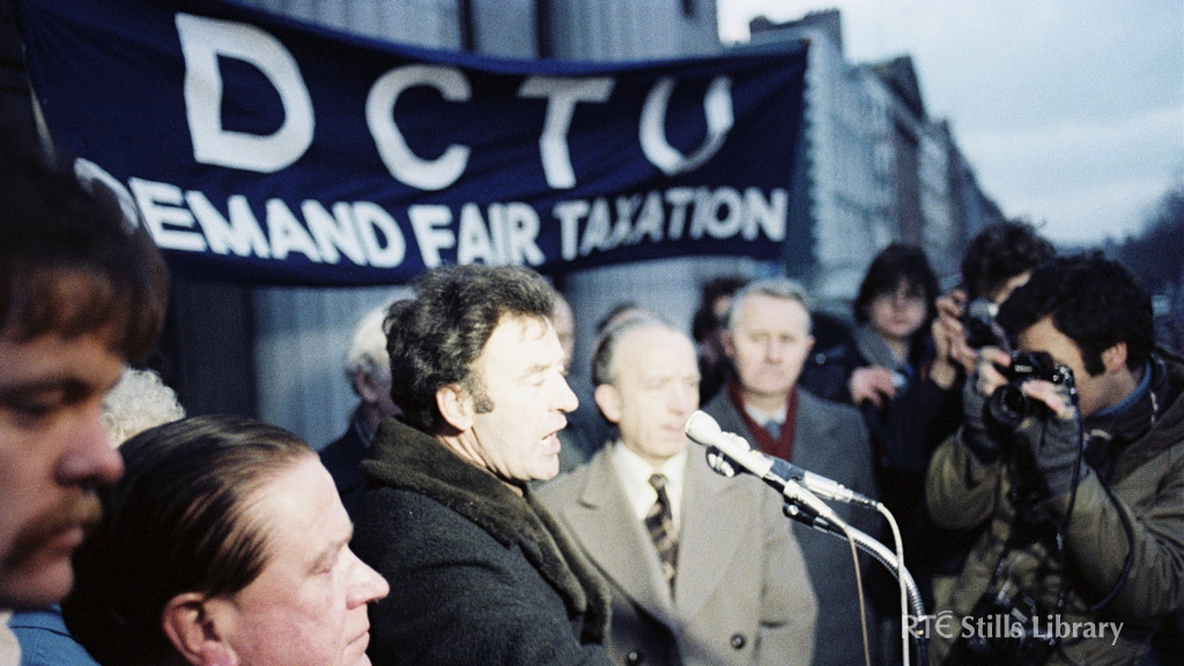
The RTÉ Archives Site asked a question :
This week we are looking for help with a photograph taken at PAYE tax protest march on O’Connell Street, Dublin, on 22 January 1980. Anyone know the man addressing the crowd? How about those on the platform with him?
Any ideas?
The photographer was Des Gaffney.
Contact us at archives@rte.ie or on Twitter @RTEArchivesView more photographs from RTÉ Archives
I did my best, sending this message to Des Derwin
Dear Des,
I came across a link below of a good photo of Sam Nolan speaking at a PAYE demonstration in 1980 –
It is on the RTÉ Archive and the administrators are asking for somebody to identify the speaker.
I think that honour should fall to Sam or Helena.
Perhaps, the message did not get through!
Sam Nolan’s funeral takes place on Saturday April 20 at 1.30pm in Glasnevin Cemetery.
Read the rest of this entry »


 Tomás Ó Flatharta