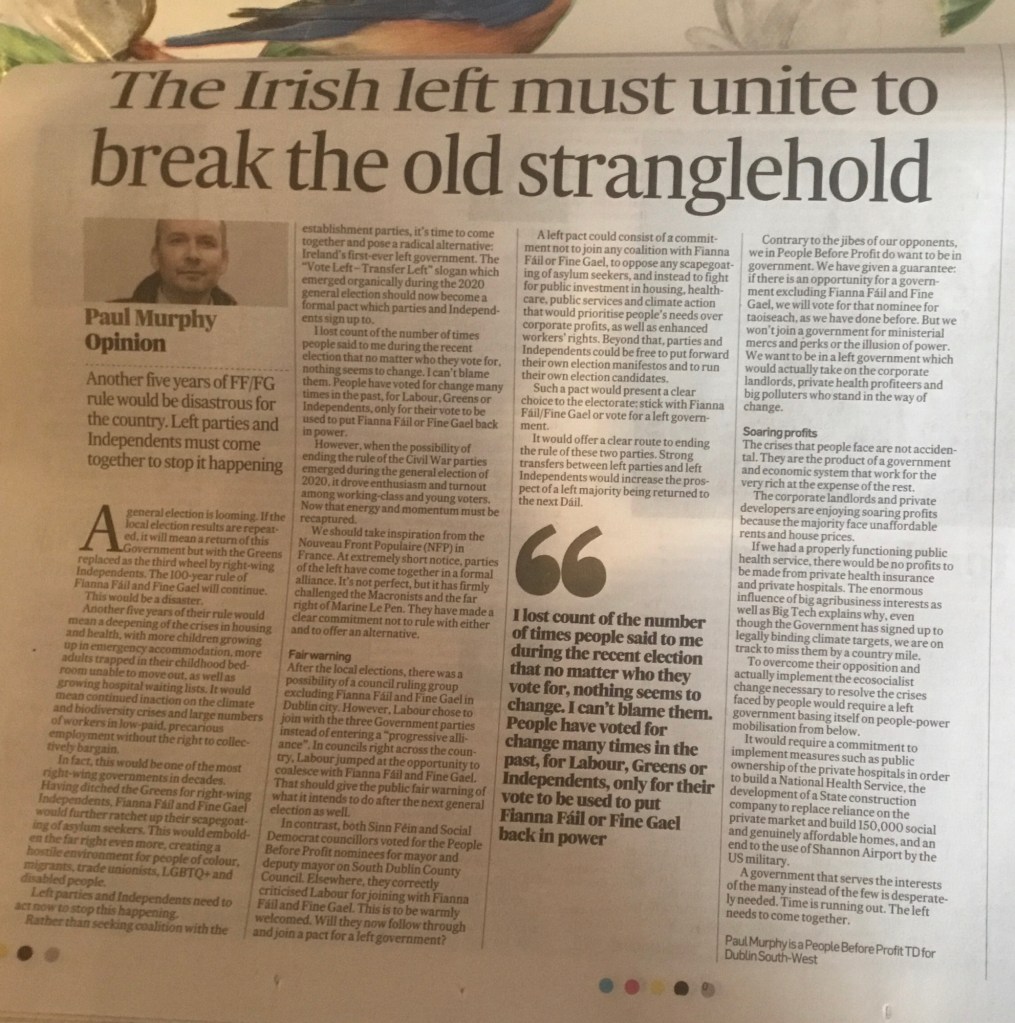
Paul Murphy’s opinion piece in the July 4 2024 edition of the Irish Times makes a strong case :
“Another five years of FF/FG rule would be disastrous for the country. Left parties and Independents must come together to stop it happening”
There is a bottom line :
No coalition with Fianna Fáil or Fine Gael.
The Irish Left must unite to break the old stranglehold, Paul Murphy TD (People Before Profit, Dublin South-West), Irish Times, July 4 2024
Time for a new united left alliance to topple Fianna Fáil and Fine Gael
Another five years of FF/FG rule would be disastrous for the country. Left parties and Independents must come together and stop this happening
A general election is looming. If the local election results are repeated, it will mean a return of this Government but with the Greens replaced as the third wheel by right-wing Independents. The 100-year rule of Fianna Fáil and Fine Gael will continue.
This would be a disaster.
Another five years of their rule would mean a deepening of the crises in housing and health, with more children growing up in emergency accommodation, more adults trapped in their childhood bedroom unable to move out, as well as growing hospital waiting lists. It would mean continued inaction on the climate and biodiversity crises and large numbers of workers in low-paid, precarious employment without the right to collectively bargain.
One of the biggest donors to Nigel Farage’s anti-net zero Reform UK during the general election campaign has significant Russian business interests, DeSmog can report.
Natural resources investor David Lilley donated £100,000 to Reform on 10 June – a week after Farage announced that he was returning as the party’s leader. Lilley’s donation was the third largest to Reform during the campaign so far.
As revealed by The Mirror and Good Law Project in the former’s print edition, Lilley controls a series of companies that own 12,000 hectares of farmland in the Stavropol region of Russia, in the south west of the country, used to produce cereals and oilseeds.
Lilley confirmed to DeSmog that he still owns this land, saying that “I have never made a secret of my assets in Russia.” He said that he had made no profit on these assets since February 2022 and that he had been prevented from selling them by the Russian state.
Farage has come under fire in recent days for suggesting that Russia’s 2022 invasion of Ukraine was provoked by the west, and for calling on Ukraine to enter peace talks with Russian President Vladimir Putin. Good Law Project executive director Jolyon Maugham told DeSmog that Reform is “starting to feel a bit like Russia’s unofficial British Embassy.”
Sometimes, a campaign alters the balance of forces in a significant manner. We can compare this fresh statistical evidence from Scotland with the real result which will appear in the early hours of Friday July 5 2024. Has British Unionist Sir Keir Starmer snatched defeat from victory in Scotland?
Sir John Curtice delivers his assessment of the latest poll results from Savanta, for The Scotsman
Labour look set to make significant gains north of the border. And the SNP are at risk of falling short of their target of winning at least half of Scotland’s seats at Westminster.
However, the battle between them now looks as though it could be significantly closer than Labour had hoped and the SNP feared when Mr Sunak called the election six weeks ago.
At that point Savanta reckoned that Labour were on 37 per cent, four points ahead of the SNP. Their lead was even slightly bigger, five points, in the middle of June. Yet in today’s poll support for Labour is, at 31 per cent, six points down on the beginning of the campaign, and seven points short of the middle of June.
Abstention lowest since 1997 at 32.5% (cf 53% in 2022)
Macron’s big gamble has failed. By calling a snap election, he thought the French people would rally around his centrist party and the moderate left to put Le Pen’s Rassemblement National (RN, National Rally) back in its box after its victory in the recent Euro elections. He assumed a bigger turnout would not favour Le Pen’s extreme right-wing, post-fascist party. On the contrary, 20% more people turned out than in 2022. The RN consolidated its Euro vote and successfully allied with a split from the mainstream Les Républicains (LR, the Republicans). In terms of actual votes – around 12 million if you add in the votes of the Zemmour current who got less than 1% – this is a massive breakthrough. Previous scores in legislative elections were less than half this.
“Macron’s gamble has backfired spectacularly, with the Rassemblement National consolidating its Euro vote and securing an unprecedented number of MPs in the first round.”
The RN has never had so many MPs elected in the first round. They were already the biggest single party in the National Assembly, and it is probable now that they will maintain that position with even more MPs. However, it is still uncertain whether they will get the 289 MPs needed for an absolute majority, which would guarantee them the premiership with their young leader Bardella.
Everything depends on what happens in the second-round run-off. The top two stand automatically, but the third candidate can run in the second round if they have more than 12.5% of the registered voters. All the discussion immediately following the election focuses on whether the best-placed candidate to defeat the RN is given a free run by any eligible third-place candidates stepping down. Leaders of the Nouveau Front Populaire (the New Popular Front-NPF) from the Socialist Party, the Ecologists, and La France Insoumise (France Unbowed – LFI) led by Jean-Luc Mélenchon, have all called for this ‘barrage’ (bloc) to stop the RN winning.
En cas de triangulaire, si le Rassemblement national est en tête et que nous sommes troisième, nous retirerons nos candidatures.
However, leaders of Macron’s Ensemble (Together) party have been much more equivocal. Some have called for blocking the RN with a single candidate, while others have said they will judge on a case-by-case basis. Bruno Le Maire, current economics minister, and Edouard Philippe, former Macronist prime minister, hold this position, saying they will vote for the social democratic left but not for the LFI. They refuse to support second-placed candidates from the LFI, whom they consider as extreme as the RN. These people do not like the way the LFI have supported the Palestinians and condemned the Israeli state or criticised police actions in ethnic minority neighbourhoods. This vacillating position could help the RN squeeze past both the Left and the Macron parties in a three-way race in some areas.
Extraordinary numbers are appearing from reliable opinion poll surveys in Britain.
MRP (Multi-level Regression and Post-stratification) surveys (explanation here : MRP explained) are much more accurate than traditional opinion polls – and still : we must remember these numbers are just a snapshot, the real thing might be significantly different on July 4 2024.
All of that said : Gamblegate (Tory insiders placing insider bets on the surprise date of the British general election) and Brexit neatly symbolise the self-created swamp of the 2020’s British Conservatives.
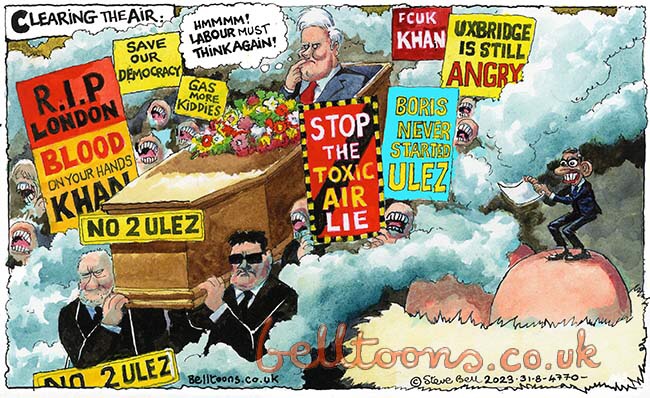
Copyright Steve Bell 2023/All Rights Reserved e.mail: belltoons@ntlworld.com tel: 00 44 (0)1273 500664
Jeremy Corbyn Might Retain Islington North
This MRP survey makes some interesting predictions for untypical constituencies. For example here is the Islington North Prediction : Expelled ex Labour Party Jeremy Corbyn (independent) might defeat the official Sir Keir Starmer candidate.
Bad six county News for the Democratic Unionist party
None of that is good news for the Democratic Unionist party (DUP). The flat earth dinosaurs of the six counties are tipped to win North Antrim (home of Ian Paisley Junior MP) but the numbers are getting tight : Antrim North Prediction
A long shot : tactical nationalist voting might cause the first Westminster Paisley election defeat since 1970 when the reverend Ian senior first won the seat.
The remote Pacific Ocean island of Saipan suddenly hit Irish and global headlines in 2002 when Irish soccer star Roy Keane walked away from the Irish team’s base for the World Cup in Korea and Japan after a blazing row with his manager Mick McCarthy. Today the island is back in the headlines after the political prisoner Julian Assange walked to freedom following a court hearing in the USA-owned North Marinara territory. Like Keane, Assange did not linger in Saipan – he flew home to his native land, Australia.
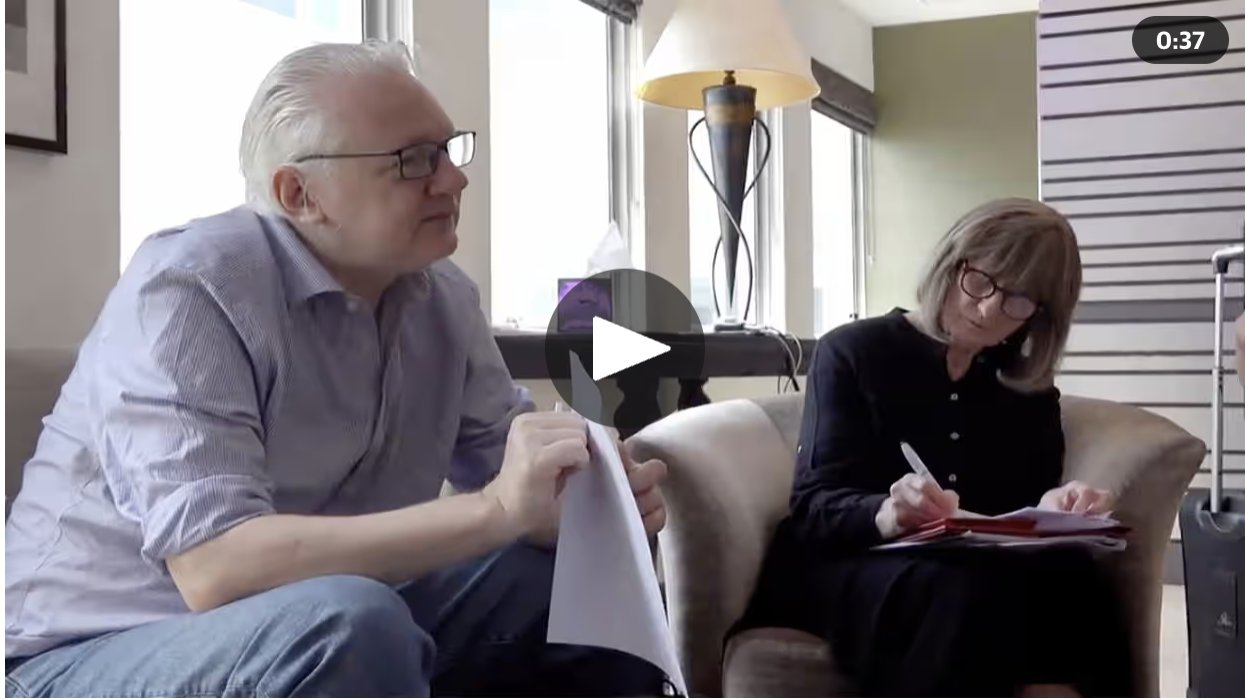
That is not the only Irish connection. Many innocent Irish political prisoners were held, like Assange, in noxious British jails such as Belmarsh. A small number of dedicated human rights lawyers became household names in Ireland. The picture below shows the released Julian Assange beside one of those lawyers, Gareth Pierce.
Political Prisoner Julian Assange and Civil Rights Lawyer Gareth Pierce
The campaigns for the release of the Birmingham Six, the Guildford Four, the Winchester Three and Judith Ward offer an important lesson :
When the left should get together in defence of political prisoners, it is very often a serious mistake to conduct a debate about the political views and activities of the prisoners. In Ireland that was true of the Birmingham 6, the H-Block/Armagh political prisoners, Nicky Kelly and the IRSP members framed for the Sallins Train Robbery, and the Jobstown Not Guilty political activists in Tallaght. Many comrades would be well advised to go back further and examine the Sacco and Vanzetti campaign in the 1920’s, and the Moscow Trial Purges of the 1930’s. The faults (or lack of faults) of the victims are regularly used as an excuse to avoid a united campaign in favour of the victims. The bigger story is that “An Injury to One is An Injury to All”.
The decision by President Emmanuel Macron to hold snap legislative elections in four weeks’ time, a move taken on Sunday immediately after the landslide victory of the French far-right in European Parliament elections, has had the effect of a political bombshell. Not least because it now appears possible that the far-right Rassemblement National party, riding high on the results of Sunday’s poll, may gain enough seats in parliament to form a government. For some in France, that prospect has made them fearful over their future. Mediapart has been listening to their concerns.
Since the victory of the far-right Rassemblement National (RN) party in Sunday’s European Parliament elections in France, and the subsequent decision by Emmanuel Macron to call snap general elections, in which the RN is hoping to gain an absolute majority, Oumar fears the worst.
“We’ll no longer have the possibility of getting our papers sorted out,” he said. “We risk being massively expelled.” The “we” he refers to are the ‘undocumented’ immigrants who hope to one day receive legal residency and working status. Oumar arrived in France from Mali in 2017. In his thirties, living in the Paris region, he finds work on a temporary basis, most often in logistics. “We come home late in the evening, we pay contributions, but we have no right to anything if we have an accident,” he said. “But the far-right, through populism, presents us as people who want to profit from [social] aid.”
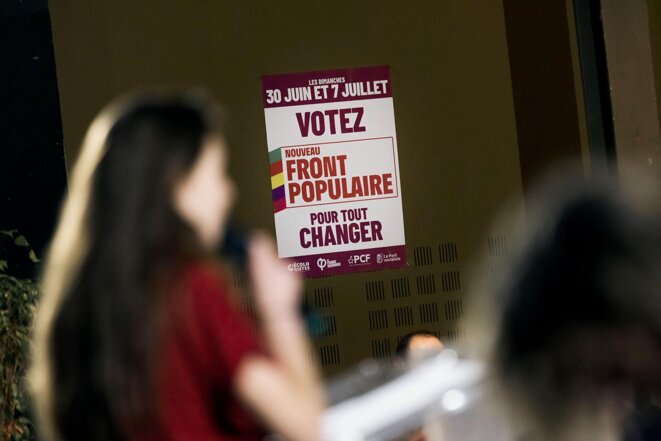
Nouveau Front Populaire – New Popular Front – Left Alliance Campaigning in French parliamentary elections against the right-wing Macron government and the Far-Right RN led by Marine Le Pen
As the father of a child who has French nationality, Oumar officially applied for residence and work permits in February, but has not yet been given a response. Since Sunday evening, his concerns have heightened.
Many potential targets of a far-right government are unsure of their future. Smail, a 36-year-old Algerian, said that on Sunday evening he told himself “it was perhaps the moment to request French nationality, because afterwards the doors will be closed”. He has a renewable ten-year residency permit, has a full-time, open-ended working contract in the fibre-optic cable business, and owns a property.
Éirigí, a socialist-republican organisation, “is a political party that was formed in 2006 by a group of Dublin-based community and political activists. We believe that modern Ireland is a deeply undemocratic, unequal and unfair country not by accident, but by design.” Their analysis of Sinn Féin’s unexpectedly weak showing in the June 7 2024 Irish Local and European Elections highlights how the party was bounced into changing its position on immigrationand racism :
With a few notable exceptions, this new talking point was propagated without context – with no detailed critique of migration in the modern world – no attempt to explain why the asylum process is in chaos – no robust defence of the core republican principle of equality – no assertion that racism, sectarianism and xenophobia are the enemies of republicanism – no calling out the peddling of hate and division by the far-right. For potential Sinn Féin voters, the lesson was clear. The party could be bounced into changing its messaging if there were votes at stake, even when those doing the bouncing were far-right bigots. It seems almost certain that the ease with which Sinn Féin was bounced on the issue of immigration did them more electoral damage than their actual position on immigration.
Sinn Féin Election Disaster – The Price Of Putting Popularity Before Principle
Two weeks have now passed since the Local and European elections in the Twenty-Six Counties. Despite Sinn Féin’s frantic spinning to the contrary, the election was nothing short of an unmitigated disaster for the party. The number of votes and seats secured by the party was even lower than the lowest expectations of pollsters, political commentators and Sinn Féin itself.
As recently as July 2022, support for Sinn Féin was at a level not seen in more than a century. The Irish Times/IPSOS opinion poll for that month found that 36% of voters in the Twenty-Six Counties intended to vote for Sinn Féin.
Irish Times/IPSOS poll results from July 2022 had Sinn Féin attracting the support of more than one in three voters in the Twenty-Six Counties. (Image courtesy of Irish Times).
Fourteen months later, in September 2023, the same poll found that 34% still intended to vote for Sinn Féin. Among voters under the age of 34, support was even higher at more than 43%. Despite this, Sinn Féin secured less than 12% of the popular vote in the 2024 Local and European elections.
So, why have two-thirds of Sinn Féin supporters abandoned the party since last September?
Prior to elections the apparent answer to this question seemed obvious to many – immigration. Immigration, it was claimed, had recently become a red-hot issue for many Sinn Féin supporters., and these supporters were now walking away from Sinn Féin in their droves because the party was too ‘soft’ on immigration. It was an open and shut case. Until it wasn’t.
When the ballot boxes were opened on this day two weeks ago, it quickly became clear that the opinion polls had significantly underestimated the scale of Sinn Féin’s woes.
Provisional results of the 2024 European Elections, as at June 19. Source: results.elections.europa.eu
At first glance it looks as if the parties to the left of the social democracy held their ground against the surge of the far right and mainstream right that marked the June 9 European Union (EU) parliamentary elections (see here for results in detail).
Although the smallest of the European parliament’s seven groups, The Left managed to maintain its EU-wide vote at 5.4% and increase its seat tally from 37 to 39 in the 720-seat assembly.
In addition, left green Members of the European Parliaments (MEPs) and those representing stateless nations (part of the Greens group as the European Free Alliance) at least maintained their numbers in the chamber.
Yet the Greens group as a whole shrank from 71 seats to 53 while that of the liberals (known as Renew) fell from 102 to 79. This drop reflected that the environmental issues that in part drove the big advance of these parties in the 2019 election were less important for many voters this time.
The campaign was dominated by insecurity about the future, the cost of living (particularly housing), the fear of war, the “immigration threat” and intolerance of difference.
In this grim atmosphere the biggest growth went to the mainstream right European People’s Party and the two far-right groups (Identity and Democracy and Conservatives and Reformists): taken together the right and far right won an extra 30 seats, bring it to 324.
Because it would take only 37 ungrouped MEPs to join them to from a reactionary majority, the June 9 result poses with new urgency two old questions about politics in the European parliament. How much, if at all, does the real balance of political forces in the chamber differ from that among its formal groupings? And how much does membership of a group represent disciplined commitment to its positions?
Left divisions over Ukraine
The questions are sharply relevant in the case of the Left group, where differences over what stance to take towards the Russian invasion of Ukraine were already pointing towards a split before June 9.
On May 31, Li Andersson, chairperson of the Finnish Left Alliance told the Helsinki Times that these differences could not be tolerated in the group in the new legislature. Referring to Clare Daly and Mick Wallace, Irish left independent opponents of military aid to Ukraine, Andersson said: “The Nordic Green Left as a whole [covering Finland, Sweden, Denmark, Norway, Iceland, Greenland and the Faroe Islands] is of the opinion that if they manage to win re-election, they can’t join our group.”
For Andersson, the same went for the new Sahra Wagenknecht Alliance: For Reason and Justice (BSW), a split in Germany from leading Left group member Die Linke (The Left). BSW opposes military aid to Ukraine and supports resuming the gas trade with Russia, in common with most of Europe’s far-right parties.
Dublin City Councillor John Lyons (Artane-Whitehall) and supporters
Independent Left candidate Councillor John Lyons topped the poll in Artane-Whitehall 2024 for first preferences in the local government elections of 7 June 2024. This was a terrific result for our small party and above all is a recognition of the consistent, empathetic and determined work carried out by John for individuals and groups in the community he represents on Dublin City Council. The high vote might also be connected to the values and priorities of Independent Left and this deserves some reflection.
Before getting to that, however, what happened in the bigger picture? What do the results tell us about Irish politics in the snapshot provided by the election?
1. Fine Gael turned public concern onto the question of immigration.
It’s an old and, unfortunately, successful tactic by conservative and governing parties that to deflect from how they have facilitated the rich getting richer, they focus public anxiety on immigrants. In the run up to the election, Fine Gael, and their Fianna Fáil and Green partners in government, forced refugees into homelessness then arranged performances such as bulldozing tents to generate attention to the issue. This worked to put a spotlight on Sinn Féin’s response.
2. The Centre Held?
Ever since COVID restrictions gave fascists a focus to organise around, they’ve been growing in Ireland. By mobilising against refugee centres, they gained a following beyond a fringe. Encouraging people to be angry against immigrants plays right into the hands of these fascists. Fine Gael took a calculated risk on this: they chose to give fascism a boost rather than face the electorate on their record in government. After the election they breathed a sigh of relief and pundits everywhere said that the centre held. The reality, unfortunately, is that fascists did make significant gains. Not the gains that they themselves and their US funders hoped for, but about 5% of the electorate voted far-right in the European elections and in the local elections they got five seats, coming very close to a sixth in Artane-Whitehall.




 Tomás Ó Flatharta