On the face of it this is political loony-land – and so much for the liberal reputation of Alliance Party leader Naomi Long, currently trying to take the East Belfast Westminster seat of DUP leader Gavin Robinson – the result will be known in the early hours of Friday July 5.
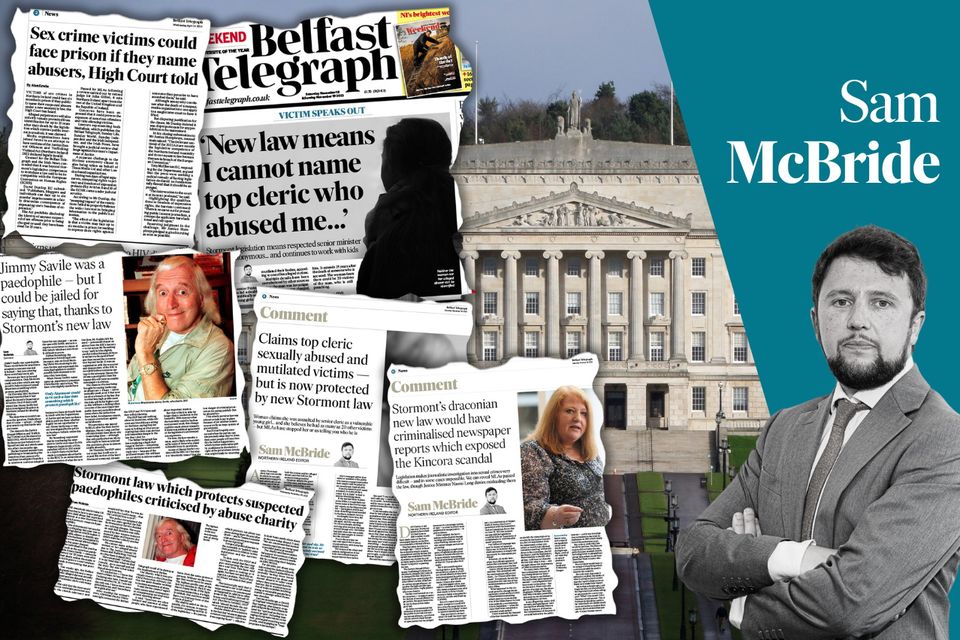
Political Journalist Sam McBride explains the background in two articles below.
One correspondent asked McBride a relevant question, straining to give Long the benefit of the doubt :
Abstention lowest since 1997 at 32.5% (cf 53% in 2022)
Macron’s big gamble has failed. By calling a snap election, he thought the French people would rally around his centrist party and the moderate left to put Le Pen’s Rassemblement National (RN, National Rally) back in its box after its victory in the recent Euro elections. He assumed a bigger turnout would not favour Le Pen’s extreme right-wing, post-fascist party. On the contrary, 20% more people turned out than in 2022. The RN consolidated its Euro vote and successfully allied with a split from the mainstream Les Républicains (LR, the Republicans). In terms of actual votes – around 12 million if you add in the votes of the Zemmour current who got less than 1% – this is a massive breakthrough. Previous scores in legislative elections were less than half this.
“Macron’s gamble has backfired spectacularly, with the Rassemblement National consolidating its Euro vote and securing an unprecedented number of MPs in the first round.”
The RN has never had so many MPs elected in the first round. They were already the biggest single party in the National Assembly, and it is probable now that they will maintain that position with even more MPs. However, it is still uncertain whether they will get the 289 MPs needed for an absolute majority, which would guarantee them the premiership with their young leader Bardella.
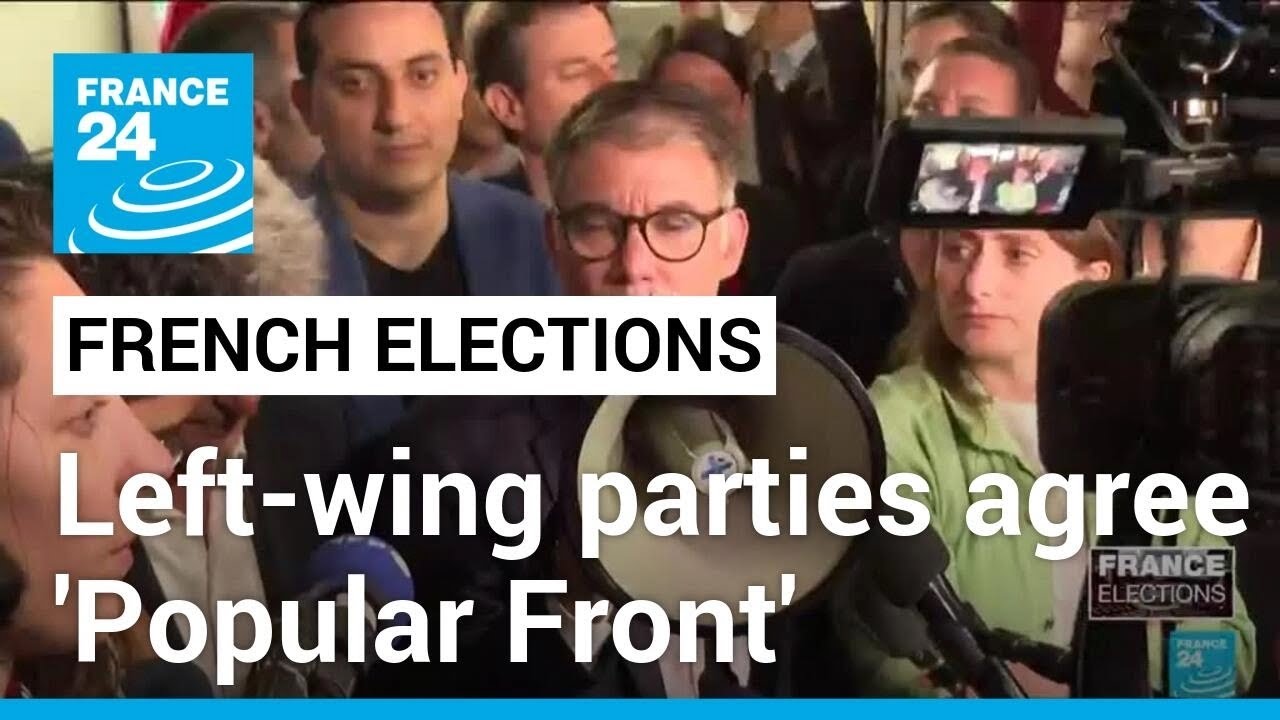
Everything depends on what happens in the second-round run-off. The top two stand automatically, but the third candidate can run in the second round if they have more than 12.5% of the registered voters. All the discussion immediately following the election focuses on whether the best-placed candidate to defeat the RN is given a free run by any eligible third-place candidates stepping down. Leaders of the Nouveau Front Populaire (the New Popular Front-NPF) from the Socialist Party, the Ecologists, and La France Insoumise (France Unbowed – LFI) led by Jean-Luc Mélenchon, have all called for this ‘barrage’ (bloc) to stop the RN winning.
En cas de triangulaire, si le Rassemblement national est en tête et que nous sommes troisième, nous retirerons nos candidatures.
However, leaders of Macron’s Ensemble (Together) party have been much more equivocal. Some have called for blocking the RN with a single candidate, while others have said they will judge on a case-by-case basis. Bruno Le Maire, current economics minister, and Edouard Philippe, former Macronist prime minister, hold this position, saying they will vote for the social democratic left but not for the LFI. They refuse to support second-placed candidates from the LFI, whom they consider as extreme as the RN. These people do not like the way the LFI have supported the Palestinians and condemned the Israeli state or criticised police actions in ethnic minority neighbourhoods. This vacillating position could help the RN squeeze past both the Left and the Macron parties in a three-way race in some areas.
Extraordinary numbers are appearing from reliable opinion poll surveys in Britain.
MRP (Multi-level Regression and Post-stratification) surveys (explanation here : MRP explained) are much more accurate than traditional opinion polls – and still : we must remember these numbers are just a snapshot, the real thing might be significantly different on July 4 2024.
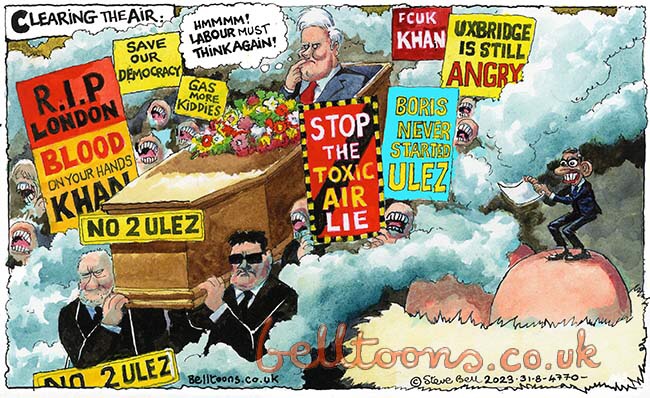
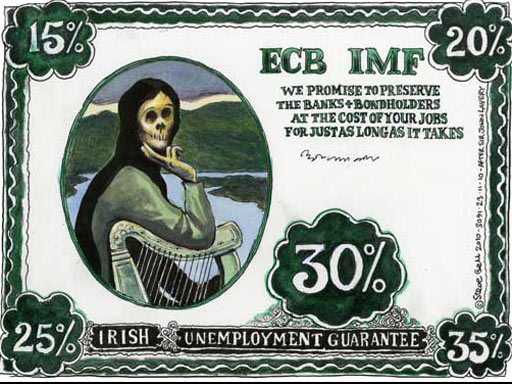
All of that said : Gamblegate (Tory insiders placing insider bets on the surprise date of the British general election) and Brexit neatly symbolise the self-created swamp of the 2020’s British Conservatives.
Copyright Steve Bell 2023/All Rights Reserved e.mail: belltoons@ntlworld.com tel: 00 44 (0)1273 500664
Jeremy Corbyn Might Retain Islington North
This MRP survey makes some interesting predictions for untypical constituencies. For example here is the Islington North Prediction : Expelled ex Labour Party Jeremy Corbyn (independent) might defeat the official Sir Keir Starmer candidate.
Bad six county News for the Democratic Unionist party
None of that is good news for the Democratic Unionist party (DUP). The flat earth dinosaurs of the six counties are tipped to win North Antrim (home of Ian Paisley Junior MP) but the numbers are getting tight : Antrim North Prediction
A long shot : tactical nationalist voting might cause the first Westminster Paisley election defeat since 1970 when the reverend Ian senior first won the seat.
The remote Pacific Ocean island of Saipan suddenly hit Irish and global headlines in 2002 when Irish soccer star Roy Keane walked away from the Irish team’s base for the World Cup in Korea and Japan after a blazing row with his manager Mick McCarthy. Today the island is back in the headlines after the political prisoner Julian Assange walked to freedom following a court hearing in the USA-owned North Marinara territory. Like Keane, Assange did not linger in Saipan – he flew home to his native land, Australia.
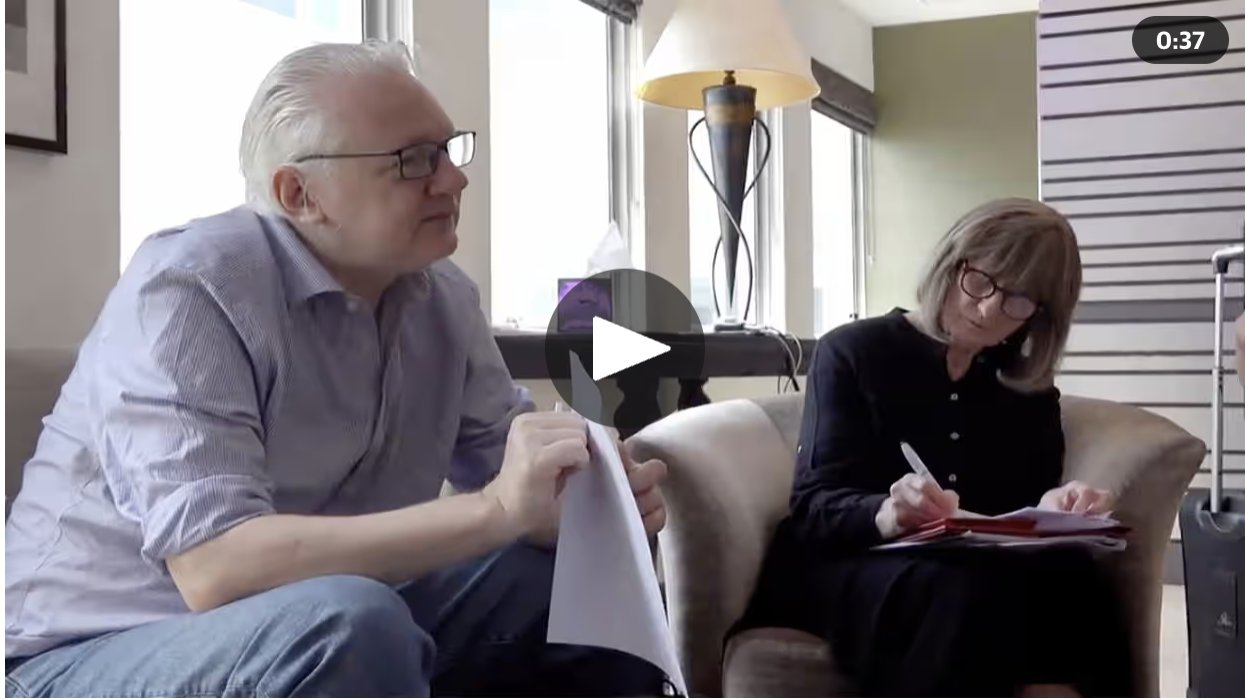
That is not the only Irish connection. Many innocent Irish political prisoners were held, like Assange, in noxious British jails such as Belmarsh. A small number of dedicated human rights lawyers became household names in Ireland. The picture below shows the released Julian Assange beside one of those lawyers, Gareth Pierce.
Political Prisoner Julian Assange and Civil Rights Lawyer Gareth Pierce
The campaigns for the release of the Birmingham Six, the Guildford Four, the Winchester Three and Judith Ward offer an important lesson :
When the left should get together in defence of political prisoners, it is very often a serious mistake to conduct a debate about the political views and activities of the prisoners. In Ireland that was true of the Birmingham 6, the H-Block/Armagh political prisoners, Nicky Kelly and the IRSP members framed for the Sallins Train Robbery, and the Jobstown Not Guilty political activists in Tallaght. Many comrades would be well advised to go back further and examine the Sacco and Vanzetti campaign in the 1920’s, and the Moscow Trial Purges of the 1930’s. The faults (or lack of faults) of the victims are regularly used as an excuse to avoid a united campaign in favour of the victims. The bigger story is that “An Injury to One is An Injury to All”.
The decision by President Emmanuel Macron to hold snap legislative elections in four weeks’ time, a move taken on Sunday immediately after the landslide victory of the French far-right in European Parliament elections, has had the effect of a political bombshell. Not least because it now appears possible that the far-right Rassemblement National party, riding high on the results of Sunday’s poll, may gain enough seats in parliament to form a government. For some in France, that prospect has made them fearful over their future. Mediapart has been listening to their concerns.
Since the victory of the far-right Rassemblement National (RN) party in Sunday’s European Parliament elections in France, and the subsequent decision by Emmanuel Macron to call snap general elections, in which the RN is hoping to gain an absolute majority, Oumar fears the worst.
“We’ll no longer have the possibility of getting our papers sorted out,” he said. “We risk being massively expelled.” The “we” he refers to are the ‘undocumented’ immigrants who hope to one day receive legal residency and working status. Oumar arrived in France from Mali in 2017. In his thirties, living in the Paris region, he finds work on a temporary basis, most often in logistics. “We come home late in the evening, we pay contributions, but we have no right to anything if we have an accident,” he said. “But the far-right, through populism, presents us as people who want to profit from [social] aid.”
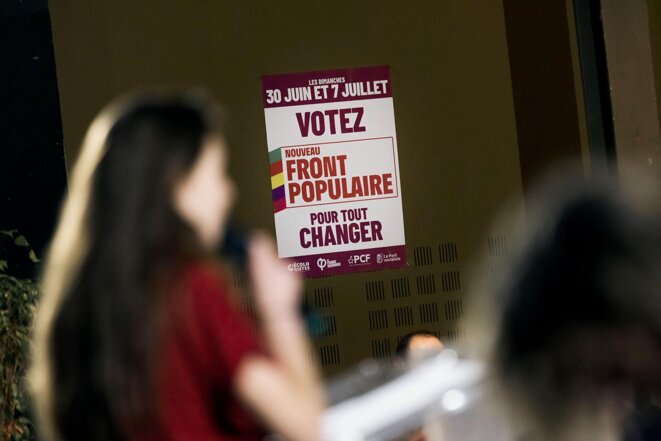
Nouveau Front Populaire – New Popular Front – Left Alliance Campaigning in French parliamentary elections against the right-wing Macron government and the Far-Right RN led by Marine Le Pen
As the father of a child who has French nationality, Oumar officially applied for residence and work permits in February, but has not yet been given a response. Since Sunday evening, his concerns have heightened.
Many potential targets of a far-right government are unsure of their future. Smail, a 36-year-old Algerian, said that on Sunday evening he told himself “it was perhaps the moment to request French nationality, because afterwards the doors will be closed”. He has a renewable ten-year residency permit, has a full-time, open-ended working contract in the fibre-optic cable business, and owns a property.
Éirigí, a socialist-republican organisation, “is a political party that was formed in 2006 by a group of Dublin-based community and political activists. We believe that modern Ireland is a deeply undemocratic, unequal and unfair country not by accident, but by design.” Their analysis of Sinn Féin’s unexpectedly weak showing in the June 7 2024 Irish Local and European Elections highlights how the party was bounced into changing its position on immigrationand racism :
With a few notable exceptions, this new talking point was propagated without context – with no detailed critique of migration in the modern world – no attempt to explain why the asylum process is in chaos – no robust defence of the core republican principle of equality – no assertion that racism, sectarianism and xenophobia are the enemies of republicanism – no calling out the peddling of hate and division by the far-right. For potential Sinn Féin voters, the lesson was clear. The party could be bounced into changing its messaging if there were votes at stake, even when those doing the bouncing were far-right bigots. It seems almost certain that the ease with which Sinn Féin was bounced on the issue of immigration did them more electoral damage than their actual position on immigration.
Sinn Féin Election Disaster – The Price Of Putting Popularity Before Principle
Two weeks have now passed since the Local and European elections in the Twenty-Six Counties. Despite Sinn Féin’s frantic spinning to the contrary, the election was nothing short of an unmitigated disaster for the party. The number of votes and seats secured by the party was even lower than the lowest expectations of pollsters, political commentators and Sinn Féin itself.
As recently as July 2022, support for Sinn Féin was at a level not seen in more than a century. The Irish Times/IPSOS opinion poll for that month found that 36% of voters in the Twenty-Six Counties intended to vote for Sinn Féin.
Irish Times/IPSOS poll results from July 2022 had Sinn Féin attracting the support of more than one in three voters in the Twenty-Six Counties. (Image courtesy of Irish Times).
Fourteen months later, in September 2023, the same poll found that 34% still intended to vote for Sinn Féin. Among voters under the age of 34, support was even higher at more than 43%. Despite this, Sinn Féin secured less than 12% of the popular vote in the 2024 Local and European elections.
So, why have two-thirds of Sinn Féin supporters abandoned the party since last September?
Prior to elections the apparent answer to this question seemed obvious to many – immigration. Immigration, it was claimed, had recently become a red-hot issue for many Sinn Féin supporters., and these supporters were now walking away from Sinn Féin in their droves because the party was too ‘soft’ on immigration. It was an open and shut case. Until it wasn’t.
When the ballot boxes were opened on this day two weeks ago, it quickly became clear that the opinion polls had significantly underestimated the scale of Sinn Féin’s woes.
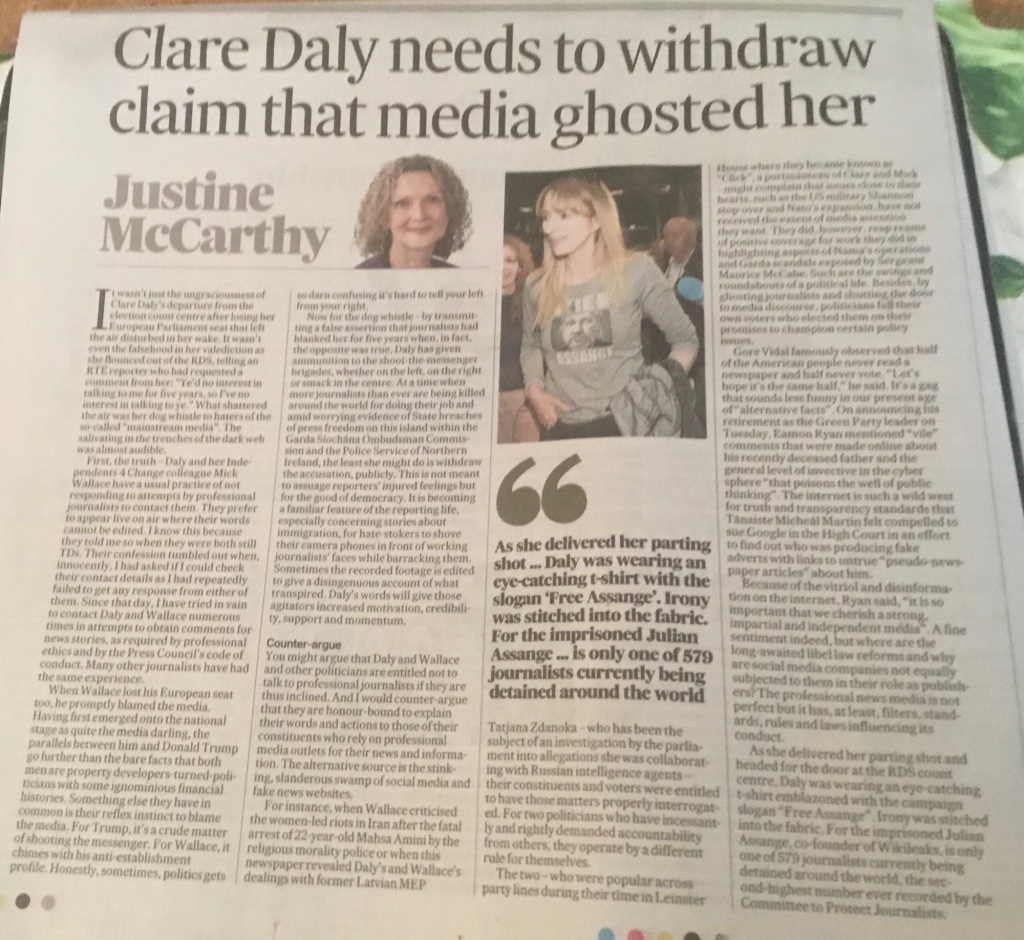
This Justine McCarthy article is a damning critique of the “shoot the messenger” technique regularly used by the former Dublin Member of the European Parliament (MEP) Clare Daly, and the ex Ireland South MEP Mick Wallace.
It wasn’t just the ungraciousness of Clare Daly’s departure from the election count centre after losing her European Parliament seat that left the air disturbed in her wake. It wasn’t even the falsehood in her valediction as she flounced out of the RDS, telling an RTÉ reporter who had requested a comment from her: “Ye’d no interest in talking to me for five years, so I’ve no interest in talking to ye.” What shattered the air was her dog whistle to haters of the so-called “mainstream media”. The salivating in the trenches of the dark web was almost audible.
First, the truth – Daly and her Independents 4 Change colleague Mick Wallace have a usual practice of not responding to attempts by professional journalists to contact them. They prefer to appear live on air where their words cannot be edited. I know this because they told me so when they were both still TDs. Their confession tumbled out when, innocently, I had asked if I could check their contact details as I had repeatedly failed to get any response from either of them. Since that day, I have tried in vain to contact Daly and Wallace numerous times in attempts to obtain comments for news stories, as required by professional ethics and by the Press Council’s code of conduct. Many other journalists have had the same experience.
Everyone on the left in Ireland and across the globe should warmly welcome this French initiative.
The New Popular Front in France, which unites trade unions, ATTAC, the Socialist Party, the Greens, the Communist Party, France Unbowed (Melenchon) and the NPA [NOUVEAU PARTI ANTICAPITALISTE] (the entire significant left) against the fascist National Rally, includes in it’s platform ‘unconditional support for Ukraine against Putin’s aggression’.
To defeat Vladimir Putin’s war of aggression, and that he answers for his crimes before international justice: unfailingly defend the sovereignty and freedom of the Ukrainian people as well as the integrity of its borders, by the delivery of necessary weapons, the cancellation of its foreign debt, the seizure of the assets of the oligarchs who contribute to the Russian war effort in the framework allowed by international law, the dispatch of peacekeepers to secure nuclear power plants, in an international context of tension and war on the European continent, and work towards the return of peace.
A June 14 poll shows Marine Le Pen’s far-right, Putin-friendly National Rally at 29.5%, the left-wing New Popular Front at 28.5%, and Emmanuel Macron’s centrist Renew at 18%. The winner-take-all district elections for the 577 seats in the French National Assembly will be held on June 30. Run-offs between the top two if no one wins a majority in the first round will be held on July 7.
With the final tallies counted and remaining seats filled, People Before Profits (PBP) Dublin South West and RISE members Diarmuid Flood and Paul Murphy review the deeply polarised Local and European Elections and outline five key takeaways.
For the second election in a row, dramatic political changes took place in the course of the local and European elections. Sinn Féin started the year polling around 30% and yet ended up with less than 12% nationally in the local Elections. Independents and Others started the year with around 15%, but won close to 25% on June 6th. Fianna Fáil and Fine Gael both hit 23%, coming from the high teens and around 20% respectively. In many ways, these appear to be the opposite political trends to what we saw in the General Election of 2020. Back then, Sinn Féin grew dramatically as hope for an end to 100 years of Fianna Fail and Fine Gael rule propelled them to be the biggest party in vote share for the first time ever. Volatility is clearly in the air.
However, what we saw in the five weeks of the election campaign did not come from nowhere. The election catalysed and accelerated existing processes. In the absence of major progressive social struggles, with the exception of the Palestine solidarity movement, the political terrain has undoubtedly shifted rightwards. Ireland has caught up with most of the rest of Europe and the Global North, with the emergence of a reactionary social movement in opposition to asylum seekers and the growth of a racist, climate denialist, anti-LGBTQ, and sexist far-right.
Daly and Mick Wallace were part of the left group in the last parliament, but the chairperson of the Left Alliance (Finland) disagrees strongly with the Wallace-Daly Ukraine policy.
Li Andersson, Chairperson of the Finnish Left Alliance, says Daly and Wallace parroted Putin’s propaganda :
Andersson said MEPs Clare Daly and Mick Wallace from Ireland, two fierce critics of support for Ukraine, can no longer sit with The Left. Despite also parroting Russian propaganda and seeking to torpedo resolutions on Russia, and seeking to torpedo resolutions on Russia, Daly and Wallace have been allowed to continue as members of The Left.
In Finland, the Left Alliance won big in the European parliament elections :
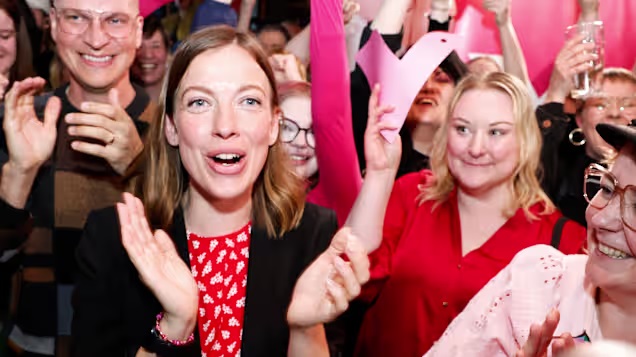
Finland’s results in the European election bucked a continent-wide trend of rising support for parties on the outer fringe of right-wing politics, with the Left Alliance and the National Coalition winning big at the expense of the nationalist Finns Party. Leftist leader Li Andersson received more votes than any other candidate has ever received in a European election. By 8:34pm, with just 60 percent of the vote counted, she had already beaten Eurosceptic Centre Party grandee Paavo Väyrynen’s total of 157 668 votes in the 1996 election. She ended up getting nearly a quarter of a million votes. Andersson was visibly delighted after the results were announced. ”I’m still in shock. This is an incredibly fantastic result, much better than I could have ever dared to expect,” she said.
Li Andersson (Left) got the highest number of votes of any European election candidate in Finnish history. Image: Tiina Jutila / Yle
CHAIRPERSON of the Left Alliance Li Andersson says The Left, one of the seven political groups in the European Parliament, should clean out members who question support for Ukraine and show sympathy for Russia.
“The groups are always reformed at the start of the term, and we want changes to the group that make it more cohesive on foreign and security policy,” she said to Helsingin Sanomat on Tuesday.
The Left Alliance is part of The Left in the European Parliament.
Helsingin Sanomat reported earlier this week that several members of the political group voted this term against resolutions concerning Ukraine, questioning the need for support – especially military support – for Ukraine. Some members have also criticised the economic sanctions slapped on Russia over its war of aggression in Ukraine.
An analysis conducted by the newspaper found that the group has divided on votes concerning Ukraine, with support coming from parties from the Nordics and opposition from parties in Central and Southern Europe.
Andersson, who herself is vying for a seat in the European Parliament, pointed out that The Left has nonetheless unanimously condemned the war of aggression prosecuted by Russia.
“I’ve stressed that there are certain things we won’t compromise on. The entire group has condemned the war unequivocally. Had that not been the case, we would’ve left the group or someone else would’ve had to leave,” she stated.
“On other issues, you can see that other parties differ from us in terms of their security policy analysis. They don’t reflect the thinking of the Left Alliance.”
How Russia and Ukraine support are viewed by other parties in the group is becoming a threshold question within the Left Alliance – one that defines what parties are capable of co-operation, according to Helsingin Sanomat.
Andersson said MEPs Clare Daly and Mick Wallace from Ireland, two fierce critics of support for Ukraine, can no longer sit with The Left. Despite also parroting Russian propaganda and seeking to torpedo resolutions on Russia, Daly and Wallace have been allowed to continue as members of The Left.
“The Nordic Green Left, [the umbrella party for left-wing parties in the Nordics], as a whole is of the opinion that if they manage to win re-election, they can’t join our group,” stated Andersson.
Sahra Wagenknecht, a German left-wing populist who has opposed military aid to Ukraine and called for the resumption of gas trade with Russia, is similarly not welcome to The Left, according to Andersson.
“We’ll represent our stance in every vote. MEPs of the Left Alliance will vote in favour of supporting Ukraine,” she pledged.
Helsingin Sanomat on Wednesday wrote that the European Parliament’s political groups have generated more discussion than previously in the run-up to the elections, a reflection of the groups’ growing importance in decision-making.
Johanna Kantola, a professor of political science at the University of Helsinki, said to the newspaper that the groups have marked differences: while the largest groups in the parliament – the centre-right EPP, the social democratic S&D and liberal Renew Europe – have highlighted their European and supranational nature, some of it has been lip service.
National interests are visible in votes and the groups exercise no group discipline, she said.
The Greens and European Free Alliance is a genuinely supranational group with a shared set of values, according to Kantola.
Finnish parties in the European Parliament have been aligned as follows: the Christian Democrats, Movement Now and National Coalition have been part of the EPP, the Finns Party of the ECR, the Social Democrats of S&D, the Centre and Swedish People’s Party of Renew Europe, the Left Alliance of The Left, and the Green League of the Greens and EFA.
Riikka Purra, the chairperson of the Finns Party, stated in mid-May that the Finns Party would stay in the ECR even if the group was joined by Fidesz, the party led by authoritarian Hungarian Prime Minister Viktor Orbán.
“We don’t have another group to go to, and you can’t be without a group. That’s when you need other structures that make it possible to co-exist,” she was quoted saying in Brussels on 14 May by Helsingin Sanomat.
Readers are urged to support this initiative :
We invite you – organisations and individuals – to sign the declaration “Ukraine: A People’s Peace, not an Imperial Peace”. Please find the declaration and our accompanying letter below. Different language versions are provided.
“Sitting MEP Clare Daily has lost her European Parliament seat in the Dublin constituency.
She was excluded on the 17th count and becomes the first outgoing MEP to lose her seat in the election.
Asked how she felt following the loss, she told RTÉ News: “You had no interest in talking to me for five years, so I’ve no interest in talking to you.”
Ms Daly hugged Independent Ireland candidate Niall Boylan before swiftly leaving the count centre at the RDS.”
The best that can be said about Niall Boylan is that he is a mini-Trump who should be shunned, like the mini-Hitler political trash which transferred heavily to him in the Dublin Euro-parliament election contest.




 Tomás Ó Flatharta