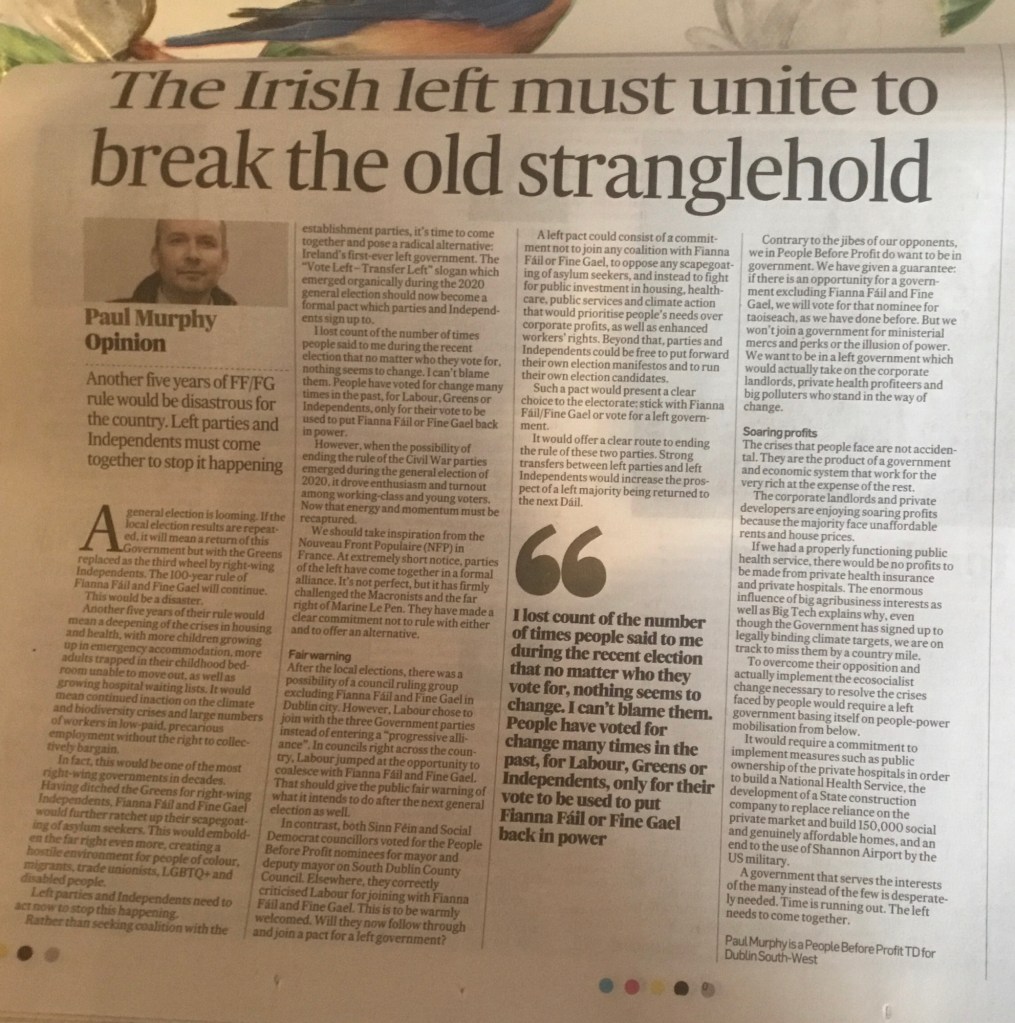
Paul Murphy’s opinion piece in the July 4 2024 edition of the Irish Times makes a strong case :
“Another five years of FF/FG rule would be disastrous for the country. Left parties and Independents must come together to stop it happening”
There is a bottom line :
No coalition with Fianna Fáil or Fine Gael.
The Irish Left must unite to break the old stranglehold, Paul Murphy TD (People Before Profit, Dublin South-West), Irish Times, July 4 2024
Time for a new united left alliance to topple Fianna Fáil and Fine Gael
Another five years of FF/FG rule would be disastrous for the country. Left parties and Independents must come together and stop this happening
A general election is looming. If the local election results are repeated, it will mean a return of this Government but with the Greens replaced as the third wheel by right-wing Independents. The 100-year rule of Fianna Fáil and Fine Gael will continue.
This would be a disaster.
Another five years of their rule would mean a deepening of the crises in housing and health, with more children growing up in emergency accommodation, more adults trapped in their childhood bedroom unable to move out, as well as growing hospital waiting lists. It would mean continued inaction on the climate and biodiversity crises and large numbers of workers in low-paid, precarious employment without the right to collectively bargain.
Abstention lowest since 1997 at 32.5% (cf 53% in 2022)
Macron’s big gamble has failed. By calling a snap election, he thought the French people would rally around his centrist party and the moderate left to put Le Pen’s Rassemblement National (RN, National Rally) back in its box after its victory in the recent Euro elections. He assumed a bigger turnout would not favour Le Pen’s extreme right-wing, post-fascist party. On the contrary, 20% more people turned out than in 2022. The RN consolidated its Euro vote and successfully allied with a split from the mainstream Les Républicains (LR, the Republicans). In terms of actual votes – around 12 million if you add in the votes of the Zemmour current who got less than 1% – this is a massive breakthrough. Previous scores in legislative elections were less than half this.
“Macron’s gamble has backfired spectacularly, with the Rassemblement National consolidating its Euro vote and securing an unprecedented number of MPs in the first round.”
The RN has never had so many MPs elected in the first round. They were already the biggest single party in the National Assembly, and it is probable now that they will maintain that position with even more MPs. However, it is still uncertain whether they will get the 289 MPs needed for an absolute majority, which would guarantee them the premiership with their young leader Bardella.
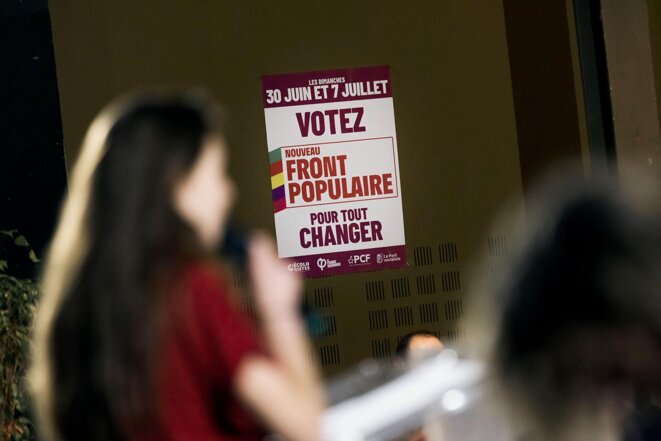
Everything depends on what happens in the second-round run-off. The top two stand automatically, but the third candidate can run in the second round if they have more than 12.5% of the registered voters. All the discussion immediately following the election focuses on whether the best-placed candidate to defeat the RN is given a free run by any eligible third-place candidates stepping down. Leaders of the Nouveau Front Populaire (the New Popular Front-NPF) from the Socialist Party, the Ecologists, and La France Insoumise (France Unbowed – LFI) led by Jean-Luc Mélenchon, have all called for this ‘barrage’ (bloc) to stop the RN winning.
En cas de triangulaire, si le Rassemblement national est en tête et que nous sommes troisième, nous retirerons nos candidatures.
However, leaders of Macron’s Ensemble (Together) party have been much more equivocal. Some have called for blocking the RN with a single candidate, while others have said they will judge on a case-by-case basis. Bruno Le Maire, current economics minister, and Edouard Philippe, former Macronist prime minister, hold this position, saying they will vote for the social democratic left but not for the LFI. They refuse to support second-placed candidates from the LFI, whom they consider as extreme as the RN. These people do not like the way the LFI have supported the Palestinians and condemned the Israeli state or criticised police actions in ethnic minority neighbourhoods. This vacillating position could help the RN squeeze past both the Left and the Macron parties in a three-way race in some areas.
Provisional results of the 2024 European Elections, as at June 19. Source: results.elections.europa.eu
At first glance it looks as if the parties to the left of the social democracy held their ground against the surge of the far right and mainstream right that marked the June 9 European Union (EU) parliamentary elections (see here for results in detail).
Although the smallest of the European parliament’s seven groups, The Left managed to maintain its EU-wide vote at 5.4% and increase its seat tally from 37 to 39 in the 720-seat assembly.
In addition, left green Members of the European Parliaments (MEPs) and those representing stateless nations (part of the Greens group as the European Free Alliance) at least maintained their numbers in the chamber.
Yet the Greens group as a whole shrank from 71 seats to 53 while that of the liberals (known as Renew) fell from 102 to 79. This drop reflected that the environmental issues that in part drove the big advance of these parties in the 2019 election were less important for many voters this time.
The campaign was dominated by insecurity about the future, the cost of living (particularly housing), the fear of war, the “immigration threat” and intolerance of difference.
In this grim atmosphere the biggest growth went to the mainstream right European People’s Party and the two far-right groups (Identity and Democracy and Conservatives and Reformists): taken together the right and far right won an extra 30 seats, bring it to 324.
Because it would take only 37 ungrouped MEPs to join them to from a reactionary majority, the June 9 result poses with new urgency two old questions about politics in the European parliament. How much, if at all, does the real balance of political forces in the chamber differ from that among its formal groupings? And how much does membership of a group represent disciplined commitment to its positions?
Left divisions over Ukraine
The questions are sharply relevant in the case of the Left group, where differences over what stance to take towards the Russian invasion of Ukraine were already pointing towards a split before June 9.
On May 31, Li Andersson, chairperson of the Finnish Left Alliance told the Helsinki Times that these differences could not be tolerated in the group in the new legislature. Referring to Clare Daly and Mick Wallace, Irish left independent opponents of military aid to Ukraine, Andersson said: “The Nordic Green Left as a whole [covering Finland, Sweden, Denmark, Norway, Iceland, Greenland and the Faroe Islands] is of the opinion that if they manage to win re-election, they can’t join our group.”
For Andersson, the same went for the new Sahra Wagenknecht Alliance: For Reason and Justice (BSW), a split in Germany from leading Left group member Die Linke (The Left). BSW opposes military aid to Ukraine and supports resuming the gas trade with Russia, in common with most of Europe’s far-right parties.
With the final tallies counted and remaining seats filled, People Before Profits (PBP) Dublin South West and RISE members Diarmuid Flood and Paul Murphy review the deeply polarised Local and European Elections and outline five key takeaways.
For the second election in a row, dramatic political changes took place in the course of the local and European elections. Sinn Féin started the year polling around 30% and yet ended up with less than 12% nationally in the local Elections. Independents and Others started the year with around 15%, but won close to 25% on June 6th. Fianna Fáil and Fine Gael both hit 23%, coming from the high teens and around 20% respectively. In many ways, these appear to be the opposite political trends to what we saw in the General Election of 2020. Back then, Sinn Féin grew dramatically as hope for an end to 100 years of Fianna Fail and Fine Gael rule propelled them to be the biggest party in vote share for the first time ever. Volatility is clearly in the air.
However, what we saw in the five weeks of the election campaign did not come from nowhere. The election catalysed and accelerated existing processes. In the absence of major progressive social struggles, with the exception of the Palestine solidarity movement, the political terrain has undoubtedly shifted rightwards. Ireland has caught up with most of the rest of Europe and the Global North, with the emergence of a reactionary social movement in opposition to asylum seekers and the growth of a racist, climate denialist, anti-LGBTQ, and sexist far-right.
Overall, the June 7 2024 Local and European elections in the 26 County bit of Ireland were good news for the ruling coalition elected in February 2020. The Fianna Fáil-Fine Gael-Greens plus Gombeens (FFFGGG) combination scored an important victory, setting them up for a possible return to the seat of government in Dublin’s Leinster House in less than 12 months, when a new general election must happen.
Even worse, due to ominous rising support for Gombeen currents (primarily the Independent Ireland [II]) party and extreme racists, FFFG might be able to dump the Greens and rule on their own – or coalesce with the II gombeens and other toxic racist-right populists.
People Before Profit is proposing a “Vote Left” transfer pact to operate in the June 2024 Local and European Elections, 26 Counties
Presenting this positive initiative Paul Murphy TD said
He was fully aware that there would be different perspectives and, but People Before Profit “sees this as just the start of a process to form a left alternative.”
Paul Murphy TD
PBP TD’s Richard Boyd-Barrett, Paul Murphy, and Brid Smith
In the article below, important points from the discussion are highlighted.
This is a serious matter, especially in a context where it is necessary to confront and defeat the extreme racist right.
Colm Breathnach offers a very good template :
Just a personal thing, but here’s my own general set of rules when it comes to voting where a Proportional Representation system is in operation (obviously First Pat The Post system is much more challenging in terms of decisions):
Start with the furthest left and keep voting until you reach the border of what you consider to be the left (for me, that’s social democratic or social liberal parties). Of course that border can shift – the Irish Greens were once inside my border of “left”, now they are definitely outside.
Exclude candidates who consistently hold reactionary positions regardless of their ostensible politics – favour genocide, homophobic etc etc. So the Daly’s of the world don’t feature or let’s say a centre left candidate who justified Israel’s genocide in Gaza.
Adjust to take account of specific concerns which one might deem important for progress to radical transformation of society. So for example you may alter your ranking to the take into account the candidates position on climate change or Irish unity etc.


 Tomás Ó Flatharta