Archive for the ‘War’ Category
“Ukrainian town fights off Russians and faces down hospital bombing” – Remember that name – Bashtanka.
Introductory Note :
Daniel McLaughlin is an old-fashioned war-correspondent, who writes for the Irish Times. This report, published on Saturday April 30 2022, illustrates very vividly the real nature of the current war in Europe, the most dangerous conflict on the continent since World War 2.
This is a war of Ukrainian national liberation against a far-right ethnic-cleansing imperialist state headed by Vladimir Putin. The residents of Bashtanka, in the words of the town’s mayor, Aleksandr Berehovyi, decided to fight because “we had no choice”.
Read the rest of this entry »Evasions on the Left Over Ukraine – Conor Kostick, Independent Left (Ireland)
This is a strongly recommended article. The author is an experienced anti-war activist, an Irish historian and writer living in Dublin. He is the author of many works of history and fiction.. For more information read the information at this link : https://en.wikipedia.org/wiki/Conor_Kostick?wprov=sfti1. https://www.leftarchive.ie/people/2778/ Some of Conor’s political writings are here : https://www.leftarchive.ie/people/2778/



Wars are not light topics that can be dispensed of with simple formulas. I, for one, cannot imagine how the success of Russia would further the cause of democracy and socialism around the world. If you do, then say so, openly, so it can be debated in public. But don’t falsify tradition and history and hide behind pathetic slogans. To paraphrase Marx, we Marxists disdain to conceal our views and aims.
John Ganz, Ben Burgis’s Bad History: Jacobin’s anti-Jacobins
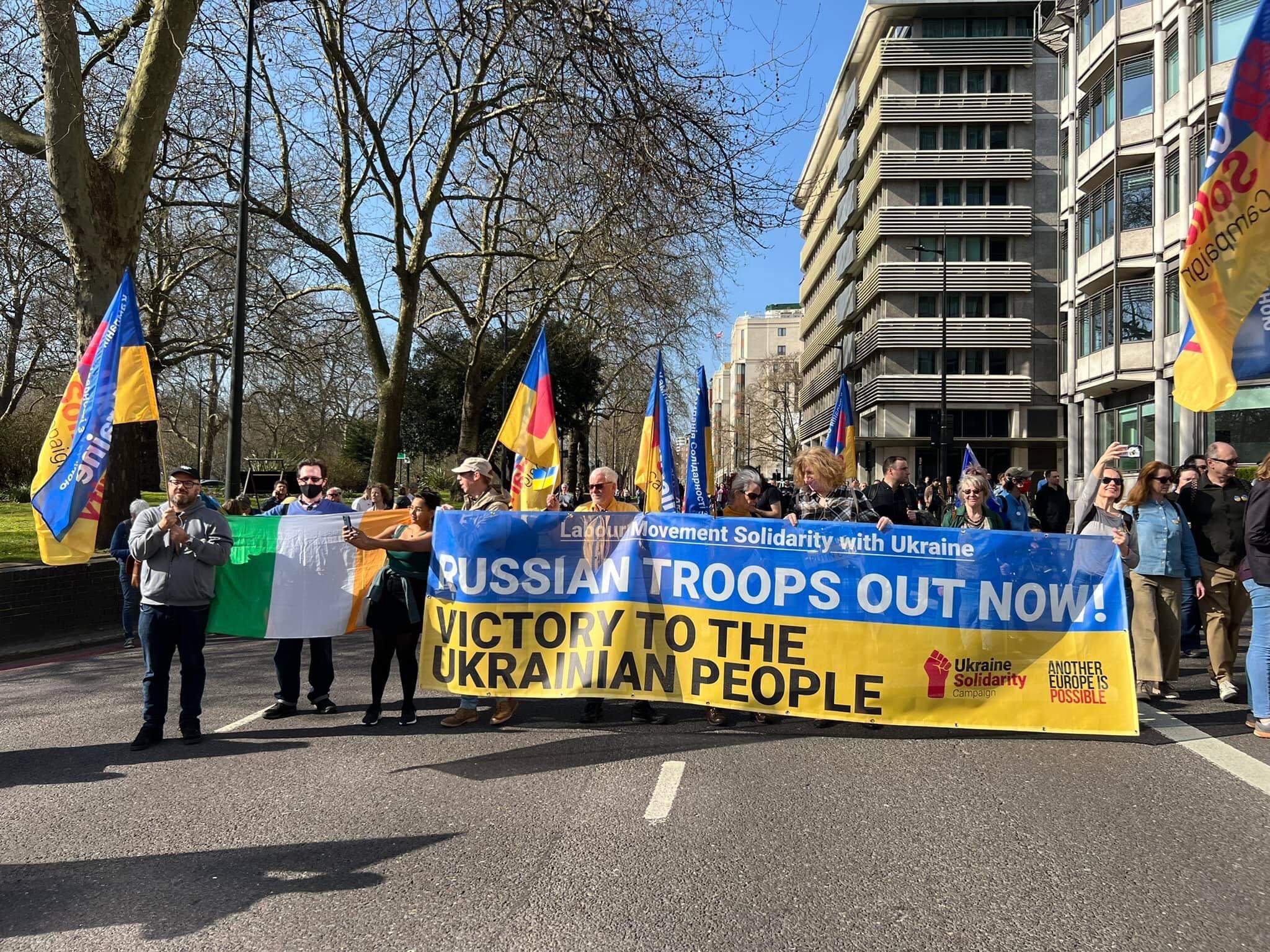
There is a type of left argument around the war in Ukraine which has arisen in the West. It is one that condemns Putin’s invasion, but refuses to offer practical support to the people of Ukraine in resisting that invasion. It is the position one can read in Jacobin, or in statements by Chomsky, Corbyn, and the Stop the War Coalition in the UK. In Ireland we have the same type of response to the Russian invasion of Ukraine from People Before Profit and the Socialist Party of Ireland.
I will use the label Evasionist Left for this approach. It’s not clear how representative this trend is internationally, as many on the left do pro-actively support the resistance in Ukraine, e.g. parties such Razem in Poland; those associated with the Fourth International like Left Bloc and the Danish Red Green Alliance; and the main left party in Japan, the Japanese Communist Party.
From Managed Democracy to Fascism – Putin’s Imposition of Obedience and Order on Russian Society. – Ilya Budraitskis
Many western left-wing anti-war activists catastrophically underestimate the far-right ethnic-cleansing and imperialist régime of Vladimir Putin – a régime which promotes huge far-right forces in the European continent such as Marine Le Pen (France) AFD (Germany) Salvini (Italy) – just naming a few. In general, such leftists wildly exaggerate the far-right in Ukraine, make absurd claims that the Russian invasion of Ukraine is an inter-imperialist war, and blame NATO for the Russian invasion of Ukraine. Popular resistance to the Russian invasion is deemed OK, provided the Ukrainian masses do not use weapons. Meanwhile Putin’s ethnic-cleansing army, which is NATO’s number one recruiting sergeant, implements a plan to dissolve the Ukrainian nation – just like, for example, Israel committed a genocide of the Palestinian people in the late 1940’s. It is necessary to engage with the left in Eastern Europe, which shines a light on the far-right reality of Vladimir Putin’s Russia. In Ireland we can respond to this with effective focused solidarity actions directed against the Russian invasion – demanding, for example, the expulsion from Ireland of the Russian Ambassador Yuri Filatov.
John Meehan April 25 2020
Ilya Budraitskis is the author of Dissidents Among Dissidents: Ideology, Politics, and the Left in Post-Soviet Russia. He writes regularly on politics, art, film, and philosophy for e-flux journal, openDemocracy, Jacobin and other outlets. He teaches at the Moscow School of Social and Economic Sciences and the Institute of Contemporary Art Moscow. Article Source https://www.tempestmag.org/.
From Managed Democracy to Fascism
Putin’s Imposition of Obedience and Order on Russian Society.
In the aftermath of its invasion of Ukraine, Ilya Budraitskis describes Russia as evolving to a new form of fascism. What had been a “managed democracy” with limited personal freedoms, has become a society and polity which requires unequivocal acceptance of the Ukraine invasion and treats any sign of deviation as treason. The article first appeared in German in Die Wochenzeitung, under the title, “Gruseliges Vorzeichen einer möglichen Zukunft.”

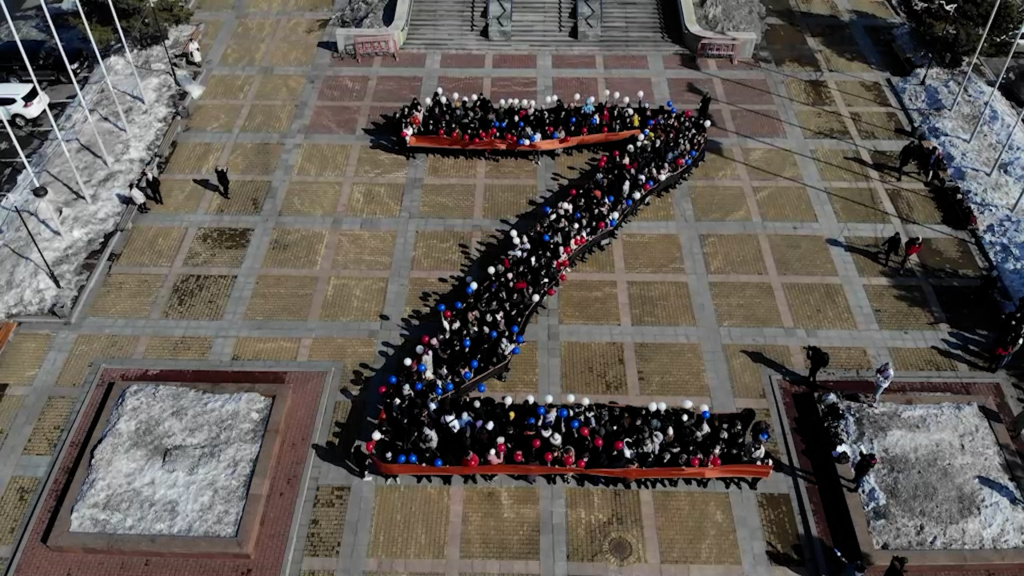
In just a month and a half since the outbreak of war in Ukraine, Putin’s Russia has entered a new period in its history. The authoritarian regime built over the last twenty years, despite ever-increasing repression, has until recently allowed the existence of limited freedom of speech, party struggle within a so-called “managed democracy,” and most importantly, the right for private life. The latter was a key element in the permanent depoliticization of Russian society: you might be unenthusiastic about government decisions or presidential rhetoric, but you always had a safe haven from “politics” in your daily business or your family circle. Today, with the letter Z, which has become almost an official grim symbol of the invasion of Ukraine, adorning the windows of public transport, schools and hospitals, the cosy space of private life has lost its right to exist.
The regime now requires unequivocal public acceptance of the war from every citizen. Any sign of deviation from this civic duty is condemned as treason, and any dissemination of information about the war other than official Defence Ministry briefs is treated as a crime. Since the war began, dozens of Russians – young and old, residents of Moscow and provincial towns – have been charged with new criminal offences of “discrediting the Russian army.” Not only going into a square with an anti-war poster, but even a pacifist badge on a backpack or a careless comment in the workplace can be grounds for arrest or a huge financial fine. The persecution of dissidents is gradually becoming not only a matter for the police, but also for “vigilantes” who are prepared to write a denunciation about a neighbour or a colleague. All this does not mean, however, that mass nationalist fanaticism has taken the place of depoliticization – on the contrary, propaganda and repression remain the exclusive monopoly of the state.[A]fter thirty years of post-Soviet authoritarianism and neoliberal market reforms, [Russian society] has consistently been reduced to a state of silent victimhood, a malleable material from which a full-fledged fascist regime can be built.
Support for the war is strictly controlled from above and does not allow for any form of self-organisation. For example, the authorities have banned right-wing radicals from organising independent marches in solidarity with the Russian army – such actions can only be carried out by local authorities according to a uniform script approved by the presidential administration from Moscow. Backing for the war can only come in the form of backing for Putin; it must reflect the complete identity of the national leader and his people, and nothing else. Anyone who is not prepared to do so is defined as an abettor of the “Nazis.” This maniacal fixation of official propaganda on the terms “denazification” and “Nazism” seems as if it specifically suggests the right definitions for the changed nature of Putin’s regime.
I think it can already be stated that today’s political regime in Russia is rapidly evolving towards a new form of fascism – the fascism of the twenty-first century. But what are its characteristics? What are its similarities and differences from the European fascism of the first half of the previous century?
A huge body of historical and philosophical literature on fascism of the past has provided a variety of answers about the nature of this phenomenon. I would focus on two largely opposing approaches, one of which can be described as a theory of “movement” and the other as a theory of “move.” The first approach (by historians such as Ernst Nolte, for example) saw fascism primarily as a mass movement aimed at suppressing a revolutionary threat from outside the state, which was too weak to protect the rule of the ruling elite. According to this approach, the fascist movement broke the state’s monopoly on violence against political opponents and then, once in power, transformed that state from within. The fascist regimes in Italy and Germany were, therefore, primarily movements that radically transformed the state and gave it a form of its own.
The second approach, by contrast, viewed fascism primarily as a top-down coup by the ruling classes themselves. This position was most clearly expressed by the sociologist Karl Polanyi, who saw in fascism an aspiration for the final victory of capitalist logic over any form of self-organisation and solidarity in society. The aim of fascism, according to Polanyi, was the complete social atomization and the dissolution of the individual into the machine of production. Fascism was thus something more profound than a reaction to the danger of revolutionary anti-capitalist movements from below – it was inextricably linked to the final establishment of the domination of the economy over society. Its goal was not only to destroy workers’ parties, but any element of democratic control from below in general.Flash mob at the Platinum Arena in Khabarovsk on 11 March 2022, organized by the Central District Management Committee and the United Russia party as part of the “We don’t abandon our own” (Своих Не Бросаем) campaign. Attendees including Young Guard of United Russia members and local residents arrange themselves in “Z” symbol formation. Photo by the City of Khabarovsk.
Modern fascism (or, as the historian Enzo Traverso defined it, post-fascism) no longer needs mass movements or a more or less coherent ideology. It seeks to affirm social inequality and the subordination of the lower classes to the higher classes as unconditional as the only possible reality and the only credible law of society.
Russian society, after thirty years of post-Soviet authoritarianism and neoliberal market reforms, has consistently been reduced to a state of silent victimhood, a malleable material from which a full-fledged fascist regime can be built. External aggression, based on the complete dehumanisation of the enemy (“Nazis” and “non-humans,” as Putin’s official propaganda puts it), was the decisive moment in the “move” made from above. Of course, the Russian regime has its own unique features and was produced by a complex combination of specific historical circumstances. However, it is very important to understand that Putin’s fascism is not an anomaly, a deviation from “normal” development – including in Western societies.
Putinism is a frightening sign of a possible future to which extreme right-wing parties striving for power in various European countries could lead. In order to fight for a different future, we all need to reconsider the very foundations of the capitalist logic, which is quietly but persistently preparing the ground for a “move” from the top, which could happen in a heartbeat. The old and somewhat forgotten dilemma of Rosa Luxemburg, “socialism or barbarism,” has become an urgent reality for Russia and for the world since the fateful morning of the 24th of February.
Read the rest of this entry »Should socialists support or oppose NATO arms to Ukraine?
Joan McKiernan and numerous other comrades recommended this article. The Easter 1916 Rising of Ireland, led by revolutionary Marxist martyr James Connolly and his revolutionary nationalist Allie’s of the Irish Volunteers, could not have happened without using weapons supplied by German Imperialism. A guiding slogan of Connolly’s Irish Citizens’ Army was “We Serve Neither King Nor Kaiser”. John Reimann’s policy is endorsed by many clear-thinking socialists including the Fourth International https://fourth.international/en. Get involved in Ukraine Solidarity initiatives http://www.europe-solidaire.org/spip.php?article61759


By John Reimann, a US Marxist and retired union militant, who blogs at Oakland Socialist: See also https://shirazsocialism.wordpress.com/2022/04/16/should-socialists-support-or-oppose-nato-arms-to-ukraine/
Today the majority of socialists in the West argue that it is our duty to oppose “our” government’s sending arms to Ukraine. They equate the situation today with that at the start of WW I. At that time, almost all socialists supported their “own” capitalists in sending their workers to that imperialist slaughter in the interests of their “own” imperialists. By doing so, those socialists not only betrayed socialism, they betrayed the working class.
Read the rest of this entry »“You either support Russian imperialism or Ukraine’s right to determine its own future, together with its civilians. Period” – Notes from a Correspondent in England
Mark Findlay reviews the Russian Invasion of Ukraine, and reactions from the left in England. The article comes from Mark’s Facebook Page,
NATO or not NATO?
Much is being said about NATO aid to Ukraine; this morning (11/04/2022), I read from Graham Durham on Facebook:
“It was good to see the pro NATO demo on Saturday, called by the PCS union and disgracefully publicised by the TUC , was a tiny flop.
The warmongering demand to ‘Arm Ukraine ‘ is a disgrace to the trade union movement which should be demanding an end to NATO expansion and aggression . As deadly weapons are sent by NATO countries to extend the war some feeble ‘leftists ‘ argue it is not NATO doing this but individual countries
No to War .Stop NATO warmongering
Monday greetings to all in the 5.38 club”
The above is fairly typical from much of the Left. Frankly, I find it hard even to include such a disgraceful post in my text. Not one word about the role of Putin and Russian imperialism, overwhelmingly the aggressor in the current war. This post neatly summarises the Tankie position. Effectively, they want Russia to win. There is no choice in the matter; either Ukraine fights them off, or it’s game over, and Russia will have won at least a large chunk of Ukraine, perhaps the entire Black sea coast plus much of the East, and Kyiv would still remain at threat. If you don’t allow Ukraine to acquire weapons, you are inviting its defeat. This is war-mongering on behalf of Putin.


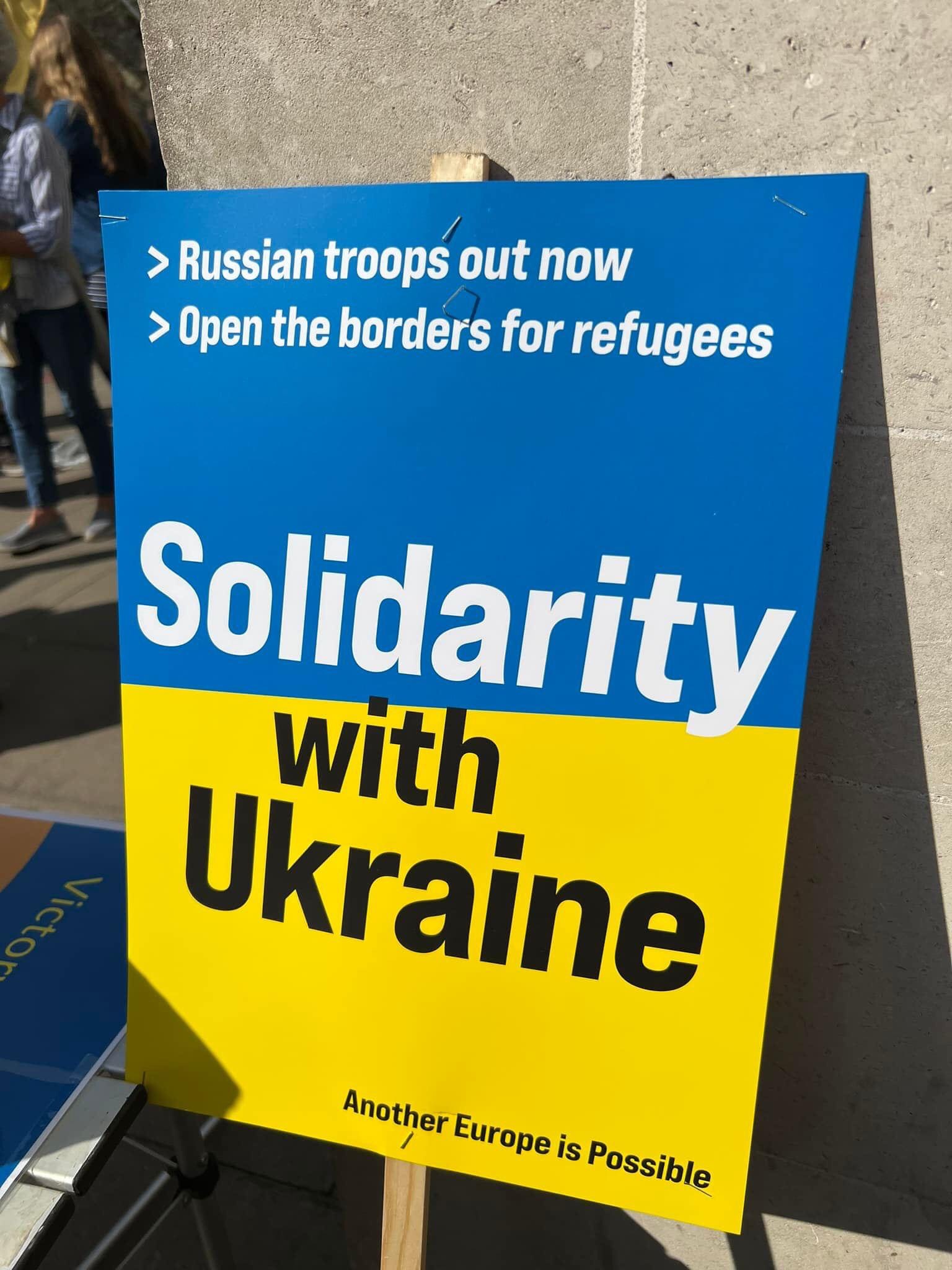
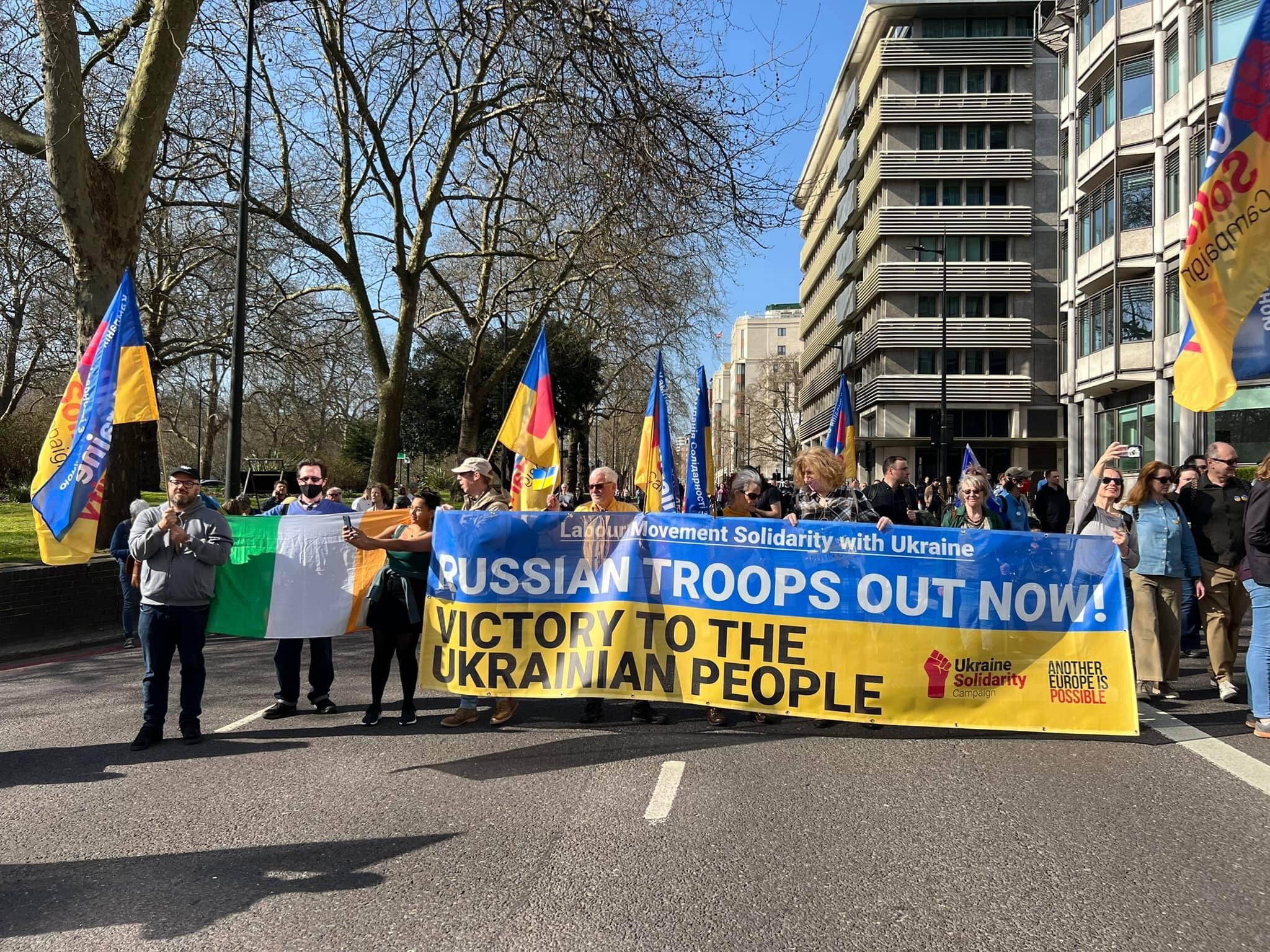
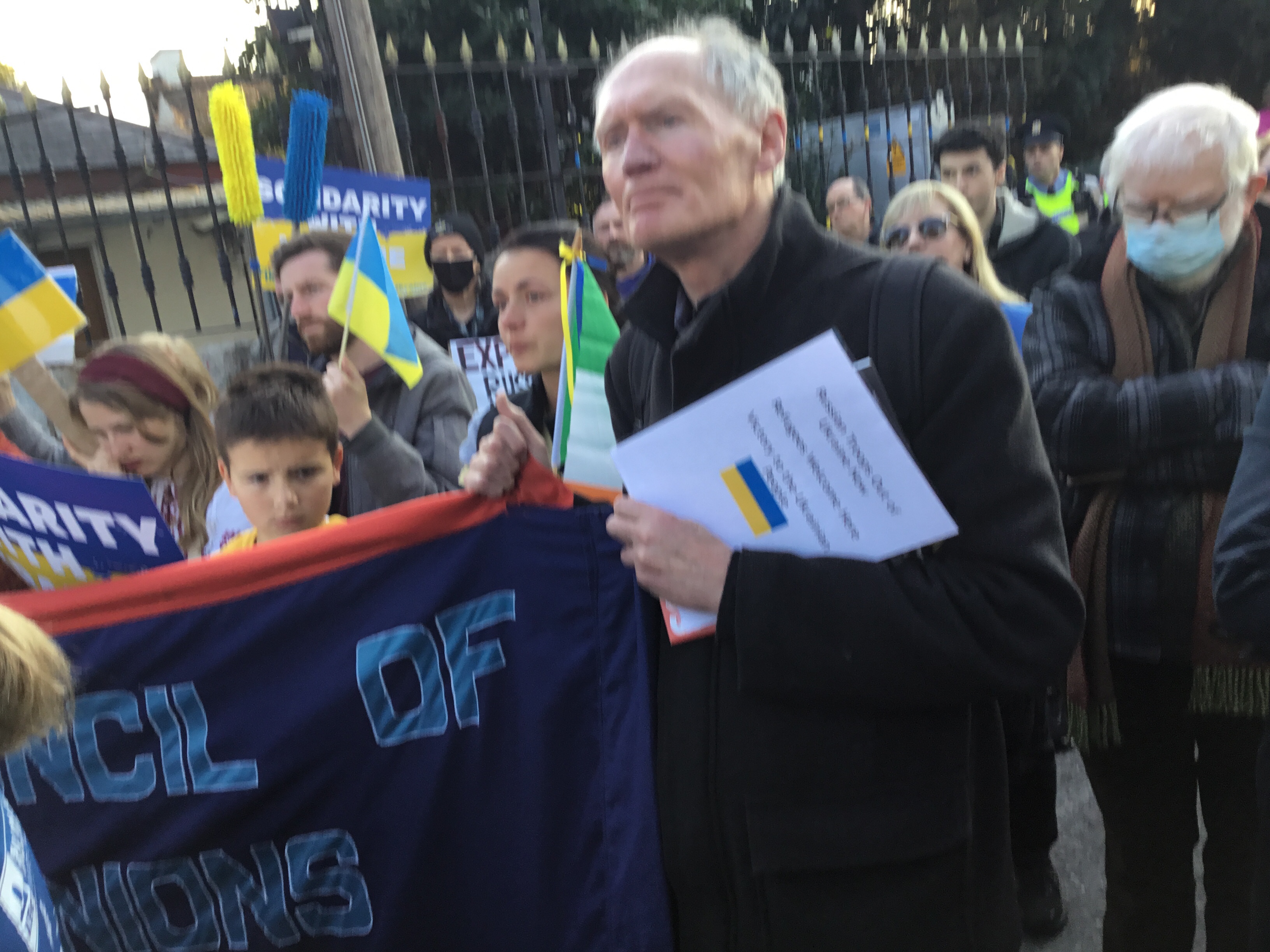
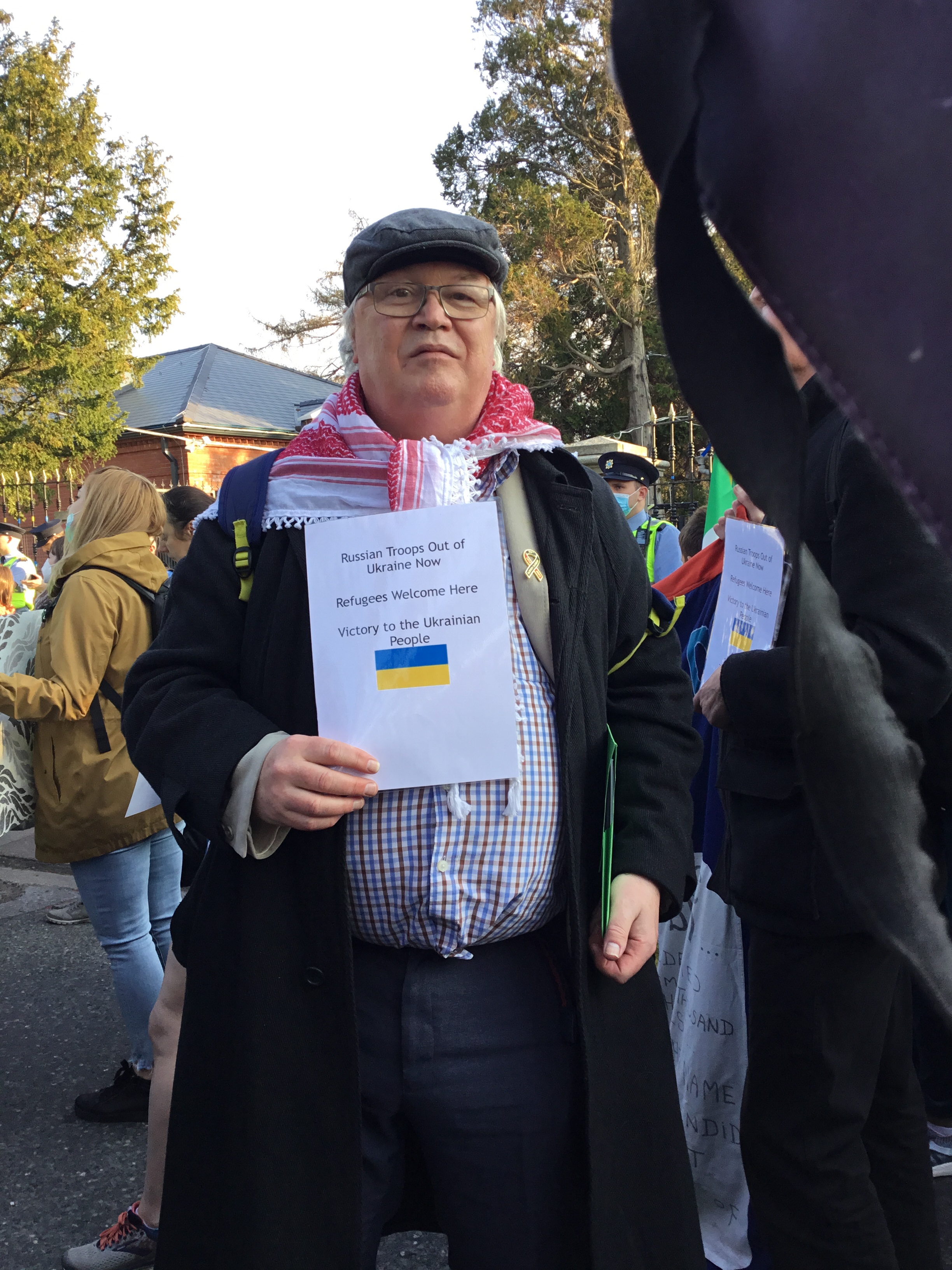
Here is an exchange in the comments to the above post:
Old schemes and new schisms
Guest post by Des Derwin
There are two general templates, one for each side of the divide on the war that is now congealing on the left, and which will mark it for the next period. Views on the war, often backed up with evidence and argument, often, and increasingly, assuming one or other of the templates and theories, spring from those assumptions, with the assumed basic starting point being increasingly advanced as a premise, even a common sense argument. People on the left are now beginning to settle into talking past each other on Ukraine, with some accompanying denunciation and insult.
Expressing it simply and analogously, one template is a war like a gang war, like the Kinahan-Hutch feud toward which any reasonable and sociable person would be neutrally hostile to both sides, against both sides and for the war to end; a war between two sets of robbers and murderers to end, full stop, right now.
The other template sees the invasion of Ukraine as an aggravated burglary in which a modest house is broken into, the occupants assaulted, older people beaten and the place ransacked almost beyond repair. If some at home could defend themselves no reasonable person would object to that, or say they should stop and allow their house to be wrecked and their relations beaten. If you could help the defender you would, even to the extent of handing them a weapon or joining with them if you could. You would, horror, probably call the cops.
There are sub-templates of course, as some believe that one of the gangs in the first template, the Hutches perhaps, are better in one way or another. Are pressed and provoked by the Kinahans, who are the dominant gang, and it would be better by far if the Hutches – who have actually struck first and spectacularly, struck a weaker neighbour friendly to the Kinahans – won and weakened the Kinahans. A few don’t see the Hutches as a gang at all and want them to win. Another variant is that there are two levels to the war, the gang feud (an inter-imperialist war), and simultaneously brutal shootings in homes and neighbourhoods when innocent ‘civilians’ get killed (a war of imperialist aggression and national defense). Some recognise both levels, prioritise the first and warn against defensive help to the victim in case it escalates all the way to Armageddon.
These schematic starting points invest the attitude of the myriad of left groups and individuals. Many base their approach on evidence, many base it on a precooked or underlying geopolitical worldview, with evidence, and sometimes with little evidence; many (non-political) people quickly reach their own spontaneous conclusions based on their own common sense and decency, and some reasonable credibility in the mainstream news media.
These broadly rival templates overlap and operate within previous great gulfs like stalinism, trotskyism, anarchism and even left social democracy. They are the tip of previously developing and now hardening differences in political weltanschauung.
For the record I fall broadly under the second template. The war is a brutal invasion by an imperialist power. There is a context of rival imperialisms certainly, as there are several contexts for everything political and military: class exploitation, regional political and material interests, particular histories, workers’ internationalism, the climate crisis, etc, etc.
There are fallouts which our local rulers will seek to use in the usual ‘shock doctrine’ way, which we need to resist, in Ireland’s case ending or diluting formal neutrality and initiating expensive militarisation. Maybe neutrality might paradoxically be the issue on which the Irish left can universally agree and unite on in common activity. But maybe not after the risen temperatures of our own civil war within the war.
Alain Krivine has left us – “leading figure of May 1968 in France, has just died aged 80. All the French media have commented on his passing”
Dave Kellaway writes an excellent tribute. source : https://anticapitalistresistance.org/krivine-who/?fbclid=IwAR0w7ZABo272oR3iPRsZIVjcdt2NqoqSrSQBU4QO3k-z4NYa-Qar28_g9X8
Five things we can learn from the life of Alain Krivine.
Alain Krivine, a leading figure of May 1968 in France, has just died aged 80. All the French media have commented on his passing. Current presidential candidates like Melenchon, who leads the left in the polls with 11%, Roussel, standing for the French CP and Nathalie Arthaud for Lutte Ouvriere have all issued statements yesterday. Former members of Krivine’s organisations who are now MPs in Melenchon’s party or leaders of the Socialist Party also made public their respect for his contribution to the left.
For people of my generation whom he inspired or who worked with him it was a sad day yesterday. Leading members of the British left such as Alex Callinicos for the Socialist Workers Party, John Rees for Counterfire or his former comrade in arms, Tariq Ali, have all publicly mourned his passing.
But for many activists reading this who are not over fifty the name might not mean a great deal. If we are to build a deeper and broader political culture of a fighting left then it is important we remember those who went before us. Their lives are sometimes rich with lessons for us today. We learn not just from some of their smarter moves but also from where they may have got it wrong.
What can we learn from Alain?
Read the rest of this entry »


 Tomás Ó Flatharta