The Dublin government is doing normal campist hypocrisy : Currently the Irish Taoiseach Micheál Martin is visiting China. Expect no mention of the Beijing régime’s well-documented human rights abuses in the Xinjiang province and persecution of the Uyghur minority – China’s boss Xi Jinping will not tolerate that kind of talk :
“Another piece of information related to the Xinjiang issue concerns the dissemination of confidential documents that would prove Xi Jinping’s direct involvement in the repression of the Uyghurs. These are three internal speeches given in 2014 during a visit to the region immediately after the attack on Kunming railway station in which Xi called for a campaign of “heavy and rapid strikes” and demanded the creation of a climate of constant pressure. These instructions already hinted at the elements that would subsequently shape the system of internment camps, forced labour and linguistic assimilation programmes, with the aim of eliminating religious practices and cultural identities considered threats to national security.”
The head of the Dublin government is saying nothing about ongoing repression of trade union activists in Hong Kong. Not a dicky-bird from Micheál about the Chinese régimes’s threatening build-up of its military forces in the South China Sea.
Here is a flavour of the Leinster House “Official Version” : Business Before Principles :
“In Shanghai, the Taoiseach will meet the city’s mayor Gong Zheng and visit Irish and Chinese companies in the country’s commercial capital. He has planned meetings with representatives from the financial services, tourism and food and beverage sectors, among others.
“In Beijing, there will be a particular focus on further and higher education – an important area with a lot of potential for both partners, and where co-operation will yield longer-term dividends in terms of research and innovation, and people-to-people links,” he said.
The Taoiseach will meet representatives from 12 Irish third-level colleges that offer full-time degree and diploma courses with Chinese higher education partners. Typically, these offer qualifications that are recognised in both Ireland and China, with courses based on those in Irish colleges.
Last month, the Sunday Times Ireland edition reported that the Irish Military Intelligence Service was concerned about security risks associated with academic links to China. But the Taoiseach later suggested that a more sophisticated approach to China’s strategic ambitions was required.
“I do accept the intelligence that’s across Europe and UK recently but on the other hand, China has never initiated, in modern times, a war. I had a very interesting, pretty careful discussion with the Singaporean Prime Minister on that. We should do more to understand the Chinese psyche and approach, and the more longer term sort of scenario, strategic thinking,” he told The Journal.” – Irish Times January 5 2026.
Denys Pilash, from Ukraine, offers us a very useful article based on principles which need to be universal across the left : Ukraine – Venezuela – Palestine – Occupation Is A Crime.
Washington’s scarecrow, catching up with its Kremlin counterpart, has conducted its own special military aberration [1]. Moreover, whilst boasting about this latest step towards what it calls the “noble peace prize” [2] and asserting its “Donroe Doctrine” [3], it makes no attempt to conceal that this is all for the sake of tasty oil and that it could not care less about the consequences of regional destabilisation. [4]
In the conflict between Soviet Russia with Joseph Stalin at its head and Nazi Germany, I would have supported Soviet Russia. I suppose you could argue that might make me some kind of Stalinist. After all, I would have been supporting the Stalinist government. Not only that, I may even have hoped the US might provide it with funding to continue to organise its military effort, so you could probably label me an American stooge too. (in fact, the US did supply Soviet Russia with millions of tonnes of food, weapons and equipment during the Second World War).
But a distinction should be made. What one is supporting most fundamentally in this case is not Stalinism but rather the struggles of the Russian people themselves,[1] their imperilled freedoms at the hands of a brutal, barbaric foreign invasion. People fighting and dying – not because they had some great love for Stalin – but because they didn’t want to be bombed and maimed and killed at the hands of a foreign power. Because they didn’t want to live their day-to-day lives under the shadow of foreign occupation.
Of course, one could ignore all this. One could assert, for instance, that the Russian population were simply being manipulated in the interests of the Stalinist government (and vicariously the US itself) and, therefore, it was Stalinism and the US government who were the true objects of international support. Certainly, the defeat of Germany did bolster the imperial power of the US and Russia. But were the millions of Russians who fought and died against fascism – were those lives merely the ‘proxies’ of the interests of Stalin and the United States government who supported him?
Such an assertion most would find obscene. It is obscene because it involves the annihilation of a living content – the struggles and sacrifice of millions of people fighting for their concrete freedoms – in favour of the interests and relationships of a set of given states and governments considered in empty and schematic isolation.
For similar reasons, I support the right of the Ukrainian people to resist foreign occupation. As a necessary corollary, I also support the means by which they might do so – even if that means receiving funding and ammunition from the US and NATO (though if you can suggest some other alternative beyond capitulation at the point of a Russian gun, I really am all ears).
But none of this is the same as saying I support Zelensky, or that I support the US and NATO. At the most basic philosophical level, it simply means to recognise that freedom – as Kant put it – is ‘an end in itself’. It has an objective and social reality whether or not the arms the freedom fighters take up are provided by this particular imperial power or that one. Likewise, freedom has an objective reality whether or not it is being menaced by Russian bombs or Israeli bombs or Nazi bombs.
And here we are. This is one outcome of arguing that one imperialism is less bad than another, that some people are oppressed while others either don’t exist (,Putin’s original playbook) or don’t really matter. Palestinians good, Ukrainians, Kurds? Not so much.
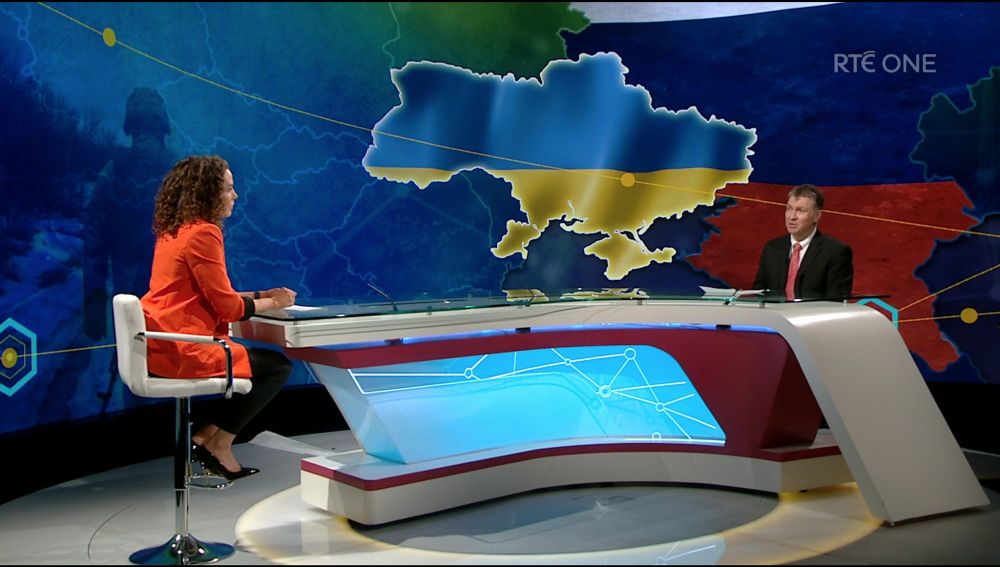
Clare Daly (ex MEP; a twice defeated Irish election candidate in 2024) was on the RTÉ 1 TV “Upfront with Katie Hannon” programme on February 17 2025, supporting the Trump-Putin stab in the back of Ukraine. She is like the peace activists who backed the Hitler-Chamberlain 1938 agreement selling out Czechoslovakia. A year later this “peace in our time” deal, promoted by a British Prime Minister Neville Chamberlain famously waving a piece of paper, paved the way for World War 2 in Europe and Nazi occupation of France, Holland, Belgium, Poland plus many more.
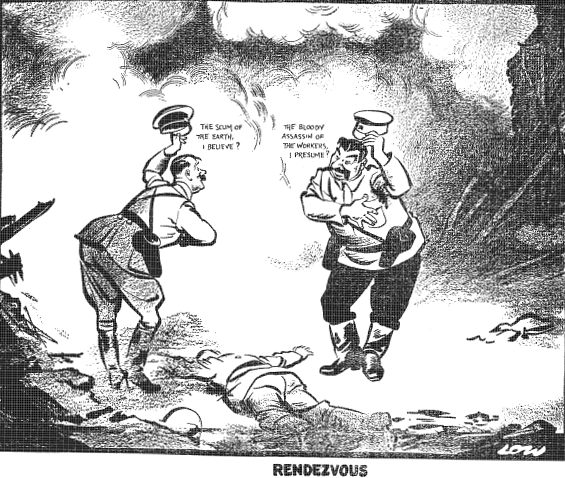
We also saw the Hitler-Stalin pact in 1939, followed in 1941 by – guess what? – a Nazi invasion of Stalin’s Russia.
Let us recall the various Clare Dalys, spiritual daughters of Stalin – one of whom claimed in 2022 that predictions Putin intended to invade Russia were “insane”.
Pro-Ukraine anti-war activists got it right, for example Donnacha Ó Beacháin :
3 years ago today I was in a TV studio expressing scepticism about Putin’s claim he was withdrawing troops from Ukraine’s borders On the same program Russia’s ambassador said anybody who suggested Russia would invade Ukraine was “insane”. Russia launched its full-scale invasion the very next week
Here is an account of the warnings Stalin ignored prior to the Hitler invasion in 1941.
Unlike the Germans, who saw the Non-Aggression Pact as necessary but temporary, Stalin had illusions that it might be lasting. Owen Matthews quotes from a 1966 interview with Marshal Zhukov, conducted by Lev Bezymensky, a Soviet historian and war veteran. In January 1941, Zhukov and others had warned Stalin of ominous German troop movements. Stalin wrote to Hitler, asking politely whether these reports were true. Hitler replied that they were, but he swore ‘on my honour as a head of state that my troops are deployed … for other purposes. The territories of Western and Central Germany are subject to heavy English bombing and are easily observed from the air by the English. Therefore I found it necessary to move large contingents of troops to the east where they can secretly reorganise and rearm.’ Stalin believed him.
Source : Winston Churchill : His Times, His Crimes, Tariq Ali, Verso Books,
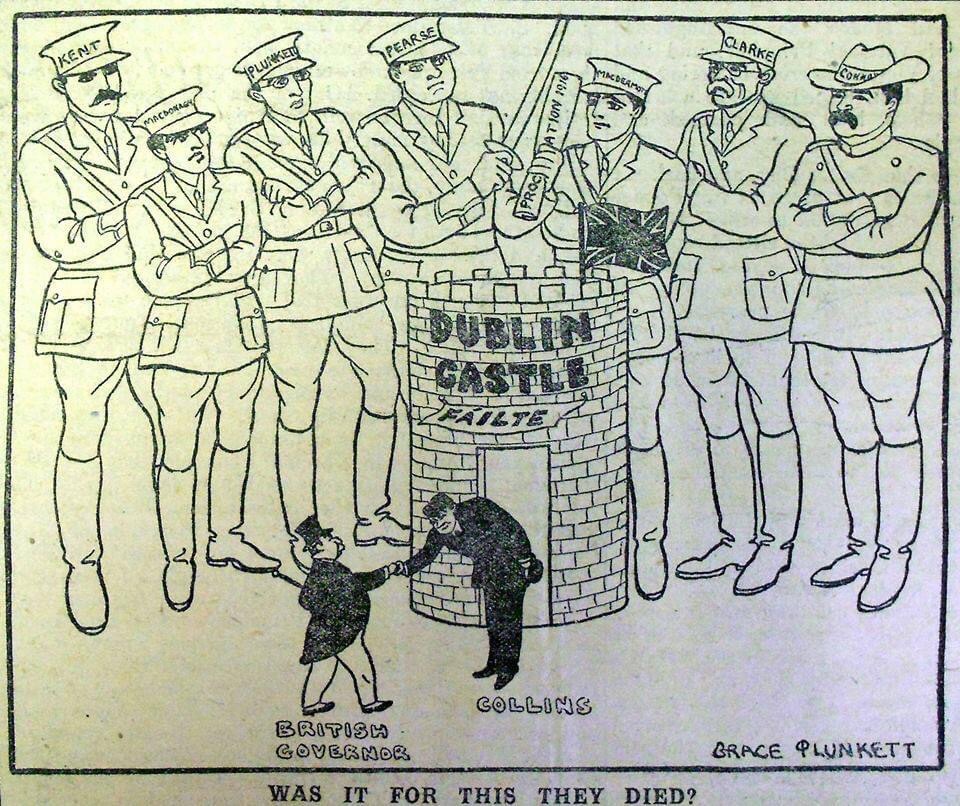
The 2025 Trump-Putin partition policy is a spiritual daughter of the 1922 Treaty which peace politicians used to stab Northern Nationalists in the back by implementing the partition of Ireland. This gave us, in the prophetic words of James Connolly, “A Carnival of Reaction” – 2 sectarian counter-revolutionary states on one small island.
Like James Connolly, Grace Plunkett (widow of 1916 Easter Rising martyr Joseph Plunkett) understood that partition, pretending to be peace, meant a sham freedom for Ireland.
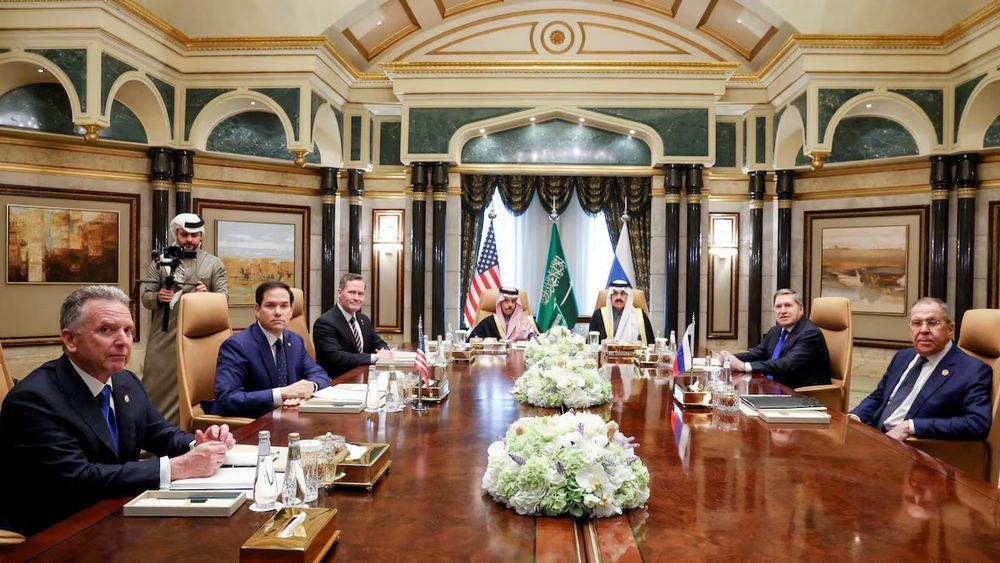
So, today, it should be obvious to all on the left : oppose a peace and partition plan promoted by 2 violent untrustworthy sociopaths.
Ask the people of Canada, of Mexico, of Greenland. Ask the people of Ukraine, of Latvia, Lithuania, Estonia, of Poland , of Finland.
A dictatorship hosting another dictatorship to negotiate with an aspiring dictatorship about the future of a democracy that’s not represented.
Two superpowers opening discussions on the future of a country which one of them is still invading, without that country
Are the international pro-solidarity left organising solidarity with Ukraine? Answer Yes
A physical and online conference in support of the Ukrainian people’s national and social rights
No to partition! Russian troops out!
This important conference will address the grave threat posed by the incoming Trump administration’s intention of imposing on the Ukrainian people a deal agreed with Putin’s Russia.
Violating international law, it would partition Ukraine and entrench the occupation of territory annexed since 2014 and expanded by Putin’s full-scale war since February 2022. It would produce a “peace” imposed through Western acquiescence in the dismembering of Ukraine, with parallels to the 1938 Munich Agreement that handed Nazi Germany 30 per cent of Czechoslovak territory.
The vulnerable position presently confronting Ukraine’s war of just resistance is a direct result of the failure to provide necessary aid by key states, despite their boasting that they “stand by Ukraine”.
The dire prospect of a partitioned Ukraine partly under Putin’s control would be the product of the appeasement policy of those sections of big business anxious to restore and develop their Russian commercial ties. In contrast, the Solidarity With Ukraine conference of progressive forces—of trade unions, socialists, social democrats, green, feminists and other social movements—will take place on the understanding that the partition of Ukraine cannot bring peace.
The only road to a just and lasting peace requires the complete withdrawal of Russian forces. While they remain in any part of Ukraine it will be impossible for Ukrainians to freely determine their own future.
Any peace negotiations should be with Ukraine as a main partner: the war should not and cannot be solved as a horse trade between the great powers at Ukraine’s expense.
Against the decline in aid and a possible Trump-Putin deal, the organisers and sponsors of the Solidarity With Ukraine conference advocate a surge in military support to strengthen Ukraine’s position in any negotiations, and to be able to continue its just resistance if no security guarantees acceptable to Ukraine are achieved.
That military aid must be accompanied with unconditional financial support for Ukraine’s reconstruction and the cancellation of its debt. We reject the corporations’ self-interested argument that solidarity with Ukraine’s armed and unarmed resistance must mean accepting the dismantling of social rights and services, either inside Ukraine or in the countries giving it support.
The struggles of Ukraine’s working people and their trade union organisations, and of the country’s feminist, environmental, LGBTIQ+ and human rights organisations have been indispensable to the country’s resistance, primarily against the Russian invasion but also against anti-social policies adopted by the Zelensky government. They are also the best guarantee that reconstruction will be in the interest of Ukraine’s social majority.
The message of representatives of such Ukrainian movements will be a central feature of the plenary sessions of the Solidarity With Ukraine conference.
They will also participate in workshop sessions that will provide an invaluable opportunity to increase understanding of Ukraine’s complex reality and develop practical solidarity initiatives with Ukrainian partners.
The conference will also adopt a final declaration, with the goal of giving as much publicity as possible to its position in favour of a just peace and just reconstruction for Ukraine and its people.
The final text and the Solidarity With Ukraine conference program will be published soon.
The resolution below was recently adopted by a left-wing organisation in Ukraine : Social Movement (Sotsialnyi Rukh).
Here is one of many important statements very relevant to the left in Ireland and elsewhere :
The growing contradictions between the centers of capital accumulation in the world capitalist system will not stop even after the complete destruction of Russian imperialist power. The left in Europe and around the world turned out to be helpless and disoriented when the Russian aggression in Ukraine occurred. Unless the international socialist movement realizes mistakes it has made and builds a new, truly internationalist cooperation and coordination, we simply have no chance of preventing the growth of inter-imperialist struggle in the future.
Resolution: The War and the Future of Ukraine and the Left Movement
The people of Ukraine have been facing hard challenges, yet they have proven their ability to fight for the right to decide on their own fate, and their determination to defend the country and to end the war as soon as possible. The authorities and representatives of market-fundamentalist ideology, together with big business, keep pushing through an economic model focused on benefiting a minority at the expense of the welfare of the absolute majority
The people of Ukraine have been facing hard challenges, yet they have proven their ability to fight for the right to decide on their own fate, and their determination to defend the country and to end the war as soon as possible. The authorities and representatives of market-fundamentalist ideology, together with big business, keep pushing through an economic model focused on benefiting a minority at the expense of the welfare of the absolute majority. In this model, workers are completely subservient to the will of their employers, while social and regulatory functions of the state are abolished for the sake of “business needs”, “competition” and “free market”.
There is more to this story than initially meets the eye. Much capitalist development is based on Ethnic Cleansing of original populations and the plantation of new non-indigenous populations – it happened in the United States of America (USA) and Australia – naming just two. It did not happen so brutally in Ireland – but British imperialism made a significant effort.
The Northern province of Ulster was “planted” in the 1600’s, but the native Irish were not completely exterminated. Waves of native Irish emigrated – especially in the 19th century after a misnamed Famine (in reality a “Great Hunger” caused by British Imperialist Policy) drove millions of the native Irish to the four corners of the globe. These emigrants kept alive the idea of Irish freedom, and played a significant role in every attempt to rid Ireland of British rule.
The stubborn Irish “national question” remains on today’s agenda because of the 1922 Anglo-Irish Treaty which divided Ireland into 2 sectarian states. A key feature of extreme Irish Unionism is identification with plantation/ethnic cleansing forms of capitalism – and that goes a long way towards explaining Irish far-right Unionist sympathy for the present day attempted ethnic cleansing of Palestine and Ukraine. We should situate recent pro-Putin and anti-Ukraine statements by the British far-right politician Nigel Farage and Sammy Wilson within this framework :
Nigel Farage Endorses DUP Antrim MP’s Wilson and Paisley, Dumping a different extreme unionist, Jim Allister
The Russian imperialist occupation of Crimea, Luhansk and Donetsk is ethnic cleansing capitalism in action – accompanied by child stealing and abuse similar to the behaviour of the Catholic Church in the 26 county bit of Ireland from the 1930’s to the 1990’s.
An excellent Ukrainian blog, Ukr-Taz, covers the story of Putin’s ethnic cleansing dreams in Ukraine, and Donald Trump’s enthusiastic support :
For all that can be said about Thursday’s debate between Joe Biden and Donald Trump — including about the former’s dismal performance and about the boundless creativity of Trump’s fabrications on almost every topic under the sun — Trump’s curious note about Putin’s “dream” stood out to me:
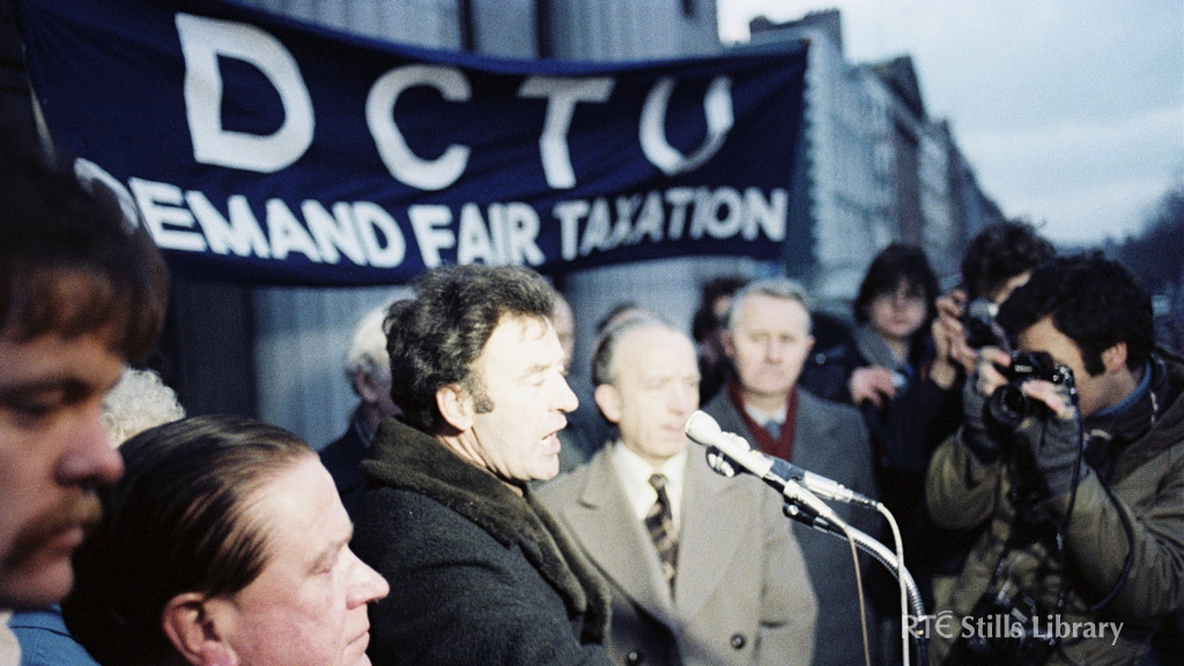
This week we are looking for help with a photograph taken at PAYE tax protest march on O’Connell Street, Dublin, on 22 January 1980. Anyone know the man addressing the crowd? How about those on the platform with him?
Any ideas?
The photographer was Des Gaffney.
Contact us at archives@rte.ie or on Twitter @RTEArchives
Sam Nolan speaking and a Dublin Council of Trade Unions (DCTU) Meeting at the General Post Office (GPO), 22 January 1980
The RTÉ Archives Site asked a question :
This week we are looking for help with a photograph taken at PAYE tax protest march on O’Connell Street, Dublin, on 22 January 1980. Anyone know the man addressing the crowd? How about those on the platform with him?
Any ideas?
The photographer was Des Gaffney.
Contact us at archives@rte.ie or on Twitter @RTEArchives
Simon Pirani’s article is recommended. Unfortunately many Irish left-wing organizations and activists, such as People Before Profit and Clare Daly MEP, have adopted the policy advocated by the British Stop the War Coalition. In the conclusions section of this essay Pirani observes :
In May [2021], you wrote that Stop the War is “supporting the people of Palestine, who have a right to resist occupation”. I agree with that. But why no such statement about Ukraine?
And if Ukrainians, or Palestinians, have a right to resist, what does it mean? Does it only mean standing up to tanks with your bare hands, as Ukrainians have had to do? Does it mean throwing stones, often the only weapons that young Palestinians have? What about proper weapons? Do you think Palestinians have a right to those? And Ukrainians?
About the Author :
Simon Pirani is a British writer, historian and researcher of energy. He is honorary professor in the School of Modern Languages and Cultures at the University of Durham.[1] From 2007 to 2021 he was senior research fellow at the Oxford Institute for Energy Studies (with a period as senior visiting research fellow in 2017-19).[2]
In 2018 Pirani published Burning Up: A Global History of Fossil Fuel Consumption, in which he portrays consumption growth as a result of world capitalist economic expansion.[3] He argues that the relationship between technological systems that account for most fossil fuel use, and the social and economic systems in which they are embedded, is paramount. His articles and presentations on this theme are collected on his website.[4] He also writes about these themes on a blog, People & Nature Link : https://en.wikipedia.org/wiki/Simon_Pirani
On the Easter weekend, on the latest gigantic march in London against UK complicity in Israel’s war on Gaza, a group of us took a banner that said “From Ukraine to Palestine, occupation is a crime”. We were welcomed by marchers around us, and people took up our slogan.
But beyond a slogan, what can we, in the labour movement and social movements in the UK, do about these conflicts that are transforming the world we live in, and heightening fears of bigger, bloodier wars?
This article should encourage all Irish revolutionary socialist activists who are anti-racists to examine our connections with the Eastern part of the European continent.
Below Maurice’s article we publish the words of Imelda May’s stunning poem “You Don’t Get to be Racist and Irish”.
An Immigrant History of a Dublin Street – From O’Connell Bridge to the Gate Theatre, via Jamaica, Finland, Ukraine and France
My thoughts are with all those impacted by the attack that took place in Parnell Square, Dublin, on 23 November. You can find some fundraisers to help here.
Irish migration history is traditionally told as a history of emigration outwards. We rarely talk about the history of immigration inwards to Ireland.
Yet a migrant population has existed in Ireland throughout its modern history. And this community’s overlooked story reflects common European migrant experiences: adversity, cultural influence, assimilation, xenophobia, and so on.
In other words, it is the kind of history that defies notions of Irish exceptionalism.
To explain more, let me take you through the immigration history of a single patch of Dublin city centre. Together, we can traverse the same streets associated with the appalling images from last Thursday; from O’Connell Bridge up towards the Gate Theatre.
I’ll try and give those images of the far-right instigated riots, now burned into so many of our anxious minds, a few historical counterpoints.
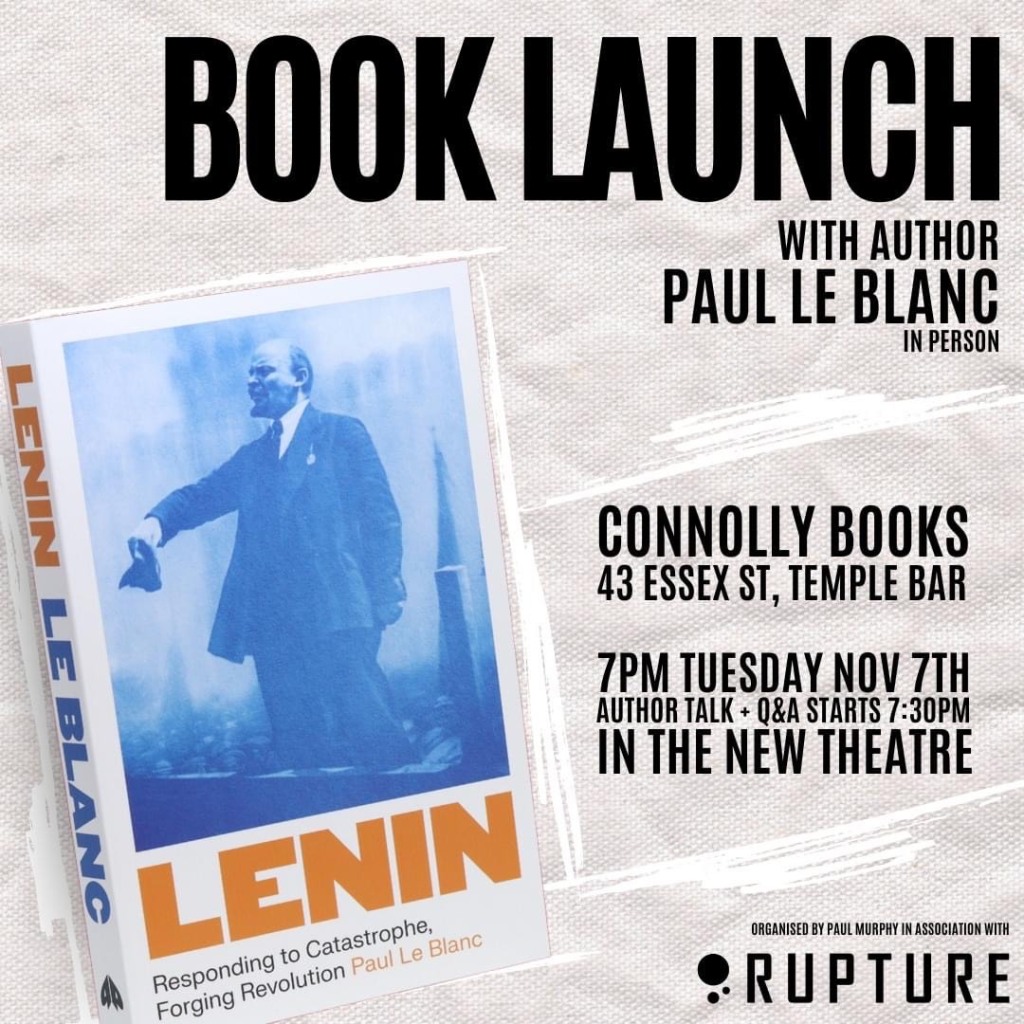
We wish to thank Dick Nichols, European Editor of the Australian Magazine Green Left Weekly, who drew our attention to an important article on Russia’s Invasion of Ukraine, written by the well-known Marxist scholar and historian Paul Le Blanc.
The author takes the side of Ukraine Against Russia :
I favour the defeat of Vladimir Putin’s invasion and victory for Ukrainian self-determination.
I oppose imperialism in all its forms – including Putin’s invasion and NATO.
I oppose capitalism and favour its replacement with the genuine political and economic democracy of socialism everywhere: the United States, Ukraine, Russia etc.
A momentous development has drawn my attention away from the unfolding climate catastrophe on which I have been riveted. Russia’s invasion of Ukraine is a major factor fragmenting the left-wing forces I hoped would become a major force in the revolutionary struggle for climate justice and human survival. Recently, I have met Russians and Ukrainians — and others from Brazil, Argentina and the United States — who have all made it clear to me that I cannot avoid dealing with this issue.1
In this article, I will attempt to do three things:
Review what some on the left assert either in favour of Russia’s invasion of Ukraine or against the Ukrainian response;
Review Russian and Ukrainian realities and views on the war; and
Touch on essential aspects of Ukrainian resistance to Russia’s invasion (including where the weapons come from).
In the footnotes I offer sources that have influenced my analysis and that I believe may be useful for those seeking to make sense of these realities. But I owe it to readers to indicate my own position from the outset. This is my bottom-line:
Review Author : Ian Parker is a Manchester-based psychoanalyst and a member of Anti*Capitalist Resistance.
This book was first published in 2014 in French – the English language translated edition is recent. The content preceded the genocidal Russian invasion of all Ukraine in 2023, which is reshaping the radical left all over the world. In my opinion a notable feature of the pro-Ukraine solidarity left which is today emerging everywhere, is a political convergence between healthy revolutionary Marxist (Trotskyist) currents and anarchist inspired revolutionaries.
John Meehan August 31 2023
Anarchism is a tricky subject for many Marxists. We know that anarchists should be our allies, but there is bad blood between us and them; blood, anarchists would say, that is mainly theirs. This book Revolutionary Affinities: Towards a Marxist-Anarchist Solidarity (2023, PM Press) by two Marxists, Michael Löwy and Olivier Besancenot, just translated into English, shows that this way of viewing the history overlooks many connections between the two traditions, and, more than that, there are many things that we Marxists need to learn from anarchism.
Confusions
There are a number of sticking points that are bound up with representations of anarchism in popular culture and the bitter history that Marxists keep repeating to account for failures of revolution. One is the appropriation of the term by liberal individualists – those who want to keep a distance from any particular political commitment because they don’t trust “politicians” (which is of itself often an understandable suspicion of authority) – and they tend to use the term as an excuse. How many times have you heard a friend or family member say that they won’t take a position or do anything to change the world because they are “a bit of an anarchist”? But there are plenty of bureaucratic and apolitical characters around the world who use the term “Marxist”, so that isn’t good reason to tar all the anarchists with the same “petit bourgeois” brush.





 Tomás Ó Flatharta