Archive for the ‘Revolutionary History’ Category
Irish Times Tribute to Nell McCafferty, March 28 1944 – August 21 2024 – Hold the Front Page – Nell has a story
An excellent tribute : Web Link :
Nell McCafferty Obituary – Journalist and Feminist Campaigner
Update, Dublin Gathering, Friday August 23, The Teachers’ Club, 36 Parnell Square West, at 12.30. Nell McCafferty’s funeral will be livestreamed.
RIP.IE Notice :
https://rip.ie/death-notice/nell-mccafferty-derry-derry-city-566175
- Born: March 28th, 1944
- Died: August 21st, 2024
- Nell got to the front page in the end :
“Nell”, she called her autobiography, and that was how she was known.

Small, fierce and feisty. That mop of curls, the waft of cigarette smoke, the tongue in cheek smile and her distinctive walk, like a sailor ashore. Everyone soon knew her smoky Derry voice, laconic, challenging, always ready to break into laughter. You never knew what Nell was going to say next. It was often outrageous. She was a character, and she loved to play herself to the hilt. She was also one of the most important Irish journalists of the latter half of the twentieth century. She listened. She paid attention. She told the truth.
She was, wrote her friend, the historian Margaret Mac Curtain, “unequalled in the extraordinary breadth and fearless candour she has brought to bear on controversial subjects.” Her journalistic career started in The Irish Times in 1970, when the paper’s late Northern editor and editor, Fergus Pyle, commissioned her to write about the new bathroom in her family home in Beechwood Street in Derry’s Bogside.
Home was her touchstone. She vaunted her street-cred. She was part of a Bogside aristocracy that included Martin McGuinness, Eamonn McCann, Seamus Deane, Paddy Doherty, John Hume, Dana and Phil Coulter. Her mother was her biggest fan and harshest critic.
McCafferty was born in 1944. Her father, Hugh, was a clerk for the British admiralty by day and a bookie’s clerk at the dog track at night. Her mother, Lily, reared six children. Another daughter died at birth.
Her parents had to work hard to keep poverty at bay. She was fascinated and frightened by the poverty of the tenements where her father was raised. One of his brothers had died as a British soldier at the Somme. Her mother’s parents were Sergeant Duffy, a Catholic RUC man, and his wife Sarah, a Protestant who “turned”.
Read the rest of this entry »Hotel Lux: An Intimate History of Communism’s Forgotten Radicals; Dublin Book Launch, Books Upstairs, Thursday August 22 2024, 6.00pm
A recommended book launch :
Link :
Book Launch, Dublin, May O’Callaghan, : An Intimate History of Communism’s Forgotten Radicals
Books Upstairs
17 D’Olier Street,
Dublin 2,
D02 RX06,
Ireland
LAUNCH: Hotel Lux by Maurice Casey
Thursday 22nd August 2024 at 6:00pm
It is our pleasure to present the launch of Maurice Casey’s new book Hotel Lux: An Intimate History of Communism’s Forgotten Radicals, which follows Irish radical May O’Callaghan and her friends, three revolutionary families brought together by their vision for a communist future and their time spent in the Comintern’s Moscow living quarters, the Hotel Lux. This fascinating history history of international communism will be launched at 6pm on Thursday 22nd August. Join us to celebrate!
Read the rest of this entry »Robert Ballagh’s “The Thirtieth of January”: A Bloody Sunday Painting and the Troubles in the Two Bits of Ireland
In this interview the artist Robert Ballagh discusses the painting “The Thirtieth of January”, depicting Bloody Sunday in Derry in 1972. The conversation provides valuable insights into Ballagh’s personal experiences and artistic process, shedding light on the political and social context of the time.
The interview provides a unique insight into the historical and cultural significance of the painting.
Critical issues related to the Irish government’s response to the conflict, the impact of the Bloody Sunday event, and the broader social and political implications are highlighted. Ballagh’s commentary on the role of the Irish government, the impact on nationalist communities, and the establishment of the Special Criminal Court adds depth to the discussion.
Bloody Sunday Painting – the Thirtieth of January – Robert Ballagh
Thursday, January 20 2022. John Meehan interviews the artist Robert Ballagh in Number Five Arbour Hill.
We are talking about Robert’s painting : The Thirtieth of January, a representation of Bloody Sunday in Derry, January 30 1972.
John Meehan :
Why did you zone in on Derry’s Bloody Sunday , and put so much effort into making this painting? What makes it different from so many other big events during “The Troubles” in the north of Ireland, which lasted for 30 years, from 1968 to 1998?
Robert Ballagh
Well, it’s a long time ago now 50 years, but I have to say that it had an enormous effect on me, and I don’t think I’m alone with that historical experience. I suppose one thing I should say, I was only thinking about this, and I haven’t said anything about this experience to others. I’m a Dubliner. I’ve lived all my life in Dublin. But unlike most Dubliners – it wasn’t by design – I had an extraordinary rich knowledge of the North of Ireland, before the conflict began. Because I was a professional musician in a showband. We used to play at least once or twice a week in the north. So I was in every town village or city in the north that had a ballroom or ballrooms. And so I experienced the reality of life in that society, and became very aware of the sectarian differences, shall we say – the nature of the society, which people didn’t appreciate at all. I tell one very short story to illustrate that. We played fairly regularly in one of the very popular ballrooms in Belfast : Romano’s in Queen Street. We developed quite a following! In the show business vernacular the word groupie was used. These girls used follow us, they came down to Dublin once or twice to hear us. And we were playing one night in Romano’s.

After the dance, they came up and we’re talking to us. They asked “When are you playing again in Belfast?”.
I remember saying “Oh, I think we’re here next week.”
“Oh, really?”
“Yeah – we’re playing in a ballroom called the Astor” which I knew was in Smithfield.
And they said, “Oh, we can’t go there.” And I said, “Why?” – because it was a public ballroom. It wasn’t attached to any organization or anything. It was a public ballroom.
They said, “Oh, no, that’s a taig hall”
And it was the first time I realized, and we realized, that our fan base in Belfast was Protestant.
Palestine, Ukraine and the crisis of empires – Simon Pirani
Simon Pirani’s article is recommended. Unfortunately many Irish left-wing organizations and activists, such as People Before Profit and Clare Daly MEP, have adopted the policy advocated by the British Stop the War Coalition. In the conclusions section of this essay Pirani observes :
In May [2021], you wrote that Stop the War is “supporting the people of Palestine, who have a right to resist occupation”. I agree with that. But why no such statement about Ukraine?
And if Ukrainians, or Palestinians, have a right to resist, what does it mean? Does it only mean standing up to tanks with your bare hands, as Ukrainians have had to do? Does it mean throwing stones, often the only weapons that young Palestinians have? What about proper weapons? Do you think Palestinians have a right to those? And Ukrainians?
About the Author :
Simon Pirani is a British writer, historian and researcher of energy. He is honorary professor in the School of Modern Languages and Cultures at the University of Durham.[1] From 2007 to 2021 he was senior research fellow at the Oxford Institute for Energy Studies (with a period as senior visiting research fellow in 2017-19).[2]
In 2018 Pirani published Burning Up: A Global History of Fossil Fuel Consumption, in which he portrays consumption growth as a result of world capitalist economic expansion.[3] He argues that the relationship between technological systems that account for most fossil fuel use, and the social and economic systems in which they are embedded, is paramount. His articles and presentations on this theme are collected on his website.[4] He also writes about these themes on a blog, People & Nature Link : https://en.wikipedia.org/wiki/Simon_Pirani
Palestine, Ukraine and the crisis of empires
On the Easter weekend, on the latest gigantic march in London against UK complicity in Israel’s war on Gaza, a group of us took a banner that said “From Ukraine to Palestine, occupation is a crime”. We were welcomed by marchers around us, and people took up our slogan.

But beyond a slogan, what can we, in the labour movement and social movements in the UK, do about these conflicts that are transforming the world we live in, and heightening fears of bigger, bloodier wars?
Read the rest of this entry »“Frogs’ legs and lobster Thermidor – or the ABC of republican strategy” – Fearghal Mac Bhloscaidh
Fearghal Mac Bhloscaidh is one of the most interesting political writers in Ireland. The article below is a detailed analysis of Ireland’s peace process, which begins with a speech delivered by Bernadette McAliskey the year before the Good Friday Agreement was signed in 1998. I remember it well. (*)
John Meehan
About the author : Fearghal Mac Bhloscaidh is a Belfast-based historian and the author of a number of important books, including Tyrone: the Irish Revolution, 1912-1923 (Four Courts Press, 2014).

As a young man, I listened to a speech by Bernadette McAliskey the year before the signing of the Good Friday Agreement – the pinnacle of what became known as the ‘peace process’. McAliskey did not object to peace, she had notoriously been subtitled by the BBC in a 1992 interview, when she said: ‘No sane human being supports violence. We are often inevitably cornered into it by powerlessness, by lack of democracy, by lack of willingness of people to listen to our problems. We don’t choose political violence, the powerful force it on us.’ (quoted in Curtis, 1998:297) By the time I heard her speak in 1997, the powerful had arrested her pregnant daughter, Róisín, with the intent to extradite her to Germany. By 2000, the powerful admitted that Róisín, who had never been charged, had no case to answer as there was ‘not a realistic prospect of convicting Miss McAliskey for any offence.’ (Guardian, 20 July 2000). What struck me at the time, was that the powerful had a vendetta against a woman and her family because she had stood up for socialist republican principles for thirty years at that stage. Last month, fifty-five years after the Burntollet march and her subsequent election as the then youngest female Westminster MP ever, McAliskey gave the main oration at the solidarity march in Dublin, where she told the crowd that ‘Palestine is the litmus test of our humanity’ and then urged those present not to vote for any politician who would legitimise the Biden administration, which was ‘enabling genocide’, by attending the St Patrick’s Day events in the White House (Irish News, 14 January 2024).
McAliskey’s speech from all those years ago stuck in my mind because in the questions afterwards she was asked about the peace process and used a powerful analogy that I hadn’t heard before at that stage, but I have heard and used myself on numerous occasions since. She welcomed an end to violence but warned that the provisional movement appeared to be going down a well-worn reformist path that would eventually denude it of any revolutionary potential. She compared the republican movement to a frog, which if placed in a pot of boiling water, will immediately sense the danger, and jump out to save itself, but, if immersed in tepid water brought slowly to the boil so that the change in temperature remains gradual, the frog does not realise it’s boiling to death. In line with their – soon to be – new mates in New Labour, Sinn Féin had swallowed TINA – there is no alternative. Plan A – armed struggle has failed, now we try Plan B. In Sinn Fein’s case, this meant the long march through the institutions, acceptance of the principle of consent and parliamentary reformism on the classical constitutional nationalist model. McAliskey had the temerity to ask for a Plan C, which might mean retaining socialist republican principles and challenging the powerful rather than getting into bed with them.
Read the rest of this entry »Rosa Luxemburg – “one of the most brilliant minds ever drawn to the socialist movement” – Plus Leninist Days – 100 Years Without Him, 100 Years With Him CIEN AÑOS SIN LENIN – CIEN AÑOS CON ÉL
We thank Paul Le Blanc for advertising this series of valuable online meetings.
More about Paul Le Blanc : Paul Le Blanc has for many years been a teacher and activist in Pittsburgh. His writings include “Lenin and the Revolutionary Party” and “A Short History of the US Working Class”. Source ; https://internationalviewpoint.org/spip.php?auteur181
Socialism or Barbarism – Why Rosa Luxemburg Matters Today
With Paul Le Blanc & Helen Scott, co-editors of the acclaimed Rosa Luxemburg: Socialism or Barbarism collection of writings. Rosa Luxemburg was one of the most brilliant minds ever drawn to the socialist movement – an outstanding theorist & a political activist. This forum will look at the relevance of her ideas for transforming a world in crisis today – & how her work was broad in scope tackling capitalism and socialism; globalisation & imperialism; war and peace; social struggles, unions & parties; class, gender, race; the interconnection of humanity with the environment & more. Part of the Socialist Ideas Series – presented by Arise – a Festival of Left Ideas & Labour Outlook.
Why Rosa Luxemburg Matters Today

LENINIST DAYS / JORNADAS LENINISTAS
Read the rest of this entry »Did British Labour Leader Sir Keir Starmer say “Israel has the right” to cut off food water and electricity to 2 million people in Gaza?
A resident of Great Britain advises these posters are appearing in an English city. The correspondent observes “Someone is sailing very close to the wind with electoral law even if it is an accurate account of what he said. This is the latest and biggest of a series of these that have popped up locally.”
Has anyone seen these posters in other parts of the British state, including the bit styled “Northern Ireland”. I am guessing the posters would be popular in Scotland and Wales. They could catch on!

A correspondent wondered “And of course it’s not what he said!” – so the blog team looked it up.
Read the rest of this entry »Paul Lynch’s Prophet Song – Ian Parker’s Critical Review
Source : Prophet Song The Grim Booker
The evening of 23 November 2023 in Dublin saw a mixture of racist protest fuelled by the far right and “riots” by marginalised youth taking what they could from stores, for which they will be punished. The alarm at the potent combination of populist rage and popular resentment was palpable (I arrived on Friday afternoon and heard accounts of what had gone on), and that Saturday’s Palestine solidarity march (which I had planned to attend) was postponed for a week.
On the Sunday evening this year’s Booker Prize was announced, Paul Lynch’s Prophet Song (Oneworld, 2023). Some enthusiasts for the book are treating it as prophecy, and it does trace a downward spiral into chaos that engulfs the south of Ireland after the election of a “National Alliance Party”.

Austerity and reaction
There has been plenty of speculation in Ireland and abroad about how Lynch touches nerves about austerity and reaction, and warnings about plot spoilers now are hardly necessary. You know what is coming before you open the book.
Read the rest of this entry »Dublin Communities Against Racism (DCAR) Publishes an anti-Ukrainian Statement – People fled war against Ukraine – they did not come because Ireland had the most generous benefits
Garrett Mullan discusses an Anti-Ukrainian statement published by Dublin Communities Against Racism.
Irish Left With Ukraine activists were shocked to see anti-Ukrainian content in a post published online by Dublin Communities Against Racism (DCAR). The post by DCAR was meant to be a left position in response to the Dublin riots following the stabbing outside a primary school in Dublin’s Parnell Square on November 23 2023.
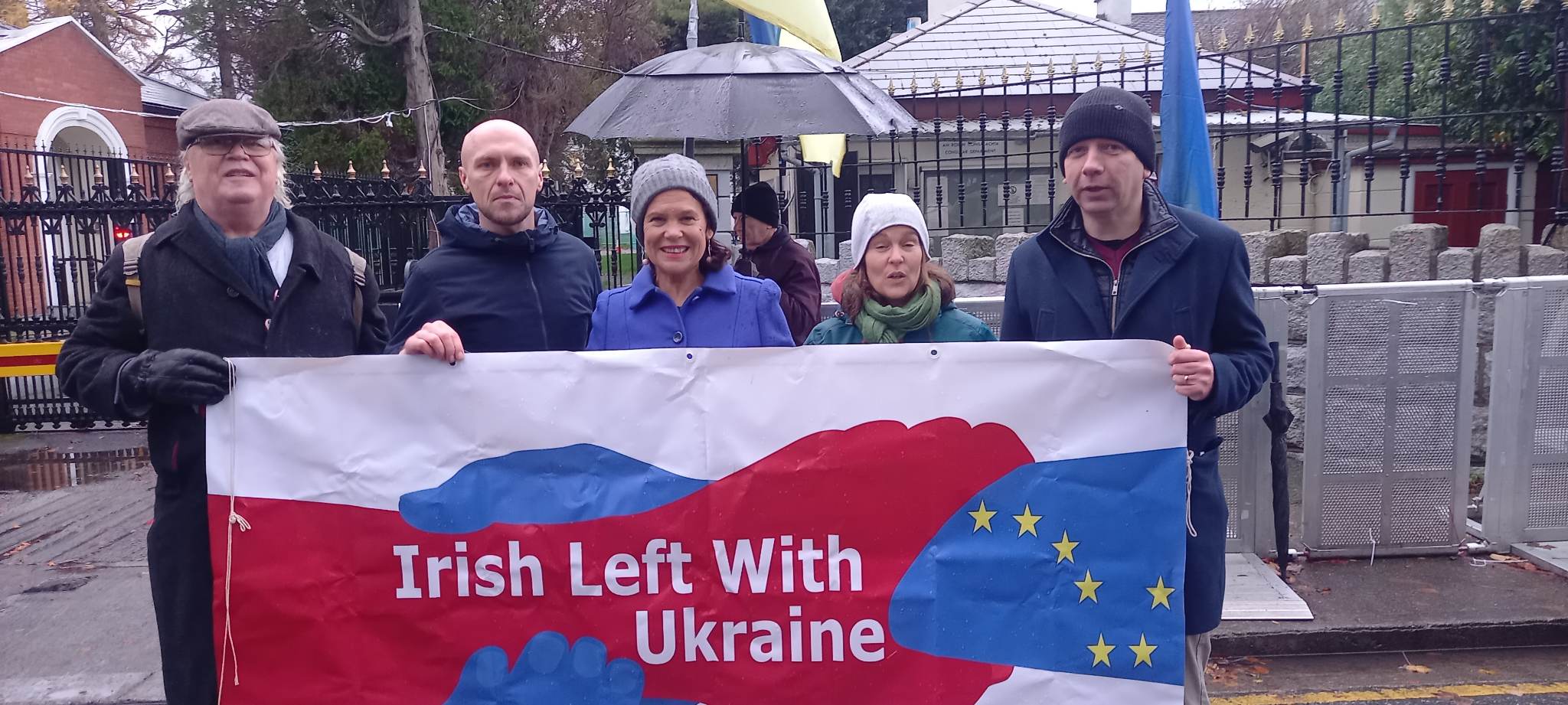
Some anti racists commented on the post, but the contents were deleted, and the posters were blocked from the site. I was surprised myself to find that I could no longer view the post of the DCAR page on facebook, as I too have been blocked. However, at the time of writing, I could still view the post on Twitter (1) Dublin Communities Against Racism on X: “1/20 Government asylum policy continues to be a hopeless shambles! For some decades prior to 2022 eligible asylum seekers were absorbed into Irish society without any great hue and cry.” / X (twitter.com)
Read the rest of this entry »


 Tomás Ó Flatharta