Archive for the ‘Feminism’ Category
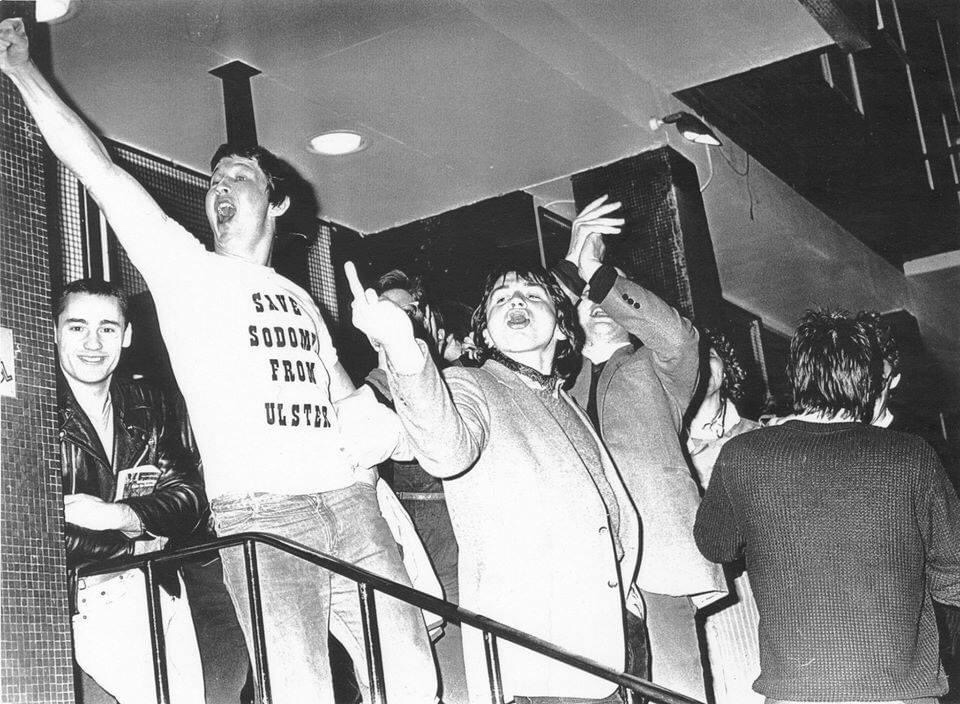
Tarlach Mac Niallais Radio Broadcast from 1984 – Gay Liberation Politics, the Partition of Ireland, Fighting Against a Carnival of Reaction
Previous Readers of this blog know about the New York Death of Belfast Gay Liberation and Socialist Activist Tarlach Mac Niallais. Thanks to an old friend and comrade of Tarlach, Cathal Ó Ciorragáin, we can listen to a New York Radio Interview with Tarlach dated October 9 1984
The interview concludes with a ballad sung by Tarlach.

Dubai ruler organised kidnapping of his children, UK court rules | World news | The Guardian
The ruler of Dubai, Sheikh Mohammed bin Rashid al-Maktoum, is an international criminal. Perhaps he will be the next monarch visiting President Michael D Higgins of Ireland in the Phoenix Park. It is time to stop grovelling to Royal Parasites. Read the rest of this entry »
Images, Funeral of Joe Kelly

Joe Kelly Greets the Mourners Coming to His Funeral, Teachers’ Club / Club na Múinteóirí, December 10 2016
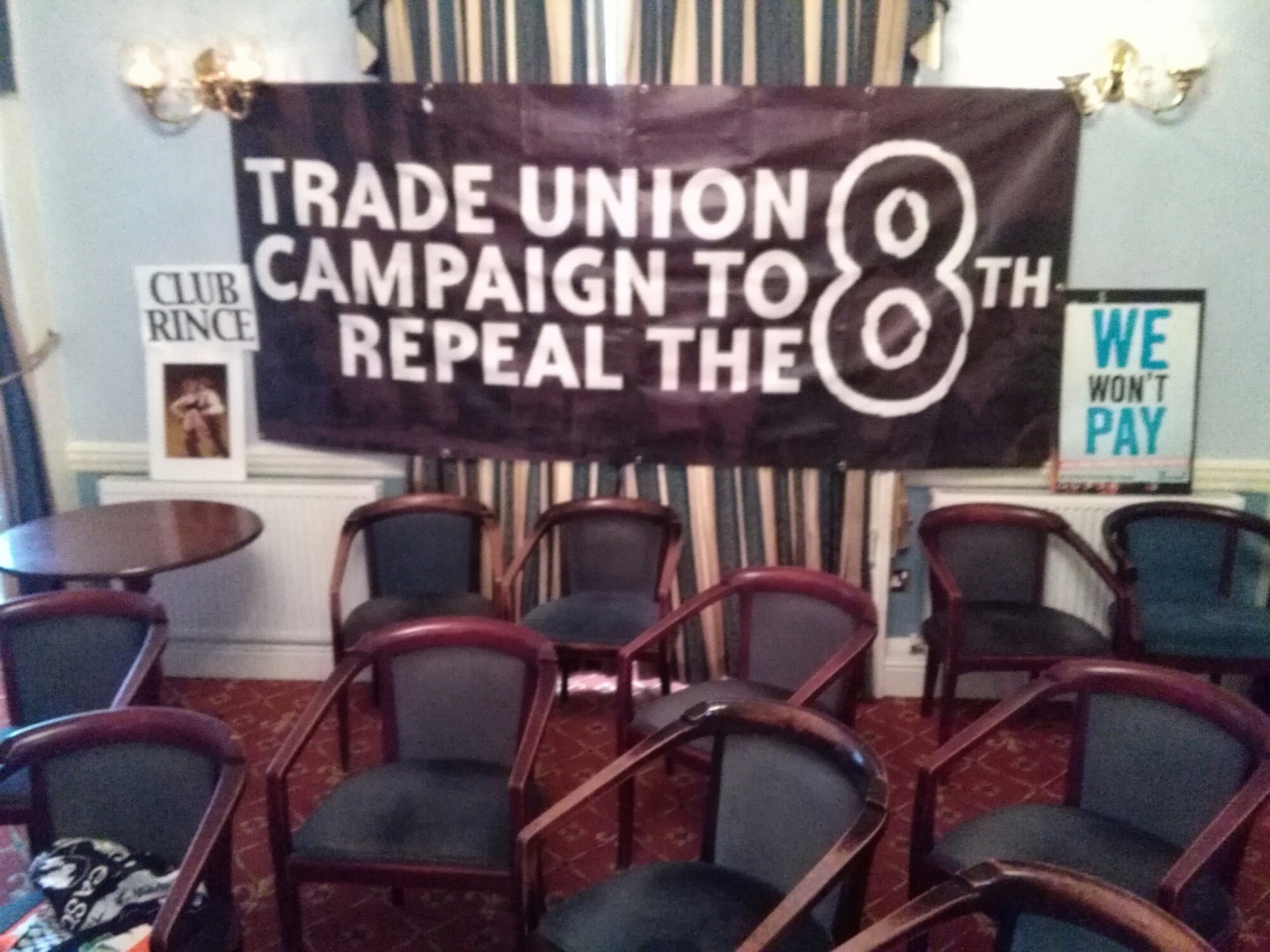
Joe Kelly’s Most Recent Campaign
The super chairperson – Joe Kelly, born April 8 1938, died Wednesday December 7 2016, Aged 78.
Tributes are pouring in to Joe Kelly. In future days a lot more will be written said and sung about an outstanding political activist and very firm friend.Death Notice of Joe Kelly


A small initial contribution is below, along with some other tributes seen on social media.
The mid-1980’s : The first big mass campaign where Joe Kelly and I worked together was Miscarriages of Justice, primarily the Guildford Four and Birmingham Six : innocent Irish people in British jails, framed by the British State, sentenced to life imprisonment and no mass campaign existed. That changed in Dublin, Joe Kelly was its heartbeat. An enormous “Parade of Innocence” in Dublin, headed by the Diceman Thom McGinty, was one outstanding result. Declan Gorman Writes About Dublin’s Parade of Innocence
Latest Result From Italy : Democracy 1 NeoLiberalism 0
Reports :
“The main motivation behind the No vote was the opposition to the government. But regardless of the diverging motivations behind the No vote, the referendum outcome defended democracy and popular sovereignty, destabilized the political system in a phase in which stability only means further attacks on democratic liberties and social rights, and opened a political space for a possible rebirth of social movements. On November 26, 150,000 women marched in Rome against male violence and on a radical platform, and the next day, thousands gathering in an assembly and workshops called for a women’s strike on March 8, uniting the fight against violence with opposition to austerity, social and health services cuts, and the casualization of labor.”
Women’s assemblies are being created in the whole country in preparation for the March action. The struggle we have ahead of us will of course be hard, as the Right is already trying to capitalize on the referendum result, hiding the fact that even a large part of PD voters voted against the reform. But the answer to this cannot be fear or lesser evilism, for these responses only work to strengthen the Right. The answer must be a return to politics as confrontation, starting from a participation in the women’s strike of March 8, which is opening the path for social resistance.”
http://www.internationalviewpoint.org/spip.php?article4793
A Very Disturbing Court Case in Dublin – Blaming A Woman Called Bernadette Scully
The English Solution to an Irish Problem
The English Solution to an Irish Problem; Martyn Turner, the Irish Times Cartoonist, Tells it As It Is

Small and Big Steps
“CHIEF MEDICAL OFFICERS in the UK have released statistics this morning on the number of terminations that were carried out in England and Wales last year, highlighting the incidence of women travelling from Ireland to avail of abortion services.
A total of 3,982 women gave addresses in the Republic of Ireland when attending clinics and hospitals during 2012. That made up the 68 per cent of the 5,850 abortions provided to women resident outside both countries. Women from Northern Ireland made up another 15 per cent of the figure.” The new restrictive X Case Law, which the Labour Party and Fine Gael ensured was carried by the Dáil last night, will not change this situation. Pro-Choice TD’s put down several amendments which were rejected; the defeated pro-choice amendments included a provision to allow women with fatal foetal abnormalities access to an abortion in Ireland. Another Savita Halappanavar type case is inevitable, sooner or later. http://www.thejournal.ie/at-least-21-women-from-every-county-in-ireland-had-an-abortion-in-the-uk-last-year-988359-Jul2013/
National Women’s Council of Ireland Director Orla O’Connor makes the current situation clear :
“Over 17,000 men and women wrote 77,428 emails to their TDs and Senators over the last few months to call for legislation to give full effect to the X case as part of NWCI’s campaign. This is evidence of the high level of public support throughout Ireland for access to safe and legal abortion in life threatening cases, including risk of suicide.”
“Yet what people were calling for has not been delivered in this Bill. Abortion remains a crime punishable by up to 14 years in prison and onerous and inaccessible procedures for women dominate the Bill. We urge the Government, as the Bill goes through its final stages, to take on board our proposed amendments so we have legislation that is fair, just and workable for women in Ireland.”
She continued,
“It is also critically important for us to acknowledge that with the passing of this legislation Ireland will continue to have one of the most restrictive abortion regimes globally. It will provide no solution to women who are pregnant as a result of rape or incest, in the case of fatal foetal abnormalities or where there is a risk to the health of the woman. Women in crisis pregnancies, over 4,000 every year, will still be forced to travel abroad for abortions. Women in Ireland must be in a position to make personal decisions about their own bodies and health care free from coercion, discrimination and the threat of incarceration. http://www.nwci.ie/news/2013/07/10/vote-on-abortion-legislation-a-historic-moment-for/
Here is Deirdre Conroy’s Account of the shameful Dáil Debate on foetal abnormality :
Minister’s contribution to debate on foetal abnormality was disrespectful to women
87 % are in favour of medical intervention for this condition http://www.irishtimes.com/news/social-affairs/minister-s-contribution-to-debate-on-foetal-abnormality-was-disrespectful-to-women-1.1460755?page=1
Legalise Abortion; Legislate for X; Dublin Demonstration Monday March 4
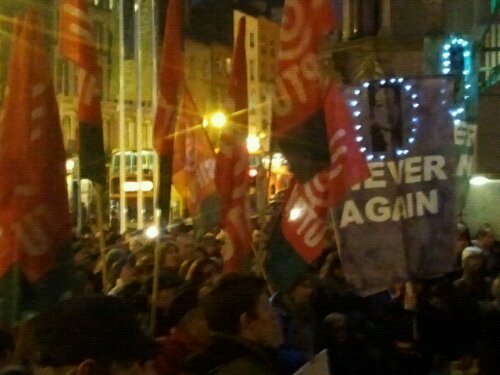
Trade Union Flags mingle with “Never Again” images of Savita Halappanavar on a bitterly cold evening at Dublin City Hall.
Paula Geraghty’s Short Video Report of the Event :
http://www.youtube.com/watch?feature=player_embedded&v=wYYObj1PXMM
Brendan Young reports on the demonstration, and makes proposals for more useful activities.
Today, March 5, is the 21st anniversary of the X Case ruling. Yesterday evening we had a great rally of 500 – 600 calling for legislation. Yesterday and last Friday, we had a historic first when major trade unions and other mass organisations – SIPTU, UNITE, the Women’s Committee of ICTU, the NWCI and USI joined together in calling for legislation that is not so restrictive as to make abortion inaccessible in practice. Both events were organised by Action on X.
Yet despite all the discussion about legislation at the January meetings of the Health & Children Committee on the Expert Group Report on abortion, we are still no clearer on when legislation will appear. There were press reports in early Feb about a memo to cabinet from health minister Reilly with proposals for a bill. The reports suggested that this memo contained proposals which were very restrictive: up to five consultants might be required to sign off approval for an abortion in the case of a woman being suicidal due to unwanted pregnancy. Previous comments suggested there would be very few locations where abortions could be carried out. These proposals provoked a row and the memo was withdrawn. So there is now no timeline for any proposals on X legislation; nor any indication of what the legislation might contain.
When Reilly announced before xmas that there would be legislation on X, people may have thought that it was a done deal. But Kenny was saying that the legislation would be as restrictive as possible. Labour are opposing the most restrictive aspects – but details are scanty and the outcome is undecided.
We cannot assume therefore, that legislation will be forthcoming before the summer. When legislation is published the anti-abortion minority will go into overdrive. So we should be clear on what we are doing over the coming months: there must be legislation for X, in the least restrictive form possible; it must include risk to life by suicide as grounds for abortion. It would be a setback for the pro-choice movement if legislation is passed that requires three, four or five consultants to sign off on an abortion; or if services are restricted to one or two hospitals, such as the Mater where Prof Patricia Casey – long-time anti-abortion campaigner – runs the suicide clinic. Such restrictions would simply deter a woman from even trying to use the services – with all of the risks that would entail.
Legislation on X will, by definition, be restricted by Art. 40.3.3 – the 8th Amendment to the Constitution. But restrictive legislation on X would be a setback. It would make a campaign for repeal of the 8th Amendment more difficult.
So we should not deflect the focus of the current debate by arguing for abortion on grounds of health (or other non-risk-to-life grounds – apart from fatal foetal abnormality) to be included in this legislation. These arguments are easily dismissed because they are excluded under 40.3.3 – the removal of which requires a referendum to change the constitution. Until X legislation is passed, without unnecessary restrictions, we should focus on that. We then move on to the launch of a campaign to repeal the 8th Amendment.
A useful activity for keeping pressure on the government (and other parties) would be for teams of people to visit TDs and councillors in their clinics. The visits would be to ask them what they are doing about implementation of the X ruling and the ABC ruling; and about when legislation will be published. They can be asked about their own position on the details of legislation – restrictions, etc; about the position of the party locally; and about what information they have regarding government proposals. If the TDs / Cllrs don’t know, they can be asked to find out.
A picket on the Dáil before the easter break on March 28 would also be useful.


 Tomás Ó Flatharta