Archive for the ‘War and an Irish Town (Eamonn McCann)’ Category
Nell McCafferty’s Funeral from Derry was broadcast late on RIP.IE – Minus an Eamonn McCann Eulogy, Gay Rainbow Flags, or any personal memories of a woman who “changed Ireland for the better”
Many people who knew Nell McCafferty could not get to her funeral in St. Columb’s Cathedral, Derry. An alternative was offered on RIP.IE – a live broadcast starting at 12.30pm. When interested viewers tuned in, they were mystified, seeing only a blank screen. The livestream did not start until after 1.00pm, as a priest shared the altar with three men conducting a religious ceremony containing no stories about one of Derry’s most talented writers, Nell McCafferty. At one screening venue a small group of Nell’s fans – including Máirín Johnson who travelled on the legendary Dublin-Belfast contraceptive train with Nell in 1971 – were not impressed. We learned later that Eamonn McCann delivered a eulogy in front of the altar – A report is below. Source :
Nell McCafferty “Changed Ireland for the Better”
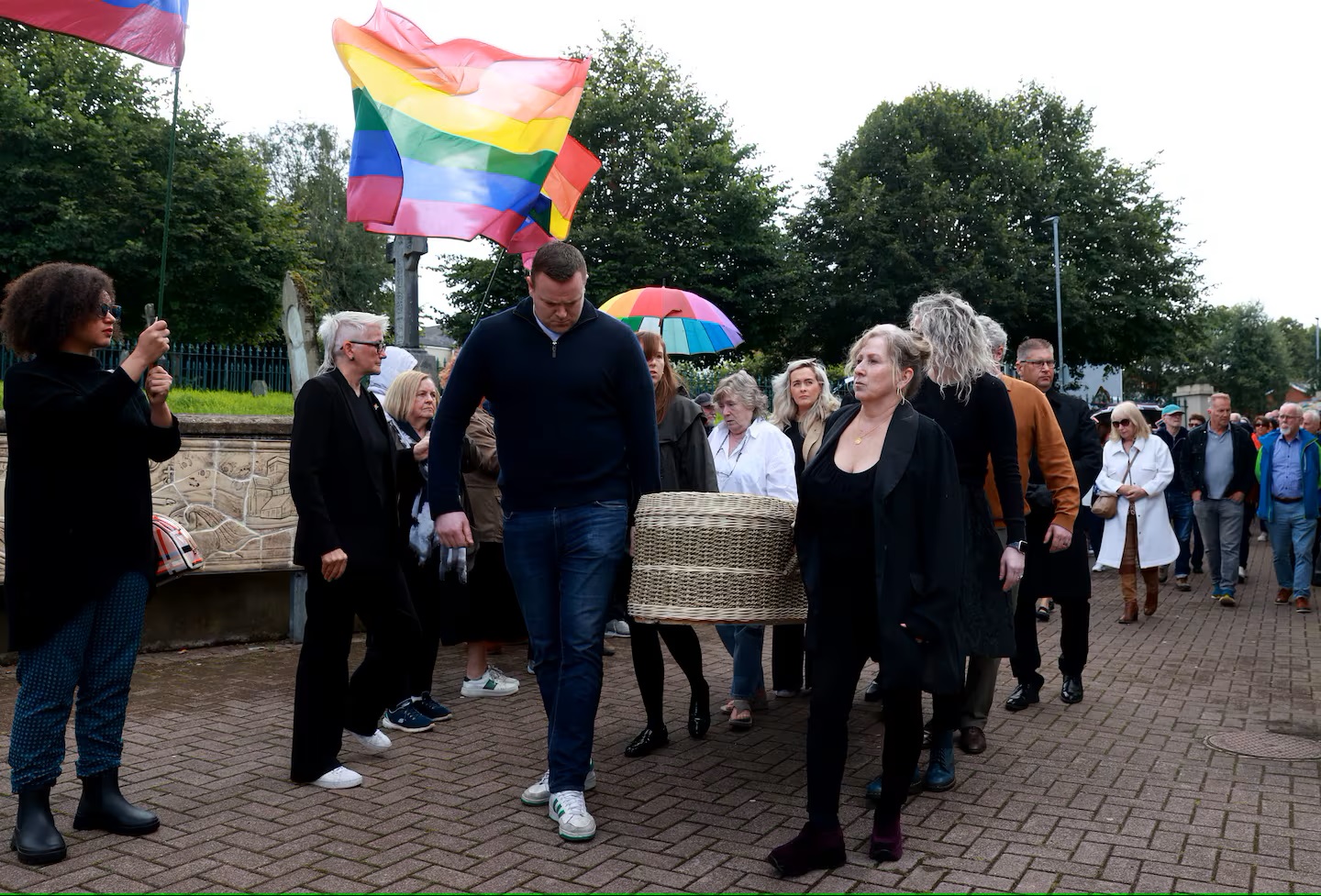

Eamonn McCann delivers a eulogy for Nell McCafferty, St Columb’s Cathedral Derry, August 23 2024
Nell McCafferty ‘changed Ireland for the better’, mourners at her funeral in Derry’s Bogside told
Campaigning journalist and author, who focused on women’s rights, poverty and social injustice, died on Wednesday aged 80
Nell McCafferty “changed Ireland for the better”, mourners at her funeral have been told.
Delivering an elegy in advance of her funeral Mass in Derry’s Bogside on Friday, the veteran civil rights campaigner and journalist Eamonn McCann said it was “given to very few of us to actually change the world”.
Read the rest of this entry »Irish Times Tribute to Nell McCafferty, March 28 1944 – August 21 2024 – Hold the Front Page – Nell has a story
An excellent tribute : Web Link :
Nell McCafferty Obituary – Journalist and Feminist Campaigner
Update, Dublin Gathering, Friday August 23, The Teachers’ Club, 36 Parnell Square West, at 12.30. Nell McCafferty’s funeral will be livestreamed.
RIP.IE Notice :
https://rip.ie/death-notice/nell-mccafferty-derry-derry-city-566175
- Born: March 28th, 1944
- Died: August 21st, 2024
- Nell got to the front page in the end :
“Nell”, she called her autobiography, and that was how she was known.

Small, fierce and feisty. That mop of curls, the waft of cigarette smoke, the tongue in cheek smile and her distinctive walk, like a sailor ashore. Everyone soon knew her smoky Derry voice, laconic, challenging, always ready to break into laughter. You never knew what Nell was going to say next. It was often outrageous. She was a character, and she loved to play herself to the hilt. She was also one of the most important Irish journalists of the latter half of the twentieth century. She listened. She paid attention. She told the truth.
She was, wrote her friend, the historian Margaret Mac Curtain, “unequalled in the extraordinary breadth and fearless candour she has brought to bear on controversial subjects.” Her journalistic career started in The Irish Times in 1970, when the paper’s late Northern editor and editor, Fergus Pyle, commissioned her to write about the new bathroom in her family home in Beechwood Street in Derry’s Bogside.
Home was her touchstone. She vaunted her street-cred. She was part of a Bogside aristocracy that included Martin McGuinness, Eamonn McCann, Seamus Deane, Paddy Doherty, John Hume, Dana and Phil Coulter. Her mother was her biggest fan and harshest critic.
McCafferty was born in 1944. Her father, Hugh, was a clerk for the British admiralty by day and a bookie’s clerk at the dog track at night. Her mother, Lily, reared six children. Another daughter died at birth.
Her parents had to work hard to keep poverty at bay. She was fascinated and frightened by the poverty of the tenements where her father was raised. One of his brothers had died as a British soldier at the Somme. Her mother’s parents were Sergeant Duffy, a Catholic RUC man, and his wife Sarah, a Protestant who “turned”.
Read the rest of this entry »Robert Ballagh’s “The Thirtieth of January”: A Bloody Sunday Painting and the Troubles in the Two Bits of Ireland
In this interview the artist Robert Ballagh discusses the painting “The Thirtieth of January”, depicting Bloody Sunday in Derry in 1972. The conversation provides valuable insights into Ballagh’s personal experiences and artistic process, shedding light on the political and social context of the time.
The interview provides a unique insight into the historical and cultural significance of the painting.
Critical issues related to the Irish government’s response to the conflict, the impact of the Bloody Sunday event, and the broader social and political implications are highlighted. Ballagh’s commentary on the role of the Irish government, the impact on nationalist communities, and the establishment of the Special Criminal Court adds depth to the discussion.
Bloody Sunday Painting – the Thirtieth of January – Robert Ballagh
Thursday, January 20 2022. John Meehan interviews the artist Robert Ballagh in Number Five Arbour Hill.
We are talking about Robert’s painting : The Thirtieth of January, a representation of Bloody Sunday in Derry, January 30 1972.
John Meehan :
Why did you zone in on Derry’s Bloody Sunday , and put so much effort into making this painting? What makes it different from so many other big events during “The Troubles” in the north of Ireland, which lasted for 30 years, from 1968 to 1998?
Robert Ballagh
Well, it’s a long time ago now 50 years, but I have to say that it had an enormous effect on me, and I don’t think I’m alone with that historical experience. I suppose one thing I should say, I was only thinking about this, and I haven’t said anything about this experience to others. I’m a Dubliner. I’ve lived all my life in Dublin. But unlike most Dubliners – it wasn’t by design – I had an extraordinary rich knowledge of the North of Ireland, before the conflict began. Because I was a professional musician in a showband. We used to play at least once or twice a week in the north. So I was in every town village or city in the north that had a ballroom or ballrooms. And so I experienced the reality of life in that society, and became very aware of the sectarian differences, shall we say – the nature of the society, which people didn’t appreciate at all. I tell one very short story to illustrate that. We played fairly regularly in one of the very popular ballrooms in Belfast : Romano’s in Queen Street. We developed quite a following! In the show business vernacular the word groupie was used. These girls used follow us, they came down to Dublin once or twice to hear us. And we were playing one night in Romano’s.

After the dance, they came up and we’re talking to us. They asked “When are you playing again in Belfast?”.
I remember saying “Oh, I think we’re here next week.”
“Oh, really?”
“Yeah – we’re playing in a ballroom called the Astor” which I knew was in Smithfield.
And they said, “Oh, we can’t go there.” And I said, “Why?” – because it was a public ballroom. It wasn’t attached to any organization or anything. It was a public ballroom.
They said, “Oh, no, that’s a taig hall”
And it was the first time I realized, and we realized, that our fan base in Belfast was Protestant.
Bertie Ahern – a former taoiseach “who accepted large donations from property developers” – seeks an honour from St. Columb’s School in Derry – Eamonn McCann dissents
Join Eamonn McCann and former St. Columb’s College pupils to say to Bertie Ahern : No thanks.
Eamonn McCann writes :
The source is Eamonn McCann’s facebook page ; https://www.facebook.com/search/top/?q=Eamonn%20Mccann
As former students of St. Columb’s College we are dismayed to learn that the college’s Past Pupils’ Union has invited Bertie Ahern to address its annual dinner.
The former Taoiseach was disgraced when it emerged a decade ago that he had played fast and loose with the truth when required to explain major aspects of his finances.
Read the rest of this entry »“War and an Irish Town” – Joan McKiernan reviews a classic Eamonn McCann study of Derry and Partitioned Ireland
Joan McKiernan is an Irish-American socialist-feminist activist living in New York.
Joan McKiernan
War and an Irish Town
Source : https://againstthecurrent.org/atc223/war-and-an-irish-town/
By Eamonn McCann
First publication Pluto Press, 1974. Chicago: Haymarket Books edition, 2018, $20 paperback.
“‘WE’RE GONNA WALK on this nation, we’re gonna walk on this racist power structure, and we’re gonna say to the whole damned government — “STICK ‘EM UP MOTHERFUCKERS.’”
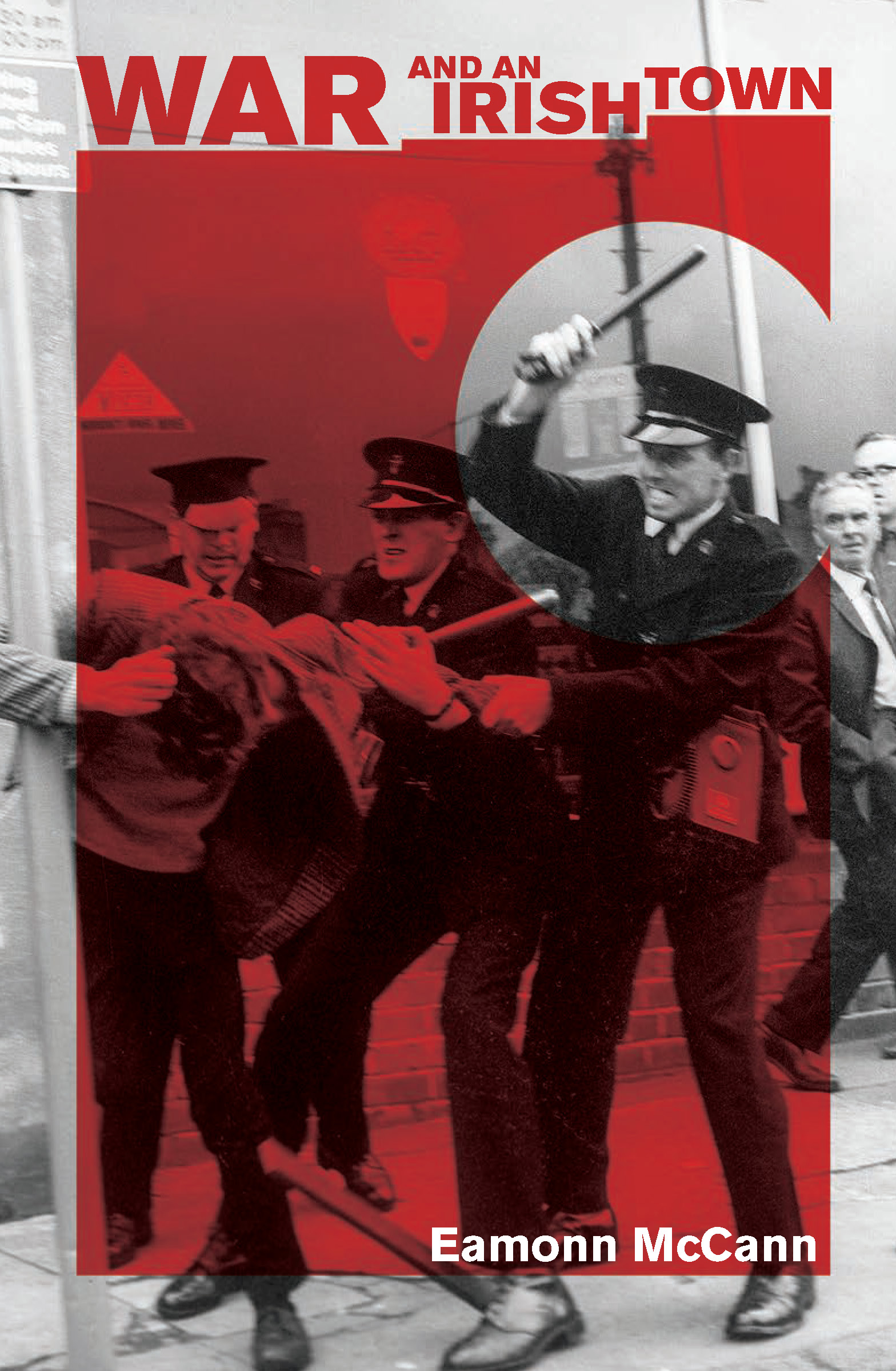
WITH THIS QUOTE from a film of the Black Panthers, Eamonn McCann, launches the Haymarket edition of his classic study of Derry and the North of Ireland Troubles, War and an Irish Town, taking us back to those heady days when so much change not only seemed possible, but likely to happen.
This is an especially timely reissue when the question of a united Ireland is again on the table.
Those in Derry that 1968 night cheering the Black Panthers’ words shared a common goal: the fight against inequality and repression, whether on the streets of Derry or Chicago where Black activists were “then under murderous assault by the feds and local police forces across the US.”
In those years, from Vietnam to Yugoslavia, Chicago to Mexico and many other places, the world was filled with students, workers, communities fighting back. McCann argues that “Each upsurge of struggle sent out a flurry of sparks which helped ignite struggle elsewhere.”
He situates The Troubles in the North of Ireland in this time of international struggles. Those who were there for those struggles should read this latest edition, with a new introduction by the author, to reconsider what happened and why we did not win. Those who were too young at the time can read about those exciting times and what lessons can be learned for the future.
Read the rest of this entry »


 Tomás Ó Flatharta