The Blockade Is the Message
How a Fuel Price Spike Became a Fascist Audition
An effective heavy vehicle blockade campaign brought the 26 county bit of Ireland to a halt in the second week of April 2026.
Parties and individuals based on the left have offered significantly different opinions about these protests.
There is no doubt that far-right organisations are involved. This poses a big problem for all forces on the left – parties, trade unions, social movements that are pro-feminist and anti-racist, and so on.
It is essential to start with concrete analysis. Left-wing actors such as People Before Profit (PBP) say they support the blockaders :
“ There is “no question” that there are far-right people trying to intervene and be present in the protest…So some of these people (the far-right) are present and are trying to shape the protest, but one: the vast majority of people who are participating in the protest have nothing to do with the far right, whatsoever.
Paul Murphy TD, People Before Profit, Dublin South-West,
“And two: I really have a strong sense that ordinary working-class people in Dublin, people who live in Dublin South-West that I represent, have a lot of support for these protests,” Murphy said.
The left shouldn’t abandon fuel protesters, Paul Murphy says
The article below, and several other reliable sources, demonstrate that Paul Murphy’s analysis is based on wishful thinking rather than concrete analysis.
The far-right are not “trying to intervene and be present in the protest”. Far-right actors initiated this campaign.
This has serious implications for all forces on the Irish left.
Summing up: socialists have to recognise the hardships caused by high fuel prices (on top of all the other high prices). Blaming the right-wing government is fine. But – an extremely big But :
The Left must pledge : no co-operation with fuel-protester fascists and racists.
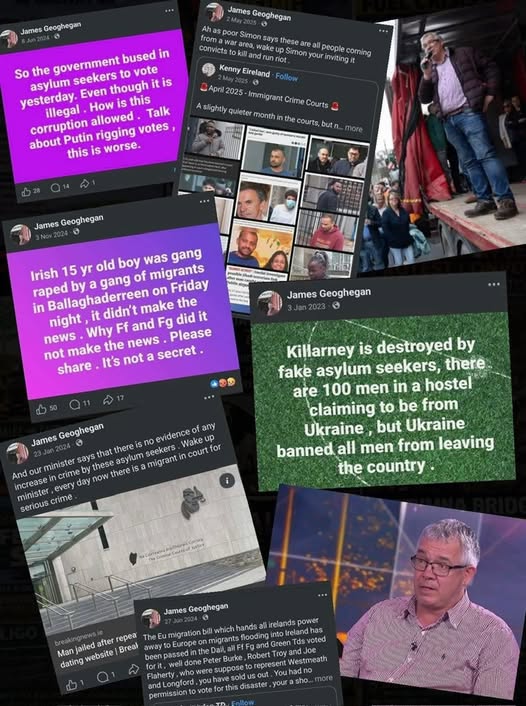
The policy of the PBP and others on the left is “support the fuel protests”.
The only way you can implement this policy is practical collaboration with the far-right on the streets and elsewhere. That means putting the lives and welfare of your own members and supporters in danger.
The left can do much better – a useful starting point for for a more progressive policy is here, written by the SIPTU researcher, Michael Taft :
Searching the Evidence – Michael Taft
This immediate problem is down to Trump’s wars in Iran, Lebanon, and other parts of the Middle East.
Question : “Will the fuel protesters shut down Trump’s Doonbeg golf course in Co. Clare, which hosts the Irish Open tournament in September 10-13 2026?
Answer : “Will they, Fuck” (with full thanks to James Gogarty – see footnote [1])
I wish to thank several comrades who provided valuable research and commentary on the blockades crisis. This crisis is far from over.
John Meehan April 13 2027
The Blockade Is the Message
How a Fuel Price Spike Became a Fascist Audition
Link :
There is a particular tell, when a “spontaneous people’s protest” isn’t quite what it claims to be. It isn’t the placards. It isn’t the high-vis vests. It isn’t even the tractors. Ireland has plenty of legitimate reasons to bring a tractor to town, and a country built on agricultural grievance has every right to express it loudly. The tell is something subtler. It’s the moment someone in the crowd, their face contorted with what is supposed to be anger about diesel, screams “What’s a woman?” at a passing TD.
That happened on O’Connell Street this week. The TD was Paul Murphy. The heckler, by Murphy’s own admission afterwards, was a known far-right agitator. The question, imported wholesale from American culture-war X/Twitter, with no organic relationship whatsoever to the price of a litre of diesel in County Meath, is the entire story of what these “fuel protests”actually are, compressed into three syllables shouted on a Dublin street. People genuinely furious about the cost of heating their homes do not, in unscripted moments of rage, reach for gender-critical talking points. They reach for the cost of heating their homes.
What we have been watching this week is not a fuel protest. It is a blockade. And the blockade is the message.
The Word Matters
Let’s start with the language, because the language is doing political work. A protest persuades. A protest occupies a public square, marches down a public street, gathers outside a parliament, and asks the country to look. A blockade does something else entirely. A blockade puts a small mobilised minority in a logistics chokepoint and squeezes until the rest of the country is forced to negotiate at gunpoint with whoever happens to be holding the chokepoint that morning. One is democratic. The other is the precise opposite of democratic, it is the substitution of leverage for argument, of coercion for persuasion, of “we have the diesel and you do not” for “we have the better case.”
It matters which word we use, because the word “protest” carries a century of legitimacy earned by people who marched and were beaten and were jailed and went on hunger strike for the right to be heard. To paste that word onto a tow-truck convoy organised by a man who thinks asylum seekers get free trips to the zoo is to launder a coercive tactic in the moral inheritance of a democratic one. It is, frankly, theft.
And the country has, this week, been held to ransom.
The Parasites and the Host
Here is the part that requires care, because it is the part the bad-faith reader will pretend you didn’t write. There are real hauliers in this. There are real farmers in this. There are real agricultural contractors whose margins were already paper-thin and who watched the price of red diesel spike in the wake of the US and Israeli war on Iran and who concluded, not unreasonably, that something had to give. Their grievance is legitimate. Their anger is legitimate. The cost-of-living crisis is real, the government’s response to it has been thin, and a country in which a working person cannot afford to fuel the vehicle they need to work is a country with a problem that politics is meant to solve.
None of that is in dispute. What is in dispute is who organised the WhatsApp groups.
The forensic work has been done by The Journal, and it deserves to be read carefully by anyone tempted to wave this away as “ordinary people venting.”The Facebook page that led the early mobilisation — The People of Ireland Against Fuel Prices — was set up in 2021 under a different name and ran a paid advertisement urging attendance at this week’s events. The ad was paid for by a company called TheTowTruck.ie, owned by a man named Sonny Boyd, who has used his personal Facebook page to claim, falsely, that Ireland is the only country in Europe to give immigrants free housing, weekly cash payments, free English lessons, and free trips to the zoo and theme parks. This is not an incidental detail. This is who paid for the advertising that brought people to the chokepoints.
The three men put forward as media spokespeople: James Geoghegan, Christopher Duffy and John Dallon, have between them appeared in livestreams with Niall McConnell of Síol na hÉireann and with Philip Dwyer, the anti-immigration agitator who was, in one of the more telling moments of the week, ejected from organising WhatsApp groups by genuine fuel protesters who told him in plain terms that the protests were “about fuel.”Christopher Duffy’s social media history includes a comment, posted under an item about Greta Thunberg, that he could not “care less if she got raped or beaten” and made “no apologies for saying that.” This is the man who has been addressing the national press from O’Connell Street as the spokesperson for what we are being asked to call a fuel protest.
And then there is the moment the mask slipped entirely. On Tuesday morning, from the back of a truck on O’Connell Street, Kildare county councillor Tom McDonnell, the same Tom McDonnell who became briefly notorious last year for saying Irish women need to “breed” more, addressed the crowd. He told them Ireland was being “destroyed” by Europe and by the government. And then, in a single sentence that ought to be carved into the lintel of every honest analysis of this week, he told them where the missing fuel-tax money should come from: empty the IPAS centres.
That is the entire economic argument of the blockade resolving, in real time, mid-speech, into the scapegoating of asylum seekers. Two and a half billion euro. From IPAS centres. To hauliers. From the back of a truck. The mathematics are not the point. The mathematics have never been the point. The mathematics are a delivery mechanism for the politics, and the politics are that someone else, someone browner, someone newer, someone with less power than anyone in that crowd, should be made to pay.
That is not a fuel protest. That is a fascist audition with a diesel-soaked script.
The Swarm
For the first few days, the international far right barely noticed Ireland. Tommy Robinson was elsewhere. Katie Hopkins was elsewhere. Ezra Levant, the Canadian impresario who has spent years monetising other people’s grievances on camera, was elsewhere. Conor McGregor — found civilly liable by the High Court of sexually assaulting Nikita Hand, and now reinventing himself as a political actor after his failed presidential bid — was, by the standards of his recent output, almost quiet.
That changed on Thursday morning. Justice Minister Jim O’Callaghan asked the Defence Forces for assistance in moving vehicles from roads and fuel depots, and within hours the swarm arrived. Robinson posted footage of army vehicles, vehicles which, the Defence Forces had to clarify, were on the streets for an entirely separate reason, and announced that the Irish government was “now at war with the Irish people.” Hopkins re-shared old anti-immigrant protest footage as if it were live. Levant flew in. McGregor offered to feed the protesters at his pub, then posted videos of his workers handing out sandwiches on O’Connell Street, and declared it was “amazing”that Dublin was now safe, a reference to the fiction, which he has spent years cultivating, that the capital is dangerous because of immigration.
The misinformation followed immediately, because misinformation is what these accounts produce: AI-generated images of Gardaí using water cannons that did not exist; old footage of sulkies racing down O’Connell Street recycled as if it were Tuesday; a video of an army vehicle trapped under a railway bridge that was not even filmed in Ireland. Former far-right electoral candidate Derek Blighe announced that “children as young as 12” had been pepper-sprayed by “regime forces” at the Whitegate oil refinery. Regime forces.Read that phrase again and ask yourself which political vocabulary it belongs to, and which it does not.
This is the European far right’s most successful tactic of the last decade, and it has now been deployed in Ireland with textbook precision. Find a real economic grievance. Build a blockade around it. Wait for the international content economy to arrive. Wait for the legitimate complainants to either leave or be drowned out. Convert the resulting footage into recruitment material. The gilets jaunes did this in France. The Dutch farmer convoys did it. Ottawa did it. The fact that it is being done here, on our streets, in our names, with our diesel, is not an accident. It is a method.
The Murphy Problem
Which brings us, with no pleasure at all, to Paul Murphy TD.
Murphy walked onto O’Connell Street earlier this week. He was met with chants of “shame on you.” Someone screamed “what’s a woman?” at him. He was told he does not stand with working-class people. He was forced — physically, on camera — to turn around and leave. And speaking to The Journal afterwards, Murphy acknowledged, in plain language, that the people who had screamed at him were all known to him, all known far-right agitators in Dublin. And then he said the left should not abandon the protest.
This is not a small mistake. This is the trap the European populist left has walked into, again and again, over the last decade, and it should be possible by now — it should be required by now — for any serious left politician to recognise the shape of the trap before stepping into it. Nobody is asking Paul Murphy to abandon his constituents in Dublin South-West. Nobody is asking him to be quiet about fuel poverty, or about a government that has been culpably absent on the cost of living, or about the obscenity of a war driving up the price of a working person’s commute. He could be saying all of those things from a thousand other platforms. He has chosen to say them from this one, and the choice of platform is the choice that matters.
Look at who got this right. Ivana Bacik TD called for the blockades to end while explicitly recognising the right to protest and the distress driving it. The Social Democrats said it was wrong to block roads and critical infrastructure while urging the government to engage. And Roderic O’Gorman TD — Roderic O’Gorman, the Green Party leader whose face has been used in homophobic memes shared by figures now embedded in this very protest — pointed out, in one of the most clear-eyed political statements of the week, that protesters should be directing their energy at the US and Israeli embassies for causing the energy crisis with their attack on Iran.
Read that again. The politician the blockaders’ organisers have spent years smearing is the one naming the actual cause of their fuel bills. Meanwhile the People Before Profit TD is explaining why he won’t abandon the people who screamed “what’s a woman” at him on a public street. Something has gone badly wrong with the political compass when O’Gorman is offering the cleanest left analysis on offer and Murphy is reaching for the megaphone next to the coffin marked RIP Ireland.
And it is not only Murphy. Sinn Féin’s positioning here deserves to be named, because honesty is the only thing that makes the rest of this argument hold. Of all the parties in the Dáil, Sinn Féin should be the first, not the last, to recognise the parasites-and-host pattern. A movement whose entire history was built on insisting that real political grievances must not be conflated with the people who attach themselves to those grievances for their own ends ought to be incapable of misreading what is happening on O’Connell Street this week. The decision to back the blockades, chasing votes that, in all likelihood, will not arrive at the ballot box anyway, is not an ideological misstep. It is a failure of the precise pattern-recognition the party’s own century is supposed to have trained into it. The undecided middle that any serious unity project depends on is not won by standing next to Tom McDonnell while he calls for IPAS centres to be emptied. It is lost there.
What This Was
Strip away the high-vis, strip away the diesel fumes, strip away the carefully filmed sandwich distribution, and what was this week, really? It was a stress test. It was the international far right discovering that the same playbook that worked in Paris and Ottawa and Eindhoven works just as well in Cork and Dublin. It was an audition — for the cameras, for the donors, for the next mobilisation, and for the one after that. The fuel was the pretext. The blockade was the rehearsal. The country was the stage.
The hauliers will go home. The diesel will eventually be cheaper or it won’t. The IPAS centres will not be emptied because the IPAS centres were never the point — they were the test of how easily the idea of emptying them could be smuggled into a crowd that came for something else. And the answer, this week, was: easily enough. Easily enough that a Kildare councillor said it out loud from the back of a truck and nobody walked away.
That is the thing to remember when the convoys disperse and the cameras leave and the columnists move on. The blockade is the message. And the message has been received, by the people who sent it, by the people who answered it, and, one hopes, by the rest of us, who still have a country to defend from the polite fiction that any of this was ever about the price of a litre of diesel.
Louth For Ever writes on Irish politics and constitutional change. Follow for analysis of Ireland’s democratic future as it’s constructed by those actually engaged in the work.
Link :
The Blockade is the Message
Footnotes :
[1] A highlight from the Mahon Tribunal, which investigated corruption in planning matters in Dublin from 1997 for fifteen years.
Will we fuck.
– Whistleblower James Gogarty told the Tribunal that he had accompanied property developer Michael Bailey in 1989 when the builder had given then-TD Ray Burke an envelope filled with tens of thousands in cash for a planning decision. Afterwards Gogarty had asked Bailey if he would get a receipt for the money. Bailey’s response, above, was succinct.
This post, written by UNITE’s Irish Region Secretary, Susan Fitzgerald, illustrates the useless result of the fuel blockade protest :
This is a very good source :


 Tomás Ó Flatharta
Leave a comment