“Stormont’s institutionalised sectarianism is beginning to look disturbingly permanent”
The Irish News columnist Patrick Murphy tells many home-truths about the Good Friday Agreement and the Stormont Assembly in Belfast.
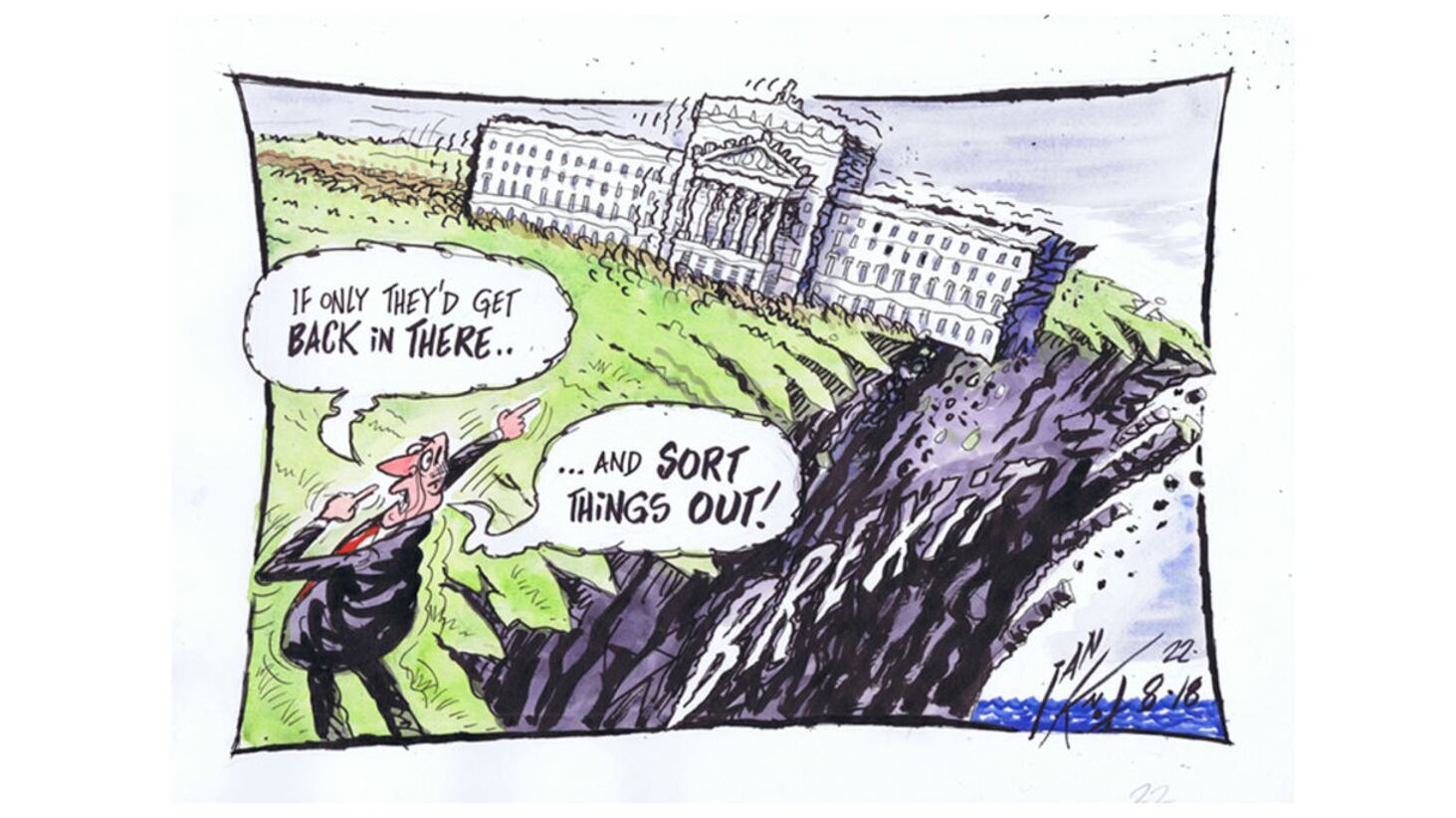
This occurs in tandem with declining support for partition within the six-county bit of Ireland. A detonator of this trend was Brexit – the British state’s 2016 right-wing exit from the European Union.
Anti-Partition supporters of the Good Friday Agreement hope its referendum provisions will be enacted – forcing an electoral end on Ireland’s partition. These people need to address an ugly truth : an Irish unity referendum within the 6 county state can only happen with the permission of the British Secretary of State for “Northern Ireland” – an office currently held by Labour MP Hillary Benn.
Benn has categorically stated he will not authorise such a referendum. Credible opinion polls suggest that by the time of the next British general election (which must occur by 2029) the Westminster government could be controlled by the far-right ultra-Unionist Reform party led by Nigel Farage.
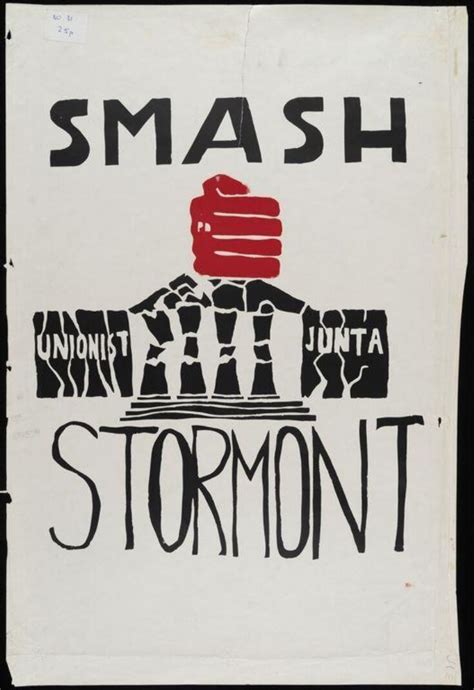
The best progressive way to end the partition of Ireland today can start with smashing Stormont. End institutionalised sectarianism and class collaboration – No coalition with right-wing parties such as the Democratic Unionist Party.
The way forward is :
1.Call for the formation of citizens’ assemblies which will draw up a political programme for the creation of a new 32 county Irish state
2. If the Irish state refuses to call a Citizens’ Assembly – something like the body which preceded the 2018 referendum in the 26 county bity of Ireland which repealed the anti-abortion 8th Amendment – the workers’ movement, women’s movement, trade unions, left-wing parties, and so on should take the initiative.
Link :
“Stormont’s institutionalised sectarianism is beginning to look disturbingly permanent”
John Meehan March 28 2026
WHEN Sinn Féin recently branded the DUP as having a “wreckers’ agenda” in the Executive, the party appeared to be finally accepting what this column has been suggesting for some time – Stormont is not working.
The solution for Sinn Féin would appear to be either to reform it, or abandon it.

Emma Little-Pengelly (Democratic Unionist Party)
However, the party has not indicated support for Stormont’s reform.
Instead, it has stated that since the Good Friday Agreement was a peace settlement, but not a political settlement (although it did not say that at the time), the political institutions “are not an end in themselves”.
This presumably means that it sees Stormont as a temporary arrangement, which will disappear in a united Ireland.
In the meantime, the social and economic problems heaped on us by Stormont’s failure will, by Sinn Féin’s logic, leave us temporarily in purgatory, rather than permanently in hell.
However, Stormont’s institutionalised sectarianism is beginning to look disturbingly permanent.
If a united Ireland means uniting people, Stormont’s battle-a-day between Sinn Féin and the DUP makes that unity unlikely and probably impossible.
The DUP knows this, so they are effectively wrecking the path to a united Ireland.
Welcome to hell disguised as purgatory.
Sinn Féin is not the first party to journey from supporting violence to preaching peace.
De Valera took that same path when he resigned as Sinn Féin president 100 years ago this month.
He had failed to convince the party to abandon its policy of abstentionism from Dáil Éireann, so he formed his own party, Fianna Fáil.
In 1932, six years after it was formed, and just 16 years after the 1916 Rising, Fianna Fáil entered government.
It has been there for 66 of the past 100 years and has held the Irish presidency five times. It might reasonably be regarded as the most successful party in Irish history.
Sinn Féin has pursued a more roundabout route.
In 1986, seventy years after the Easter Rising, it decided to end abstentionism from the Dáil. Eleven years later its first TD was elected.
Today, nearly 60 years after the Troubles began and 110 years after 1916, it is the largest (and richest) political party in Ireland, but it has still not achieved power in Dublin.
So why has it taken so long? Three factors have made a difference: IRA violence, the changed nature of southern politics and, of course, engaging in a sectarian Stormont.
In de Valera’s case, the Easter Rising lasted a week and the War for Independence lasted about three years. The modern IRA’s campaign lasted almost 30 years.
The longer the war went on, the more reluctant southern electors were to support violence.
After all, in the 1940s de Valera’s government had executed six IRA men, including Lurgan’s Thomas Harte.
In the north, the war entrenched sectarian division, so it halted rather than hastened Irish unity.
In electoral terms, de Valera had only to counter Fine Gael and by courting the Catholic Church, he had an ally which guaranteed electoral absolution for any policy failings.
Today, Sinn Féin faces a combined Fianna Fáil/Fine Gael coalition which, although it has a poor record on many social issues, often fends off SF by referring to its support for IRA violence and its failings in Stormont.
Those failings are of Sinn Féin’s own doing. It bought into the Good Friday Agreement’s analysis that the Troubles were caused by two opposing nationalities.
This was a direct contradiction of the republican philosophy which recognises a single Irish nation, uniting Protestant, Catholic and Dissenter.
They may have got the peace right, but they got the politics wrong.
Sinn Féin decided it would represent only Catholics. It tried to replace a Protestant parliament for a Protestant people with a Catholic party for an increasingly Catholic population.
De Valera stuck by the single nation concept of republicanism and Fianna Fáil stayed out of the north.
Although he was elected MP for South Down from 1933 to 1938, he never took his Stormont seat. Instead, his 1937 Irish Constitution laid claim to the whole island of Ireland and he left it at that.
Sinn Féin abandoned that claim in the Good Friday Agreement and opted to govern the north instead.
What it saw as a stepping stone to a united Ireland is now proving to be a barrier. It bought into the wrong model of government – a mistake which it now appears to recognise.
It is guaranteed a share of sectarian power in Stormont, but that share perpetuates rather than resolves division – which is why we can probably expect a lot more wrecking.


 Tomás Ó Flatharta
Leave a comment