The fall of Peter Mandelson and the many questions the British government must now answer
The Keir Starmer Labour government in Britain is in serious trouble despite having a huge parliamentary majority of around 170 seats.
Link :
The fall of Peter Mandelson and the many questions the British government must answer
No accident waiting to happen can ever have delivered on its promise so spectacularly as Lord Mandelson, with the continuous revelations of his ties to convicted sex offender Jeffrey Epstein. The decision by the UK prime minister, Keir Starmer, to appoint Mandelson as ambassador in Washington DC always appeared a high-risk, high-reward strategy. But no reward could ever have repaid such risk.
There is a grim fascination in seeing a prominent public figure’s reputation incinerated in real time. Mandelson’s entreating emails to a convicted abuser and trafficker of minors were still quite recently sufficient of an embarrassment before he was then photographed urinating in public.
The new normal is to appear on front pages in his underpants. Next will come questions about the meaning of emails that appear to show him betraying the most cardinal principles of public office, for monetary gain, from a criminal.
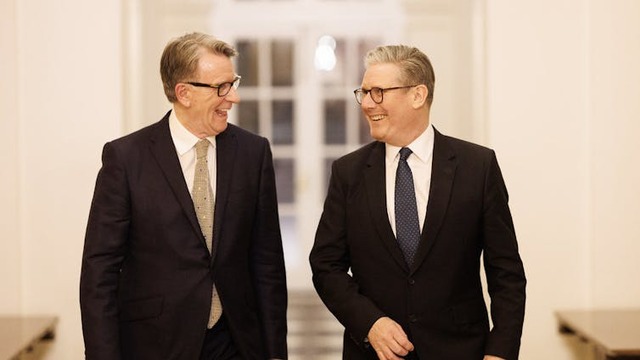
Mandelson had clearly started 2026 with the intention of rehabilitating himself and re-entering public life: a Sunday morning BBC interview, columns in the Spectator, an interview in the Times. Journalists’ requests for comment were replied to. No longer.
What was striking across these appearances – given Mandelson’s talents – was his maladroitness. Not to have apologised to the victims of trafficking when pressed in that initial high-profile interview, only to realise his error and concede the following day did not bear the hallmark of a master of public relations.
The rehabilitation plan, moreover, evidently did not include a strategy for the documents that were to be released as part of another huge cache of material relating to Epstein.
There is now the suggestion that Mandelson may have forwarded government-sensitive information to a foreign banker while he was, effectively, the deputy prime minister and that he encouraged that banker to intimidate his colleague, the chancellor of the exchequer, Alistair Darling. The banker allegedly did “mildly threaten” Darling. Darling knew someone was leaking, but, having died in 2023, never knew who. Now we have an idea.
To separate the procedural from the human, for now, the issue that leaves the current government most exposed is Starmer’s personal choice of Mandelson as US ambassador. One of two things must have happened: a catastrophic failure in vetting and in due diligence, or the government ignoring red lights from vetting and due diligence.
This is also an origin story scandal for the Labour party, in which Mandelson has deep roots. It has always lived in fear of its leaders succumbing to the charms of plutocrats. It happened in 1931, in the “great betrayal”, when Labour leader Ramsey McDonald formed a government with the Tories and Liberals to resolve a financial crisis – one reason the saintly Clement Attlee nationalised the Bank of England in 1946. Attlee’s deputy leader was Herbert Morrison, Mandelson’s grandfather.
This matters more now because Mandelson’s influence in the party meant that he has acted as a mentor to so many – not least the prime minister’s chief of staff, Morgan McSweeney, the man arguably more responsible for this government than Starmer himself, and the person said to have pushed for Mandelson to be given the ambassadorship. The fissures of the Blairites and the soft left are reopening.
Removing Mandelson
There will be those who take pleasure from so public a defenestration of so polarising a figure. Two such will be the Reform and Green party candidates in the Gorton and Denton byelection.
A room of scriptwriters could not have devised a situation calculated to land more effectively for a canvasser from an insurgent party to stand on a doorstep and asks a voter how satisfied they are with the way the country’s run, and in the qualities of their leaders.
Even before the revelations about his friendship with a billionaire paedophile, Mandelson was the personification of the increasingly maligned and resented globalist, lanyard-wearing, chauffeured classes. The online conspiracist hares that have already been sent running are unnecessary: this scandal is in no need of embellishment.
Some always knew. Mandelson masterminded Labour’s electoral approach for a decade, but when he succeeded Neil Kinnock as leader in 1992, John Smith would have nothing to do with him. Smith died suddenly, and Tony Blair’s sudden ascent was facilitated by Mandelson, to the undying enmity of Gordon Brown.
Brown appointed Mandelson his first secretary of state, but from a position of weakness. He is now making his fury known. The current prime minister appointed Mandelson his ambassador to the UK’s closest and most important ally, but from a position of weakness. Brown, at least, can vent his fury – he no longer has office to lose.
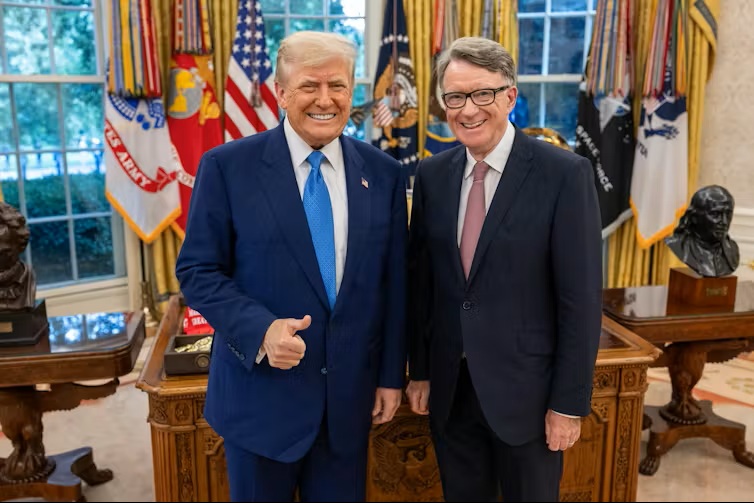
In the space of a few hours, Mandelson’s future shifted from the certainty of ignominy to the possibility of prison. We are already beyond historical parallel. For 60 years, John Profumo has been the yardstick for political scandal in the UK (and another where the exploitation of women was lost in a voyeuristic melee). We have a new one.
In other political cultures, Mandelson would by now have been airlifted to a safehouse outside Moscow or Riyadh, given sanctuary, never to be seen or heard of again. But the prime minister will be seeing and hearing of Mandelson for some time to come.
When it comes to making appointments – a prime minister’s elemental power – Starmer has frequently made the wrong choices, through innate caution and timidity, to the detriment of his government. It is the one exception to this cautious approach that may prove to be the most consequential of all.
Martin Farr, Senior Lecturer in Contemporary British History, Newcastle University
https://theconversation.com/republishing-guidelines —>
P.S.
• The Conversation. Published: February 3, 2026 5.31pm GMT.
This article is republished from The Conversation under a Creative Commons license. Read the original article.
• Martin Farr, Newcastle University
My research interests centre on British politics and public life since the First World War, biography, political parties, elections, government, and media. I welcome enquiries in these areas.
Most recently I’ve completed the writing of book chapters about Barack Obama and David Cameron, and Donald Trump and Theresa May, and Trump and Boris Johnson for the Palgrave Handbook of Presidents and Prime Ministers. Before that my most recent publications were a chapter on popular culture in 1960s Britain for a volume on imperial history, one on the 1970 General Election for a book marking the fiftieth anniversary of the Heath government, and another on Parliament and the death of Margaret Thatcher for a book about Thatcherism. I’ve two books contracted for publication in 2022: Margaret Thatcher’s World, an international history of Thatcherism, for De Gruyter, and Reginald McKenna: Statesman among Financiers, 1916-1943, the second (and final) volume of my biography, for Routledge. I have ’in progress’ one article which offers a comparative assessment of the deaths of Hugh Gaitskell (1963) and John Smith (1994), and another on the film version Oh! What a Lovely War (1969).
I’ve published on declinism and British coastal resorts, British mass tourism in the 1970s, the 1918 Reform Act and the House of Commons, and the Labour Party in the 1980s (in Labour and the Left in the 1980s). Other publications include the first volume of a political biography, and articles on British politics and strategy in the First World War, the 1918 General Election, and the Labour Party and strategic bombing in the Second World War. I’ve co-edited two volumes on the British abroad: Travellers and Tourists and Experiencing Imperialism, in the former of which I’ve a chapter on British mass tourism. In 2014 I was principal investigator for the North East and Cumbria on the AHRC/BBC project World War One at Home. I also interview former MPs for the History of Parliament Oral History Project.
I head Britain and the World, an international research association which has a peer-reviewed journal, book series, and an annual conference which alternates between the US and the UK
• The Conversation is a nonprofit news organization dedicated to helping academic experts share ideas with the public. We can give away our articles thanks to the help of foundations, universities and readers like you. Donate Now to support research-based journalims


 Tomás Ó Flatharta
Leave a comment