Fascism in Ireland 1922 – 2025
Compared with most wealthy capitalist countries (for example Russia, the United States of America, Britain, France, Germany, the Netherlands) far-right racist politics have been late taking off in the two bits of Ireland in the early part of the 21st century. The article below – Irish Politics Affected by Fascism Since Partition in 1922 – provides useful context.
In my opinion it overlooks a critical reason for the relative weakness of racist poison in the 26 county bit of Ireland : the rise of a mass women’s liberation movement in Ireland since the 1960’s; collapse of the Catholic Church’s prestige and moral authority – especially since the early 1990’s – because of its criminal opposition to abortion, divorce, contraception, equal pay – and the institution’s role in systematic torture of women and babies in “homes”.
The 6 county bit of Ireland was not, strictly speaking, fascist – but this Orange State was “A Protestant State for a Protestant People” – and extreme right unionist parties have always shared racist and imperialist politics promoted by the British far-right.
Before the November 2025 Irish General Election far-right racist candidates hoped to build on a relatively significant breakthrough in the June 2025 European and Local Elections. However, a hero of Irish women, Nikita Hand, took a legal case, alleging violent rape, against the prominent kick-boxer racist Conor McGregor in October and November 2025.
More details here :
During the election campaign a woman called Nikita Hand took a legal civil action, alleging rape, against an international celebrity, the kick-boxing superstar Conor McGregor. McGregor is closely associated with a number of mini-Hitler racists, some of whom were elected to Dublin council seats in June 2024. These included Philip Sutcliffe (Dublin South-Central) and Paddy Holohan (Dublin South-West). Most rape trials in Ireland are held behind closed doors, and the details are not widely broadcast.
Link :
Irish General Election November 29 2024 – Return of a Fianna Fáil-Fine Gael Coalition – Setback for the Left
John Meehan April 28 2025
Irish Politics Affected by Fascism Since Partition in 1922
The Dublin riots, which caused an estimated €20 million worth of damage in November 2023, the violence that surrounded some of the protests in July last year and the week-long rioting in Belfast following the Southport stabbings shocked the political establishment in Ireland and the wider world. For decades there has been a political myth that Ireland is one of the few countries to have escaped the influence of fascist and far-right politics. The reality is that Ireland and Irish politics have been affected by fascism since the ideology first emerged a century ago.
The first apostles of fascism in Ireland were the Fascio di Dublino Michele D’Angelo, a tiny but influential group among the 200-strong Italian-Irish community in Dublin, who organised Ireland’s first fascist group within weeks of Mussolini coming to power during the march on Rome in October 1922. However, these Italian fascists never sought to influence domestic Irish politics outside their own community. They generally kept a low profile except for annual public appearances in Armistice Day parades to celebrate the end of the First World War and private appearances at the Italian embassy each year to mark the anniversary of the march on Rome. A far more substantial threat to the stability of Irish politics was the Dublin-based Free State Command of the British Fascisti established in the last weeks of the Irish Civil War in May 1923. The British Fascisti, which later changed its name to the simpler and more patriotic-sounding British Fascists, was founded by an English woman named Rotha Lintorn-Orman. She believed that Irish republicans, Russian communists and Indian nationalists were all part of a secret global Jewish conspiracy to destroy Christianity and the British Empire. The group was active across Ireland between 1923 and 1934, and Protestant loyalists in Dublin, Belfast and Coleraine flocked to its ranks. Many of them were former British Army officers, Royal Irish Constabulary constables, Black and Tans, and B-Specials who had fought against the IRA in the War of Independence. One of their most infamous members was Ormonde Winter, a convicted child killer and former chief of British intelligence in Ireland from 1920 to 1921. Another was William Joyce, a man from Galway who had been an informer for the British Army during the War of Independence and who was later hanged for broadcasting propaganda from Nazi Germany under the moniker “Lord Haw-Haw”. The British Fascists fell apart as an organisation in 1935 with the death of Lintorn-Orman and the defection of many of its members to the British Union of Fascists (BUF), which was founded by Oswald Mosley a few years earlier.
Unusually for a British fascist and ardent imperialist, Mosley had a keen interest in and understanding of Irish politics. He founded a puppet organisation of the BUF in Belfast named the Ulster Fascists. The group’s aim was to unite nationalist Irish Catholics with loyalist Ulster Protestants in a united Ireland that would form part of a new fascist alliance within the UK and the wider British Empire, which had Mosley as its leader. The Ulster Fascists attempted to build an alliance with fascist groups in southern Ireland but as soon as this process began, the organisation was torn apart by internal debates over the constitutional status of Northern Ireland. Without doubt the most infamous fascist group in Irish politics was Eoin O’Duffy’s “Blueshirts”. Originally called the Army Comrades Association, the Blueshirts were founded as a veterans’ organisation for soldiers who had fought in the Free State Army during the Irish Civil War.
The association quickly graduated from traditional Irish conservative Catholic-nationalism to openly embrace and adopt the wave of fascist politics and Nazism that was sweeping Europe in the early 1930s. The association formally adopted a blue shirt as their official uniform in imitation of Hitler’s Brownshirts and Mussolini’s Blackshirts. In addition the group took on the fascist salute, greeting each other with their right arm extended at a diagonal angle while shouting “Hoch O’Duffy”. The Blueshirts merged with both the leading opposition Cumann na nGaedheal party and the National Centre Party to form Fine Gael. In its early years with O’Duffy as its leader the Fine Gael party espoused fascism and waged a longstanding antisemitic campaign against Ireland’s Jewish community. In particular they harassed Bob Briscoe, an IRA veteran of Lithuanian descent, who was a Fianna Fail TD and the sole Jewish member of the Oireachtas. The leadership of Fine Gael and the Blueshirts included men like James Conroy, a former Free State army officer, who had murdered two Dublin Jews — Barnet Goldberg and Emanuel Kahn — in 1923 for the supposed “crime” of dating Catholic women. Others included the future taoiseach John A Costello, who in 1934 declared to the Dail: “The Blackshirts were victorious in Italy, Hitler’s Brownshirts were victorious in Germany … and the Blueshirts will be victorious in Ireland.”
For decades the Fine Gael party has been in denial about its fascist origins, as evidenced by the current “History of Fine Gael” section of the party’s website, which simply reads: “Fine Gael has long been the major vehicle of innovative reform and new thinking in the Irish state, with a proud record of achievement, and with 30,000+ members is the largest political party in Ireland today.” The reality is that the founding members of Fine Gael who wore Blueshirt uniforms waged a lengthy terrorist campaign against the Irish government, An Garda Siochana and their IRA opponents. The Blueshirts plotted a fascist coup during the “March on Dublin”, waged numerous gun battles against both gardai and the IRA, and made several attempts to kill gardai, including an armed attack on a garda station in Kildorrery, Cork. The Blueshirts also killed a young IRA volunteer in Ennis named James Glynn, sparked widespread rioting in Irish cities and organised arson attacks that destroyed the homes of two Fianna Fail TDs. Furthermore they stockpiled illegal arms and explosives and led a campaign of harassment against the small urban Jewish communities in Cork and Dublin. Eventually rumours about O’Duffy’s closet homosexuality, his alcoholism and increasingly militant rhetoric proposing a Blueshirt invasion of Northern Ireland led to split between him and the Fine Gael party. O’Duffy died in political obscurity after leading his followers to Spain to fight alongside the Nazis on behalf of General Franco’s fascist regime. Throughout the Second World War Irish Nazi collaborators, including both former members of the British Fascists and IRA leaders like Seán Russell, hoped that a Nazi victory would lead to the realisation of their own disparate political aims.
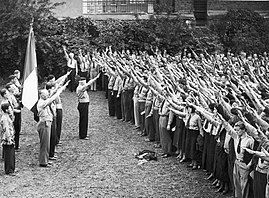
In the aftermath of the Second World War a variety of tiny neo-Nazi parties sprung up in Ireland but none managed to make any public impact and almost all of them broke up in obscurity, riven by criminality and infighting. Ireland remained largely free of far-right political groups until the late 2010s when the Mediterranean migrant crisis, the wave of refugees fleeing the Syrian civil war and global climate change led to the formation of several fringe far-right and neo-fascist parties. This was followed from late 2018 onwards with dozens of arson attacks on accommodation centres for refugees and asylum applicants. The re-emergent Irish far-right thrived during the Covid-19 pandemic and this led to large-scale far-right rallies in the capital and in regional Irish cities for the first time since the 1930s. During the pandemic there was an increasing collaboration between fundamentalist Catholics, antivaxers, conspiracy theorists, Holocaust deniers, closet neo-Nazis and other disparate far-right groups. The traditional left-wing opposition to such rallies was largely absent in compliance with the national healthcare restrictions then in place, while gardai in most instances ignored the frequent breaches of healthcare regulations by the far-right and the emergent threat posed by their increasingly violent actions. Today far-right violence is increasingly encouraged and promoted not by formal far-right political parties but through their propaganda being spread by YouTubers, so-called citizen journalists, conspiracy theorists and influencers. In some cases this has resulted in far-right agitators from Dublin travelling to Belfast to join loyalist-led anti-immigration rallies, thereby achieving for the first time the green-orange, far-right unity that Mosley had failed to achieve a century earlier.
Though Ireland is one of the few countries in Europe not to have succumbed to fascism in the 20th century, we as Irish people have to realise that we do not have an intrinsic immunity to fascism and Nazism. The fact that a small but growing and increasingly extreme far-right and fascist-inspired fringe continues to haunt Irish politics, a century after fascism’s first manifestations in Dublin, should be of concern to all those who value democracy and freedom in Ireland. To quote Frederic Mullally, the British journalist and anti-fascist: “To not take the threat of the fascist resurrection seriously is to turn our backs with a shrug of indifference, on the foul inhumanity of Belsen and Buchenwald, on the memory of millions of innocent men, women and children fiendishly butchered on the high altar of fascism.”
Burn Them Out! A History of Fascism and the Far Right in Ireland by Pádraig Óg Ó Ruairc is published by Bloomsbury Head of Zeus and is available from bookshops now. It was launched by Dr Brian Hanley of Trinity College at Hodges Figgis, Dawson Street in Dublin on Tuesday, April 15.
Link :


 Tomás Ó Flatharta
Leave a comment