Archive for the ‘Venezuela’ Category
Democratic centralism & broad left parties: from 2008
Democratic centralism & broad left parties
- Republished by Socialist Resistance, March 23, 2013
This document by the British group Socialist Resistance was first published in 2008 and addresses the question of the type of organisations socialists need to build now. At a new and even stronger pulse of the same debate, it is timely that it has been re-published now, a statement of Socialist Resistance’s views on the questions of broad parties and internal regime which are very relevant to the debates now happening on the left.

Tin pots are only useful sometimes
Since the beginning of the decade important steps have been made in rebuilding the left internationally, following the working class defeats of the ‘80s and ‘90s and the negative impact of the collapse of the Soviet Union. Starting with the demonstrations against the World Trade Organisation conference in Seattle at the end of 1999, an important global justice movement emerged, which fed directly into the building of a massive anti-war movement that internationally dwarfed the anti-Vietnam war movement in the 1960s. These processes breathed fresh life into the left, as could be seen already at the Florence European Social Movement in 2002 where the presence of the Rifondazione Comunista and the tendencies of the far left was everywhere. In addition, the massive rebirth of the left and socialism in Latin America has fuelled these processes.
However unlike the regrowth and redefinition of the left symbolised by the years 1956 and 1968, in the first decade of the 21st century things were much more difficult objectively, with the working class mainly on the defensive. Multiple debates on orientation and strategy have started to sweep the international left, leading to a reconfiguration of the socialist movement in several countries.
Positive aspects of this process include historic events in Venezuela and Bolivia (with all their problems), the emergence of Die Linke – the Left party – in Germany, the Left Bloc in Portugal and indeed new left formations in many countries.
In other countries the left redefinitions have been decidedly mixed. For example the Sinistra Critica (Critical Left) went out of the Communist Refoundation in Italy, over the fundamental question of the latter’s support for Italian participation in the Afghanistan war and neoliveral domestic policies. In Brazil a militant minority walked out of the Workers Party (PT) to found the Socialism and Liberty Party (PSOL), over the central question of the Lula government’s application of a neoliberal policy which made a mockery of the name of the party. This splits, for sure, represented a political clarification and an attempt to rescue and defend principled class struggle politics. But the evolution of the majority in both the PT and Communist Refoundation are of course massive defeats for the left.
So, in many countries debates are opening up about what kind of left we need in the 21st century. This is of course normal; each successive stage of the international class struggle, especially after world historic events of the type we have seen after 25 years of neoliberalism, poses the issue of socialist organisation anew. It is absurd to imagine that it is possible to take off the shelf wholesale texts written in Russia in 1902 or even 1917, and apply them in an unmediated way in 2007. Even less credible is the idea of taking the form of revolutionary organisation and politics appropriate for Minneapolis in 1934(1) and simply attempting to extrapolate it in a situation where revolutionary politics has been transformed by central new issues (of gender and the environment in particular); where the working class itself has been transformed in terms of its cultural level, geographical distribution and political and trade union organisation; and where the experience of mass social movements and the balance sheet of Stalinism (and social democracy) has radically reaffirmed the centrality of self-organisation and democracy at the heart of the revolutionary project.
As we shall discuss in more details below, it is now obvious that the models of political organisation and habits of engagement with the rest of the left, adopted by some self-proclaimed Trotskyist organisations (like Gerry Healy’s SLL-WRP) were strongly pressurised by third period Stalinism and organisational methods and assumptions inherited from the Stalinised Comintern. No section of British Trotskyism was entirely unaffected by this pressure.
Against this background the split in Respect might not seem too unusual. But there is something special about it, considered on an international level. While there were no principled questions of politics involved (as there were in Italy and Brazil), nevertheless the main revolutionary organisation involved, the SWP, managed to alienate almost the totality of others forces within the movement. This is a spectacularly unfavourable result for a revolutionary organisation and one that cannot be explained by the myth of an anti-socialist “witch-hunt”. Something much more fundamental in politics is involved.
Revolutionary Socialism and ‘broad left parties’
As noted above, the experience of building broad left parties internationally has been decidedly mixed; in some cases they have slid to the right and ended up supporting neoliberal governments. For some on the revolutionary left, what we might call the ‘clean hands and spotless banner’ tendency, this shows that attempts at political recomposition are a waste of time. Far better to just build your organisation, sell your paper, hold your meetings, criticise everyone else and maintain your own spotless banner. But underlying this simplistic approach is actually a deeply spontaneist conception of the revolutionary process. This generally takes the form of the idea that “under the pressure of events”, and after the revolutionary party has been “built”, the revolutionary party will finally link up with big sections of the working class. With this comforting idea under our belts we can be happy to be a very small (but well organised) minority and be sanguine about the strength of the right and indeed the far right.
In our view this simplistic “build the party” option is no longer operable; indeed it is irresponsible because it inevitably leaves the national political arena the exclusive terrain of the right. In the era of neoliberalism, without a mass base for revolutionary politics but with a huge base for militant opposition to the right, it seems to us self-evident the left has to get together, to organise its forces, to win new forces away from the social-liberal centre left, to contest elections and to raise the voice of an alternative in national politics. This is what has been so important about Die Linke, the Left Bloc, the Danish Red-Green Alliance and many others.
This was the importance of the Workers Party in Brazil and the Communist Refoundation in Italy at their height: that they articulated a significant national voice against neoliberalism that would have been impossible for the small forces of the revolutionary left.
More than that: the very existence of these forces, at various stages, had an important impact on mass mobilisations and struggles – as for example Communist Refoundation did on mobilising the anti-war movement and the struggle against pension reform in Italy. The existence of a mass political alternative raises people’s horizons, remoralises them, brings socialism back onto political agendas, erects an obstacle to the domination of political discourses by different brands of neoliberalism and promotes the struggle. It also acts as a clearing house of political ideas in which the revolutionaries put their positions.So with a broad left formation in existence everyone is a winner – not!
No broad left formation has been problem free. For revolutionaries these are usually coalitions with forces to their political right. They are generally centres of permanent political debate and disagreement, and they pose major questions of political functioning for revolutionary forces, especially those used to a strong propaganda routine. They inevitably involve compromises and difficult judgements about where to draw political divides.
What an orientation towards political regroupment of the left does not involve is a fetishisation of a particular political structure, or the idea that broad left parties are the new form of revolutionary party, or the notion that these parties will necessarily last for decades. For us they are interim and transitional forms of organisation (but see the qualification of this below). Our goal remains that of building revolutionary parties. It’s just that, as against the ‘clean hands and spotless banner’ tendency, we have a major disagreement about what revolutionary parties, in the 21st century, will look like – and how to build them.
The functioning of revolutionaries in broad left parties
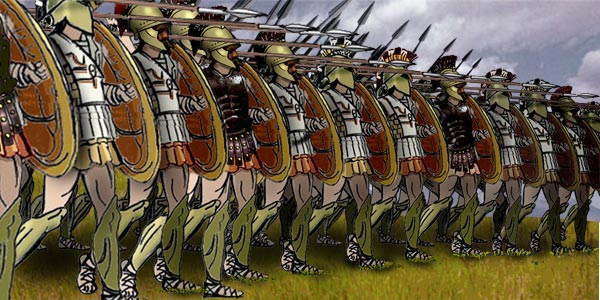
Do we still need Phalanxes?
Broad left parties (or alliances) are not united fronts around specific questions, but political blocs. For them to develop and keep their unity, they have to function according to basic democratic rules. However this cannot be reduced to the simplistic notion that there are votes and the majority rules. This leaves out of account the anomalies and anti-democratic practices which the existence of organised revolutionary currents can give rise to if they operate in a factional way. On this we would advance the following general guidelines:
- Inside broad left formations there has to be a real, autonomous political life in which people who are not members of an organised current can have confidence that decisions are not being made behind their backs in a disciplined caucus that will impose its views – they have to be confident that their contribution can affect political debates.
- This means that no revolutionary current can have the ‘disciplined Phalanx’ concept of operation. Except in the case of the degeneration of a broad left current (as in Brazil) we are not doing entry work or fighting a bureaucratic leadership. This means in most debates, most of the time, members of political currents should have the right to express their own viewpoint irrespective of the majority view in their own current. If this doesn’t happen the real balance of opinion is obscured and democracy negated. Evidently this shouldn’t be the case on decisive questions of the interest of the working class and oppressed – like sending troops to Afghanistan. But if there are differences on issues like that, then membership of a revolutionary current is put in question. One can also imagine vital strategic and sometimes important tactical questions on which a democratic centralist organisation might want its members all to vote the same way. But these should be exceptional circumstances and not the norm. In practice, of course, on most questions most of the time members of revolutionary tendencies would tend to have similar positions.
- Revolutionary tendencies should avoid like the plague attempts to use their organisational weight to impose decisions against everyone else. That’s a disastrous mode of operation in which democracy is a fake. If a revolutionary tendency can’t win its opinions in open and democratic debate, unless it involves fundamental questions of the interest of the working class and oppressed, compromises and concessions have to be made. Democracy is a fake if a revolutionary current says ‘debate is OK, and we’ll pack meetings to ensure we win it’.
- Revolutionaries – individuals and currents – have to demonstrate their commitment and loyalty to the broad left formation of which they are a part. That means prioritising the activities and press of the broad formation itself. Half in, half out, doesn’t work.
- We should put no a priori limits on the evolution of a broad left formation. Its evolution will be determined by how it responds to the major questions in the fight against imperialism and neoliberal capitalism, not by putting a 1930s label on it (like ‘centrism’).
- The example of the PSoL in Brazil shows it is perfectly possible to function as a broad socialist party with several organised militant socialist currents within it. The precondition of giving organised currents the right to operate within a broad party is that they do not circumvent the rights of the members who are not members of organised currents.
The SWP’s ‘democratic centralism’ – national and international
Readers will note that the above series of considerations is exactly how the SWP did not function in Respect. It is a commonplace that those who function in factional and bureaucratic ways in the broader movement generally operate tin pot regimes at home. There are strong reasons for thinking that the version of ‘democratic centralism’ operated by the SWP is undemocratic. This is not just a matter of rules and the constitution, but there are problems there as well.
- Decision-making in the SWP is concentrated in an extremely small group of people. The SWP Central Committee is around12 people, a very small number given the size of the organisation. Effective decision making is concentrated in three or four people within that.
- Political minorities are denied access to the CC. At the January 2006 conference of the SWP long-time SWP member John Molyneaux put forward a position criticising the line of the leadership, but his candidacy for the CC was rejected because it would “add nothing” to CC discussions.
- Tendencies and factions can only exist during pre-conference periods. This effectively makes them extremely difficult to organise. In any case, political debates and issues are not confined the SWP leadership’s internal timetable.
- There is no real internal bulletin and little internal political discussion outside of pre-conference period. Real discussion is concentrated at the top.
- As the expulsions of Nick Wrack, Rob Hoveman and Kevin Ovenden show, the disciplinary procedure is arbitrary and can be effected by the CC with no due process or hearing in which the accused can put their case.
In his contribution to the SWP’s pre-conference bulletin John Molyneaux said:
“…the nature of the problem can most clearly be seen if we look at the outcome of all these meetings, councils, conferences, elections, etc. The fact is that in the last 15 years perhaps longer) there has not been a single substantial issue on which the CC has been defeated at a conference or party council or NC. Indeed I don’t think that in this period there has ever been even a serious challenge or a close vote. On the contrary, the overwhelming majority of conference or council sessions have ended with the virtually unanimous endorsement of whatever is proposed by the leadership. Similarly, in this period there has never been a contested election for the CC: ie, not one comrade has ever been proposed or proposed themselves for the CC other than those nominated by the CC themselves. It is worth emphasising that such a state of affairs is a long way from the norm in the history of the socialist movement. It was not the norm in the Bolshevik Party or the Communist International. before its Stalinisation. It was not the norm at any point in the Trotskyist tradition under Trotsky.”
John Molyneaux put all this down to the nature of the period and the low level of the class struggle in the 1980s and 1990s. It is from obvious that this is true. Its root cause is the conception of ‘democratic’ centralism that the SWP have.
We could note at this point that the SWP’s internal regime is the polar opposite of that of a similarly sized, but much more influential, organisation, the LCR in France, where the organisation of minorities and their incorporation in the leadership is normal. In fact the SWP’s supporters in France have gone into the LCR and form a…permanent faction, Socialism Par en Bas (SPEB) that would of course be banned inside the SWP itself!
Equally the functioning of the international tendency that the SWP dominates – the IST – is dominated by a notion of ‘international democratic centralism’ in which the SWP takes upon itself the right to boss other ‘sections’ around, down to the smallest, detailed tactic. This, unsurprisingly, results in splits with any organisation that develops an autonomous leadership with a minimum of self-respect. So for example the SWP split on no principled basis at all with its Greek and US sections in 2003 – expulsions that were carried out by the Central Committee of the SWP, and only confirmed as an afterthought by a hastily-summoned meeting of the IST.
There is an irony in all this. Up until the late 1960s the International Socialists – precursor organisation of the SWP – maintained a sharp critique of ‘orthodox Trotskyism’, not least in regard to its organisational methods. IS members tended to see Leninism as being, at least in part, ‘responsible’ for Stalinism, and instead counterposed ‘Luxemburgism’ against ‘toy Bolshevism’. After the May-June events in France, Tony Cliff adopted Leninism and wrote a three-volume biography of Lenin to justify this. The irony consists in the fact that the version of Leninism that Cliff adopted became, over time, clearly marked by the bowdlerised version of Leninism that the IS originally rejected.
Opposed conceptions of the left
There is a false conception of the configuration of the workers movement and the left, a misreading of ideas from the 1930s, that is common in some sections of the Trotskyist movement. This ‘map’ sees basically the working class and its trade unions, the reformists (Stalinists), various forms of ‘centrism’ (tendencies which vacillate between reform and revolution) and the revolutionary marxists – with maybe the anarchists as a complicating factor. On the basis of this kind of map, Trotsky could say in 1938 “There is no revolutionary tendency worthy of the name on the face of the earth outside the Fourth International (ie the revolutionary marxists – ed)”.
If this idea was ever operable, it is certainly not today. The forms of the emergence of mass anti-capitalism and rejection of Stalinism and social democracy has thrown up a cacophony of social movements and social justice organisations, as well as a huge array of militant left political forces internationally. This poses new and complex tasks of organising and cohering the anti-capitalist left. And this cannot be done by building a small international current that regards itself as the unique depository of Marxist truth and regards itself as capable of giving the correct answer on every question, in every part of the planet (in one of its most caricatured forms, by publishing a paper that looks suspiciously like Socialist Worker and aping every tactical turn of the British SWP).
The self definition of the Fourth International and Socialist Resistance is very different to that. We have our own ideas and political traditions, some of which we see as essential. But we want to help refound the left, together with others, incorporating the decisive lessons of feminism and environmentalism, in a dialogue with other anti-capitalists and militant leftists. One that doesn’t start by assuming that we are correct about everything, all-knowing and have nothing to learn, especially from crucial new revolutionary experiences like the Bolivarian revolution in Venezuela.
Today the ‘thin red line of Bolshevism’ conception of revolutionary politics doesn’t work. This idea often prioritises formal programmatic agreement, sometimes on arcane or secondary questions, above the realities of organisation and class struggle on the ground. And it systematically leads to artificially counterposing yourself to every other force on the left.
Against this template, the SWP is Neanderthal, a particular variant of the dogmatic-sectarian propagandist tradition that has been so dominant in Britain since the early 20th century. It is time that its members demanded a rethink.
Postscript: ‘Leninism’
In his interview on Leninism in International Viewpoint, Daniel Bensaid points out that the word itself emerged only after the death of Lenin, as part of a campaign to brutally ‘Bolshevise’ the parties of the Comintern – ie subordinate them to the Soviet leadership.
For us the name, the word, is unimportant. What is important is to incorporate what is relevant today in the thinking of great socialist thinkers like Lenin, Trotsky, Luxemburg and Gramsci. Lenin was far from being a dogmatist on organisational forms; from him we retain major aspects of his theoretical conquests on imperialism and national self-determination, the self-organisation of the working class, the notions of revolutionary crisis and strategy, and his critique of the bureaucracy in the workers movement and social democratic reformism.
All these great thinkers were prepared to change their forms of organisation to suit the circumstances; the unity of revolutionary tendencies is not guaranteed by organisational forms, but by programme and a shared vision of the revolutionary process. Thus we reject the idea that by our ideas about left regroupment we are ‘abandoning Leninism’, any more than we are abandoning Trotskyism or what is relevant in the ideas of Rosa Luxemburg. What we are abandoning, indeed have long abandoned, is the template method that sees Leninism as a distinct set of unvarying organisational forms.
We repeat: some of these organisational forms, including a monopoly of decision-making by a tiny central group with special privileges (often of secret information and un-minuted discussion) – came from a beleaguered Trotskyist movement, that inherited many of its organisational forms wholesale from the Stalinised Communist International. You can’t understand the Healy movement without the Communist Party of Great Britain or the French ‘Lambertists’ without the immense pressure of the French Communist Party. The brutal ‘Leninism’ of the Communist Parties and the importation of aspects of its practices into the dogmatic-sectarian Trotskyist organisations we do indeed repudiate.
(1)This is a reference to the American Socialist Workers Party, which played a central role in the Teamster Rebellion in Minneapolis in 1934. The US SWP led by James P. Cannon had a massive impact on British Trotskyism, not least through Cannon’s organisational textbooks The Struggle for a Proletarian Party and History of American Trotskyism.


 Tomás Ó Flatharta