Archive for the ‘Ireland’ Category
Several Trade Unions Opposing Household Tax
THE SECOND-LARGEST trade union in the State has urged its members not to pay the household charge.
Unite yesterday called on its 60,000 members not to register for the charge ahead of the March 31st deadline.
Unite was among several trade union groups which yesterday voiced their opposition to the €100 household charge.
“We are urging people not to register and will stand beside those who are willing to show courage and resist the charge,” spokesman Rob Hartnett said at a press conference.
The Dublin Council of Trade Unions welcomed the campaign against the charge and supported “efforts of the organisers to encourage people not to register and not to pay”, Des Derwin of the umbrella body noted yesterday.
The executive of the council took up the position at its February meeting, he said. The body represented most trade unions in Dublin but not all unions have taken up this position, he added.
http://www.irishtimes.com/newspaper/ireland/2012/0321/1224313641895.html
Austerity in Europe: Susan George on the rise of neoliberal and undemocratic Europe
Susan George interviewed for the Transnational Institute (TNI). Posted at Links International Journal of Socialist Renewal.
March 1, 2012. Text printed below video. Video posted here from YouTube.
What is the continuity you see between the Maastricht Treaty, through the Lisbon Agenda and the Lisbon Treaty, to the “six pack” and now this new fiscal treaty?
The Maastricht Treaty was a treaty that presented two completely arbitrary figures: 3 per cent budget deficit with regard to the GNP and 60 per cent for the debt. Why not 4 per cent or 2 per cent? Why not 55 or 65 per cent? Nobody knows. They came out of the sky, those numbers, doubtless from the Bundesbank. But they have become sort of religious symbols, the holy numbers of Maastricht. That was the first effort to get government policy under control, but countries did not respect that, including Germany
When the time of Lisbon came, we’d rather stopped talking about that. Lisbon was about different issues. When people read that treaty (which they did in France, it was the biggest debate we’ve had since May ‘68) — and realised what was actually in the European treaties, they were horrified.
There were innumerable issues in that treaty which people were opposed to: that we were going to be forever under the command of NATO with the US president as commander-in-chief; all the economic detail and other issues in France which made people frightened of laïcité — secularism. But above all, people understood often for the first time that the entire economic program of the EU was, and always had been, completely neoliberal and put “free and undistorted competition” and the free market way above social protection.
In France, we had a huge campaign based on about 1000 collectives that sprung up all over the country, but nobody in the establishment expected us to win. We started off with 70 per cent for the yes, 30 per cent for the no. That is probably why they let us have a referendum. And we voted 55 per cent no. The establishment was furious. All of the major media, most of the politicians, they were stunned and they were furious. And they said in private, never again.
So what happened after that? After the French and the Dutch had voted against this treaty in no uncertain terms (the Dutch vote was 60 per cent against), they got into a very secret group. They had a small committee writing a new treaty, making it even more complicated. They drafted the Lisbon Treaty with the help of the top judicial experts of the commission. It was completely opaque as a process. There were no elected representatives in the group that wrote it. And they simply took the constitution that we had defeated threw out the anthem and the flag and a couple of other little trimmings. But as Valéry Giscard d’Estaing said — and he was the chief architect of the constitution — they have made cosmetic changes to make it easier to swallow. And every other official, including Germany’s Angela Merkel, said this is exactly the same thing as the constitutional treaty. Nothing has changed. And many, many other officials said that including Baroso, the president of the commission.
So here we have the Lisbon Treaty, we’re not allowed to vote on it because obviously we’re going to vote the wrong way. It was made clear that no one will have a referendum — except for Ireland. Gallant little Ireland, has in its constitution that it must have a referendum every time there is a change in the European constitution. And we should all have that provision. The European Constitution and the European legislation provides 80-85 per cent of our national legislation, it just gets transferred into national law. Therefore, when you are under the control of a non-democratic Europe, this is very serious because that is going to be transposed into your own national law.
Fortunately, I had the good luck to be asked by the Irish to help them in fighting against the Lisbon Treaty. Again, we won. It was fantastic! Starting from a very low level, and then for one reason or another, people understood what it was about. They said no, even though it was extraordinarily complicated to read.
And so, they didn’t vote correctly either. They had to be disciplined; they had to be told to vote again. By that time the crisis had broken, and the Irish were more or less told that if you don’t vote right this time and say yes, then you are going to be in very deep trouble, you are not going to get any loans and you are not going to get any help coming out of the crisis. So they dutifully went back to the polls and voted yes.
Why do we have to have, in addition to all of this, what is called the “six pack“, and now a new treaty that we should just call the “austerity treaty” (it has a much longer name but forget that, it’s the austerity treaty). Why do we need this? We need it because Germany, principally, and a few other countries, want this engraved in stone. They want those Maastricht numbers, that people were not paying attention to, engraved in marble: 3 per cent budget deficit allowable maximum, 60 per cent debt allowable maximum. This means that member states are going to lose one of their principal powers in national sovereignty — the power over their own finances. They are not going to be able to control that because it is all going to be controlled by Brussels.
We have a serious problem with this because Brussels wants austerity. What does that mean? Austerity simply means that there is going to be an attack on every measure that has been passed before and since World War II to give ordinary people, workers, ill people, children, old people the benefits that they fought for and won over the last 50 to 100 years. It is that serious!
We do have higher debts, and we do have budget deficits, but the European Commission and the governments are pretending that these deficits exist because we have been “living beyond our means”. That is not the case. It is not because old people have been getting their cheques for retirement or the unemployed have been receiving compensation. It has nothing to do with social spending.
We have deficits because when the crisis came, our governments had to spend huge amounts to bail out the banks. They had to confront a drop in GNP of about 5 per cent — which is a lot of money. They had to try to compensate for that which also costs a lot of money. And since there was more unemployment, they were not receiving the tax income that they were used to receiving. That was a drop in the income with an increase in the expenditures. And since they won’t tax the rich either, there was no money in the till.
What do they do? They say, ah, it is up to the people to pay. So what has happened is that the banks have contributed zero, they are not being asked to make sacrifices at all. We are punishing the innocent, the people who are supposed to pay through austerity, and we are rewarding the guilty because the banks are continuing to receive huge privileges and subsidies from our governments.
That is why we must defeat this fiscal compact, this austerity treaty, and all the measures that come with it unless we want Europe to be retrograded to, shall we say, the 19th century. That’s what it is about.
[Susan George is a TNI fellow, president of the board of TNI and honorary president of ATTAC-France (Association for Taxation of Financial Transaction to Aid Citizens).]
Violent Legacy of Irish Troubles, British Double-Standards – Boston College Row Revisited
Ed Moloney’s Irish Echo Editorial (an Irish-American Newspaper) on the Boston tapes controversy is required reading for all people genuinely interested in dealing with the violent legacy of the Northern Ireland Troubles (1969-1998, signing of the Good Friday Agreement).
Two key quotes :
Number 1 :But the war has now ended, peace reigns and there is a desperate need for dealing with the past in a way that solidifies that peace and ensures an untroubled future.
The British have chosen a way that does the opposite. The Boston College subpoenas symbolize an approach to this issue based on revenge and the view that alleged combatants in that war should be dragged before the courts, convicted and jailed.
Number 2 :
There will be those, of course, who will say that if Gerry Adams did order Jean McConville’s “disappearance” then he deserves to be prosecuted. In a normal society, one ruled by a normal government, that would be a difficult argument to answer. But Northern Ireland is not, even with the peace process, a normal society and nowhere is this more evident than in the administration of justice.
The plain, undeniable fact is that there are double standards in the way justice is doled out in Northern Ireland.
Read, Circulate, and Act.


Slowly, but inexorably, the penny is dropping, both here in the United States as well as back in Ireland.
The Boston College subpoenas seeking access to oral history interviews with former IRA activists on behalf of the police in Northern Ireland are about the dumbest things that have ever happened in the long relationship between the United States, Britain and Ireland.
The difficulty is not how to describe why they are so dumb, but in counting the ways in which they are so dumb.
First of all, this is not the way in which to heal a conflict like that in the North of Ireland.
Over 3,000 people died and tens of thousands were scarred, physically and mentally, by a war that was undoubtedly one of the longest and most violent, if not the most violent in Irish history.
But the…
View original post 1,543 more words
A Government Starting to Crack? Are we over-optimistic?
Perhaps we are over-optimistic, – and the little voice should always say “optimism of the will, pessimism of the spirit” – we think that was Antonio Gramsci’s advice to activists – but it looks like the Kenny- Gilmore government is on the slide downwards towards a Cowen-Gormley meltdown – let’s hope!

By now most will have read the comments Leo Vardkar made about RTÉ, and I’ll get to them in a moment. But let’s start with his less than opportune timing as regards this remark:
He also said RTÉ was “encouraging people to break the law” by giving access to campaigners urging people not to pay the household tax. He claimed RTÉ would not give access to groups advocating that people refuse to pay the television licence fee.
Well perhaps they would if there was a campaign of mass non-payment on the TV license.
But what if instead of ‘law-breakers’ being the problem, the truth is the law itself is broken?
According to The Journal.ie
THE HIGH COURT has granted leave for a challenge to be made against the household charge because the necessary legislation and the statutory instruments are in the English language only – and have yet to be…
View original post 1,029 more words
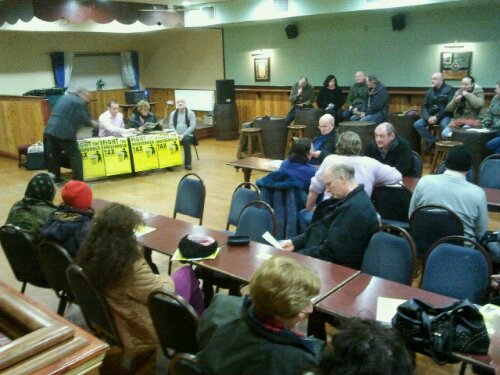
Phil Hogan gets go-ahead to use bills because of household tax mass boycott
Government admitting non-payment of household tax is supported by a vast majority of the population. Read below biased headline of a right-wing newspaper.
Vote No to Austerity Europe – No to the Treaty on Stability, Co-ordination and Governance – Platform of the Campaign Against the Austerity Treaty
Vote No to Austerity Europe – No to the Treaty on Stability, Co-ordination and Governance –
Platform of the Campaign Against the Austerity Treaty
The proposed new Treaty on Stability, Co-ordination and Governance in the Economic and Monetary Union– in reality an Austerity Treaty – is an undemocratic attempt to institutionalize austerity across Europe. Its ‘Fiscal Compact’ would deny the right of Member State governments to run a ‘structural’ budget deficit of more than 0.5%. This would remove the democratic right of national parliaments to decide national budgets, with that power shifting to the unelected European Commission and European Court of Justice. This would be a fundamental transfer of power away from elected governments. We call for a ‘No’ vote in the referendum. Read the rest of this entry »


 Tomás Ó Flatharta