Archive for the ‘Ernest Mandel’ Category
An Irish Rising Day, November 17 2012 – “The great only appear great because we are on our knees. Let us rise!” – Jim Larkin
http://www.facebook.com/actiononx2012
The foundations of the right-wing Fine Gael / Labour Coalition are shaking, trembling, and rocking from side to side :
If it falls, good riddance
“Today a statue of “Big Jim” stands on O’Connell Street in Dublin. The inscription on the front of the monument is an extract in French, Irish and English from one of his famous speeches:
Les grands ne sont grands que parce que nous sommes à genoux: Levons-nous.
Ní uasal aon uasal ach sinne bheith íseal: Éirímis.
The great appear great because we are on our knees: Let us rise.The slogan, first used on the 18th century French radical paper Révolutions de Paris,[14] also appeared on the masthead of the Workers’ Republic, founded by James Connolly in Dublin in August, 1898. Originally the organ of the Irish Socialist Republican Party, this periodical later became the official organ of the Communist Party of Ireland, which was founded in 1921. The original slogan is usually attributed to Camille Desmoulins (1760–1794), the French revolutionary”
Today :
Mass protest is the only way to win change on abortion
http://www.thejournal.ie/readme/savita-protest-dublin-677586-Nov2012/
The November 17 Never Again Dublin Demonstration got huge media coverage in Ireland and abroad.
The Irish Times Reported :
It was headed by a giant banner which read “Never Again”, adorned with images of the 31-year-old Indian dentist.
Organisers of the Dublin march said about 20,000 people had turned out, but a Garda spokeswoman said they estimated the figure to be between 10,000 and 12,000.
http://www.irishtimes.com/newspaper/breaking/2012/1118/breaking3.html
Clare Daly TD spoke powerfully :
http://www.youtube.com/watch?feature=player_embedded&v=faZj8L5pqGw
See also this statement from the ULA TD’s Clare Daly and Joan Collins :
Labour and Fine Gael bear responsibility for death of woman who was denied abortion
– The crisis is triggered by 7 governments’ refusals to act on the 20-year-old 1992 Supreme Court X Case Abortion Judgment
– The crisis is caused by the preventable death of Savita Halappanavar – 20 TD’s voted for Clare Daly TD’s Bill to implement the X Case Judgment – 111 Members of the Leinster House Parliament – mainly Fine Gael and Labour Government Deputies – voted against – Read the rest of this entry »
London conference: New parties of the left
On Saturday 29th September the British group Socialist Resistance organised a very interesting day of discussion in London on the new European, broad, pluralistic, left parties. It was a kind of update of their seminal conference on the same theme held in London in 2000. Minus one or two of the organisations that have since died or shrunk. As is common on the British left there was no cognisance of Ireland or the ULA in the published programme for the day.
It was also a kind of ‘film of the book’ of the uneven but instructive New Parties of the Left: Experiences from Europe (Resistance Books 2011).
Both Tomás and I were at the 2000 meeting but as it was a busy weekend I unfortunately could not travel to this meeting. Never mind, technology has since allowed us to attend meetings without actually going to them and many of the speeches were recorded and put up on the Socialist Resistance website. The actual line up seems to have departed slightly from the advertised billing.
Below is the line up for the day and then the filmed speeches in the rough chronological order in which I think they were delivered.
Des Derwin
New parties of the left
A day of debate organised by London Socialist Resistance
Saturday 29 September, 10:30am – 5pm
With Stathis Kouvelakis (Syriza), Kate Hudson (Respect), Adam Hanieh (author and activist), Sandra Demarcq (NPA – France), Andrew Burgin (CoR), Alan Thornett (Socialist Resistance), Michael Voss (Red Green Alliance – Enheidlisten, Denmark), and Phillipe Nadouce (Front de Gauche).
At ULU, Malet Street, London, WC1
stathis-kouvelakis-on-greece-6376827
kate-hudson-on-new-left-parties-6376775
denmark-s-red-green-alliance-6376835
the-radicalisation-in-the-arab-world-6376840
the-need-for-broad-parties-of-the-left-6376878
Book Launch – Ireland in the World Order, written by Maurice Coakley – Thursday September 20, 7.00pm, Teachers’ Club 36 Parnell Square West, Dublin 1
Invitation to a Dublin launch of a new book :
Ireland in the World Order, written by Maurice Coakley

Maurice Coakley focuses on key elements that contributed to Ireland’s development, examining its bloody and violent incorporation into the British state, its refusal to embrace the Protestant Reformation and failure to industrialise in the 19th century. Coakley considers the crucial question of why Ireland’s national identity has come to rest on a mass movement for independence.
Andy Storey will launch the book
Details :
Thursday September 20, 7.00pm, in the
Teachers’ Club 36 Parnell Square West, Dublin 1
Feel free to bring a friend
Ireland in the World Order examines Ireland’s development from the medieval to the modern era, comparing its unique trajectory with that of England, Scotland and Wales.
Maurice Coakley focuses on key elements that contributed to Ireland’s development, examining its bloody and violent incorporation into the British state, its refusal to embrace the Protestant Reformation and failure to industrialise in the 19th century. Coakley considers the crucial question of why Ireland’s national identity has come to rest on a mass movement for independence.
Cutting through many of the myths – imperialist and nationalist – which have obscured the real reasons for Ireland’s course of development, Ireland in the World Order provides a new perspective for students and academics of Irish history.
About The Author
Maurice Coakley lectures in the Journalism and Media Studies faculty of Griffith College, Dublin.
More information at this link :
Ireland in the World Order – by Maurice Coakley
Show Me The Money: Austerity Treaty – fact sheet from ULA Steering Committee member Eddie Conlon
Show Me The Money
The Yes side’s key argument is that if we don’t vote Yes, we will not be able to access ESM funds for a potential second bailout Therefore, they suggest, we will not be able to access any funds and the result will be a need to close the deficit gap in one year – hence more austerity.
They have been assisted by the media in turning this into the question of the debate, rather than debating the actual contents of the Austerity Treaty, the austerity it imposes, and the attack on democratic rights.
We need to be able to answer this question in such a way as to not turn it into the 18 billion euro question, and instead to turn the discussion back to austerity. When they say “show us the money” we should say “show us the cuts”.
The first thing we should say is:
- Seeking another bailout us an admission that government policy has failed. It is ludicrous of the government to tell us that we must take all of the pain associated with austerity so that we can get back to the markets and regain our sovereignty and at the same time tell us we must vote yes so that we can have another bailout and give up our sovereignty yet again. The need for another bailout is because austerity has failed. Therefore we need an alternative to austerity.
- A bailout will come at a cost. Firstly we are committed to providing €11b to the ESM if required. Secondly any money that comes from the fund will come with demands for more cuts, privatisation etc. As the Amendment to Art 136 says “The granting of any required financial assistance under the mechanism (ESM) will be made subject to strict conditionality”
But we should be clear that:
- The government has colluded in linking the treaty to the ESM
- It has a veto on the ESM.
- There are other sources of money if the government really wants them
- The EU has given commitment to further funding in the future perhaps for its own reasons.
- The government have colluded in linking the treaty to the ESM and is engaging in blackmail
The ESM Treaty was agreed unanimously at the European Council in February. Therefore the government did not oppose it. The government are presenting the link between the two treaties as an unfortunate reality. The link was not in the original ESM Treaty of July 2011. Read the rest of this entry »
The future of the workers of Europe is being decided in Greece (Statement of the Fourth International)
A key point :
Greece has become a laboratory for Europe. They are testing out on human guinea-pigs the methods which will then be applied to Portugal, Spain, Ireland, Italy and so on. The Greek people have revolted, in the workplaces, in the streets and at the ballot boxes, against these cruel policies.
Link to International Viewpoint article Here :
The future of the workers of Europe is being decided in Greece
SYRIZA or the magnificent breakthrough of a unique unifying and original experience
SYRIZA or the magnificent breakthrough of a unique unifying and original experience
| by Yorgos Mitralias | ||
| Translated by John Catalinotto | ||
A nightmare for “those on top,” a hope for “those on the bottom,” SYRIZA made a sensational debut on the political landscape of Europe in deep crisis. After quadrupling its electoral strength on May 6, SYRIZA now aims not only to become the largest party in Greece in the June 17 elections, but to be able to form a left-wing government which will repeal the austerity measures, repudiate the debt and chase the Troika out of the country. So it’s no surprise if SYRIZA fascinates many outside Greece, and if almost everyone is asking about its origin and true nature, its goals and ambitions.
SYRIZA, however, is not exactly a newcomer to the European left. Born in 2004, the Coalition of the Radical Left (SYRIZA) would have to attract the attention of political scientists and the international media, not least because from its beginning, it was a totally new and original type of political entity in the landscape of the Greek, European and even global left. Read the rest of this entry »
Syriza Member of Greek Parliament to Speak in Dublin on Thursday May 24 in Wynn’s Hotel, Abbey Street, 8pm – Supporting Campaign for a No Vote on the Austerity Treaty in the May 31 referendum
The Irish Government’s Finance Minister Michael Noonan explains the crisis in Greece by guessing how much feta cheese Irish people buy each week.
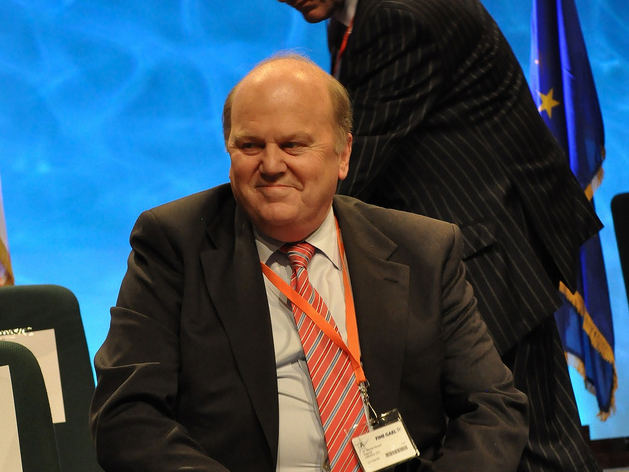
Let Them Eat Greek Cheese
Defending these comments he said :
I’m trying to stop contagion. It’s one of my jobs as finance minister to protect the Irish economy.
According to a well-researched article on politico.ie, Deputy Noonan has got that wrong too :
http://www.politico.ie/social-issues/8569-michael-noonan-there-he-goes-again.html
If you are in Dublin on May 24, come to the meeting addressed by the Syriza MP – we will publish more details as they become available.
International Viewpoint has published three contrasting articles called “What next for Greece?”


 Tomás Ó Flatharta