Western left campist fantasy of egalitarian China Jacobin Glorifies Leftist Yellowface, Ignores Chinese Perspectives in Article on “Chinamaxxing”
Western left campist fantasy of egalitarian China Jacobin Glorifies Leftist Yellowface, Ignores Chinese Perspectives in Article on “Chinamaxxing”
Jacobin Glorifies Leftist Yellowface, Ignores Chinese Perspectives in Article on “Chinamaxxing”
Source :
Western Left Campist Fantasy of egalitarian China
Brian Hioe reports :
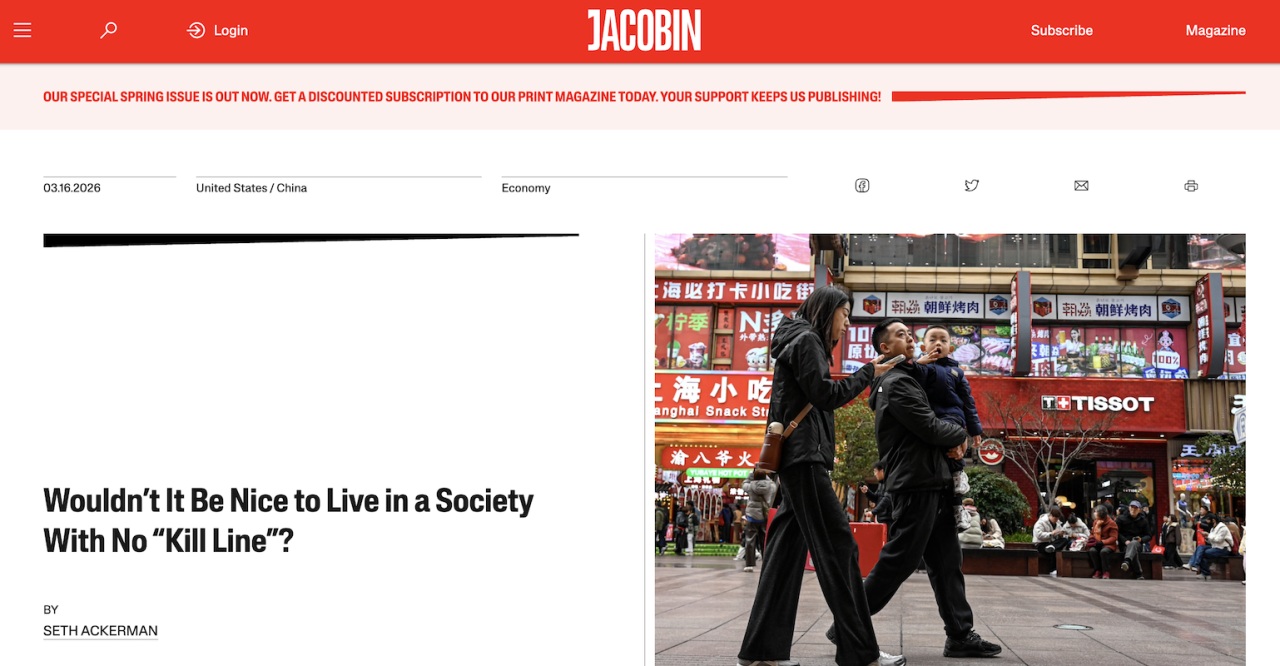
A RECENT ARTICLE in Jacobin by Seth Ackerman on “Chinamaxxing” again reveals the usual blind spots of Western leftists. Ackerman discusses the online phenomenon of “Chinamaxxing”–the recent turn of Gen Z teens on social media claiming that they are in a “very Chinese period of their life.” Gen Z teens have taken to mimicking Chinese cultural habits, such as taking off shoes indoors or drinking hot water. For Ackerman, this highlights the “kill line” in the US–that living conditions are desperate and marked by scarcity–that Gen Z Americans have turned toward imitating such cultural habits.
Brian Hioe
For one, Ackerman conveniently never discusses the racial projection at work, nor does it ever seem to occur to him that this is a form of culturalist Orientalism. It is, after all, hardly just a Chinese habit to take off shoes indoors. And one is hard pressed to find the connection between drinking hot water and remedies to stark socioeconomic inequality.
Indeed, it is not even as though the phenomenon of Chinamaxxing refers to Westerners deciding that they would prefer to see China’s system of economic governance in the West. Rather, it is Westerners deciding to criticize the social inequality of the West through a parody of what they imagine China to be like, pantomiming what they see as Chinese cultural habits. The phenomenon of westerners miming Chineseness has uncomfortable echoes of yellowface, in this sense.
Yet Ackerman then goes to blithely discuss Chinese reactions to the widening income gap in the US without ever interrogating that China might itself be a highly unequal society. Presumably, Ackerman owns consumer electronics, such as a smartphone, in order to work. In what country does he think that his iPhone was made?
After all, while Ackerman raises the reactions of some Chinese netizens to the so-called “kill line” in which the poor are abandoned to die in American society, or otherwise relegated to a meager paycheck-to-paycheck existence, China, too, is such a society. Electronics factories in China are such that in some factories, after a worker gets out of bed to work, another worker takes his place in the bed in order to maximize the use of space. Workers are routinely recruited from students. An ongoing controversy is that the monthly pension in China for 180 million elderly individuals living in rural areas is only 28 USD.
It is such that one has seen many terms, not unlike “kill line”, used to describe contemporary conditions in China. The term “996” (996工作制)–praised by American tech oligarchs such as Elon Musk–refers to the brutal work schedule in which tech workers are at the job six days a week, from 9 AM to 9 PM.
Likewise, the term “closed loop management system” (閉環管理) arose to describe conditions during COVID-19, in which factory workers were isolated and only allowed to travel between work and dormitories. This was to prevent the spread of COVID-19 while ensuring that factory lines could continue running. Dissatisfaction with China’s COVID controls led to the outbreak of the White Paper protests in 2022, with over a hundred arrested in its wake, many of which whose fate remains unknown.
It may not be surprising, then, that the migrants who end up working in factories have come to be termed a “low-end population” (低端人口) that is considered disposable by authorities. As such, one has seen migrant neighborhoods razed in China as part of evictions, even in major Tier 1 cities such as Beijing.
The extreme social pressure in China has led many to leave the country, as part of what has been termed “run-ology” (潤學)–in that individuals are literally seeking ways to run away from the country. Moreover, many young people have chosen to withdraw from the pressures of society and simply “lie flat” (躺平) instead of participating in the rat race, a practice that the state has criticized because this interferes with capitalist productivity.
Remarkably, it seems never to occur even once to Ackerman that he could have spoken to a Chinese leftist, activist, or academic for his piece. It proves remarkable that, in spite of Jacobin’s claim to emphasize working-class solidarity, the lived realities of those in China are excluded entirely from Ackerman’s argumentation. Realities in China are ignored in favor of rose-tinted projections. Rather than see Chinese as fellow members of the working class contending with harsh capitalist realities, they are only ever objects to project far-flung fantasies onto.
In this sense, Jacobin reveals that while it claims to advocate socialist politics, it only ever evaluates the world from the narrow, self-interested perspective of America rather than that of any global working class. Ironically, even from the self-interested perspective of the US, there hardly seems any way of overcoming capitalism on a country-to-country basis, without the unity of the international working class. There will hardly be any solution to global capitalism without the unity of the US and Chinese working classes against their shared enemies of capital and the state, rather than one side whitewashing the struggles of the other, through argumentation that glorifies the very same state that acts to defend the oppressive conditions faced by workers. Arguments such as Ackerman’s, then, only reveal how far Jacobin is from any solution.
Brian Hioe> is one of the founding editors of New Bloom. He is a freelance journalist, as well as a translator. A New York native and Taiwanese-American, he has an MA in East Asian Languages and Cultures from Columbia University and graduated from New York University with majors in History, East Asian Studies, and English Literature. He was Democracy and Human Rights Service Fellow at the Taiwan Foundation for Democracy from 2017 to 2018 and is currently a Non-Resident Fellow at the University of Nottingham’s Taiwan Studies Programme, as well as board member of the Taiwan Foreign Correspondents’ Club.


 Tomás Ó Flatharta
Leave a comment