Dishonesty of Many Campists About China – “Progressive International’s Adulation of “Whole-Process Democracy” Celebrates Capitalist Party-States”
Dishonesty of Many Campists About China – Progressive International’s Adulation of “Whole-Process Democracy” Celebrates Capitalist Party-States
Ashley Smith Comments :
The dishonesty and delusion of today’s campists about China is truly astonishing. In one publication, a couple of authors deny the mass repression and internment of Uyghurs. In another, two more embarrass themselves by celebrating the capitalist police state as a socialist democracy. How can this pass as Marxist analysis? How can anyone on the left take this seriously?
Ashley Smith facebook page
Brian Hioe writes :
Progressive International’s Adulation of “Whole-Process Democracy” Celebrates Capitalist Party-States
Say Nothing About Human Rights
A RECENT ARTICLE by Paweł Wargan and Jason Hickel, published by the Progressive International, is adulatory about what it claims to be “whole-process democracy” in China. Nevertheless, interrogating the claims of the article finds that these claims to be in themselves contradictory.
“Whole-process democracy” is a term that apologists of the Chinese Communist Party have increasingly embraced in past years, as a term to describe what they claim to be the superiority of the Chinese party-state. Supposedly, rather than serving as a means of social control, the party-state serves to concentrate the democratic will as part of what is termed “whole-process democracy” or the “mass line.”
Of course, this claim is fanciful. Almost every single state under the sun claims that its political system is one that most perfectly embodies the democratic will of the people–and yet many of these states are, of course, authoritarian.
Wargan and Hickel gesture in grandiose fashion toward the usual claims about the wonders of Chinese modernization, while suggesting that it is because of the people’s participation in “whole-process democracy” that this resulted in a development process in which the people’s will was respected. But there is little, if anything, to suggest that this is true in China.
Contemporary China is full of skyscrapers that tower over urban displacement, with urban landscapes proliferating with disenfranchised delivery drivers who are a permanent underclass that services the needs of the upwardly socially mobile. The CCP has, too, maintained a vast underclass of factory workers that service the needs of Western countries, as well as the domestic market, because this cements China’s integration into global capitalism, giving it its foothold on power. However long the authors go on about socialist democracy and how this is superior to Western capitalist democracy, it proves amazing to see that they seem to think the leadership of the CCP is not, in fact, composed of capitalists. One can look at the personal wealth of many CCP leaders to see proof to the contrary.
The authors, too, are fundamentally unable to link the growth that China has seen since the Chinese Revolution to the elan vital–the secret sauce–of Chinese Communism rather than, say, rapid growth due to catching up from conditions of uneven development. The authors claim, along the lines of apologia for the Soviet Union during its existence, that the superior economic growth of China compared to western countries shows the superiority of the Chinese system, never mind that this is a productivity, capitalistic metric, but fail to note that as China has met pace with the rest of the world, rates of growth are slowing in China.
One notes the authors’ claim that “the Chinese democratic process is in many ways more responsive and more participatory than Western models of liberal democracy.” But, remarkably, to prove this, the authors actually take as valid the claim that there are multiple political parties in China–never mind that only one party has ever held power in the People’s Republic of China (PRC). As flawed as liberal democratic apologist Samuel Huntington’s two turnover test is–the view that a country is democratic if it completes two peaceful transitions of political power after elections–the PRC could hardly ever see that.
The authors, too, claim that a flaw of Western democracies is that the public does not exercise democratic rights except during voting. Yet it is not as though the system that Wargan and Hickel outline is not even narrower than that.
The chart in question
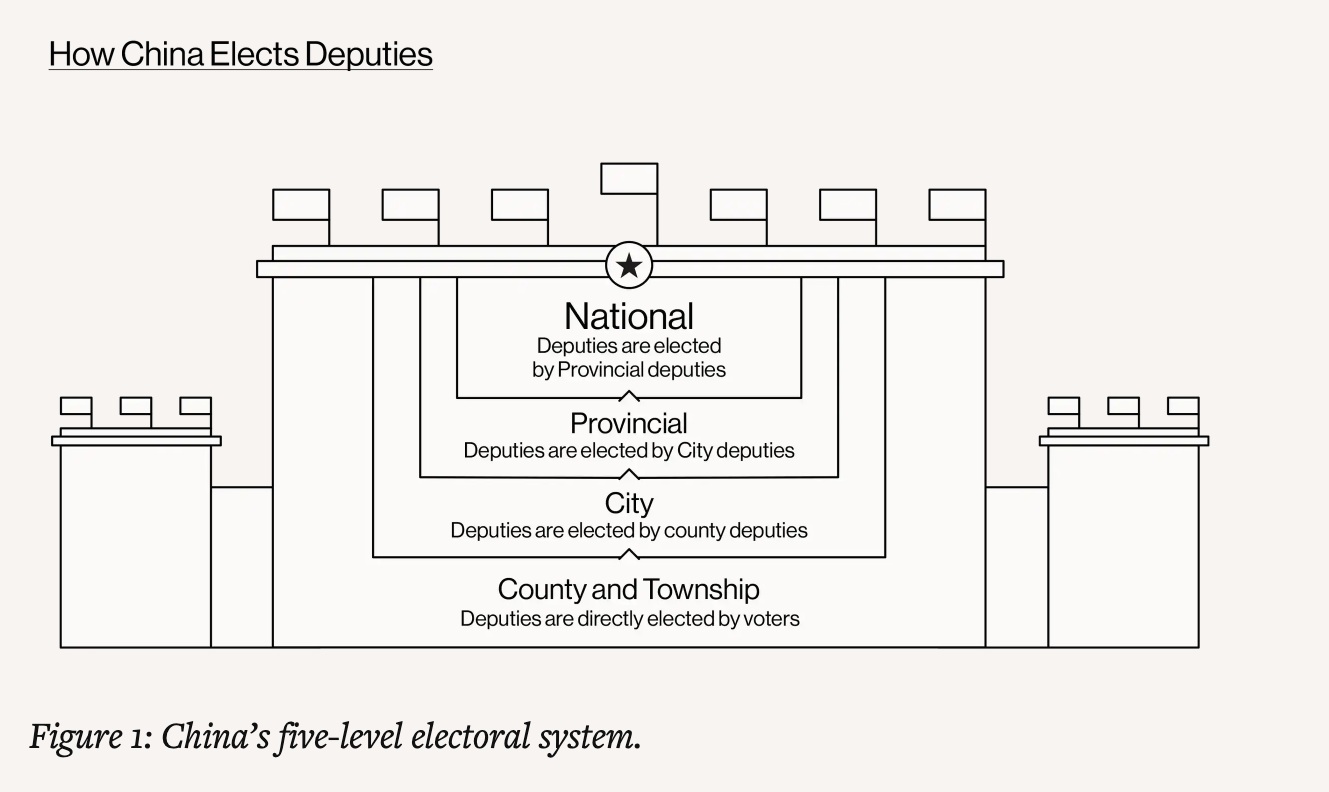
At one point, the two authors of the piece show a chart of how higher echelons of the CCP are chosen through voting by lower echelons; as though this would result in a more democratic system, rather than resulting in political leaders chosen by narrower and narrower groups of elites as one goes up. Ironically, Wargan and Hickel term this to be “democratic centralism”–perhaps the two would be better served revisiting the literature from the early Soviet Union, hitting out against bureaucratization.
One can see how “whole-process democracy”, then, simply results in a personality cult built around the ideology of a party leader. For all the claims by Wargan and Hickel that “whole-process democracy” is democratic, one notes that the two have to refer continuously to the political thinking of state leaders such as Mao, Lenin, and Xi Jinping. Indeed, one notes that the two credit Xi Jinping with devising “whole-process democracy” and that of the article’s 37 citations, they are disproportionately of Mao or Xi.
Though the authors cite polling data to claim that Chinese are happy with their democracy, one is best reminded of Mao’s apt quote that political power grows out of the barrel of a gun–one is hardly inclined to answer truthfully about one’s views when one has a gun pointed at their head. A truer assessment of satisfaction with the CCP’s governance is seen in the thousands of wildcat strikes that occur in China annually, as well as the spontaneity and breadth of the White Paper protests that broke out several years ago on a scale that no externally-directed Color Revolution could ever match.
“Whole-process democracy”, then, is the usual abstraction about one’s preferred political system being the most democratic one, and that this is used as a justification for authoritarian rule. All this is the usual warmed-over leftist Orientalism–at times, one is struck by the fact that the authors seem overawed by social services offered in China that also exist in Western society, for at one point in the article, the authors seem overawed by a help hotline. One finds such apologia intellectually shallow at best, while also being ludicrously laughable.
About Brian Hioe :

Brian Hioe is one of the founding editors of New Bloom. He is a freelance journalist, as well as a translator. A New York native and Taiwanese-American, he has an MA in East Asian Languages and Cultures from Columbia University and graduated from New York University with majors in History, East Asian Studies, and English Literature. He was Democracy and Human Rights Service Fellow at the Taiwan Foundation for Democracy from 2017 to 2018 and is currently a Non-Resident Fellow at the University of Nottingham’s Taiwan Studies Programme, as well as board member of the Taiwan Foreign Correspondents’ Club.
丘琦欣,創建破土的編輯之一,專於撰寫社會運動和政治的自由作家偶而亦從事翻譯工作。他自哥倫比亞大學畢業,是亞洲語言及文化科系的碩士,同時擁有紐約大學的歷史,東亞研究及英文文學三項學士學位。


 Tomás Ó Flatharta
Leave a comment