Brendan Hughes, Gerry Adams, and a collapsed court case in London’s Royal Courts of Justice
Newspaper readers who followed reports of a very unusual Gerry Adams London trial were not surprised by its collapse.
Procedurally. for this category of case, there is a 3 year time limit. People injured in three IRA bombings – Old Bailey 1973; Docklands and Manchester 1996 – put Gerry Adams in the dock seeking nominal damages of £1 on the grounds that the former Sinn Féin president had been an IRA leader.
Claimants were well aware of these rules, – they did not have a leg to stand on legally. The only issue was whether Judge Jonathan Swift (yes, same name as the famous Irish satirist who wrote Gulliver’s Travels!) would apply the rules. Judge Swift would have looked a bigger fool than Lemuel Gulliver if he ignored the regulations, and an appeal court later overturned his verdict. [1]
Mark Hennessy contributed this analysis in the March 19 2026 issue of the Irish Times :
The former president of Sinn Féin is facing a civil suit for £1 damages from three victims of IRA bombings – John Clark in the Old Bailey explosion in 1973, Jonathan Ganesh at Canary Wharf in 1996 and Barry Laycock a few months later in Manchester.
Under legal rules, tort cases for personal injuries in England and Wales should be lodged within three years of the event, but papers in this case – spurred on by the onset of British legacy legislation – were not lodged until May 2022.
Judge Jonathan Swift must decide this point first. If the claims are out of time, then none of the other issues can be ruled upon – and section 33 of the 1980 Limitations Act exemptions are “not rare, but they are not routine, either”, to quote a lawyer.
Just as significantly, there is the issue of abuse of process in the case, which has been mentioned tangentially throughout the seven days of hearings that have taken place in London this week and last.
Beginning his closing arguments, barrister Edward Craven, for Adams, argued that the true intent of the case was not to win personal damages from the 77-year-old, but rather to see him face a public inquiry for his role during The Troubles.
Such an ambition was clear from the claimants’ campaign to raise money to fight the case, where they told supporters that there had never “been a proper inquiry” into Adams’s role and he had never been “obliged to account” for his actions.
However, this, Craven argued, goes beyond what a British civil court can do. It is obliged to do justice to all parties, but it is not able to carry out “inquisitorial investigations” that go beyond the claim for damages made before it.
“Why are you not applying for a strikeout? You are saying that it is being used for a purpose that applies [to justify a strikeout]. It is a case of abuse, or it is not,” the judge said, if just a little sharply.
Gerry Adams claimed he was never an IRA member.
Adams made comments about Brendan Hughes during this case which were extremely undignified – crude personal abuse.
There was no need for it. He could easily have used less inflammatory and hurtful language.
Here is an easy prediction : When Gerry Adams dies, every honest commentator will agree with “the dogs in the street” – he was a leader of the IRA since the 1960’s – and in particular, that the account written by Brendan Hughes is 100 per cent true.
Suzanne Breen sums it all up very well – she discusses a strongly worded public statement issued by the daughter of Brendan Hughes, Josephine.
John Meehan March 22 2026
Hughes’ daughter Josephine this week challenged Adams for his comments in London. She posted on Facebook: “Gerry, I hope my father’s face haunts you the rest of your days, to stand in a British court and basically call my father a liar.
Josephine Hughes
“I hope everyone sees through you like my daddy did. I couldn’t be prouder of my daddy.”
Haunted Hughes ostracised for refusing to play SF’s game
SUZANNE BREEN, SUNDAY LIFE, March 22nd, 2026
Beneath a picture of the Sacred Heart in a tiny, threadbare flat in Divis hung a photo of two tanned, smiling young men in Long Kesh, arms around each other: Gerry Adams and Brendan ‘The Dark’ Hughes.
From his home, Hughes would look down on the city that his bombs had once reduced to rubble. A former ‘officer commanding’ of the Belfast brigade, he killed and saw fellow republicans die too.
The best friends emerged very differently from the conflict. One was burdened by the war, the other elevated in its wake.
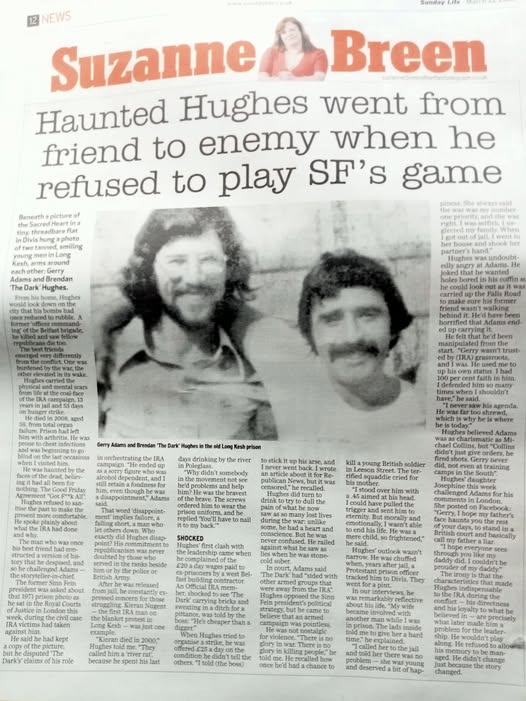
Hughes carried the physical and mental scars from life at the coal-face of the IRA campaign, 13 years in jail and 53 days on hunger strike.
He died in 2008, aged 59, from total organ failure. Prison had left him with arthritis. He was prone to chest infections and was beginning to go blind on the last occasions when I visited him.
He was haunted by the faces of the dead, believing it had all been for nothing. The Good Friday Agreement “Got F**k All”.
Hughes refused to sanitise the past to make the present more comfortable. He spoke plainly about what the IRA had done and why.
The man who was once his best friend had constructed a version of history that he despised, and so he challenged Adams — the storyteller-in-chief.
The former Sinn Fein president was asked about that 1971 prison photo as he sat in the Royal Courts of Justice in London this week, during the civil case IRA victims had taken against him.
He said he had kept a copy of the picture, but he disputed ‘The Dark’s’ claims of his role in orchestrating the IRA campaign. “He ended up as a sorry figure who was alcohol dependent, and I still retain a fondness for him, even though he was a disappointment,” Adams said.
That word ‘disappointment’ implies failure, a falling short, a man who let others down. Who exactly did Hughes disappoint? His commitment to republicanism was never doubted by those who served in the ranks beside him or by the police or British Army.
After he was released from jail, he constantly expressed concern for those struggling. Kieran Nugent — the first IRA man on the blanket protest in Long Kesh — was just one example.
“Kieran died in 2000,” Hughes told me. “They called him a ‘river rat’, because he spent his last days drinking by the river in Poleglass.
“Why didn’t somebody in the movement not see he’d problems and help him? He was the bravest of the brave. The screws ordered him to wear the prison uniform, and he replied ‘You’ll have to nail it to my back.’”
Shocked
Hughes’ first clash with the leadership came when he complained of the £20 a day wages paid to ex-prisoners by a west Belfast building contractor. An Official IRA member, shocked to see ‘The Dark’ carrying bricks and sweating in a ditch for a pittance, was told by the boss: “He’s cheaper than a digger.”
When Hughes tried to organise a strike, he was offered £25 a day on the condition he didn’t tell the others. “I told (the boss) to stick it up his arse, and I never went back. I wrote an article about it for Republican News, but it was censored,” he recalled.
Hughes did turn to drink to try to dull the pain of what he now saw as so many lost lives during the war: unlike some, he had a heart and conscience. But he was never confused. He railed against what he saw as lies when he was stone-cold sober.
In court, Adams said ‘The Dark’ had “sided with other armed groups that were away from the IRA”. Hughes opposed the Sinn Fein president’s political strategy, but he came to believe that an armed campaign was pointless.
He was not nostalgic for violence. “There is no glory in war. There is no glory in killing people,” he told me. He recalled how once he’d had a chance to kill a young British soldier in Leeson Street. The terrified squaddie cried for his mother.
“I stood over him with a .45 aimed at his head. I could have pulled the trigger and sent him to eternity. But morally and emotionally, I wasn’t able to end his life. He was a mere child, so frightened,” he said.
Hughes’ outlook wasn’t narrow. He was chuffed when, years after jail, a Protestant prison officer tracked him to Divis. They went for a pint.
In our interviews, he was remarkably reflective about his life. “My wife became involved with another man while I was in prison. The lads inside told me to give her a hard time,” he explained.
“I called her to the jail and told her there was no problem — she was young and deserved a bit of happiness. She always said the war was my number one priority, and she was right. I was selfish. I neglected my family. When I got out of jail, I went to her house and shook her partner’s hand.”
Hughes was undoubtedly angry at Adams. He joked that he wanted holes bored in his coffin so he could look out as it was carried up the Falls Road to make sure his former friend wasn’t walking behind it. He’d have been horrified that Adams ended up carrying it.
He felt that he’d been manipulated from the start. “Gerry wasn’t trusted by (IRA) grassroots, and I was. He used me to up his own status. I had 100 per cent faith in him. I defended him so many times when I shouldn’t have,” he said.
“I never saw his agenda. He was far too shrewd, which is why he is where he is today.”
Hughes believed Adams was as charismatic as Michael Collins, but “Collins didn’t just give orders, he fired shots. Gerry never did, not even at training camps in the South”.
Hughes’ daughter Josephine this week challenged Adams for his comments in London. She posted on Facebook: “Gerry, I hope my father’s face haunts you the rest of your days, to stand in a British court and basically call my father a liar.
“I hope everyone sees through you like my daddy did. I couldn’t be prouder of my daddy.”
The irony is that the characteristics that made Hughes indispensable to the IRA during the conflict — his directness and his loyalty to what he believed in — are precisely what later made him a problem for the leadership. He wouldn’t play along. He refused to allow his memory to be managed. He didn’t change just because the story changed.
[1] “Jonathan Swift (30 November 1667 – 19 October 1745) was an Anglo-Irish writer, essayist, satirist, and Anglican cleric. He was the author of the satirical prose novel Gulliver’s Travels (1726) and the creator of the fictional island of Lilliput. He is regarded by many as the greatest satirist of the Georgian era and one of the foremost prose authors in the history of English and world literature” https://en.wikipedia.org/wiki/Jonathan_


 Tomás Ó Flatharta
with reference to Jonathan Swift , readers might enjoy https://eurofree3.wordpress.com/a-modest-proposal-for-preventing-the-loyalists-in-ireland-from-being-a-burden-on-their-fellow-citizens-or-country-and-for-making-them-beneficial-to-the-publick/
benmadigan
Mar 23, 2026 at 2:15 pm