I take this opportunity to recommend this excellent article from Kavita Krishnan which she published in early December. (see below).
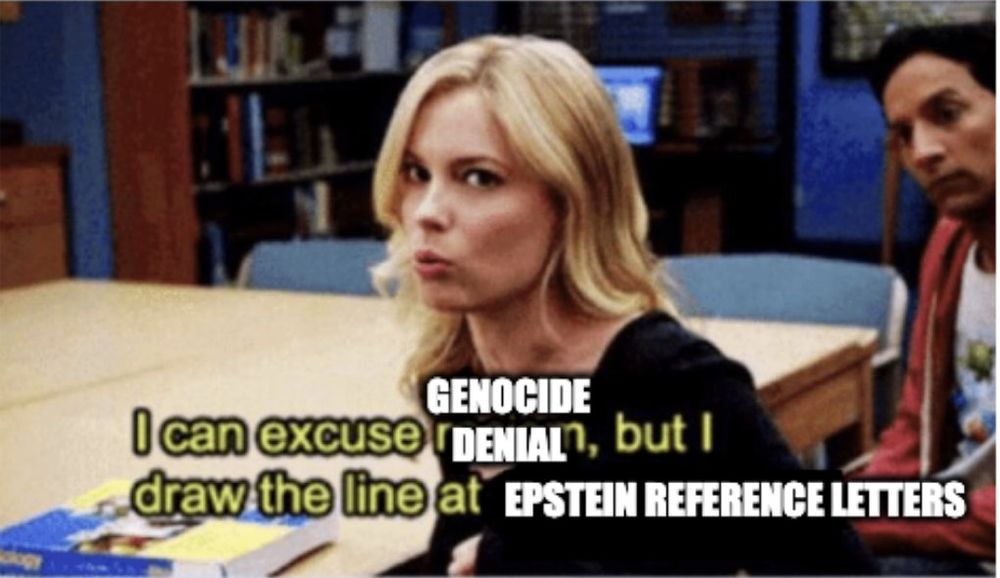
Noam Chomsky could afford terrible statements about the systematic mass murders and genocidal wars in Cambodia, Bosnia, Rwanda and Syria. Even during the Russian mass terror against the Ukrainian people, he raised more understanding of the aggressor than the attacked population.
His support for Epstein reveals the same pattern. The Indian feminist Marxist Kavita Krishnan puts his behaviour into the broader context.
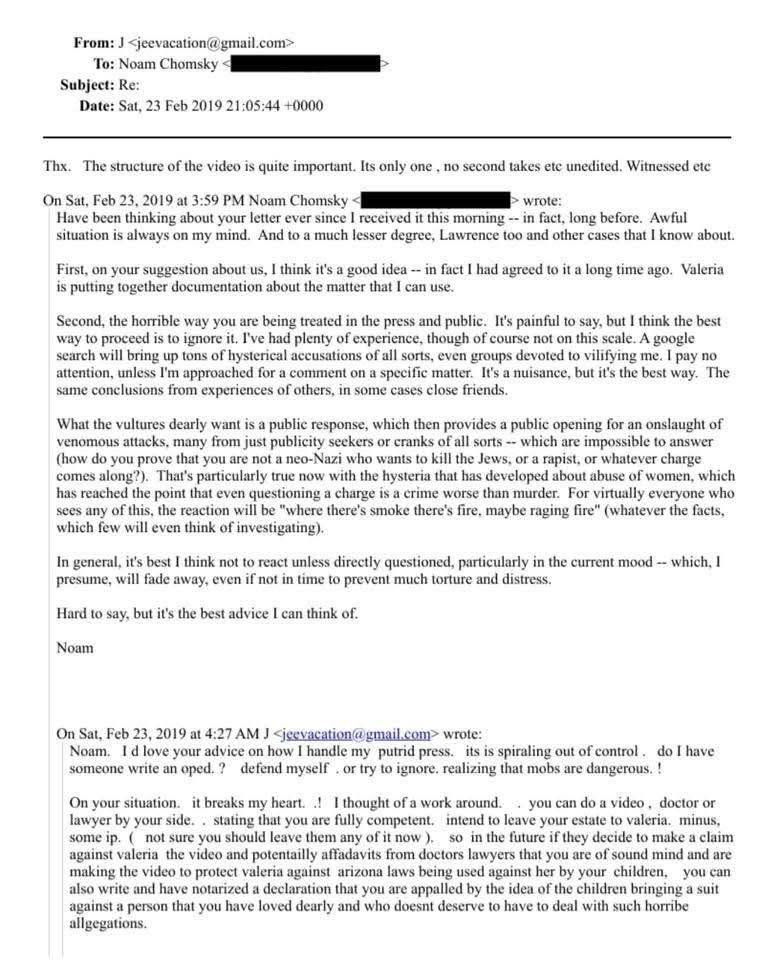
This email from Chomsky to Epstein proves that he wasn’t just giving his friend the benefit of doubt, not knowing the full nature and extent of his crimes. He was actively colluding with Epstein, strategising about how to deal with the revelations about those crimes in the press.
It’s not that Chomsky was incapable of empathy – he was, but he had empathy only for the unfortunate predator, victimised by a journalist who was nuisance enough to put faces and voices to a gaggle of female accusers generating a ‘hysteria’ of solidarity.
What Chomsky calls ‘horrible’ treatment of Epstein by the press, was the November 2018 piece in the Miami Herald, ‘Perversion of Justice’ – Julie Brown’s stellar investigative journalism exposing the secret deal struck a decade ago that betrayed scores of children trafficked and abused by him, who had found the courage to help police build a cast iron case.
This email must go on his tombstone, it must feature in every obituary when he passes, it is not just a stain on his political legacy, it IS integral to his legacy. His collusion with Epstein is a result of the same abstract geopolitical doctrine that passed for his politics, one that allowed him to deny the humanity of victims of horrific mass crimes against humanity – in Cambodia, Bosnia, Rwanda, Syria, Ukraine, China.
(Edited the post for accuracy, people pointed out he was calling his accusers hysterical, not the girls. He does use hysteria again, to refer to the public response to accusations of abuse of women.)
What Noam Chomsky’s friendship with Jeffrey Epstein says about progressive politics
The Left icon overlooked sexual violence, much like India’s literary and cultural progressives have embraced a man whose rape conviction was overturned.
Kavita Krishnan, December 6 2025
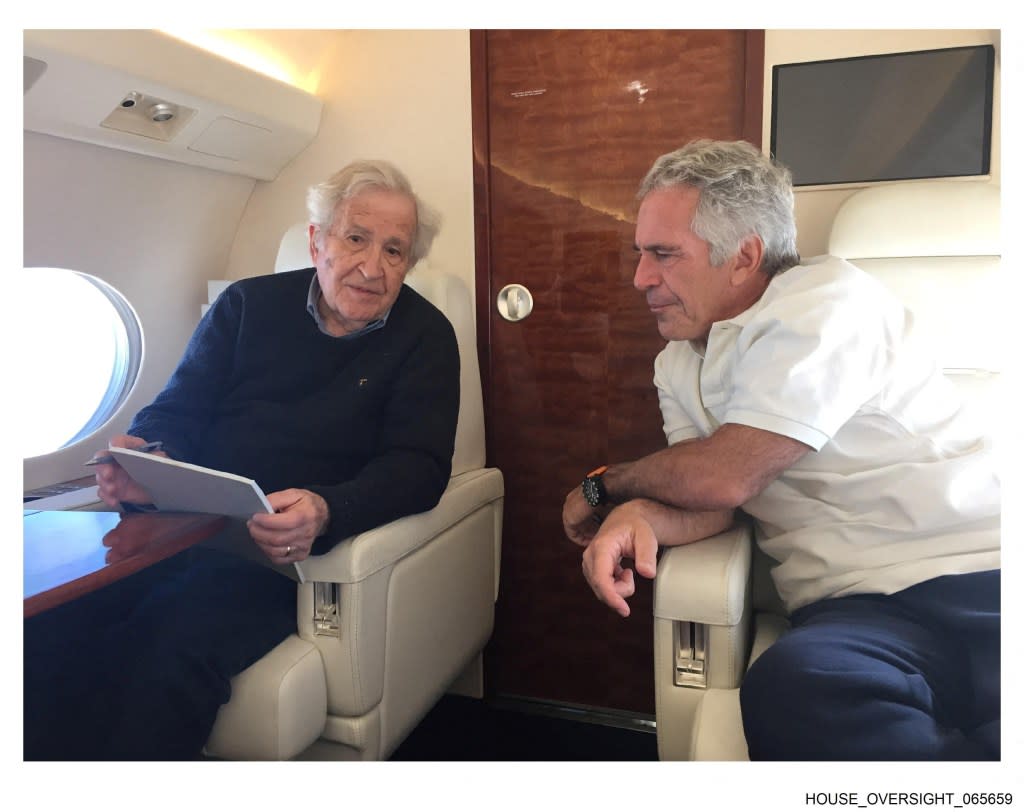
“I’ve met [all] sorts of people, including major war criminals. I don’t regret having met any of them.” That was public intellectual Noam Chomsky’s belligerent reply in 2023 to a newspaper’s question about his connections to Jeffrey Epstein. More recently, Epstein’s emails reveal a close friendship with Chomsky and his wife.
Of particular interest is a testimonial (undated but written in or after 2017) written by Chomsky for Epstein, in which he describes their friendship of six years as a “valuable” and “rewarding” experience, thanks to Epstein’s intellectual breadth and insights, and says that “Jeffrey has repeatedly been able to arrange, sometimes on the spot, very productive meetings with leading figures in the sciences and mathematics, and global politics, people whose work and activities I had looked into though I had never expected to meet them.”
In the infamous BBC Newsnight interview, Andrew Mountbatten Windsor was asked if in retrospect, knowing Epstein was a paedophile and sexual predator, he felt any “guilt, regret, or shame” about his friendship with Epstein. No, he said, “the reason being is that the people that I met and the opportunities that I was given to learn either by him or because of him were actually very useful…(it) had some seriously beneficial outcomes in areas that have nothing to do with (his crimes).”
Both Chomsky and Andrew are saying they don’t regret being Epstein’s friend because through him they could meet useful and important people.
Andrew faces the allegation of raping a young minor girl trafficked by Ghislaine Maxwell and Epstein. I must emphasise here that knowing or meeting Epstein does not in any way imply that Chomsky was party to his crimes against girls and women. I’m not suggesting “guilt by association” nor am I interested in a “gotcha” moment at his expense.
But for me the question is this: what does Chomsky’s relationship to Epstein tell us about whether sexual violence survivors matter to our politics – to Left and progressive politics?
In 2005, authorities had begun investigating allegations made by 36 minor girls, one as young as 14, that Jeffrey Epstein had pressured them into giving him sexual massages and had trafficked them to other men. They unearthed a wealth of evidence backing the girls’ words, and eventually in 2008 a draft indictment charged him with 60 counts of federal crimes, enough to earn him a life sentence.
But Epstein infamously got away with a mere rap on his knuckles. In a sweetheart plea deal he confessed to a minor charge of soliciting a minor for prostitution and spent 13 months in an open prison arrangement where he was free in the day and returned to prison at night. All this was widely discussed and criticised in the mainstream media.
In 2023, Chomsky explained why he and his wife befriended Epstein in spite of his conviction for sex crimes against minor girls. “What was known about Jeffrey Epstein was that he had been convicted of a crime and had served his sentence,” he said. “According to prevailing US laws and norms, that yields a clean slate.”
Let’s unpack this a little.
Chomsky is a Left icon whose writings introduced generations to the nature of power, impunity for the powerful, and the propaganda that manufactures consent for such systemic inequity, violence and impunity. If working-class children had complained of being trafficked by a filthy rich CEO to do toxic and dangerous work, and the CEO got away with a rap on his knuckles, would Chomsky argue that he now had a clean slate?
But the rules seem different when the working-class children in question are girls, trafficked and enslaved not for factory labour but for sex work. In Chomsky’s political world, these individual survivors of sexual predation are invisible.
The key term in Chomsky’s testimonial is “prevailing norms”. The hint is that the MeToo movement changed prevailing norms and Chomsky’s friendship with Epstein must not be judged by the new feminist norms. But that’s untrue. Even police officials publicly condemned Epstein’s plea deal as a mockery of the prevailing standards of justice, as did most commentators in the “mainstream” media. Why was Chomsky happy to accept the plea deal’s norms which had fallen to a shameful low by any standards?
Speaking to the media in 2008 after his guilty plea, Epstein used an astonishing metaphor which revealed how he viewed his actions and “prevailing laws and norms”. He “likened himself to Gulliver shipwrecked among the diminutive denizens of Lilliput”, saying “Gulliver’s playfulness had unintended consequences. That is what happens with wealth. There are unexpected burdens as well as benefits”.
In his email to Epstein, we should remember, Andrew signed off with the words “Play more later”. Paedophilic predation is seen by Epstein and his circle as “playfulness”. Epstein saw himself as special, entitled by wealth to “play” with “diminutive people” like underage girls without money or status. The prevailing laws and norms were made by diminutive, small-minded people who could not understand the culture of those so far above their station.
As a public intellectual, Chomsky is seen as a defender of “diminutive people”. But he befriended and vouched for Epstein – and has till date not spoken a word in support of the “diminutive” survivors.
The fact that Chomsky expressed admiration for Epstein’s ability to pick up his phone and connect immediately to the world’s Big People is telling: did he really not think that this ability, these connections, might have something to do with the lightness of his punishment?
Why did Chomsky even write that testimonial for Epstein addressed “To Whomsoever It May Concern”? We know that Epstein launched a major PR campaign to rehabilitate himself after pleading guilty to child sexual abuse. Part of that PR campaign included donations to universities and meetings with intellectuals and scientists, all of which helped polish his tarnished image. Did Chomsky write that testimonial at Epstein’s request – his contribution to that PR campaign? Chomsky wrote that testimonial as a public figure – he owes it to the public now to explain why he did it.
The problem is Chomsky is not an exception. Here in India, I’ve just read rave reviews of a stage performance by Mahmood Farooqui in Dastan-e-Ret-Samadhiadapting the Hindi novel Ret Samadhi (for which the writer and translator, both women, received the Booker Prize). Farooqui was once convicted for rape and his conviction was overturned by a higher court.
The judge who acquitted him agreed accepted the trial court’s assessment that the survivor’s word was credible and that she had indeed said “no”. By the letter and spirit of the “prevailing” law, that’s rape, open and shut. But the judge created a new legal concept, lowering the prevailing laws and norms, to acquit. A “feeble no”, he ruled, could mean a yes.
The very phrase “feeble no” is a reminder that the survivor did say no, which proves that she was, in fact, sexually violated against her will. I hear progressive friends say, “He’s been acquitted, so he’s innocent, so why shouldn’t we platform him, we can’t punish him in perpetuity.”
To each of them I say: you’re free to platform and celebrate Farooqui. But on every stage, every page that you do so, you are emblazoning your ringing endorsement and advertisement of the motto – A Feeble No is a Yes. Like Chomsky, you too are happy to embrace the most grotesque and farcical mockery of judicial norms as your own.
The “feeble no” judge held an educated woman’s no to a higher standard: it was her job to make her “no” forceful enough for the man to understand. But he held the man to a very low standard: despite his mastery of language, literature, performance arts and cinema, this man could not be expected to understand that no actually means no. He could not be expected to use his words if in doubt and ask the woman – you said no, would you like me to stop?
Chomsky was dazzled by Epstein and his fellow dinner guest “the great artist” Woody Allen (also accused of sexually abusing his own daughter as a toddler). India’s literary and cultural progressives are dazzled by the artistry of the man with the “feeble no” fig leaf.
If you treat sexual assault allegations against a man as irrelevant to your political assessment of his intellect, his art, and his ideas, you are the opposite of progressive. The norms have progressed and you had better catch up or be left behind.
Kavita Krishnan is a feminist activist and writer, author of Fearless Freedom (Penguin 2020).
Christian Zeller is an activist in the European Network for Solidarity with Ukraine (ENSU). https://ukraine-solidarity.eu/
He is a professor of economic geography and editorial board member of the German-language journal,emancipation — Journal for Ecosocialist Strategy. Zeller is the author of Climate Revolution: Why we need an ecosocialist alternative (in German).


 Tomás Ó Flatharta
[…] Noam Chomsky, Left Icon, Crashes – “What Chomsky’s Friendship With Jeffrey Epstein… […]
“Staggering Range of Jeffrey Epstein’s Social Network – A self-help group for the 0.01 per cent” | Tomás Ó Flatharta
Feb 7, 2026 at 1:56 pm