Once Upon A Time in the White House – Civilised People Wondered : Would timid European powers back the nauseating Trump-Putin “peace in our time” war crime plan and assist the carve-up of Ukraine?
Two fascist gun-slingers : convicted rapist President Donald Trump (USA) and indicted international war criminal Vladimir Putin (Russia), embraced in Alaska. The USA grabbed Alaska in the 19th Century through a deal with Russia, its imperialist partner-in-crime. Uncle Sam took over the vast icy territory through the ugly and brutal method of ethnic cleansing. Civilised people hoped this ugly feature of international capitalism was a thing of the past. Wishful thinking : it is returning with ominous force in the 21st Century – especially in Ukraine and Palestine.
Volodymyr Zelensky was a target of the Alaska fascist-fascist war-crime plan. The President of Ukraine was summoned to the White House (Washington DC). A charade was staged.
Leaders of the main imperialist powers in Western Europe saw a car-crash coming : On the one hand they were opposed to witnessing Zelensky crushed by the fascist-fascist Trump-Putin steamroller, and they did not want to be accomplices to an infamous surrender. Haunting memories : the pathetic 1938 British Imperialist leader Neville Chamberlain came back from a Munich summit with the Nazi warlord Adolf Hitler – “peace in our time” said Neville, as the people of Czechoslovakia and its leader Edvard Benes were sacrificed. One year later – “peaceful” Herr Hitler invaded Poland, World War Two began.
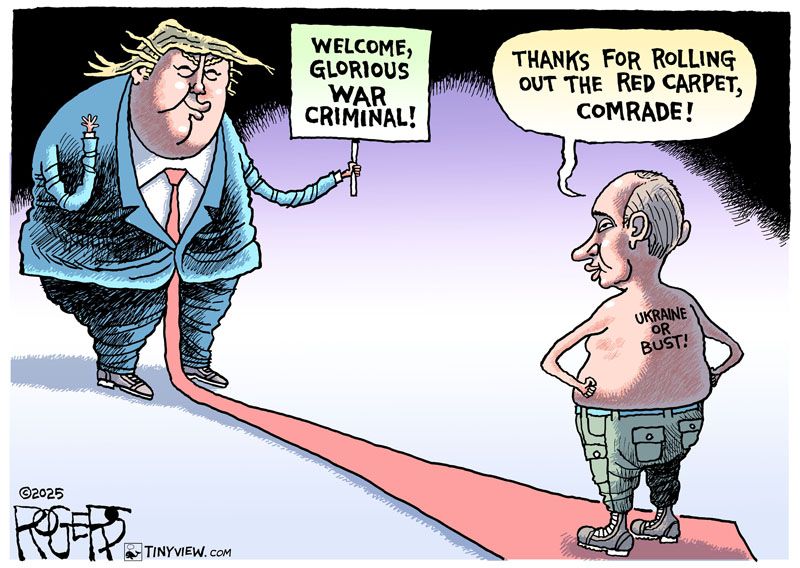
On the other hand Macron of France, Merz of Germany – and company – wanted to avoid a direct and open clash with the White House gangster, Putin’s ally Trump. Therefore, observers were offered a charade : One after another Zelensky, Macron, Merz, Von der Leyen, Meloni, Starmer, and Rutte smeared the vain gangster Trump with praise.
One caustic observer noted that Donald Trump
is – and is behaving like – an unpredictable, selfish ignoramus. He is constantly mollycoddled by a group of sycophants – whether domestic or international – to prevent him from crashing the car.
- Michael McDowell, Irish Times, August 20 2025
Observers familiar with the extreme-right political career of Senator Michael McDowell – a former Justice Minister in the Dublin Government – may be taken aback. The Senator is the type of of local right-winger from a small country that gangsters like Presidents Trump-Putin normally need. This is a striking example of thieves falling out.
Senator Mc Dowell kept going :
The result was a nervous, contrived engagement with the media in which the Europeans and Zelenskiy all engaged in sycophantic head-nodding and dressed up all their comments as being endorsements of carefully chosen shards of Trump’s shifting opinions. The scene was vaguely resonant of medieval courtiers dealing with an unpredictable, irascible king.
Idiot-King Trump Seeks Nobel Peace Prize
McDowell points out that the nauseating charade will continue :
Now Trump has apparently settled on a process that Putin and Zelenskiy must meet on a bilateral basis – presumably without a prior ceasefire – and exchange incompatible demands. This will be done in the absence of the idiot-king.
Then there should be what Trump refers to as a “trilat” – a meeting which might end the war, with Trump preparing to accept the Nobel peace prize for which he has already been nominated by the great international pacifist, Binyamin Netanyahu. That appears to be the “deal” in Trump’s mind.
A review of a significant number of credible international media outlets suggests the Trump-Putin fascist twins are losing the battle for the hearts and minds of the popular masses. A tide may be turning – that is the encouraging news for all principled anti-imperialist, civilised, left-wing activists.
Already, activists in Alaska led the way.
In order to further stimulate active engagement, the following article is recommended :
Putin is back in the driver’s seat on Ukraine
Moscow is seeking victory, not compromise, through diplomacy — and Trump is playing along
Alexander Gabuev Financial Times August 19 2025
The writer is director of the Carnegie Russia Eurasia Center in Berlin
It’s been a good week for Vladimir Putin. Last Friday, he convinced Donald Trump that it’s better not to seek a ceasefire, but a comprehensive deal to end the conflict in Ukraine — and that diplomacy should proceed in parallel with the fighting. Then, on Monday, Volodymyr Zelenskyy and other European leaders failed to convince Trump to revert to his earlier stance and that Russia should be punished with stringent sanctions if it failed to agree. Now Putin is back in the driver’s seat and his game plan is to drag on the negotiations while wearing down Ukraine on the battlefield. The Kremlin hopes to dictate the terms of a settlement, with an impatient US president as a willing accomplice. This outcome is still avoidable but Europe needs to choose wisely how to spend its limited political capital.
Continuing the war remains Putin’s only source of leverage to secure a desirable outcome, and he is unlikely to surrender this tool even under pressure. If the guns fall silent without a deal, the Kremlin calculates, Ukraine could drag out the negotiations forever by going back to its morally and legally justified demands, including a return to its 1991 borders — while its military is being beefed up even further by Nato.
Three factors explain Putin’s confidence in the benefits of continuing to fight. First, while the Russian economy is cooling down and the revenue stream is shrinking, it still has steam to power Putin’s war machine for at least another 12-18 months. In June, the Kremlin adapted its budget to focus its evaporating cash flow on the war at the expense of civilian needs. Second, Putin is convinced that China and India, the two lifelines of the Russian war economy, will not throw his country under the bus. New Delhi seems unlikely to abandon Moscow despite a 25 per cent tariff that Trump imposed to punish it for trading with Russia, and China has threatened to retaliate should the US try to coerce it into parting ways with Putin.
Finally, the Kremlin is convinced that the battlefield dynamics are shifting in its favour — and that Ukraine’s losses in this war of attrition may soon be accelerated. Not only is Russia massively scaling up drone production; its recent breakthrough near the strategically important city of Pokrovsk in Donbas, which Kyiv scrambled to patch, signals the worsening of Kyiv’s persistent manpower problem.
Russia’s progress comes at a tremendous cost, but Putin believes it is sustainable as long as Moscow maintains a manpower advantage. The Kremlin recently began issuing draft papers online and penalising those who don’t show and is prepared to rely increasingly on tools of coercion rather than dwindling financial incentives to keep the new recruits coming. Moscow believes it can keep Trump interested in a deal long enough for Russian forces to erode key Ukrainian positions. The concessions he is demanding from Ukraine — first and foremost the surrender of fortified parts of Donbas under Ukrainian control — are unacceptable to Zelenskyy for military, moral and political reasons. For Kyiv to consider a peace deal, it would have to be based on credible security guarantees that prevent Russia from reinvading. What Putin has put on the table instead to get Trump’s attention is a familiar trap first suggested by Moscow in the spring of 2022.
It’s a collective promise to help Ukraine withstand foreign invasion given by permanent members of the UN Security Council and some other countries that would in effect grant Moscow a veto over its implementation. In return for this sham guarantee, Russia wants to dismantle Ukraine’s real tools for maintaining sovereignty: its armed forces, military industry and defence co-operation with the west. That’s why the idea of a European reassurance force to be introduced in Ukraine after a ceasefire to secure peace will not be acceptable to the Kremlin. With such divergent positions and both sides still able to fight, the war is most likely to drag on — even if Russia and Ukraine start the high-level negotiations Trump has proposed. The grim reality is that the talks will be accompanied by ongoing fighting that may continue for months or years.
It’s impossible to predict how Trump will react when he discovers that peace talks are not bringing about peace. If the US reduces itself to the role of an arms merchant for Ukraine and maintains intelligence sharing, that will be bad, but not fatal, for Ukraine — if the Europeans can step in to fill the void on weapons, money and technological support for the Ukrainian defence industry.
Right now, the best investment of Europe’s limited resources is to extend Ukraine’s ability to continue fighting while trying to compress Russia’s timeline through continued economic pressure from new sanctions on Russian entities and better enforcement of existing restrictions.
Focus is needed to chart a progressive and humane way forward. Active engagement is vital. The Trump-Putin fascist twins can be confronted and forced backwards – many of their natural allies are backing off.
John Meehan August 22 2025


 Tomás Ó Flatharta
Leave a comment