Deepest condolences to all Cathleen’s family, friends, feminists, socialists, community activists and neighbours. She was a true warrior for all sorts of progressive causes. a very inclusive person, good singer, and unafraid to speak very plainly and politely when it was necessary. She was great company. There are great memories. She helped make Kilbarrack Dublin and Ireland a better place, especially for women. John Meehan
I first met Cathleen in the mid 1980’s via her great friends Joe Kelly and Therese Caherty.
Here are a few memories
23 People launched The Alliance for a No Vote (ANV), October 6 2001 in Dublin. Ivana Bacik, a Trinity College Dublin (TCD) Law Professor, introduced the discussion. ANV spokespersons included Sinéad Ní Chúalacháin, Catherine Naji and Cathleen O’Neill.
Founding organisations :
Irish Family Planning Association; Irish Council for Civil Liberties Women’s Sub-Committee; Lawyers for Choice; Cork Women’s Right to Choose Group; Dublin Abortion Rights Group; Women’s Education Research & Resource Centre, UCD; Pro Choice Campaign; Socialist Party; Workers’ Solidarity Movement.
Bertie Ahern’s government tried to sneak in an anti-choice amendment to the Irish constitution overturning a 1992 Supreme Court decision which made abortion in Ireland legal in certain circumstances – the X Case Judgement. The pro-choice side won.
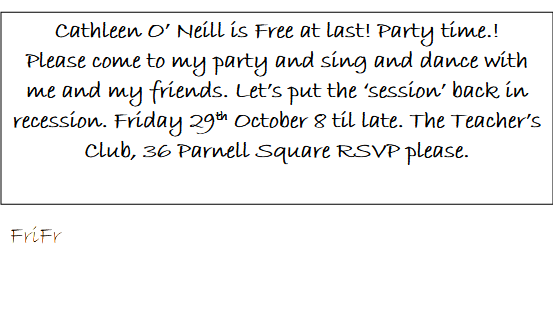
On October 12 2010 Cathleen issued the following invitation to many friends :
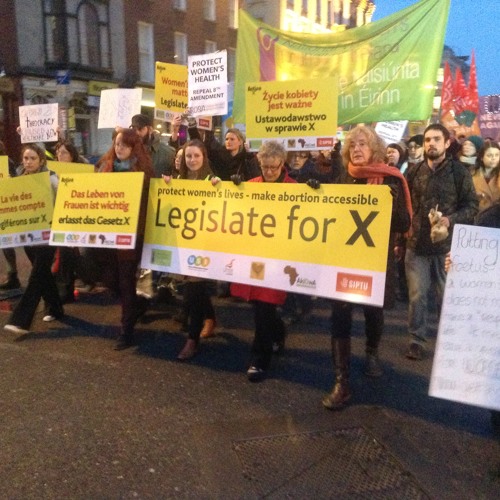
In 2013 Cathleen was campaigning :
Listen to her here :
Cathleen O’Neill from the Kilbarrack CDP speaks on protesting for action on the X case in 1992, and now again in 2013. Listen to what she said at Barnardo’s Square in front of 700 others.
Co-hosted by the Trade Union Campaign to Repeal the 8th and the Coalition to Repeal the Eighth, this public meeting focuses on Article 40.3.3 as a workplace, class, equality and human rights issue. The trade union movement has an extensive history of championing those who are denied full equality. Without the right to make decisions about their bodies, women and girls in Ireland are second class citizens. This event explores how Ireland’s largest civil society movement can help to change that.
Chaired by Ailbhe Smyth, convenor of the Coalition to Repeal the 8th Amendment, our meeting opens with an overview by Dr Fiona Bloomer of the groundbreaking Abortion as a Workplace Issue: A Trade Union Survey North and South of Ireland.
Maggie Ryan of the TUCR8A, which has long identified the 8th as a workplace issue, explains why that is the case.
Community and reproductive rights activist Cathleen O’Neill examines the 8th Amendment as a further erosion of the lot of working class women.
Mags O’Brien of the ICTU Global Solidarity Committee focuses on abortion as a human rights issue.
Emily Waszak of Strike4Repeal and Migrant and Ethnic Minorities for Reproductive Justice gives Article 40.3.3 a comprehensive equality audit.
The campaign hopes to see you there. And please feel free to invite others to attend.
Solidarity Maggie, Mandy, Mary, Therese, Des, John and Gregor Committee members of Trade Union Campaign to Repeal the 8th
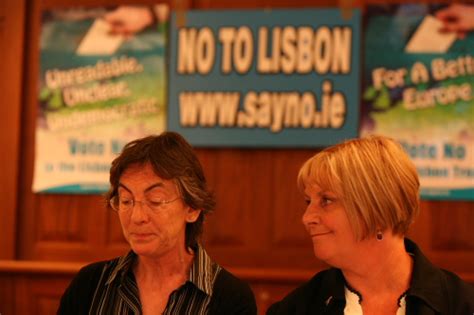
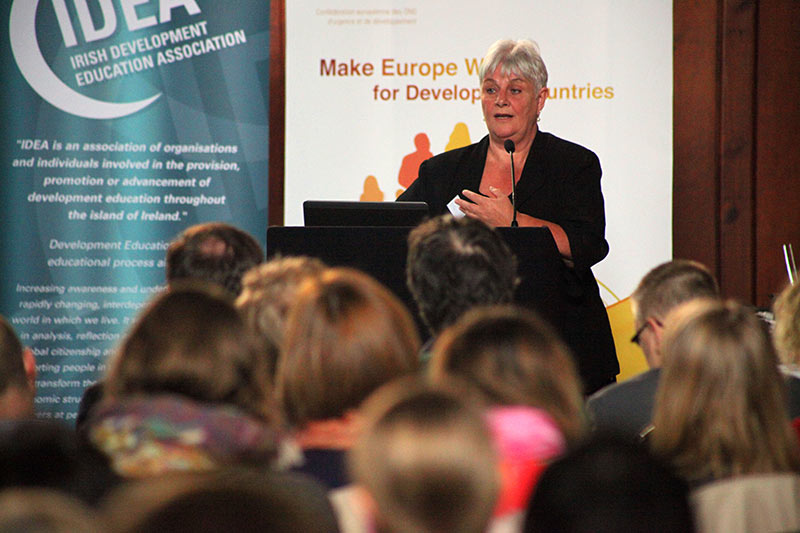
Cathleen O’Neill with Therese Caherty, Campaigning Against the EU Lisbon TreatyCahtleen O’Neill Speaking at the funeral of her dear friend Joe KellyCathleen spoke at this 2013 Demonstration in Barnardo’s Square, DublinThis collage features a mural in Kilbarrack honouring Cathleen O’Neill – it also mentions Roddy Doyle’s fictional Barrytown, and the actor Colm MeaneyCathleen O’Neill speaks at an Education Conference
Finally, this 2012 Irish Times feature gives us a look at Cathleen O’Neill’s life :
is a community activist and runs Kilbarrack CDP, an independent community development project, and is also on the board of Saol, which works with female drug addicts and their children in Dublin’s north inner city. Along with Kathleen Lynch, she is a member of Praxis, an education group starting community learning circles based on the theories of Brazilian educational philosopher Paolo Freire
‘I GREW UP IN Ballyfermot in the 1950s, the eldest of 13 children. It was a great place to grow up: I loved school, did really well in the primary cert and got a scholarship to second level at 13. But the scholarship didn’t cover books, the uniform, extra-curricular activities. There was a fee for typing paper, 1s6d, for business studies: for four months, I ducked paying and things were getting nasty. One day, I said, ‘Sister Immaculata, I haven’t got your 1s6d, I’m never going to have your 1s6d’. And I left.
“I started work in the sewing factory on Monday. I felt angry from the age of 13 to 33, the point at which I joined Klear [Kilbarrack Local Education for Adult Renewal] set up by five working class women. I’d followed the stereotype of the working class woman – by that age, I had five kids and a bad husband.
“My life began at 33. We five women were all great readers, and even though it was a recession, and I was now parenting five kids alone, it was a magic time. Four of us set up a group to look at politics, at women’s studies.
“We invited Kathleen out to talk about equality in education. When I saw her I felt she was a friend before I knew her: it was her ideas, her respect, how she ‘got’ us. The minute I met her in Kilbarrack, I knew her for life. Later, at a conference in TCD around 1986, there’d been a big debate about whether ‘community women’ – a polite term for working class – would be invited. I sat next to Kathleen: she kept poking me, saying ‘you’re not going to let them away with that, are you?’
“She invited me to speak at a UCD seminar, said, ‘Come to the house and we’ll talk about what you’re going to say’. After that, she asked me to do a good few things – asked me to co-write some articles. I began to reflect on social class and wrote a poem, Class Attack, that developed into a play. There is a big class divide in Ireland, made all the worse for not being acknowledged. My friendship with Kathleen came together over Class Attack.
“Gus Martin invited me to do an English degree but Kathleen persuaded me to do equality studies.
“Here’s the friendship of her: the day I was doing my exam to get into the masters, she picked me up and brought me to the exam centre, a posh school in Blackrock, and was there when I came out. And the pride of her the day I graduated! “Another side of our friendship are the hooleys: Kathleen and her husband John give great hoolies – Kathleen loves singing and dancing.
“When I first met her what impressed me was her energy, her unflinching honesty. She was so brainy, could take the most complex thing and make it understandable. She’s always animated, loves people, gets and respects them . . . she’s a lovely woman, that’s what I thought. . .
“The biggest thing about her is her generosity of spirit – I love her to bits.”
KATHLEEN LYNCH
is professor of Equality Studies and head of UCD’s School of Social Justice, a department she played a key role in founding in 2005. Lynch has worked in an advisory capacity to the Irish Government, the EU and international bodies on issues of equality and social justice, particularly in the field of education. She also works with a number of Irish voluntary and community organisations
‘I MET CATHLEEN in the 1980s at an event in UCD. What led me to really getting to know her was the play her group, Klear, had created, called Class Attack. I knew they would like to have it recorded so I arranged for UCD’s education department to do that. It’s been used as an educational resource for years now. It was a very important challenge to the power of experts, professionals and well-meaning people who decided what was good for you, if you were poor.
“I felt she was an anam cara, a soulmate. She has extraordinary honesty, Cathleen is what you see, even though you may not always like what she says to you. She had great wisdom, great sociological insight that a lot of sociologists and economists do not have. I felt I would learn from her and I did.
“She was one of the few people at the time really attempting to create a different concept of education, so people could think critically, would always question, never take the world as given. In academic life we often don’t have experiential knowledge, and you really can’t know injustice unless you live it.
“If you don’t have a dialogue with people living with injustice, you take away their voice. Cathleen and I have this idea of education as a dialogue, that we could come to know the world together.
“Cathleen comes to parties at my house: we love to sing, but she’s a much better singer than I am.
“I come from Co Clare, and was brought up to see everybody as equal to me. My parents were big farmers but when I came to Dublin, it was a surprise to me how people were so obviously class conscious. I used to joke that if you were a snob in Clare, you’d have no friends.
“I came to UCD, studied sociology and social policy and qualified as a social worker in the early 1970s. My first job was in research, then I lectured in St Pat’s teacher education college, did an MA. And I worked in Sherrard House as a housemother for homeless girls: I found it shocking to see the absolute vulnerability of people with no support. I went to Denmark, worked as a chambermaid; when I came back, a job came up in UCD, in the education department.
“In the late 1980s, a lot of us felt the need to create a new space to study equality issues – from class to gender to sexuality to race, there’s no hierarchy in injustice. And we established the MA in Equality Studies.
“Through all this, I always felt that Cathleen was my point of reference. You could always check in with her, she would always tell you if you were going wrong. I would trust her judgement completely and if I needed help of any sort, she would give it.
“I feel at home with her, she’s great fun, I enjoy her company. I feel we’ve been through a lot together: she’s fought battles, I’ve had mine. We have a similar vision of life, and the solidarity that comes with that.”






 Tomás Ó Flatharta
Leave a comment